Blogs
|
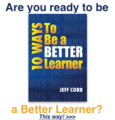
This is the final installment in my 10 Ways to Be a Better Learner series (click the link to access the previous nine). It has taken me a while to post these, partly owing to other obligations, but perhaps even more because I have tried to be very deliberate in thinking through them. Deciding on the last one has been particularly challenging, but I have finally come back to where I started on it: the best learners embrace responsibility. You can spin that a lot of ways, but I have two main points in mind:
1. The best learners recognize that their learning is not purely about themselves - it is an ongoing part of being someone who contributes to the world in positive, productive ways.
I don’t mean this in the sense of simply being employable - though certainly continuous, lifelong learning is more important in that arena than ever. I mean it in the sense of having the capacity to engage with and help solve problems, both large and small; to help make the most of opportunities that arise throughout our lives. To do these things as much for the positive impact they have on others and the world around us as for ourselves. There is no way to do this effectively other than through continuous, lifelong learning.
We are, of course, free to do otherwise - that’s why this is a question of embracing responsibility. We must choose which path to take.
2. The best learners go to great lengths to learn well and learn correctly.
For this one, I’m borrowing a page from John Dewey (see also his "guest" post here on 4 Essential Attitudes for Effective Lifelong Learners). In Democracy and Education, Dewey writes about responsibility as:
…the disposition to consider in advance the probable consequences of any projected step and deliberately to think them through: to accept them in the sense of taking them into account, acknowledging them in action, not yielding a mere verbal assent.
In more contemporary speak, you do the work, and you do it because you agree with #1 above and are motivated by it (along with other motivations you may have).
Again, there are plenty of shortcuts - and plenty of evidence in the news every day that people are taking them. We are all free to take the shortcuts, but again - that’s why this is a question of embracing responsibility.
Those who choose to do the work learn "what is involved in really knowing and believing a thing" - and they revel in it.
Jeff
P.S. - Again, you can find all of the part of this series by clicking 10 Ways to Be a Better Learner. I welcome your comments on any of the posts, and I encourage you to use the social links (Twitter, Facebook, StumbleUpon, etc) at the bottom and to the left of each post to share them with others.
Related posts:15 Ways of the Successful Self-Directed Learner
10 Ways to be a Better Learner: No. 8 - Use Technology Better
10 Ways to Be a Better Learner: No. 5 - Set and Manage Goals
Jeff Cobb
.
Blog
.
<span class='date ' tip=''><i class='icon-time'></i> Aug 19, 2015 01:45am</span>
|
|
I wrapped up my 10 Ways to Be a Better Learner series recently with an exhortation to "Embrace Responsibility." Seth Godin has since published two new posts that I think tie very well into the relationship between learning and responsibility.
In the first of these, Marketing of the placebo: Everyone gets their own belief, Seth notes the universal tendency for human beings to believe fervently in the truth of things which actually are not true. Placebos - harmless substances substituted for real medicine in clinical trials and other scientific testing - are a telling example of this phenomenon. While technically of no medical value, countless tests have demonstrated that placebos have power nonetheless simply because people who take them without knowing any better often believe they work.
And so it also goes with incorrect and even harmful ideas.
The second of these two posts, Run your own race, looks at the issue of influence through the lens of competition. As motivating and seemingly positive as competition can be, it often leads to our actions being based more on the influence of others than our own motivations and ideas.
Now, placebos have their place. And certainly, as I have noted before, we do want to seek positive sources of influence. But we need to check the facts. We need to guard against unearned and unproductive influence. As Seth puts it,"everyone is entitled to their own beliefs, but they’re not entitled to their own science."
Bottom line: We need to act consciously and take responsibility for our learning.
Jeff
P.S. - Paid for by Jeff Cobb and the Mission to Learn Blog. I take full responsibility for the information and opinions conveyed in this blog post.
P.S.S. - I am working on expanding the 10 Ways to Be a Better Learner Series into an eBook. I welcome any thoughts you have on any part of the series.
Related posts:10 Ways to Be a Better Learner: No. 10 - Embrace Responsibility
May the Learning Force Be With You
Jeff Cobb
.
Blog
.
<span class='date ' tip=''><i class='icon-time'></i> Aug 19, 2015 01:44am</span>
|
|
I heard recently from the folks over at Online College Classes, and after taking a look at their site, thought it was worth mentioning here. They have done a good job aggregating a lot of open educational resources across the Web - from course materials, to videos, to podcasts, to textbooks. It’s already a very valuable resource for finding free online education and I imagine it will only get better over time.
My only quibble is that they are calling this "College Classes." I am sure that is purely for search engine optimization - a lot of people search on the term "online college classes" - but still, there is no reason any of this has to have anything to do with either college or traditional classes. (Go on, take a minute and imagine there’s no classes.)
Nonetheless, it’s a great resource worth bookmarking.
Jeff
Related posts:Getting a First-Rate Business Education Online - Free
Top 10 Click Getters from the Free Learning Monitor
Jeff Cobb
.
Blog
.
<span class='date ' tip=''><i class='icon-time'></i> Aug 19, 2015 01:44am</span>
|
|
No surprise: a lot. In this TEDxBoston talk, Jean-Baptiste Michel and Erez Lieberman Aiden offer an entertaining and insightful overview of the computations they have been running on 5 million books scanned by Google. Those 5 million books offer up more than 500 billion words published over hundreds of years and the patterns they reveal are fascinating. The video is only about 14 minutes long, so I won’t spoil any of the highlights by writing about them here. It’s well worth your time to watch the whole thing.
Many thanks to Brain Pickings for pointing this one out.
Jeff
Related posts:
7 Secrets of a 9 Billion Dollar Industry
Jeff Cobb
.
Blog
.
<span class='date ' tip=''><i class='icon-time'></i> Aug 19, 2015 01:44am</span>
|
|
While we’re often urged by wise people to strive for more than mere competence, it’s important to understand the important role that competence plays in learning, growing, and achieving great things - and to value it quite a bit more.
"The feeling of competence results" writes psychologist Edward Deci in Why We Do What We Do, "when a person takes on and, in his or her own view, meets optimal challenges." This feeling leads to a sense of satisfaction and fuels our intrinsic motivation - the type of motivation that comes from within. As Deci explains it,
The "rewards" linked to intrinsic motivation are the feelings of enjoyment and accomplishment that accrue spontaneously as a person engages freely in the target activities. Thus, feeling competent at the task is an important aspect of one’s intrinsic satisfaction. The feeling of being effective is satisfying in its own right, and can even represent the primary draw for a lifelong career. People realize that the more they invest in a job, the better they will get at it, and thus the more intrinsic satisfaction they will experience.
In our faster, farther, better culture the small steps that contribute to competence are, in fact, the building blocks of greatness. It is, in the right circumstances, admirable to be "passionate, obsessed, provocative, impatient, hungry" and "driven," but we need to get there honestly. Looking around these days, I can’t help but feel that a bit more focus on competence could be a good thing.
Jeff
No related posts.
Jeff Cobb
.
Blog
.
<span class='date ' tip=''><i class='icon-time'></i> Aug 19, 2015 01:43am</span>
|
|
I’m just back from 10 days in Bocas de Toro, Panama, where I spent part of the time studying Spanish by the sea in Bocas Town. While I have studied Spanish before, I am a bit rusty to say the least. One of my goals was to improve my ability to support (and keep up with!) my pre-schooler son, who seems to be absorbing the language like a sponge at his school. This got me wondering about the claims that adults are at a disadvantage when it comes to learning languages. How true is this?
As you might expect, there is some truth to the claims that adults cannot learn new languages as well as children, but in general they seem to be overblown. If you are past your toddler days, but have your heart set on learning a new language, here are a few points to keep in mind.
1. Yes you can
If you think that learning a new language is bound to be difficult, if not impossible, think again. Research suggests that adults do have strong abilities for new languages. In a recent experiment, for example, groups of 8-year olds, 12-year olds, and adults were presented with a new, made-up language rule to learn. The adults turned out to be better than kids in every aspect of learning. Sara Ferman, one of the linguist involved in the study reported that:
When asked to apply the rule to new words, the 8-year-olds performed no better than chance, while most 12-year-olds and adults scored over 90 per cent. Adults fared best, and have great potential for learning new languages implicitly. [Note: the researchers had already established that 5-year olds performed poorly at the task and thus did not include them in the study.]
The results seem supportive of an earlier National Teaching and Learning Forum (NTLF) article which argues that:
The advantage for adults is that the neural cells responsible for higher-order linguistic processes such as understanding semantic relations and grammatical sensitivity develop with age. Especially in the areas of vocabulary and language structure, adults are actually better language learners than children. Older learners have more highly developed cognitive systems, are able to make higher order associations and generalizations, and can integrate new language input with their already substantial learning experience. They also rely on long-term memory rather than the short-term memory function used by children and younger learners for rote learning.
None of this, of course, means that learning a new language is easy, but it does make it clear that adults have solid capabilities when it comes to learning a language.
2. Mindset matters
Of course, if you are really convinced that you can’t learn a new language, or if the whole thought of trying makes you anxious, you may wind up with a self-fulfilling prophesy. The Wikipedia entry on second language acquisition notes that "Anxiety in language-learning situations has been almost unanimously shown to be detrimental to successful learning." Additionally, as the NTLF article quoted above puts it, "The greatest obstacle to older adult language learning is the doubt - in the minds of both learner and teacher - that older adults can learn a new language."
Bottom line: you need a growth mindset if you want to learn a new language successfully.
3. "Commitment" can be a drag
One of the key ways in which very young children do seem to have a clear advantage over older language learners is that they have not yet fully "committed" to a primary language, and thus their brains remain more accepting of a variety of languages. As psychologist Aaron Newman puts it,
when our brain is first exposed to language, learning occurs by strengthening and weakening connections between neurons. With years of using our first language (or languages), these connections become more hard-wired and therefore harder to change later when learning a new language. Learning new languages essentially competes for some of those same neural pathways, and it’s hard to re-wire the pathways.
While certainly not easy to do, there is at least some evidence suggesting it may be possible for adults to "re-tune" their brains significantly and thus overcome some of the challenges of commitment. But again, even given the issue of commitment, there is clear evidence that adults are capable of learning second languages and learning them well.
4. Practice - but not perfect practice - makes perfect
One of the reasons my wife and I were keen to study language in Panama was that, in addition to the instruction we would receive in the classroom (from a native speaker), we would be able to get a great deal of real-life practice out on the streets. This kind of practice is an area in which kids very often have an advantage. As Aaron Newman puts it,
Most often, children are surrounded by people speaking the language they are learning, so they are immersed in it. Adults often try learning in classroom settings, but aren’t using the new language throughout the day. Children are also less inhibited about using the words and sentences they are learning, and less self-conscious about making mistakes.
Like most adults, I’m usually reluctant to forefront my ignorance by making mistakes. It helps a great deal to be someplace as easy going as Bocas de Toro. It was helpful that the folks at Spanish By the Sea, where we studied, were really committed to the idea of studying in a fun, relaxing setting while also making sure that they spoke Spanish to us at all times.
Of course, if you can’t travel to a Spanish-speaking country, there are now a variety of options for finding native speakers for online conversation and instruction. And if you are particularly uptight about making mistakes, you might try out language games as an approach to learning a new language.
5. Individual results will vary
Even for younger learners, the ability to learn multiple languages varies. Innate ability is a factor, as is personality. For adult learners, your first language - and how similar it is to any new language - will also be a factor. ("Commitment" is less of an issue when learning similar languages.)
Your motivations for learning the language can also be a big factor. If you are intrinsically motivated by a sincere interest in the language and a desire to learn it you will likely fair much better than if you are extrinsically motivated by things like grades or other forms of recognition.
Clearly there are a wide range of factors involved in learning a language, but many of these - like being willing to take risks, finding the time for appropriate practice, and immersing yourself as much as possible in the language - really have little to do with ability. They are more about confronting the challenges of adult life - and this, again, is where motivation can be particularly important. If you want to do it, though, the evidence is clear enough that adults are not inherently bad at learning languages.
Jeff
No related posts.
Jeff Cobb
.
Blog
.
<span class='date ' tip=''><i class='icon-time'></i> Aug 19, 2015 01:43am</span>
|
|
I put the following together as a sidebar for the eBook I am creating from the How to Be a Better Learner series. Thought I’d go ahead and share it here. Feedback welcome. - JTC
The range of technology tools you can use to support and enhance your learning is truly amazing. The following list covers some of my favorites along with brief notes on how I use them. Nearly all of these are available across multiple platforms - i.e., PC/Mac, iPad, iPhone, Android, etc.
1. RSS Reader
The free Google reader (http://www.google.com/reader) is probably the most important tool in my learning mix. I use it to subscribe to and organize information from a wide variety of blogs and Twitter feeds, with a heavy emphasis on tracking the writings of "curators."
2. Blog(s)
I read a lot of blogs, but I also consider writing blog posts on a regular basis to be a key part of my lifelong learning. To write about something, you have to understand it well enough to put it into your own words - a sure fire way to learn. I use free (and amazing!) WordPress software (http://wordpress.org) for most of my blogging, but a much more streamlined option I have also used lately is Tumblr (http://tumblr.com).
3. Twitter
While some people think of Twitter as "noise," I see it as valuable stream of real-time information and links to valuable resources. It’s also a great tool for building your learning network. Free tools like Hootsuite (http://hootsuite.com) and Tweetdeck (http://tweetdeck.com) can help you better organize the people you follow into groups, track hashtags (keywords that begin with a "#" symbol).
4. iTunes
I’m a podcast junkie, and I find iTunes to be the easiest place to find and subscribe to podcasts. Also, Apple offers the amazing iTunes University, where you can find great free content on nearly any topic from top flight universities. Finally, if you create podcasts - which I also do as part of my learning activities - you can easily publish them to iTunes. (See my free Podcasting Guide for more information on how to create podcasts.)
5. Delicious
The Delicious (http://delicious.com) social bookmarking service enables you to save links so that they are accessible through any Web browser and can be shared with others. It’s a great place to keep track of resources you find on the Web and also to find resources that others have saved and tagged. You can find mine at http://delicious.com/jcobbm2l/
6. Evernote
Evernote (http://www.evernote.com) provides digital note-taking software in both a free and a premium version. It makes it easy to capture, save, and share notes - both written and audio - and, most important for me, to sync them across multiple devices.
7. LinkedIn
I use search and the Groups functionality on LinkedIn a great deal when I am trying to find expertise in specific areas related to my work. You can use Facebook in a similar way, I just happen to find LinkedIn more useful in my line of work. For a fuller discussion of how LinkedIn can be used for learning, see 7 LinkedIn Tactics for Lifelong Learning.
8. Zite
Zite (http://www.zite.com) is an iPad application that leverages your Google Reader and Twitter accounts to create a personalized "magazine." The magazine becomes even more personalized over time as you indicate whether or not you like the articles it serves up. I’ve found it to be a great tool for continually narrowing in on the best sources for a small set of topics of most interest to me. Every time I launch Zite, the range of resources it presents becomes more and more relevant.
9. Instapaper
Often when I am reading through blog posts or Web pages I come across great resources that are too lengthy to read right way. Instapaper (http://www.instapaper.com) gives me a great way to save them for later, when I have more time. Another option is the appropriately named Read It Later.
10. Slideshare
Often the people who speak at meetings, seminars, and other events are a great source for information about particular topics. More and more, these people post their PowerPoint slides to SlideShare (http://slideshare.net), a site where you can easily upload, share, search, and comment on slides.
11. YouTube
YouTube (http://www.youtube.com) is now the second largest search engine behind Google (which owns it), and for good reason - it is home not only to many highly entertaining but also many highly educational videos. Sifting through them to find the gems can be a bit daunting, but if you want a great starting point, check out Open Culture’s Smart YouTube Channels and Intelligent Video collections.
12. Kindle
I don’t actually own a Kindle (yet), but I am nonetheless an avid user of Kindle software on my iPad. The ability to carry around and reference an entire library of books in a single, small device is of inestimable value to me. My hope is that over time Amazon improves up the already helpful capabilities for highlighting, taking notes, and sharing. If these become more flexible, Kindle has the potential for being a truly revolutionary learning platform.
So what are your favorite tools and how do you use them?
JTC
Related posts:
By The Numbers: 5 Favorite Learning Habits List Posts You May Have Missed
10 Ways to be a Better Learner: No. 8 - Use Technology Better
Jeff Cobb
.
Blog
.
<span class='date ' tip=''><i class='icon-time'></i> Aug 19, 2015 01:42am</span>
|
|
I wrote a while back about the concept of deliberate practice, which is basically the idea that if you want to achieve mastery of something you need to (a) practice a lot, and (b) practice well. A study I came across recently, however, suggests that practice may not be the key to greatness that writers like Malcolm Gladwell have made it out to be.
While there is little doubt that continuous deliberate practice does improve performance, it may still not be enough to enable the leap from good to great. Recent research suggests that the capacity of your working memory - the part of memory that actively process new information as we encounter it - may be a more important factor. Dr. Zach Hambrick, an associate professor of psychology at Michigan State University, says that "While the specialized knowledge that accumulates through practice is the most important ingredient to reach a very high level of skill, it’s not always sufficient." Intellectual ability matters, and "the jury’s still out" on exactly how much control we have when it comes to enhancing our natural intellectual abilities.
This may feel like bad news to some learners, but it is important to remember that practice does lead to improvement, regardless of intellectual ability. So, while some may be satisfied with nothing less than greatness, there is much to be said for a life of continuous growth and improvement. Deliberate practice can certainly contribute significantly to that goal.
Jeff
P.S. - Serendipitously, the day after I published this, the New York Times published an editorial by Zach Hambrick: Sorry, Strivers: Talent Matters
Related posts:
How Do You Get to Carnegie Hall? 8 Keys to Deliberate Practice.
10 Ways to Be a Better Learner: No. 6 - Practice, Deliberately
Nobody tells this to people
Jeff Cobb
.
Blog
.
<span class='date ' tip=''><i class='icon-time'></i> Aug 19, 2015 01:42am</span>
|
|
[tweetmeme] With the holidays approaching I’m guessing there are a few readers out there like me looking for gifts with some educational value to them. Here are some gifts - in the form of learning activities - you may want to consider for the lifelong learners in your life. Most of them are digital, so you don’t have to worry about getting them shipped some place on time.
1. Learn to Save the World $25 at a Time
I thought I’d start with one that might not seem obvious. Kiva is a nonprofit that facilitates micro-lending to entrepreneurs across the world. By lending as little as US $25, you can help a shop owner in Ghana increase her inventory or a small farmer in Costa Rica build a greenhouse. (Examples of projects I have helped fund through my Kiva account.) Naturally, you can’t help but learn a lot along the way. US $25 gets you a downloadable Kiva gift card to fund a friend or family member’s account.
2. Monkey Around at a Zoo or Museum
I’m lucky to live not too far from the North Carolina Zoo and we also have fantastic museums in our area. Just do a quick Google search and you will almost certainly come up with great museum or zoo annual membership options in the vicinity of someone on your list.
3. Take Note
Readers here know I am an advocate of taking and reviewing notes, and I’m slowly becoming addicted to Evernote, the note-taking application that syncs your notes across the Web, your desktop, your iPad, and your mobile phone. For US $5 a month, or $45 a year, you can snag a premium subscription that offers some great extra features (and a T-Shirt) for the avid learners in your life.
4. Experiment
The array of gadgets, gizmos, and kits that the amateur scientist now has access to is really quite astounding. Check out the wide selection at Edmunds Scientific.
5. Get Lectured on the Go
Anybody who says the lecture is dead hasn’t experienced the great content available from the Teaching Company or LearnOutLoud. I’d call it brain candy, but it is far too nutritious for that metaphor. One of my favorite learning activities this year has been Robert Greenberg’s How to Listen to and Understand Great Music, but there are selections to cover all interests available from both sites. Pick a topic, and grab a gift certificate.
6. Try some APPlied Learing
My iPhone and my iPad have become two of my key learning devices. While a lot of the available apps for these devices are free, some come with a small price tag - and 99 cents many times over adds up! Help the lifelong learner in your life stay on budget by giving an iTunes gift certificate. This will cover not only apps, but also anything else available from the iTunes store. And be sure to point your recipient to 10 Excellent iPad Apps for the Lifelong Learner. (Note: you can also get Android app gift cards at Amazon.com
7. Train the Brain
Lifelong learners are always looking for ways to beef up the ‘ol gray matter. Give the learner in your life a boost with Lumosity Brain Games.
8. Learn a Language
Ah, a mainstay of New Year’s resolutions: "This year I am going to learn to speak ___________." Help the learner in your life keep that resolution with some great language learning options like those from Transparent.com and Visual Spanish (FREE Spanish Lessons!).
9. Give to Learn
There are so many ways in which nonprofits support our learning and the learning of others, but they can’t do their work without adequate funding. You can hardly go wrong in choosing an organization to contribute to, but if you are looking for ideas, one of my favorites is Heifer International.
10. Read …wait for it… a book
Yes, that’s right. The good ‘ol book, in paper form, is still one of the greatest gifts there is. If you aren’t sure what a good book might be, check out the New York Times list of 100 Notable Books of 2011 or its Modern Library selection of Top 100 Novels. Whatever you choose, my recommendation for buying is to find a local independent bookstore, if one still exists in your area. We’re lucky here in my area to have the great Flyleaf Books.
Got other ideas? Please share them in the comments.
Happy Holidays,
Jeff
Related posts:
10 Last Minute Gifts for Lifelong Learners
20 Social Networks for Lifelong Learners
4 Essential Attitudes for Successful Lifelong Learners
Jeff Cobb
.
Blog
.
<span class='date ' tip=''><i class='icon-time'></i> Aug 19, 2015 01:42am</span>
|
|
Interested in getting a free book in exchange for your thoughts?
I’ve been working on converting my "10 Ways to Be a Better Learner" series into a brief book. After a good bit of updating, rewriting, and editing, I now have what is very close to a final draft. Before I send it off to be converted into various formats, I am hoping to get a few kind folks to take a look at it and, if they like it, offer some words of praise that I can include on the back cover, etc.
So, here’s the deal: You can either comment here or contact me using the Mission to Learn Web form. I’ll send you a PDF of the book as it currently stands. Read it, and if you like it, please send back a few words that reflect what you liked about it, your feelings about the book, etc. You know, "This book rocked my world and changed my life" - that sort of thing.
If you don’t like it, that’s okay too - you are under no obligation to say anything positive about it. (Though, I am also under no obligation to print anything negative you say about it
Either way, you get to keep the draft and I will also send you a signed copy of the final book (assuming you want it!)
That’s it. Thanks.
Jeff
No related posts.
Jeff Cobb
.
Blog
.
<span class='date ' tip=''><i class='icon-time'></i> Aug 19, 2015 01:42am</span>
|