Blogs
|
It’s been a while since I last wrote about a serious game, but I continue to track games that support learning. One I heard about recently - on NPR, I think - is a game called Spent developed by Urban Ministries of Durham (NC). The premise - one that rings all too true for too many people - is that homelessness is something than can happen to anyone. Here’s how the Urban Ministries Web site puts it:
Work hard. Do the right thing. Homelessness is something that will never happen to me. Sometimes, all it takes is one life-changing experience to land you on the streets: a job loss, death of a loved one, divorce, natural disaster, or serious illness.
Next thing you know, a chain of events sends your life spiraling out of control…
How would you cope? Where would you go? What would you do? Figure something out, right?
Problem is, things often aren’t so easy to figure out. I decided to see if I could make it by taking a job as a waiter - work that at least felt familiar to me from college and grad school days.
Of course, to make things work, I had to live 30 miles from my job and forego health insurance. And I had landlord issues. And my gas was cut off. And the final straw was paying for some medicine my mother needed. All in all, I made it 18 days before I was completely tapped out of money and on my way to becoming homeless.
Spent is not a terribly complex game, but it is very effective. A while back I wrote about a similar experience I had with playing 3rd World Farmer. While certainly not the same experience as the real thing, games can go a long ways towards providing context for learning in an amazingly effective way. As Jane McGonigal argues - quite convincingly - they may may be one of the best shots we have at learning to change the world. Whether that proves true or not, Spent is definitely worth checking out and sharing with others.
Jeff
P.S. - If you like this post, please share it. And if you are a lifelong learner not yet subscribed to Mission to Learn, I’d be truly grateful if you would consider subscribing by RSS feed or e-mail.
Related posts:Game Mechanics, Bwah Hah Hah!
5 Learning Games for Climate Change - Blog Action Day
Can you learn to save the world by playing games?
Jeff Cobb
.
Blog
.
<span class='date ' tip=''><i class='icon-time'></i> Aug 19, 2015 01:53am</span>
|
|
I’ve decided to focus on note-taking for the next post in my "10 Ways to Be a Better Learner Series," and in the process of digging into the topic more, I came across Popplet, a tool described in a Media Commons Project post as an "application for individually or collaboratively "curating," or spatializing the relationships between, notes." That sounded intriguing, so I decided to try it out.
The video below will give you a high level idea of what Popplet is all about. It’s short, so have a look and then read on.
Basically, I decided to use Popplet to start jotting down notes about the process of note-taking and how it might support learning. I wanted to capture areas where I need to do a little more investigation - for example, it has been a while since I have looked at research on how note-taking supports cognition and memory. It also occurred to me that I would need to consider how notes function in isolation, as tools for our own review and reflection, versus how they might function when they are shared - a thought that prompted the need for a whole separate Popplet which could be connected to the initial one. The result was a rudimentary mind map, which you can see below (or click through if you don’t see it.)
Now, Popplet can be used in much more dynamic and visually engaging ways than this, but for my purposes, just being able to map things out easily was powerful enough. The process of writing things down and visualizing the flow prompted me to ask questions that I might not have otherwise asked.
I’m far from finished, but I thought it would be worth going ahead and spotlighting Popplet as a tool. One final important feature: this can be shared so that others can not just see your Popplet, but actually collaborate on creating it. So, if you would like to collaborate on putting together thoughts about note-taking, just comment below or use the contact form. I have no doubt it will be a noteworthy experience.
Jeff
Related posts:15 Free Online Collaboration Tools and Apps
10 Ways to Be a Better Learner: No. 4 - Be An Active Note Taker
Learn English with Michael Jackson
Jeff Cobb
.
Blog
.
<span class='date ' tip=''><i class='icon-time'></i> Aug 19, 2015 01:52am</span>
|
|
One of the commentors on "10 Ways to Be a Better Learner: No. 3 - Ask Questions" raised the question (!) of how to ask good questions. Serendipitously, as I was doing some research on note-taking, I noticed that Fiona McPherson (who long time readers may remember from the About Memory podcasts a while back) has a post titled "Asking Better Questions." In it, she highlights three key decision points for determining whether a question is effective:
does it make the information more meaningful?
does it make the information more comprehensible?
does it increase the number of meaningful connections?
I particularly like the last one. While Fiona, in the context of this post, is referring primarily to connections between concepts, ideas, and information, questions are also an essential tool in forming connections to more meaningful learning networks.
I highly recommend reading the full Asking Better Questions post. In it, Fiona goes through a range of "Why?" questions that might be asked based on a set of initial facts and then critiques these questions. (Note: When she writes "Look again at our original questions," make sure you do it. A quick review of the earlier post in which the "original questions" appear makes the "Asking Better Questions" post a lot clearer.)
Given my repeated focus on asking "Why?" here on Mission to Learn, I’ll wrap up by highlighting an important point that Fiona makes about "why" questions:
Why questions, like any questions, are only effective to the extent that they direct attention to appropriate information.
Research confirms that it is better to search for consistent relations than inconsistent ones. In many cases your background knowledge may include information that is consistent with the new information, and information that is inconsistent.
By asking "Why is this true?" you focus on the consistent information.
Now - go read Fiona’s post. Why wouldn’t you?
Jeff
Related posts:10 Ways to Be a Better Learner: No. 3 - Ask Questions
The Three Essential Career Questions
10 Ways to Be a Better Learner: No. 2 - Cultivate Your Network
Jeff Cobb
.
Blog
.
<span class='date ' tip=''><i class='icon-time'></i> Aug 19, 2015 01:52am</span>
|
|
To be honest, I have almost no idea what the demographics of the Mission to Learn readership are, but I assume some percentage of readers is familiar with the work of Seymour Papert. For readers who aren’t, I’d say it’s well worth spending some time getting to know his work, and as it happens, there is a new resource that can help you do it. Via Stephen Downes, I’ve recently become aware of The Daily Papert, a blog that offers a daily dose of "the words and wisdom of Dr. Seymour Papert." Here are a few gems from the feed, but be sure to subscribe to get more:
"I think it’s an exaggeration, but that there’s a lot of truth in saying that when you go to school, the trauma is that you must stop learning and you must now accept being taught." (Feb. 28)
Papert’s Principle: "Some of the most crucial steps in mental growth are based not simply on acquiring new skills, but on acquiring new administrative ways to use what one already knows." (Feb. 24)
"Part of learning is getting information. Somebody stands in front of the classroom and preaches, and information is somehow flowing into people’s heads, or so it is said. But that’s only one part of education. The other part, which Dewey would have emphasized, is about doing things, making things, constructing things. However, in our school systems, as in the popular image of education, the informational side is again dominating." (Feb. 16)
DON’T: get hung up monitoring your kids’ every mouse click
DO: begin to share their joyful experience of discovery (Feb. 10)
"The most powerful idea of all is the idea of powerful ideas." (Jan. 24)
The Daily Papert - make it part of your Mission to Learn.
Related posts:5 Powerful Reasons to Make Reflection a Daily Learning Habit, and How to Do It
Jeff Cobb
.
Blog
.
<span class='date ' tip=''><i class='icon-time'></i> Aug 19, 2015 01:52am</span>
|
|
[tweetmeme] The Emrys Press has recently released How Language Is Lost, a volume of poetry by sometime Mission to Learn contributor Celisa Steele. As readers here know, I am a fan of poetry in general, and as it happens, I am an even bigger fan of Celisa’s poetry specifically. The video below is of her reading the eponymous poem from the collection. The text of the poem is included at the end of this post. (I encourage listening before reading when it comes to poetry.)
From the perspective of Mission to Learn, I like this poem because I think it illustrates so well how much meaning a poem can capture and convey. That illustration is tinged with irony - poetry itself is a language lost to most of us. I hope you will give this a listen and a read. Share it, and also be sure to visit the Emrys Web site to find out how to get a copy of How Language Is Lost.
Here’s the text of Celisa’s poem:
HOW LANGUAGE IS LOST
The Abipón had a word for
everything, even the invisible
amphitrichous spirits that
swam the Argentine Gran Chaco.
Wrestling, riding, raiding the Spanish for horses—
tributes to unseen gods (rabbit-like, prone to disappearing)—
gave way to farming, kneeling in naves.
Their own shamans couldn’t shape-shift anymore,
forgot the prophesied destruction—a vast yellow snake
swallowing rivers, trees whole—and crouched silently in the dust
as a clerk counted them like animals, like cattle,
sent his report back to court: 5,000 in 1750.
When King Carlos expelled the Jesuits in 1768,
half the Abipón had died of small pox.
The cleavage between this life and the old was complete.
Fifty years later, when a shriveled woman
with spiraled palm leaves in her pierced ears
and blue tattoos around her elbows lies on a straw mat
in a hut corner in Resistancia,
————————————————the younger woman—no relation—
cooking over a smoky fire and soothing a baby to sleep
does not understand her dying words,
her articulation of the world to come,
the world lost.
***
Be sure to visit Celisa’s Web site at http://www.celisasteele.com/ and follow her on Twitter at http://www.twitter.com/celisasteele
Related posts:So easy a three-year old can do it
Top 100 Language Learning Blogs
15 Language Learning Tools for Lifelong Learners
Jeff Cobb
.
Blog
.
<span class='date ' tip=''><i class='icon-time'></i> Aug 19, 2015 01:51am</span>
|
|
I don’t have much time to write this morning, but I could not let the day pass without acknowledging the 70th birthday of Bob Dylan. It would be hard to name another complete stranger who has had a more persistent influence in my life - whether directly through his music, or indirectly through the myriad artists he has inspired and influenced. He likely has more of a presence in your life than you realize - even if you are among those who have never understood why people think so highly of him. Quite an achievement for a college drop-out from Duluth, Minnesota.
Dylan himself was and is a learner of the first order. By most accounts, when he arrived in New York City in the early 60s, there was nothing much to set him apart from all the other musicians banging around Greenwich Village at the time. But Bob was passionate and focused. Intuitively, he understood concepts like deliberate practice and flow, and by 1963 he was well on his way to transforming popular music forever. He’s never stood still and never gone stale, even if listening to him in concert these days can be a bit of a painful experience at times.
In recent years, my appreciation for Dylan’s music has increased as my young son has latched onto his music. His preference at this point is for the early years, and as a result I have now strummed "Blowin’ in the Wind" and "The Times They Are A Changin;" on the guitar more times than I would have ever cared to. My son - four years old - now knows pretty much all the words to each, and I have no doubt that the music and the language have contributed significantly to his own learning.
The video above is of Dylan singing a version of one of my favorites - "Tangled Up in Blue," the first song from Blood on the Tracks. Enjoy.
Jeff
No related posts.
Jeff Cobb
.
Blog
.
<span class='date ' tip=''><i class='icon-time'></i> Aug 19, 2015 01:51am</span>
|
|
I’ve written before about the dangers of "homophily" - the human tendency to gravitate towards others who are like us - and I also highlighted "cultivating your network" as one of my 10 Ways to Become a Better Learner. I was inspired to reflect more on the power of each of these concepts recently as I was reading Josh Kaufman’s excellent book The Personal MBA (inspired by his blog of the same name).
Kaufman uses the term convergence to discuss "the tendency of group members to become more alike over time," and also highlights a complementary concept - divergence, "the tendency for groups to become less like other groups over time." These forces are at work constantly - not just in high schools across the world, but in our workplaces, our communities, and perhaps most obviously, in our political system.
Perhaps influenced by the fretting and hand-wringing prevalent in the press these days, I have a tendency to focus in the negative impact of both convergence and divergence. A Google-filtered search here, a "Like" or two there, and before you know it, you are in a wonderland where everyone seems to read what you read, watch what you watch, and think what you think. No need to think, grow, or see anything in shades other than stark black and white. Just kick back and soak up all those affirming vibes.
This is the dark side of the "force" that is generated when convergence and divergence meet the network effects that the Web now makes possible. But Kaufman rightly emphasizes the potential positive of this force for those dedicated to learning:
Convergence is useful if you consciously choose to spend time with people you’d like to become more like. At the same time, breaking away from groups that aren’t serving you is painful but necessary to grow.
If you have been a reader here for a while, you probably already know how much I appreciate the use of the word "consciously" above. As with so many aspects of lifelong learning, there is no rocket science in the concepts of convergence and divergence, but you have to be conscious of them and you have to consciously act to use them in positive ways.
So, take a moment to reflect on how convergence and divergence factor into you life act accordingly. And may the force be with you.
Jeff
Related posts:5 Powerful Reasons to Make Reflection a Daily Learning Habit, and How to Do It
Jeff Cobb
.
Blog
.
<span class='date ' tip=''><i class='icon-time'></i> Aug 19, 2015 01:50am</span>
|
|
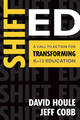
Right around this time last year, I started working on a book with futurist colleague David Houle on transforming K-12 education. We had the book wrapped up by early fall, but with the world of traditional publishing being what it is (we published this with Corwin), Shift Ed: A Call to Action for Transforming K-12 Education didn’t hit the shelves until early April. Since that time, I have done a pretty lousy job of doing my part in promoting it. With this post, I am hoping to change that situation, and my first step is to find some fellow bloggers who might be interested in getting a copy of the book and writing about it.
If you are interested, here’s the deal:
I’m giving away a total of five free copies of the book to the first five people to comment on this post and ask for one. There are, however, a couple of conditions:
There needs to be some sort of reasonable angle for writing about this on your blog. I’m not looking only - or even mostly - for "edubloggers," but on the other hand, if your audience is primarily World of Warcraft afficionados, you need to have some good reason why they might be interested in hearing about a book on education reform.
You need to have a subscription base of more than 250. Apologies to smaller bloggers on this one, but publishers don’t give writers all that many copies of their books. I need to try to get decent mileage out of the ones I have. (This one is purely honor system - I don’t plan to go check up on people’s subscription numbers.)
If you meet those requirements and are interested, just comment below and be sure to put a correct e-mail address in the comment form (this does not show up for other readers). I will e-mail you to get address details.
How you write about the book is up to you. You can do a traditional review, if you like. Or, you could expand on one of the book’s themes. Or, you could offer your own thoughts on transforming education. Or, all of the above. I don’t require that you like the book or say positive things about it - though if you want to bash it, I do request that you be as constructive as possible in the process.
Shift Ed, by the way, is relatively short - around 150 pages - and it reads quickly. It is truly meant to be a "call to action" rather than an in-depth policy tome, and aside from what David and I have put into it, it contains contributions by some great thinkers and practitioners like Tony Wagner and Ian Jukes. Here’s what best-selling author Dan Pink (A Whole New Mind) has to say about it:
America needs a new educational vision. Shift Ed provides a clear vision that emphasizes the essential ingredients of a 21st-century education based upon creativity, collaboration, and critical thinking. Houle and Cobb make a great case that nothing less than transformation will be enough.
Whether you go for the free copy or not, I hope you will check out the Shift Ed Web site, consider buying a copy of the book, and spread the word to others.
Jeff
Related posts:How Do You Read A Book?
15 Online Resources for Book Lovers
Getting a First-Rate Business Education Online - Free
Jeff Cobb
.
Blog
.
<span class='date ' tip=''><i class='icon-time'></i> Aug 19, 2015 01:49am</span>
|
|
I’ve written about goals a number of times here on Mission to Learn, but primarily from the standpoint of setting them. This video from FranklinCovey is about executing them. (Many thanks to Seth Kahan for pointing me to it.) While it is aimed at a business audience, I think you will find that the concepts and key points also translate easily into personal life and learning.
The video starts from the obvious but consistently ignored point that pursuit of our goals is often in direct conflict with the seemingly urgent demands of everyday life. The first step in managing this conflict is to identify no more than three "wildly important" goals (WIGs) to focus on at any given time. Set more than three goals for yourself, and your likelihood of achieving any of them starts to decline to zero pretty quickly.
I’ll leave it to the video to fill you in on how to achieve your 1-3 wildly important goals. It doesn’t offer up any miracle claims or snake oil, just thoughtful common sense that will have a real impact if you follow it. It’s well worth 17 minutes of your time.
Jeff
Related posts:10 Ways to Be a Better Learner: No. 5 - Set and Manage Goals
While My Guitar Gently Weeps - Or the Importance of Setting Learning Goals
Jeff Cobb
.
Blog
.
<span class='date ' tip=''><i class='icon-time'></i> Aug 19, 2015 01:49am</span>
|
|
I’m finally getting back to my series on ways to be a better learner. In case you missed the first three, you can find them at:
10 Ways to Be a Better Learner: No. 1 - Growth Mindset
10 Ways to Be a Better Learner: No. 2 - Cultivate Your Network
10 Ways to Be a Better Learner: No. 3 - Ask Questions
In this post, I briefly take up a topic I have touched on a number of times before: taking notes.
This one may seem glaringly obvious, but as I have suggested in earlier posts, (a) note taking is something we often don’t do - particularly outside of formal educational situations, and (b) even when we do it, we often don’t do it well.
Establishing a consistent habit of writing things down can be very powerful. A significant body of research supports the idea that simply writing something down contributes greatly to the process of moving it into long-term memory. As Françoise Boch and Annie Piolat write in their helpful overview of the research on note-taking,
the result of taking notes is much more than the production of a passive "external" information store, as the note taking action itself is part of the memorization process and results in the creation of a form of "internal" storage (Kiewra, 1987)."
But the initial act of writing things down is only part of the equation if you want to leverage the full power of note-taking. Notes need to be reviewed multiple times over time - a requirement that points to the need for organizing notes well so that they can easily be accessed and reviewed. And beyond simple review, notes are much more powerful as a learning tool if we take the time to rework them, re-state them in our own language, reflect upon them, and connect them to our existing knowledge. In other words, notes are not something to simply jot down and file away, they are something to be actively mined over time.
I’m going to keep this post short because I plan to return to the topic of note-taking quite a bit over the coming months, but if you are interested in learning more about the research related to note-taking, I recommend the article referenced above that summarizes the research on note-taking. Additionally, Fiona McPherson, who I interviewed a while back on memory, has written a book on note-taking and offers some good rules for note-taking on her site.
What have you found effective (or not) when it comes to note-taking as a part of your lifelong learning habits? Please comment and share. And if you haven’t already, I’d be grateful if you would subscribe to Mission to Learn by RSS or e-mail.
Related posts:10 Ways to Be a Better Learner: No. 7 - Be Accountable
10 Ways to Be a Better Learner: No. 6 - Practice, Deliberately
10 Ways to be a Better Learner: No. 8 - Use Technology Better
Jeff Cobb
.
Blog
.
<span class='date ' tip=''><i class='icon-time'></i> Aug 19, 2015 01:49am</span>
|