Blogs
|
Watched part of Meet the Robinsons this week. This clip is a great example of what we mean by failure being an important part of learning.
Mike Kaechele
.
Blog
.
<span class='date ' tip=''><i class='icon-time'></i> Aug 26, 2015 04:19pm</span>
|
|
I am debating in my mind an assumption of social studies teachers everywhere and I know it’s in the Common Core: having students interpret primary source documents. Just to be clear this is one of those rough drafts of my thoughts kind of posts. What that means is critique my ideas like crazy but don’t hold me to any position I might take here because I am not taking a stance that primary sources shouldn’t be taught. I am asking why we do and if we have good reasons.
I probably need to differentiate between types of primary source materials. Photos, art, movies, images of time period objects, seem like great primary sources to use to help students comprehend a time period. I am really thinking about text-based primary sources that are often written at a very high vocabulary level and use obscure words.
Analyzing primary sources of many types is the primary job of historians. Most of our students will not grow up to be historians. I am thinking about primary sources in much the same way that I think about the quadratic formula in algebra: important to mathematicians but not very practical to the rest of us. So future historians need to know how to read and interpret primary sources documents but do all students?
Is it our job to teach the skills one needs to be a professional historian or is it our job to expose students to the patterns of history and to teach them to think critically?
This week we spent a day exploring the Triangle Waistshirt Factory Fire. We watched this short clip from the history channel:
This is a historical re-enactment of the tragic fire that includes many important details to the context of the situation and why it is important historically. Afterward students gave correct and thoughtful answers in a discussion about what happened, the results, and why it still matters today. We could have read historical accounts from journals of survivors, looked at newspaper articles the next day, etc. Some of my students would have really engaged with that. The truth is though that I have many reluctant readers who would probably just stare at the documents, bored and never engage because of difficult vocabulary, complex, sentence structures, and old English words. If a video gives the same content that a primary source does, but in a more interesting format, and leads to a deep level of understanding and solid discussion, what is the advantage of using the primary source? Is it being a "literacy snob" to value primary sources over other forms of literacy?
Some teachers will argue that the critical thinking skills and interpretation skills learned through analyzing primary source documents are important for all students. Again I think that we can teach those skills without using primary source materials necessarily. My goal in my classes is to challenge students to become thoughtful citizens.
Are we forcing a "skill" on students that is not relevant to them and actually makes the subject boring to students?
Mike Kaechele
.
Blog
.
<span class='date ' tip=''><i class='icon-time'></i> Aug 26, 2015 04:19pm</span>
|
|
Although I teach in a project based learning and standards based grading school, the standards are not always a part of the final product, but are assessed along the way as they are foundational knowledge for it. So it seems I still end up having students writing short essays to explain the standards for most assessments.
I was looking for some ways to shake this up so students did not just have to write for every assessment. Here are two ideas that I came up with. The first was to have students create a short presentation of primary source images. Then students screencasted themselves explaining why they chose the images and how the pictures explained the standard.
The second was for students to sketch pictures to explain the standard. I have been thinking about visuals lately especially after meeting Amanda Lyons at Educon and seeing her great visual notes (check our her blog Visuals for Change). I showed them RSA Animate ‘s site and some of their videos as an example of images supporting someone’s thoughts. (If you want to make real RSA style videos check out this post from Paul Bogush.)
Amanda Lyons Community Mural at Educon
Since I wanted this to be quick and easy for assessment I just asked the students to draw their pictures and then either write some sentences next to them explaining the drawings or come explain their sketches to me verbally. I wanted the process to be simple since I was more interested in their visual thoughts than I was in creating a video.
How do you encourage visual thinking in your classroom? What are alternative ways of assessment that you use to keep it fresh?
Mike Kaechele
.
Blog
.
<span class='date ' tip=''><i class='icon-time'></i> Aug 26, 2015 04:19pm</span>
|
|
Photo Credit: Omar Eduardo via Compfight cc
I feel like our school has done a few things right that really improve it. One thing we do that I feel is very powerful is team teaching. I teach with a partner in an integrated social studies/ELA class. I so value working with another teacher and I could list many advantages to it, but the one I want to focus on for this post is the huge advantage for new teachers. This year we hired four new teachers as we are a new school adding another class of 100 students each year. Three of them are first year teachers. Also last year one of our original teachers was a first year teacher.
So my partner and I team teach a group of 50 students. The science and math teachers work by themselves half of the time and team teach the other half. Team teaching allows the new teacher to get their feet wet in the classroom without having to be alone with organizing a classroom, preparing content, discipline, and a host of other things. It allows the new teacher to learn from a master teacher over time and plan together. Team teaching is like a paid internship for the new teacher as they are never by themselves. I also think it stretches and grows the mentor teacher too.
From an administration point of view it does not have to cost any extra money because it can be the same teacher to student ratio just with the larger classes. The one problem many schools might have is the space to have these large classrooms, but other than that I think it is a simple yet powerful apprentice model. I think this model of team teaching could be a huge positive change in schools. It would help with retention of young teachers, bring energy to established teachers, and help build skills and confidence in new teachers. I can say I absolutely would have improved greatly as a young teacher if I would of had this opportunity.
Mike Kaechele
.
Blog
.
<span class='date ' tip=''><i class='icon-time'></i> Aug 26, 2015 04:18pm</span>
|
|
Painting for people in nursing homes
Students just finished our first school wide project: Revolution Garden. This project combined 9th and 10th graders in their four cores looking at the Industrial Revolution to answer the driving question: "How will you Revolutionize the World?" Students studied the history of industrialization and its effects. They then picked a local, modern problem to work with a community partner on a solution. Students had to submit a grant proposal and present a showcase of their ideas. Students were competing for real money donated by our county United Way.
We created a different schedule for the three weeks of this project giving students "team time" to work on their project besides the related standards that they were studying in their core classes. Part of the students’ requirements was to find their own community partner. It was exciting for them to make calls and emails and get responses, sometimes in the middle of class. Many of the students had prepared professional posters and presentations for the showcase. We talked about how they needed a "hook" to get visitors to come to their booth. Students brainstormed props to to attract the community to check out their idea. Some students used food and others printed 3D models of their prototypes. I think this was a great learning moment for them to be both creative and marketable.
Papaya Bars
The showcase was a huge success with many wonderful ideas. Our county ISD has a grant writer who came and she wants to pursue federal grants for many of the projects. We also had the city Chamber of Commerce group come through and built some great relationships with local businesses.
3D prototype
We had six projects receive funds to continue their projects. Their concepts included:
A children’s book on recycling to be published and donated to local elementaries
Healthy fruit smoothies to be sold at our school
Bio luminescent plants (yes they have a geneticist working with them who says it is possible)
Delicious papaya bars containing healthy enzymes
A website that correlates donations to state senators to their voting records
A microchip to be installed in things like jump ropes to be implemented into video games.
Microchip for video games
Nurdle Research
This project was our most ambitious as a school as it crossed grade levels and classes and had us creating new schedules and home rooms for student teams. It also was very open-ended for students but very relevant by focusing on current problems and involving the community. I think this kind of project motivates students because of the relevant choice given them. Once again when given the chance our students blew us away with their ideas!
Mike Kaechele
.
Blog
.
<span class='date ' tip=''><i class='icon-time'></i> Aug 26, 2015 04:18pm</span>
|
|
Simulations of the stock market have been around for decades usually focusing on understanding how stocks work and used in an economics or personal finance class or to teach fractions. I wanted to create a short (1 day) simulation of the famous 1929 Stock Market Crash. The goal of this simulation is to get students to feel the lure of over investing when the stock market grows at a fast, unrealistic rate and then to see how fast they can lose it all when the market drops. I wanted them to feel excited about investing and making money so that they would go all in and then crash when the market lowered.
I used this with 10th graders in an American Studies class. There were a couple of bugs with my formulas and designs that I have fixed (you can’t have a good program without some field testing). Here is the spreadsheet and here is the DOW Average inputs that I used. Rather than try to explain it all here I made a screencast tutorial for how to use it with your class.
1929 Stock Market Crash Simulation by Mike Kaechele is licensed under a Creative Commons Attribution-NonCommercial-ShareAlike 3.0 Unported License.
A few other hints are to take it slow at first but don’t take too long explaining it. The best way for students to figure it out is to just start playing it. After a few rounds, stop and ask the class who is making the most money and then have students share strategies. All it takes is for a couple of students to figure out that they can make tons of money buying on margin to get the class excited. Be sure to ask how many are still making money after the market crashes.
I like to show them the graph that I have linked in the DOW Average Inputs and lead a discussion about the history. The quotes are also priceless and show that economists believed that they had solved the boom/bust cycle of capitalism It should lead to the question of "Why did the stock market crash?" and that is when I turn them loose on research. This simulation could also be a good entry event.
PS: If you try this simulation drop me a comment and let me know how it went with your students.
Mike Kaechele
.
Blog
.
<span class='date ' tip=''><i class='icon-time'></i> Aug 26, 2015 04:18pm</span>
|
|
This past winter I had the privilege to attend and lead a conversation at Educon at Science Leadership Academy in Philadelphia. As I assume everyone already knows, it is a wonderful conference full of deep conversations with wonderful educators from around the U.S. and Canada. It absolutely met my high expectations and it was great to meet so many online friends face-to-face for the first time.
I teach at Kent Innovation High, a New Tech Network Problem Based Learning High School that is similar in philosophy to SLA. We have decided that Educon is too rich of an experience to be limited to the East Coast. A parent and a student that went with me to Educon met with Chris Lehmann and Diana Laufenberg about modeling a conference after Educon at our school. They were very gracious and generous in sharing with us how they set up and run Educon.
So without further adieu we are excited to introduce NovaNow, the Time to Innovate is Now! September 27-28, 2013 at Kent Innovation High in Grand Rapids, Michigan. NovaNow is a conference for educators of all kinds to share their best ideas, plans, and dreams about learning. It is also a place where thoughtful questioning and critiques are encouraged. Presentations are not given, but rather conversations are led around learning.
Photo Credit: A Deeper Blue via Compfight cc
Located in the Midwest between Chicago and Detroit, this conference will coincide with the world class public art show ArtPrize, named one of the five festivals in the world that you won’t want to miss by Time Magazine. So stay Saturday night and enjoy the outdoor art on Sunday.
Check out the conference site to register or even better yet put in a submission to lead a conversation. Follow #NovaNow on Twitter to hear more news about the conference. We look forward to you joining us this fall!
Mike Kaechele
.
Blog
.
<span class='date ' tip=''><i class='icon-time'></i> Aug 26, 2015 04:17pm</span>
|
|
We started a new project today on racism and African-American Civil Rights. I thought I would share the process of our entry event. First without any explanation we watched this story on Youtube.
Part 1
Part 2
We then had a discussion about them and how racism still exists "in parts of the United States." My students also pointed out that it depends on "where you are, especially in the south."
Next students took the White/Black preference test from Harvard. This test measures whether you have a preference for European Americans or African Americans. I am not sure how accurate it actually is, but that alone led to a rich discussion afterwards. We did talk about the philosophical basis of the test and whether or not students thought it was valid. Either way we agreed that it was possible to have biases at times without realizing it.
The final step to our entry event was for students to view this slideshow. We have just finished a project on the Great Depression and looked at many primary source photographs. We have been talking about doing the work of a historian and looking for clues to history from the pictures.
Students were engaged with the pictures and it turned out that for those who noticed the date on the photograph that a quick Google search brought them to an article about them.
When we talked about them as a class most students were very surprised to learn that the "parade" was in Grand Rapids, our city. Many students did not realize the KKK was active in Michigan or even in the north. Others were surprised that there were women members and that their faces were showing. Some students expressed concern that they had never been taught about this before.
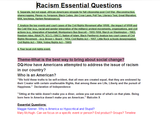
The progression of these activities drew students into the topic and we definitely had them hooked. Now we moved into sharing our Driving Questions and had students generate Essential Questions (this is what we call "Need to Knows"). We are finishing the year with a theme on rights so we have a theme question on top of the Driving Questions. Also to frame the question: "Who is an American?" I used a couple of quotes to give them some context. Here is a screenshot of the Google Doc. The top part in green is our state standards. Students each take a line underneath and add their own questions generated from both the state standards and the entry events.
We have not shared with students yet, but their final product will be a web page on a local Civil Rights place/event. We then hope to make a walking tour of Grand Rapids Civil Rights places with QR codes that link to their webpages. We are excited for students to leave this project with a lasting impression that racism is part of the history of the North and Grand Rapids in particular. We also want students to realize that racism is still among us but that they can make a difference in sharing with others the great progress that has been made in the past.
Mike Kaechele
.
Blog
.
<span class='date ' tip=''><i class='icon-time'></i> Aug 26, 2015 04:17pm</span>
|
|
Photo Credit: SezzRS via Compfight cc
What do you do when students choose to fail?
Mike Kaechele
.
Blog
.
<span class='date ' tip=''><i class='icon-time'></i> Aug 26, 2015 04:17pm</span>
|
|
I want my students to talk about racism. What it is. Does it still exist? What does it look like? I want them to discuss stereotypes and prejudice. I want them to debate whether affirmative action is still necessary. I want them to discuss what to do about illegal immigration and to analyze "white privilege."
But I don’t want them to just argue from viewpoints that they already hold mostly based on their family and community background. I have students from rural, urban, and suburban neighborhoods. Some live in areas with virtually no diversity while others live in places with virtually no Caucasians( a different kind of no diversity). I want students to bring their life experiences to the conversation, but that alone is not enough.
We are in the middle of a project on Civil Rights focusing on the African American perspective. We have not talked about the previously mentioned questions. My students are not ready yet. Many of my white students do not understand the sacrifices made to end segregation by thousands of regular people. Segregation did not end just because MLK gave a speech in DC one day. Many people were abused and many people died in the struggle for equality. My white students need to understand the seriousness of the abuses and the commitment to the struggle.
Many of my minority students also do not know the history of the Civil Rights movement. They have spent too many years learning about "dead white guys." They know about Dr. King and Rosa Parks, but they didn’t know this. They don’t know about Booker T. Washington, W.E.B. Dubois, Malcolm X, Bayard Rustin, or the hundreds of students that were Freedom Riders. Minority students are empowered when they read about how people of their race stood up and claimed their right to a "seat at the American table."
This is why I teach history. Once all of my students appreciate the struggle for freedom and equality in America, then we will discuss all the current issues of our day. We have worked hard not to turn this project into white guilt but rather a celebration of the everyday heroes who stood up for their inalienable rights. We do not ignore the atrocities of our past but use them to understand how legal equality does not automatically mean actual equality. I want all of my students to be empathetic, compassionate citizens who will shape their part of the world for real equality.
We haven’t talked about racism yet because we are not quite ready. But we will…
Mike Kaechele
.
Blog
.
<span class='date ' tip=''><i class='icon-time'></i> Aug 26, 2015 04:16pm</span>
|