Blogs
|
Crescent City Connection, New Orleans taken from my hotel window
The theme for NTAC this year was "Building Bridges." My bridge that I have been building this week has been connections to other educators. My favorite part of NTAC was meeting friends old and new. Some of you I have "known" on Twitter, sometimes for years. Others of you I just happened to sit by you in a session or in the hall. I spent all of my time looking for folks to talk to and to hear their stories.
My favorite connections are those that lead to future collaborations with each other and with my students. In a session about collaboration I listened as teachers proposed network projects around inventions, water, and an online magazine showcasing student writing, poetry, art, and videos. I am so excited to see these connections happen and grow because I know it will lead to students getting excited about collaboration.
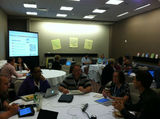
At the table starting from the left: @cfanch, @Beejee71, @me, @suzieboss, Ed Briceño. Photo by @rmjohnson45
Next time you are at a conference don’t just hang out with the people you came with. Introduce yourself to some new people, strike up a conversation with someone about their work, and learn from each other.
Connect with someone and grow YOUR network. Better yet continue the relationships through blogging, Twitter, Skype, or other places. You and your students will never be the same.
Mike Kaechele
.
Blog
.
<span class='date ' tip=''><i class='icon-time'></i> Aug 26, 2015 04:12pm</span>
|
|
I am proud to share this inspiring Ignite talk by my social studies colleague, Trevor Muir. I am blessed to work with great people like Trevor who inspire students daily.
Mike Kaechele
.
Blog
.
<span class='date ' tip=''><i class='icon-time'></i> Aug 26, 2015 04:12pm</span>
|
|
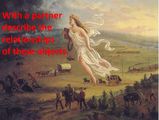
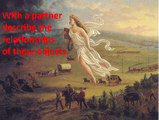
We started our first project this week. Our entry event went very well. Rather than explain it I will show it to you and let you see if you can figure it out for yourself. The students were given these instructions:
Here are the objects in the center of the room.
We also played "Panama" by Van Halen while they checked out the items. Next students made guesses about what each thing sybolized. Many of them were stumped. When a student made a correct guess we threw them a popsicle. After letting them guess for a few minutes we shared a slideshow of primary source resources with them. See how you many you can guess before checking out the slides (adapted from Bruce Lesh).
Students figured out everything except for the concrete paver. This activity was a great start for our project. Students were engaged in the inquiry and very motivated to figure out what everything stood for. We followed this up with revealing our Driving Question: " ‘Murica…cuz MD?" Students now had to figure out what that meant.
The next day the first thing that happened was two students came up to me to guess what the concrete paver stood for. Good attempts but still not correct. One of them said, "I thought about it all night." That was music to my ears. I highly recommend using objects related to a project as an entry event. It is great way to start inquiry, build curiosity, and creates conversations between students.
How could you use objects as an entry event for a project?
PS: Make a guess and check the answers in the comments.
Mike Kaechele
.
Blog
.
<span class='date ' tip=''><i class='icon-time'></i> Aug 26, 2015 04:11pm</span>
|
|
From http://www.flickr.com/photos/yovenice/5353326350/
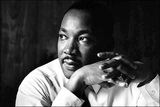
At our school we have an orientation week and run a round robin schedule where we have a group of students for the whole morning. I like to introduce students to myself and class with some research. So I had students look at the site http://www.martinlutherking.org/ I had them answer some questions about it on a Google Form. Some groups took it serious and studiously read it and answered the questions (you know a teacher asked them to do this so they comply mindlessly). Other groups were pretty quick to question the validity of the information. I asked those groups to find evidence that it was "fake."
Eventually in all classes we used http://www.radcab.com/ to talk about how to evaluate sources. Students looked more carefully and discovered the site was created by StormFront, a white supremacist group. They also looked up one of the "experts" David Duke and found out that he was formerly Grand Wizard of the KKK. This led to an excellent discussion about bias. We also dispelled the myth that a site is "good" if it is .org or .gov.
I had one student who bought the whole thing as legit who was really surprised that he was tricked. When he found out it made a huge impression on him and he will not fall for something like this again. Another student told our secretary it was one of her best learning experiences at our school.
I left them with the thought that they should doubt and test everything. I told them, "If your mother says she loves you, ask for her sources." I love setting a tone for our class of critical thinking and questioning to start the year. I want students to expect the unexpected in our class and to look critically at everything.
Mike Kaechele
.
Blog
.
<span class='date ' tip=''><i class='icon-time'></i> Aug 26, 2015 04:10pm</span>
|
|
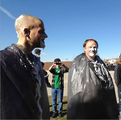
Only picture I can find of both of us
Our students (Andrew Holly is my team teacher) were preparing to debate the motive of the United States during our period of expansion in the Spanish American War. A couple of days before the actual debate we had a practice debate with silly topics for practice. We wanted students to get used to the format, see how much research they needed to do in preparation, and practice public speaking with no pressure. We condensed the time limits by a third to fit all of them in one day.
We used such topics as vampires vs. zombies, hotdogs vs. hamburgs, red vs. blue, Michigan vs. Michigan State, and our favorite Kaechele vs. Holly. Groups randomly drew their topics and had twenty minutes to research and prepare. For the groups that had us we gave each side five minutes to interview us and ask us anything they wanted.
We can’t take credit for this idea as we did a debate last year and the students didn’t like the lame topic we gave them and requested Kaechele vs. Holly. It was a blast. Students this year didn’t know us as well since it is the beginning of the year whereas last year we did our debate at the end of the year.
We feel like allowing students to debate us is a great experience for the whole class. It lets the class get to know us better, but most importantly it shows them that we don’t take ourselves too seriously. It helps us build relationships with our students as being approachable and a culture of fun and weirdness in our room. Being vulnerable in front of your students is always a win.
Mike Kaechele
.
Blog
.
<span class='date ' tip=''><i class='icon-time'></i> Aug 26, 2015 04:09pm</span>
|
|
Photo Credit: Patrick Q via Compfight cc
We add some geography assessments to our American History curriculum because it is important to understanding the events. We currently are in a project on American Imperialism at the turn of the twentieth century. We ask students to locate places like Hawaii, Guam, and Philippines so that they can see how they were "stepping stones" to China, another place that they need to locate.
We also ask them to find Cuba, Puerto Rico, Columbia, and Panama to see the places of the Spanish American War and to understand the need and placement of a canal to connect the Atlantic and Pacific.
We could just have them label a paper map for the places. Instead we give them the list of places and ask them to find them, study them, and then come show them to us of Google Earth. I find using Google Earth to be valuable because first of all they "drive" and have to find their bearings. Next they get to see relationships better. For example many students are surprised about how far away Hawaii is from the mainland of the U.S. This re-enforces how important it was for trade and military. Google Earth is like using a globe instead of a flat map. I think it just shows the relationships more accurately than flat maps.
The geography also leads to important questions such as why did we care about Guam and Puerto Rico when they are so tiny? Why were we negotiating with Columbia for the Panama Canal Zone? Visually students see why we needed a canal because it was so far around South America.
Mike Kaechele
.
Blog
.
<span class='date ' tip=''><i class='icon-time'></i> Aug 26, 2015 04:09pm</span>
|
|
Photo Credit: Rev. Xanatos Satanicos Bombasticos (ClintJCL) via Compfight cc
My students and I are still getting to know each other. Last week I had to make a new classroom rule because their behavior was driving me crazy. They kept coming up and politely asking me to use the bathroom or get a drink.
I told them this had to stop because I don’t like it. They are no longer allowed to ask permission to go to the bathroom or get a drink!
From now on if they have to go to the bathroom or get a drink, they just go do it. I feel like it is demeaning to them every time they ask me to go do a normal body function.
Trust, Respect, Responsibility-that is the creed of our school. I think high schoolers can handle going to the bathroom with out any notice from me!
Mike Kaechele
.
Blog
.
<span class='date ' tip=''><i class='icon-time'></i> Aug 26, 2015 04:09pm</span>
|
|
A parent shared this video about a local artist who made his own "car" designed for "what the car wants for itself." I think this is a great example of the maker movement. My favorite quotes:
It is a lot easier in our culture just to buy things. The things that we find valuable to ourselves aren’t things that we bought at some lame store. It’s things that we created or either passed down or we found them. Or there’s something funny about them. Those have value to us.
I feel like we’re losing that sort of passion. We just buy things now. A lot of people have excuses for not doing things. And they’re discouraging whenever I hear them because they are all false senses of their own abilities to explore and create.
…For some people it’s enough to just to think about it, or talk about it, or watch it on TV, or read about it in a book. My advice is to get your hands dirty, and wonder, and not be afraid to ask questions like ‘Why is that this way?’
…In everything we do there’s parameters. To ignore those is the key.
(Emphasis mine).
Reboot Buggy from Baas Creative on Vimeo.
Mike Kaechele
.
Blog
.
<span class='date ' tip=''><i class='icon-time'></i> Aug 26, 2015 04:08pm</span>
|
|
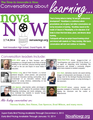
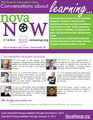
My school, Kent Innovation High, is hosting NovaNow, a conversation based conference this February 7-8, 2014. Here is a testimonial from Kit Hard, one of our conversation leaders:
Why NovaNow is Going to Blow Your Mind!
Let me tell you why I’m super excited about NovaNow - a unique educational event February 7-8, 2014 hosted at Kent Innovation High and Kent ISD in Grand Rapids, MI. It is a new and engaging conference model is based on the Educon conference hosted each year in Philadelphia, PA at the Science and Leadership Academy. Last January I had the privilege of attending Educon 2.5 in Philadelphia, PA and it was one of the best professional learning experiences of my career. Now you’ll be able to experience that same dynamic facilitated conversation format right here in our own backyard. It’s an opportunity you won’t want to miss.
One of the more transformative elements of NovaNow is the opportunity to spend the first morning embedded in Kent Innovation High with student tour guides escorting you through a student-centered, Project Based Learning environment in action. You’ll be blown away by the self-directed learning, innovative teaching practices, and enjoy engaging in meaningful conversations with students, staff, and other educators.
In the afternoon and on the second day, be prepared to have your pre-conceptions about educational conferences blown-up. This will not be a sit-n-git, sage on the stage style conference. One of the defining elements will be the emphasis on facilitated conversations with interactive activities that will expose you to design thinking and an innovation mindset.
And that’s just the "formal" stuff. The real action happens in the hallways, cafes, and evening meetups around town. And it keeps on happening through the long-term connections you’ll make with amazing educators from around the mid-west!
Thanks Kit! We appreciate the endorsement and look forward to everyone joining us. Register before December 6th and save $25.
Check out the website or this flyer for more details! Also follow us on Twitter and Facebook.
Nova Now Flyer
Mike Kaechele
.
Blog
.
<span class='date ' tip=''><i class='icon-time'></i> Aug 26, 2015 04:08pm</span>
|
|
It’s tough. We want so badly for our students to be successful that sometimes we forget what the road to success looks like. Hint: it’s filled with stuff that’s not very rewatchable. Russ Goerend
We finished our Choose Your Own Adventure YouTube video project a couple of weeks ago and I have been putting off this post. I was disappointed and a bit embarrassed by how it turned out. Russ summarizes my feelings nicely. It was the culmination of a project studying WWI and WWII from the American perspective. We had each class of 40+ students working on creating these videos stores as a group. Yup, forty students working together on one final product. It was a bit like…
It was a challenge organizing this endeavor but we left as much as possible up to the students. Students did a nice job of storyboarding and dividing up into roles such as writers, actors, directors, props, and editors. The breakdowns started when the directors did not get files to the editors immediately. Clips that had poor audio, bad lighting, and mistakes did not get previewed until days after shooting them. Video files were contaminated and some of them were lost. In the end one class ended up with no final product and the other class’ video was incomplete and only partly uploaded to YouTube with very poor editing.
I wanted to brag about how good this project was and show off an amazing final product. It didn’t happen this time. Yet the students worked hard. They brought in props and costumes and wrote a decent script. They tried to do everything right, but they are not professionals. The first scenes took a long time to film as they figured out set, props, and lighting. The majority of them had zero experience in any of their assigned roles. They were also under a tight time schedule as we had a field trip planned to launch our next, grade-wide project. There was no way that we could not give them more time. From my perspective I wished I had organized the editing part of the project better.
In PBL we always say that "the process is more important than the product." In this case I feel that is true. The final product may not have turned out to be anything that the students are proud of but the effort and the skills learned were. I also know that future video projects will be better due to this experience. You don’t win an Oscar in your first movie. So though I was disappointed at first due to unrealistic expectations on my part, upon reflection I am proud of what students did and how they grew from the experience.
Mike Kaechele
.
Blog
.
<span class='date ' tip=''><i class='icon-time'></i> Aug 26, 2015 04:08pm</span>
|