Blogs
|
An Every Classroom Matters Episode
Want to save time? Want free resources? Open education resources (OERs) can help busy teachers everywhere! Do you know how to find them? Use them? License them? Make your own? Today’s guest, Sue Jones, has created a helpful guide to OERs and is using them in her highered classroom. You can do this! Listen to today’s show to get started.
Important Takeaways
How OER resources can save teachers lots of time.
Finding videos, PowerPoints, and more that you can actually use.
A fast tip for figuring out which free videos are accurate.
A cool network where educators share tons of free resources.
How to share while preventing "stealing." (I share how I license my work.)
Why teachers are so excited about OER resources.
Educator Resources
Finding, Sharing and Integrating OER Presentation by Sue Jones that we talked about in the show
YouTube and copyright/li>
OER Commons
Creative Commons Search- a turbo fast way to search!
Flickr
Slideshare
lincs.ed.gov
Citing Creative Commons work
Kyle Pearce’s math animations
David Wiley’s 5 R’s of Reuse
Interview Links
@geonz
Sponsor
Lesley University has an impressive line-up of online programs specifically designed for busy teachers. If you’re interested in strengthening your professional training, your resume or your career options, you’ll want to take a look at what Lesley has to offer.Lesley’s programs include: •creative learning environments •experienced faculty •small classes, and •the kind of supportive online community that we all value and want.
Take a moment to check out Lesley’s programs for teachers by going toOnline.Lesley.edu/BamRadio.
Check Out Lesley University’s Online Programs
You can subscribe to the podcast on iTunes or elsewhere, get the RSS feed, or listen via the media player above.
Join the Every Classroom Matters Awesome Educators Network on Facebook
The post OER: How to Find, Use and Share Free Teaching Tools and Resources appeared first on Cool Cat Teacher Blog by Vicki Davis @coolcatteacher helping educators be excellent every day. Meow!
Vicki Davis
.
Blog
.
<span class='date ' tip=''><i class='icon-time'></i> Dec 04, 2015 05:58am</span>
|
|
An Every Classroom Matters Episode
Jon Schwartz is the California teacher who created Rockademix. He found that Karaoke is an incredible way to teach reading and English as a Second Language (ESL) students. You’ll find so many ideas that you can use to teach reading (and any subject). This method can produce great results! The California state Senate named Jon "Tech Hero of 2011." If you write music, maybe you should write some for your classroom. If not, start looking for some!
Important Takeaways
How a blues song unlocked a child struggling to learn English and how it led to the creation of a company.
How Karaoke can boost reading.
Free ways that every child can create music in any classroom.
How Jon’s classroom transformed when he started using music to teach kids.
How to engage kids who are struggling readers by using music.
Educator Resources
Rockademix
A Peek into Jon’s Classroom
Jon shares the music that started it all and how you can download a free copy of the Constitution song and video with dance moves.
Interview Links
@kidslikeblues
@rockademix
Other ECM Shows on Music
We’ve had quite a few other award winning educators who are demonstrating to all of us how well music works in the classroom! There’s a reason many of us remember the Saturday Morning "Schoolhouse Rock" songs we sang about the US government. "I’m Just a Bill" or "Conjunction Junction, What’s Your Function?"
If you’re struggling to teach something. Find a song! Teachers are writing music everywhere now!
Jed Dearybury, teacher from South Carolina ECM episode #130
"Taking Risks to Engage Students" with Scott and Tim Bedley episode #60
Listen to Jon Schwartz
Watch this video to see how the blues teach about the constitution https://youtu.be/AOalfo0ZhXAPowered By the Tweet This PluginTweet This
Every Classroom Matters is a bi-weekly Radio Show by Vicki Davis on BAM Radio network with best practices for busy teachers. Subscribe.
Show notes prepared by Lisa Durff, Production Coordinator for Every Classroom Matters.
If you need help, use this tutorial.
The post Stop Struggling! Teach English Language Learners with Karaoke! appeared first on Cool Cat Teacher Blog by Vicki Davis @coolcatteacher helping educators be excellent every day. Meow!
Vicki Davis
.
Blog
.
<span class='date ' tip=''><i class='icon-time'></i> Dec 04, 2015 05:57am</span>
|
|
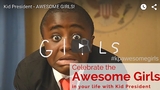
Trends to Help You Teach Kid President is cool. He is now looking for awesome girls to celebrate. His video is endearing (and funny) but rings true. Girls often don’t think they’re awesome.
I felt invisible and unwanted by my peers until I lost weight and started winning beauty pageants — at least in my small town. Being smart was not a good thing. Being pretty was. I remember feeling very un-awesome.
We MUST tell girls they are awesome just like they are!
We can complain about "the media." But now we have a cute kid (and his brother) who want to celebrate awesome girls. We should be all over this one! Pile on! So, if you want to help girls or are working with girls, why not join Kid President in celebrating these awesome girls!
This fun activity is perfect if you’re working with girls and self-esteem. Watch the video (and laugh) - come on people, the video is hilarious. But then,
Why not take pics of your classroom of girls and tweet to #kpawesomegirls?
Why not celebrate some awesome girls in your life?
Why not share some awesome inspiring girls of history?
Who knows some awesome girls??? Let’s have fun with this!
So, Kid President is doing this, he’s cool. Much cooler than you and me saying it. (Sorry teacher friends, that is how it is.) Girls (and boys) need to know they are awesome. Each child is a masterpiece. Every child matters. With all the messages girls get in magazines and media, we need to help them see their own beauty. This is a trend we can join.
So, I’m going to start by tweeting out that my friend Angela Maiers is a #kpawesomegirls (that is with an "s") because of her #choose2matter movement.
OK @iamkidpresident my friend @angelamaiers is a #kpawesomegirls 4 starting the #choose2matter movement & helps kids know theymatter
— Vicki Davis (@coolcatteacher) September 23, 2015
Kids matter. I’ll use any means necessary to help them know that. How about you? Who are the awesome girls in your life?
The post Celebrate Awesome Girls with Kid President! #kpawesomegirls appeared first on Cool Cat Teacher Blog by Vicki Davis @coolcatteacher helping educators be excellent every day. Meow!
Vicki Davis
.
Blog
.
<span class='date ' tip=''><i class='icon-time'></i> Dec 04, 2015 05:57am</span>
|
|
Friendly Technology for Beginners We bank online. We buy things on our computers. But what do we know about computer security? Everything from our wills to our accounting software is on our home computers. But one drive around a neighborhood with my phone looking for hotspots, and I can see dozens of homes ready for a hacker to steal their information.
We put in alarm systems. Do we purchase firewalls? Do we password protect our wifi and home computers? Do parents and kids share the same login ids? These are just a few of the 22.
22 Computer Security Tips Everyone Should Know
Here’s a quick video with the 22 most common mistakes I’ve seen since beginning my work with computers in 1993. This is a beginning video that I also share with my students and their parents.
A Few Important Questions from the Computer Security Video (Watch it!)
Do you have a firewall?
Did you change the firewall’s password from the default?
Does your wifi have a password?
Do you have user accounts for your children? (Not administrative.)
Do you have parental controls on your child’s account? (Or can they install software and let hackers onto your computer when downloading games?)
Do you let strangers or whoever charge their phone in the USB on your PC?
Do you have a secure password for your home computer?
Do you know the most common ways people steal passwords?
Computer Security Software & Hardware to Check Out
Antivirus Software
Avast Free
AVG Free
Kaspersky Antivirus
Other Software
Malwarebytes- for malware
Ninite - to help you quickly install updates for all your software
Zone Alarm - only if you need it (listen to the recommendation)
LastPass - A Password Manager (I like this one - WARNING - Learn how to set this up and be careful! I wrote about this here.)
1Password- Another password manager
Hard Drive for Backup
Western Digital My Passport 1TB External Hard Drive
My Go-To Computer Security Experts and Resources
Luke Allen’s Technology Toolbox
David Pogue’s Book - Pogue’s Basics: Essential Tips and Shortcuts (That No One Bothers to Tell You) for Simplifying the Technology in Your Life
Other Articles I’ve Written for Beginners You May Want to Read
10 Things Everyone Should Know About Passwords
8 Great Email Etiquette Tips for Educators and Everybody
5 Steps to Internet Safety (Free Download)
Location Based Safety Guide
What did I miss? I’ve already updated the video once. Is there anything else that needs to go in there?
I know this is a very simple explanation, but my audience is beginners. I’d appreciate feedback before I share this with my students next week.
As I recommend in the video, you should have a local computer expert you can consult to advise you on all matters. This is to get you started, but you are responsible for your own computer security and safety. No one video could explain every single risk, nor did I try to. This is to start you on your journey. I am not liable for your computer security in any way - you are. Please consult your local computer technician. And now, that disclaimer is done!
The post If You Don’t Know these 22 Things About Computer Security, You’re Headed for Trouble appeared first on Cool Cat Teacher Blog by Vicki Davis @coolcatteacher helping educators be excellent every day. Meow!
Vicki Davis
.
Blog
.
<span class='date ' tip=''><i class='icon-time'></i> Dec 04, 2015 05:56am</span>
|
|
MATH FREEBIE ALERT: Awesome Foldables and Downloads from Sarah Hagan
Math = Love Blog
Sarah Hagan is one busy math teacher from Oklahoma. Her site has:
Foldables
Templates
Bulletin Boards
Graphic Organizers
If you know any math teachers, this is one of those sites that is a MUST SHARE! Just scanning her site, I see Frayer models, integer operations work mat, downloadable mathematical research projects, college algebra real number line project, order of operations graphic organizer. All ages here.
Here’s where to follow her:
Sarah Hagan on Google Plus
@mathequalslove
Tell every math teacher you know! Awesome! (What are your favorite places for freebies?)
Free math resources from Sarah Hagan
The post MATH FREEBIE ALERT: Awesome Foldables and Downloads from Sarah Hagan [Link] appeared first on Cool Cat Teacher Blog by Vicki Davis @coolcatteacher helping educators be excellent every day. Meow!
Vicki Davis
.
Blog
.
<span class='date ' tip=''><i class='icon-time'></i> Dec 04, 2015 05:56am</span>
|
|
Technology Research and News A recent Wall Street Journal Article is attracting attention. It found (gasp) using computers doesn’t give you better test scores. Technology in classrooms means little. Here’s why:
"The report suggested that "we have not yet become good enough at the kind of pedagogues that make the most of technology; that adding 21st century technologies to 20th century teaching practices will just dilute the effectiveness of teaching."
Report results are based on an assessment in 2012 that tracked students in more than 40 countries and surveyed them on computer habits and conducted both written and digital tests.
On average, seven out of 10 students in countries surveyed use computers at school and students average at least 25 minutes a day online. In some countries, like Turkey and Mexico, about half of the students don’t have access to a computer at home.
The survey found that students with more exposure to computers do better, on average, than those with little exposure to computers, but the OECD cautioned against drawing conclusions based on that result. The data could simply reflect that school systems that invest in technology also invest in better teachers and draw on students from a higher socio-economic class, who tend to do better in school."
The Wall Street Journal, "Technology in Classrooms Doesn’t Always Boost Education Results, OECD Says"
IT IS HOW YOU USE TECHNOLOGY!
How do you teach with tech? WHAT DO YOU DO WITH IT?
You can’t get smarter just rubbing Einstein’s head. If he were still alive, you’d have to talk to him. You’d want to interact to improve.
Technology in the Closet
Before I became a high school teacher, I taught teachers how to use technology. I’ll never forget my discovery about edtech.
I was lost in the building. I opened the door to the closet instead of the conference room. The closet was full from bottom to top with computers in boxes.
I had just been working in a poor school with few computers. But this closet was full. When I asked if the teachers could have them, I was told they stockpiled them at the end of the fiscal year. They would figure it out. Over a year later when I went back and peeked, the closet was still half full. Nobody figured it out.
I discovered that HAVING technology means nothing. You have to:
Have technology in the classroom,
Students must have access, and
Teachers must know how to teach with tech.
Using Technology in Ways that Improve Classroom Learning
It is not about what you HAVE but what you DO with what you HAVE.
Unless you HAVE NOTHING — and then you don’t even HAVE a chance. And that is unfair.
Technology is here. It can make a massive difference if you HAVE the know-how to teach with it effectively.
Edtech Professional Development Must Amp Up
I went to a recent professional development about differentiated instruction. It was one day of lecture. I couldn’t believe it.
We need PD! But teacher training must model what we’re teaching.
When I teach collaborative writing, we write collaboratively.
When I do a workshop on global collaboration, we collaborate globally.
When I do a workshop on differentiation, I differentiate.
To do otherwise is not only hypocrisy, but it is also a waste of money.
And that is where we are.
A gulf yawns between the haves and HAVE NOTS.
I would argue this.
Good Technology Access + Good Technology Pedagogy = Improvement
and
Good Technology Access + Bad Technology Pedagogy = No Improvement
and
No Technology Access = No Improvement
And the latter two in this list aren’t much different. It is more than technology access. It is how we teach with what we have.
It would be like giving new customer care reps an awesome new system and not training them. But it happens each and every day in our schools. This report is no surprise. It just validates what many in education technology have been saying all along.
If you’ve got the technology, let’s talk about good teaching with it.
The post Why Technology in Classrooms Doesn’t Always Boost Education Results appeared first on Cool Cat Teacher Blog by Vicki Davis @coolcatteacher helping educators be excellent every day. Meow!
Vicki Davis
.
Blog
.
<span class='date ' tip=''><i class='icon-time'></i> Dec 04, 2015 05:55am</span>
|
|
Hot Research, Trends, and Teacher Resources Today I’m going to be experimenting again with a news feature that I ran a few years back. I’ll summarize some of interesting research, trends, and helpful resources. Let me know in the comments if you like me bringing back this feature and if you find it useful. I plan to try this for a while and measure the response. I want to help educators be excellent every day. Part of being excellent is reading things and being a lifelong learner. Tweet me things you think need to be shared on a wider basis.
Resources You Can Use in the Classroom
Free Technology for Teachers: Google Expeditions is Possibly Coming to a School Near You
http://www.freetech4teachers.com/2015/09/google-expeditions-possibly-coming-to.html#.VgmHSstVhBc
Cool virtual reality tool. I have one my sister gave me for Savannah college of Art and design that they did with the iPhone. It was incredible. Cardboard with a smartphone inserted. It uses the accelerometer inside to really make it feel 3d. It does. You can actually get kind of dizzy.
From Richard Byrne’s site.
"Earlier this year Google unveiled a new virtual reality program for schools. The program is called Expeditions. Expeditions uses an app on the teacher’s tablet in conjunction with the Cardboard viewer to guide students on virtual reality field trips. Today, Google announced that they are bringing Expedition demonstrations and the required kits to schools all over North America, Brazil, the United Kingdom, Australia, and New Zealand."
We’re NASA Mars scientists. Ask us anything about today’s news announcement of liquid water on Mars. : IAmA
https://www.reddit.com/r/IAmA/comments/3mq1wl/were_nasa_mars_scientists_ask_us_anything_about/
NASA mars scientists posted at 1:30 pm on 9/28/2015 just a few hours after it was announced that liquid water was found on MARS — that they would be answering questions on Reddit. This is a cool thread. yet another reason to join Reddit.
10 Questioning Strategies to Differentiate Instruction | Minds in Bloom
http://www.minds-in-bloom.com/2015/09/10-questioning-strategies-to.html
Laura Poinier’s post has some easy-to-do strategies that can help you start differentiating NOW. I especially love what she says about giving kids prior notice.
The simplest and most effective strategy to help students succeed is to give them extra time to process. Do this by giving prior notice before cold-calling. Assure specific students that you will never "cold-call" them and will instead let them know ahead of time when they will be asked to participate. How? During independent practice or bell ringers, privately tell a student, "Your answer to number one is perfect; I’m going to ask you to share it when the timer goes off," or "After Bobbi and Jake read, you are going to read paragraph three aloud." Many students who struggle academically act invisible or act out to avoid public academic failure. Giving prior notice is a great way to reduce anxiety and misbehavior.
Free Technology for Teachers: 5 Research Tools Students Often Overlook
A fantastic overview / reminder to students about some incredible research tools right in front of them. Share this one!
Writing
Editing tips to take your writing from good to great - Crew blog
http://blog.crew.co/take-draft-good-great-editing-tips/?utm_content=buffer3a9aa&utm_medium=social&utm_source=twitter.com&utm_campaign=buffer
This is an awesome article with tons of quotes from writers. A marvelous one to share with your creative writing classes.
Research that People Are Talking About
New Research: Spending DOES Make a Difference, Especially for the Poorest Children | Diane Ravitch’s blog
http://dianeravitch.net/2015/09/28/new-research-spending-does-make-a-difference-especially-for-the-poorest-children/
"The authors-C. Kirabo Jackson, associate professor of human development and social policy at Northwestern University, Rucker C. Johnson, associate professor of public policy at University of California, Berkeley, and Claudia Persico, a doctoral candidate in human development and social policy at Northwestern University-show that "increased school spending is linked to improved outcomes for students, and for low-income students in particular…Increasing per-pupil spending yields large improvements in educational attainment, wages, and family income, and reductions in the annual incidence of adult poverty for children from low-income families.
As they also show, it matters how the new money is spent-such as on instruction, hiring more teachers, increasing teacher pay, hiring guidance counselors and social workers. Money well-spent "can profoundly shape the life outcomes of economically disadvantaged children and thereby reduce the intergenerational transmission of poverty. Money alone may not lift educational outcomes to desired levels, but our findings confirm that the provision of adequate funding may be critical.""
Sleep Scientists Confirm Getting To Work Before 9 AM Is Torture
http://www.lifehack.org/316086/sleep-scientists-confirm-getting-work-before-9-torture
Scientists are continuing to advocate that work and school start later. Researcher Paul Kelley CLAIMS that test scores and work productivity should start at 10am. Of course, what he doesn’t account for that this would push sports to later in the day and kids would go to bed even later than they do already. You can only cram so much into a day. Anyway, it is interesting reading. One of the most important things is emphasizing and encouraging to parents that kids get enough sleep.
What Parents Can Do To Avoid Passing Anxiety On To Their Kids | MindShift | KQED News
http://ww2.kqed.org/mindshift/2015/09/28/what-parents-can-do-to-avoid-passing-anxiety-on-to-their-kids/
"Children of anxious parents are more at risk of developing an anxiety disorder. But there’s welcome news for those anxious parents: that trajectory toward anxiety isn’t set in stone.
Therapy and a change in parenting styles might be able to prevent kids from developing anxiety disorders, according to research published in The American Journal of Psychiatry Friday."
Music and Learning: Why Teachers Should Consider Music in the Classroom | The Inspired Classroom
http://theinspiredclassroom.com/2015/09/music-and-learning/
The research on why music is so helpful in the classroom.
Being a Better Online Reader - The New Yorker
http://www.newyorker.com/science/maria-konnikova/being-a-better-online-reader?utm_content=buffer8a084&utm_medium=social&utm_source=twitter.com&utm_campaign=buffer
Fascinating overview of the research and controversy of online and e-reading versus reading with a physical book. From what I’ve read the "jury is still out" but still, there are definitely times you must have a physical book. For example, my daughter struggled in Calculus - we decided to save up and bought her the $800 printed calculus book (instead of the $124 online book). Her grades are decidedly UP. There are certain materials, I believe, that are best shared on the printed page. Here’s what researcher Anne Mangen a professor at the National Centre for Reading Education and Research at the University of Stavanger, in Norway is quoted in the article which says,
Much of Mangen’s research focusses on how the format of reading material may affect not just eye movement or reading strategy but broader processing abilities. One of her main hypotheses is that the physical presence of a book—its heft, its feel, the weight and order of its pages—may have more than a purely emotional or nostalgic significance. People prefer physical books, not out of old-fashioned attachment but because the nature of the object itself has deeper repercussions for reading and comprehension. "Anecdotally, I’ve heard some say it’s like they haven’t read anything properly if they’ve read it on a Kindle. The reading has left more of an ephemeral experience," she told me. Her hunch is that the physicality of a printed page may matter for those reading experiences when you need a firmer grounding in the material. The text you read on a Kindle or computer simply doesn’t have the same tangibility.
One interesting note on this article. They don’t follow some of the principles of helping make a page readable online. I found the page hard to read not because of the words, but the layout. I would argue that the way a page is presented also impacts how reading happens.
Trends About Today’s Students
How mobile technology in education is shaping the next generation of employees | Information Age
http://www.information-age.com/technology/mobile-and-networking/123460243/how-mobile-technology-education-shaping-next-generation-employees
This article talks about how today’s teaching is going to change the business world. Sadly, I think that much of the teaching they CLAIM happens (such as mobile learning and differentiation) may not be as widespread as they think. Either way, this generation is different and I do think they expect to be a truly mobile workforce. Of course it will be interesting to see how the kids who are lucky enough to have personalized learning feel about the workforce.
How one school is turning Generation Z into entrepreneurial innovators | Information Age
http://www.information-age.com/it-management/skills-training-and-leadership/123459052/how-one-school-turning-generation-z-entrepreneurial-innovators
And I’m seeing this too. This generation wants to start their own business. We see this with Shark tank type experiences. This is a cool overview of what one college is doing as they literally help students start businesses in school instead of doing projects that go in the trash.
Posted from Diigo. The rest of my favorite links are here.
The post Improving the Education of Kids in Poverty and Other Helpful News appeared first on Cool Cat Teacher Blog by Vicki Davis @coolcatteacher helping educators be excellent every day. Meow!
Vicki Davis
.
Blog
.
<span class='date ' tip=''><i class='icon-time'></i> Dec 04, 2015 05:54am</span>
|
|
An Every Classroom Matters Episode
Beth Kanter is a leading social media expert for nonprofits. She gives advice on how schools should manage their Facebook, Twitter, and social media efforts. Most schools need more volunteers and donors (or at least positive press). Schools can even motivate students to share positive things. Social media can help if you know how.
Important Takeaways
How should schools spend time on social media? Measure success?
How one group found a video with a million views didn’t help get more volunteers and donors.
Engage and empower PhilanthroTeens to support your school on social media.
Make it easier for volunteers to sign up.
Make it easier to donate through social media. (We talk about Facebook’s "donate now" button.)
Explanation of A/B testing and how it can help your school.
Beth Kanter wrote the Networked Nonprofit book series. She is considered a leading expert in the use of social media for social change. Social media is a mindset. Social media is a skill. Social media can help you, not just be a problem. Anyone working with social media in schools should follow Beth.
Educator Resources
The Networked Nonprofit: Connecting with Social Media to Drive Change by Beth Kanter
Measuring the Networked Nonprofit: Using Data to Change the World by Beth Kanter
Facebook donate now button
Interview Links
@kanter
bethkanter.org
Sponsor
Volunteerspot.com is a free tool that will make it easier to engage potential volunteers and donors. Make parent-teacher conferences easy. Pick the times you can meet. Email/share the link. Parents DON’T need a password or login to sign up. Volunteerspot will remind them. Volunteerspot is easy and FREE! Sign up today.
Sign up for Volunteerspot.com now.
Join the Every Classroom Matters Awesome Educators Network on Facebook
You can subscribe to the podcast on iTunes or elsewhere, get the RSS feed, or listen via the media player above.
Episode 174: Get More Volunteers and Donors for Your School
Listen to this episode with Beth Kanter to learn how to get more volunteers and donors for your school.
The post How to Get More Volunteers and Donors for Your School appeared first on Cool Cat Teacher Blog by Vicki Davis @coolcatteacher helping educators be excellent every day. Meow!
Vicki Davis
.
Blog
.
<span class='date ' tip=''><i class='icon-time'></i> Dec 04, 2015 05:53am</span>
|
|
Useful Pedagogies and Tools for Educators Sketchnoting is not just an attractive way to take notes, it can improve retention and learning. These sketchnoting resources will get you started with your students. You don’t have to have a ton of talent, just a little know-how. I’ll update these sketchnoting resources, so tweet me or leave a comment to add your favorites. Don’t get overwhelmed, just get started.
Twitter Tip: If you want to find and share great sketchnotes, follow the #edusketch hashtag on Twitter.
Resources on Sketchnoting and Visual Notetaking:
Most Valuable Sketchnoting Resources
Sylvia Duckworth’s incredible presentation Sketchnoting for Beginners.
Kathy Schrock’s Sketchnoting guide
Smashing Magazine’s Article on Sketchnoting
Karen Bosch’s Free Sketchnote Course on iTunes
Notetaking Skills for 21st Century Students - one of my most popular blog posts that incorporates visual notetaking/sketchnoting into how I teach students to take notes.
Sylvia Duckworth’s Sketchnote/ Visual Notetaking Blog Post for Beginners
Karen Bosch’s Sketchnoting Tools Website
Doodlers Unite - Popular TED Talk by Sunni Brown - She uses the term "doodle" but many I know use sketchnotes or edusketch as their titles. Warning - you can’t really use this video with K12 kids, it has an inappropriate joke in it. Pick some of the others I’ve listed here.
Sketchnoting Tools
Sketchnoting Fans: Paper 53 Built a Sketchnote Community
Karen Bosch’s Tool Recommendations (scroll down for her current recommendations)
10 Habits of Bloggers that Win, Sylvia Duckworth’s Sketchnote of the ebook by Vicki Davis
Places to See Awesome Sketchnotes
Sylvia Duckworth’s Sketchnote Flickr Account - Sylvia sketches relevant things for educators today.
Sketchnote Army Website
Sketchnotes on Pinterest (this is a search for the tag, you must filter to find the ones you want, but I love trolling for ideas here.)
Sacha Chua’s Evernote Notebook of Sketchnotes (hat tip Todd Finley for pointing me to her!)
People Who Sketchnote Education Topics
@sylviaduckworth Sylvia Duckworth
@langwitches Silvia Tolisano
@braddo Brad Ovenell-Carter
@karlyb Karen Bosch
@rockourworld Carol Anne McGuire
@rebezuniga Rebeca Zuniga
@amyburvall Amy Burvall
@sachac Sacha Chua
Sketchnoting Resources and Books to Help You Dive Deep
The Doodle Revolution: Unlock the Power to Think Differently by Sunni Brown [BOOK]
The Sketchnote Handbook: the illustrated guide to visual note taking by Mike Rohde [BOOK]
What are Sketchnotes? (Great sketchnotes explaining sketchnotes.) [SKETCHNOTES]
How to Create Awesome Visual Notes [BLOG POST]
Brad Ovenell-Carter’s Sketchnoting Primer (video above) [VIDEO]
Sketchnote Podcast (they are videos - 10 part series you can use with kids as you watch people draw on camera.) [10 VIDEOS]
Sketchnoting Research and News
Drawing to Learn | Learning Sciences Research Institute
http://www.lsri.nottingham.ac.uk/research/drawingtolearn
"Ainsworth, Prain and Tyler (2011) in a paper in Science argue that drawing can play a number of important roles in learning:, namely:
Drawing to enhance engagement — surveys have shown that when students draw to explain they are more motivated to learn compared to traditional teaching of science.
Drawing to learn to represent in science — the process of producing visual representations helps learners understand how scientific representations work.
Drawing to reason in science — student learn to reason like scientists as they select specific features to focus on in their drawings, aligning it with observation, measurement and/or emerging ideas
Drawing as a learning strategy — if learners read a text and then draw it, the process of making their understanding visible and explicit helps them to overcome limitations in presented material, organise and integrate their knowledge and ultimately can be transformative.
Drawing to communicate — discussing their drawings with their students provides teachers with windows into students’ thinking as well being a way that the peers can share knowledge, discovery and understanding."
Skills and Strategies | Doodling, Sketching and ‘Mind Mapping’ as Learning Tools - The New York Times
http://learning.blogs.nytimes.com/2015/09/24/skills-and-strategies-doodling-sketching-and-mind-mapping-as-learning-tools/?_r=2
Excellent article on the strategies and skills students need about sketchnoting, doodling, and mind mapping. These are important skills. Kathy Schrock is quoted in the article. Hat tip to Sylvia Duckworth for this gem.
The post Epic Sketchnoting Resources: How to Get Started Teaching Sketchnoting appeared first on Cool Cat Teacher Blog by Vicki Davis @coolcatteacher helping educators be excellent every day. Meow!
Vicki Davis
.
Blog
.
<span class='date ' tip=''><i class='icon-time'></i> Dec 04, 2015 05:52am</span>
|
|
An Every Classroom Matters Episode
Raised by an "alcoholic and an outlaw" father, Kevin Honeycutt grew up in poverty. He says childhood had many "midnight runs." His Dad would let the kids pack their belongings in one trash bag each. Kevin was always the new kid. Foster homes. Extreme poverty. But someone saved him. It was his teachers. This episode is his story.
Important Takeaways
How you can "flip a kid" and change a life
You have lots of kids who transfer in and out, do you still make a difference?
"Rebelieving" in someone
How band and art classes changed his life
How to help kids with no hope succeed
Finding success secrets
I asked him,
"If you were your own teacher. If "little Kevin" were in your class for 15 days, what would you tell him?"
I replayed Kevin’s response to that question over and over. His answer haunts me. We should all be saying this.
Do you feel this way? When I’ve poured my heart and soul into a child and they transfer, I cry. I mourn. I wonder if I made a difference. Kevin fills me with hope.
The show is full of great quotes. (below)
Educator Resources
Your Digital Dad [free ebook]
Your Digital Dad YouTube Series
Interview Links
@kevinhoneycutt
Join the Every Classroom Matters Awesome Educators Network on Facebook
You can subscribe to the podcast on iTunes or elsewhere, get the RSS feed, or listen via the media player above.
The post Story of a Young Life Turned Around by Great Teachers appeared first on Cool Cat Teacher Blog by Vicki Davis @coolcatteacher helping educators be excellent every day. Meow!
Vicki Davis
.
Blog
.
<span class='date ' tip=''><i class='icon-time'></i> Dec 04, 2015 05:51am</span>
|