All Resources
 Loading...
|
Setting up a template for your eLearning project gets you on the right foot for the rest of your course development. Creating a consistent, branded template will ensure that all your content looks the part and functions well, and save you precious time. But Articulate Storyline templates can be an easy stumbling block for the uninitiated.
|
|
Twenty-twenty has certainly been an eye-opening year. After months of stay at home orders, travel restrictions and social distancing, businesses are starting to wonder what their organizations will do as we approach a phase of viral response that will likely include multiple waves of varied states of alert according to the threat levels across multiple geographies. Corporate learning and development teams were quick to respond to initial changes in the working conditions of employees, but most of those responses were short term modifications to adapt quickly to the new conditions. Many have observed that a post-pandemic world may well be shaped differently. Organizations have significant financial incentives to explore shifting employees to partial or full-time remote status. The rapid eLearning industry was built on the notion that persistent, on-demand training materials could lower costs and improve access to learning content.
|
|
If you’re managing a distributed team, you know getting everyone on the same page to drive productivity is more important than ever. But depending on where you are, this could be difficult. In some states, stay-at-home orders and other restrictions are being lifted, while others are a long way from in-person meetings.
|
|
For many, the need to train employees using video has dramatically grown in importance. But for those being asked to implement it, video training can present challenges winning the support of stakeholders and producing learning that is performance-focused.
|
|
Now more than ever, trainers and students need to know their virtual interactions are protected and secure.
Join us for this webinar in which our Adobe Connect Evangelist will share best practices to keep your virtual trainings and classroom secure.
|
|
One of the biggest myths in the L&D world is that "we must train workers." Workers are inherently learners. If they are not, we would see massive job failures. In fact, workers are also relentless learners. They fix, solve and improve work issues every minute of their work day.
|
|
In this session, attendees will gain insight from practitioners who will share their perspectives on using video to drive skill development programs. Skill development programs require: Access to and absorption of knowledge, proof of comprehension and/or demonstration, practice and mentorship, and stick-to-it-ness in order to effectively apply skills to new areas.
|
|
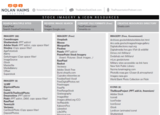
PowerPoint MVP Nolan Haims provides for TMN members the fantastic list of stock imagery and icon resources used at Nolan Haims Creative.
|
|
For the fourth year, Training magazine and Wilson Learning Worldwide have teamed up to conduct the Annual Leadership Survey, which focuses on creating effective leaders and preparing the next generation of leaders.
|
|
Adding interactions is an integral part of building eLearning courses. These interactions can usually be triggered on a hover, click/tap, or drag. From these, the most used trigger is a click. Also, for making your courses accessible, you are required to limit yourself to using click-based interactions and refrain from including hover- or drag-based interactions.
|
|
The learning ecosystem is rapidly evolving, and the changing technologies and growing resources available to help individuals learn is likely a bit overwhelming for your Learning and Development team. With the only guarantee being that change is inevitable, how do you build a training solution that will meet your organization’s needs 6, 12, or 24 months down the road?
Discover how open-source technology can help you create a flexible and future-proof training program for your organization.
In this White Paper, you'll learn:
The evolving role and capabilities of the Learning Management System (LMS) within the larger learning ecosystem
The leading open-source learning platforms and how to determine which is the right fit for your needs
How to maximize the interoperability of open-source to extend and future-proof your learning program
|
|
Discover the three phases of leadership Walt Disney went through to become the wise leader we remember and discover how the leadership lessons he learned, and that Walt Disney World still follows, can improve the performance of your organization’s leaders.
|
|
COVID-19 forced many organizations to transition to remote work in just a few days. But now that many employees have been working remotely for weeks, employers are beginning to realize the benefits of remote work, and many organizations will continue working remotely at least part of the time. Even though your teams might not be in the office, you still need to train your workforce on compliance topics like appropriate behavior or how to stay safe online. And because employees are encountering new challenges, you might also want to consider offering training on other topics, like productivity, effective remote leadership, software, and communication. The good news is that you can do all of this with online employee training. Now more than ever, it's important to make tools and resources readily available for your employees, no matter where they are.
In this infographic, you'll learn how you can deliver a consistent and seamless training experience to your dispersed and virtual workforce.
You'll also learn:
Tips for sourcing content
When to create your own content
How to maximize training effectiveness
The most impactful delivery methods
|
|
We’ve been socialized to believe learning ends when we finish school or university or an e-course. But we’re wrong. With the half-life of skills at 5 years, everyone needs to be constantly upskilling to keep up with the pace of technology—they need continuous learning.
And while many organizations are aware of the learning sciences needed to propel their programs forward, they are unsure how to turn these great ideas into digital learning that drives results.
This eBook explores why learners need continuous learning to achieve mastery--and what you can do about it to grow revenue and improve learning outcomes.
Download this free eBook to learn:
Why professional learners need continuous learning to reach mastery
Four models to build and scale your business with continuous learning
How to choose the right model for your learning program
|
|
The problem with PowerPoint? It's too easy. Everybody can create slides in about an hour so nobody dives very deep. Here are a few deep dives to uncover features, functions, and shortcuts that you need to have in your toolbox.
|
|
Are you ready for a remote sales force? Sales for companies around the globe have been disrupted by travel cancellations and remote work in the face of COVID-19. Managing a dispersed sales team is a unique challenge. Corporate travel restrictions mean less contact with prospects, with the industry, and with the market. But with the right strategy, sales managers can succeed.
|
|
This webinar will reveal and teach some of the most innovative strategies during this time of transition.
Unlike any other time before in our history, the session provides learning and development departments and never seen before opportunity. This webcast will teach specific strategies to coach and reinforce coaching virtually.
|
|
As a result of the COVID-19 crisis, many executives, including JP Morgan CEO, Jamie Dimon, predict the global economy will be in recession for the rest of 2020 and perhaps even into 2021. Consequently, many organizational leaders will conduct top-to-bottom reviews of programs in an attempt to cut budgets and save money. Are you prepared to show how your major programs drive the business in this new post-pandemic world? Implementing or using some of the concepts of the ROI Methodology now can safeguard your budgets during and after this time of uncertainty.
|
|
According to the 2018 Gallup Report, 67% of workers are experiencing some sort of work disengagement. Gallup looked deeper into managers’ impact on employee engagement and found:
77% of employees believe their manager needs to improve the meaningfulness of the feedback they currently provide
74% of employees believe their manager needs to more directly relate feedback to their job performance
79% of employees believe their manager needs to improve how they manage their
employee’s performance to motivate them to excel in their position
BUT all is not lost; This gap represents an opportunity. To discover more about the opportunity, click to download this paper.
|
|
We are living in unprecedented times. 'Work' as we know it is changing. In order to thrive, organizations must re-invent themselves and embrace the new normal. As a former Fortune 500 business executive who has seen it all, Jill understands how organizations operate, and what they need to do to attract, retain, and engage employees - whether they sit under your nose or work remotely.
|
|
During these unprecedented times, social distancing is the need of the hour. Join Dr. Pooja Jaisingh to see how we can use the information available on this topic to build an interactive and animated eLearning course using Adobe Captivate.
|
|
In this webinar, you'll learn techniques that anyone can use to create stunning PowerPoint slides, without any design experience or ability. You'll also discover that these techniques also help your audience understand and remember your points more clearly. Best of all, they're easy to incorporate into your slide preparation.
|
|
Employee training and development is not an "event" it's a process. Training in the 21st century needs to be ongoing, agile, and one that is personalized to individual needs.
And with the growing remote workforce, evolving and advancing technologies, where do you begin? Traditional employee development methods are being replaced by:
micro-learning
simulations
gamification
AI and more
Download this complimentary guide, The Definitive Guide to Upskilling, to learn about the 4 essential strategies for building and refining an upskilling program with personalized content and hands-on training that aligns with your company.
|
|
Join our experts from Adobe and Verizon Wireless on this webinar and discover how to elevate your virtual trainings and classrooms by adding interactive elements. Jamie Freeman will take you through a slew of creative ideas for adding orchestrated interaction into your virtual training. She will ensure that any virtual training you host is an event to remember! While Alistair speaks about the role interactivity plays in elevating the effectiveness of your delivery.
|










.png?1591213312)