Blogs
|
Guest Post by Beverly Kaye and Sharon Jordan-Evans
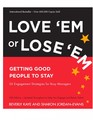
I’m delighted to share a guest post from my friends Beverly Kaye and Sharon Jordan Evans. They are the co-authors of the bestseller Love ‘Em or Lose ‘Em: Getting Good People to Stay... the fifth edition of which is now available. Sharon and Bev address 26 strategies leaders can use to optimize engagement and retention. Being a wife and mom myself, ‘becoming more family friendly’ is one of my personal favorites.
People disengage or quit when rigid workplace rules cause unbearable family stress. Would they leave your organization over work/family conflicts? Yes. Employees are asking for a workplace that helps them balance the demands of their work and family lives, rather than forcing them to choose one over the other. Today and from now on, organizations that are not family-friendly will definitely have a harder time finding and keeping good people.
What Does Family Mean, and What Do They Want?
What do we mean by the word family? Some of you might immediately picture small children and two parents. Others picture a young newlywed couple, a single male caring for his aging father or the members of a large extended family. In the U.S., the Gen-X-er and his dog could be a family, while in Asia the pet seldom qualifies.
One family-friendly strategy won’t meet all of these employees’ individual needs. It’s critical to consider the different types of families in your group, and then think about (and talk about) the approaches that will work best for each of them. Remember, the most accurate way to get this information quickly is simply to ask your employees.
Get Flexible
You have tremendous opportunities to get family-friendly within your own work group. What you do (and fail to do) as a manager can mean so much to your employees as they juggle work and family. And much of what you can do as a manager costs you and your organization little or nothing.
Think flexibly the next time an employee asks you for different work hours or time off to help a spouse, parent, or friend. Think about the real costs of saying yes. Will productivity suffer? Will you set a dangerous precedent?
It is more likely that your employees will applaud (maybe silently) your open-mindedness and willingness to help a valued employee in a time of need. Remember to set clear expectations for your employees’ results and hold them to those results. Then you will have room to flex when it matters.
Get Supportive
Some managers mistakenly think that they should clearly separate themselves from their employees’ personal lives. You have much more to gain by showing your interest in their lives outside work.
We have heard about managers who became involved in several appropriate ways. As you read these approaches, think about which ones might work for you and your employees:
Allowing employees’ children to come to work with them occasionally, usually to celebrate a special occasion or because of a special need
Driving to an employee’s house to be with her and her family following a death in the family
Accompanying employees to their children’s ball games and recitals
Inviting an employee and his or her parents, relatives, or children to lunch
Allowing well-behaved pets into the workplace
Researching eldercare alternatives for an employee who needs help with aging parents
Sending birthday cards or cakes to employees’ family members
Setting up special e-mail and resource areas on the company intranet for employees’ children
Locating resources (the company lawyer) for an employee struggling with the health insurance company
There are positive payoffs for your efforts to become more family-friendly, including increased loyalty, money saved, and the competitive edge that a loyal and productive workforce will provide.
Beverly Kaye and Sharon Jordan-Evans are the authors of Love ‘Em or Lose ‘Em: Getting Good People to Stay, the bestselling guide that provides twenty-six strategies to keep talented employees happy and productive. In addition to updating and revising all information for the fifth edition, the authors have included more international stories and statistics. Available January 2014 on Amazon and in bookstores everywhere! Beverly Kaye is the Founder of Career Systems International. Sharon Jordan-Evans is the President of the Jordan Evans Group.
The post How Family Friendly are you Really appeared first on Julie Winkle Giulioni.
Julie Winkle Giulioni
.
Blog
.
<span class='date ' tip=''><i class='icon-time'></i> Jul 14, 2015 09:13am</span>
|
|
In case you missed it, check out Juana Llorens’ summary of opportunities for informal learning in groups. http://www.astd.org/Publications/Blogs/L-and-D-Blog/2012/06/Thinking-About-Promoting-Informal-Learning-in-Groups.aspx
Saul Carliner
.
Blog
.
<span class='date ' tip=''><i class='icon-time'></i> Jul 14, 2015 09:13am</span>
|
|
by Saul CarlinerThe summer travel season, when many of us explore new places and experience new things, is ripe with opportunities for true informal learning—that is, learning where you, as the learner, set the objectives and determine for yourself when you have achieved them. (This differs from informal learning for the workplace, which represents more of a partnership between employers and workers on the process, content, location, and purpose of learning, and—like other types of informal learning—can happen consciously or unconsciously. See Chapter 1 of Informal Learning Basics for more about these definitions.)Some might learn a new sport. Some might try a new artistic activity, like journal writing or painting. Some might try their hand at cooking a different type of cuisine. Some might hike new paths. And some, like me, might explore new museums. Museums captured my imagination at a young age, fostered my intellectual awakening, and provided many hours of wonder about—and engagement with—art, history, science, nature, and even music. More immediate to the point, museums fostered my interest in informal learning, because that’s what they do.So how can you get the most from your museum visit—without killing it? Here are some tips. Start with a flexible agenda. From the get-go, give yourself permission to wander and explore whatever strikes your fancy. This museum visit isn’t a business meeting where you have specific tasks to accomplish; it’s supposed to be fun. So don’t kill it by over-planning it. Once inside, focus on what interests you. See something that catches your attention? Go to it. Gaze at it. Read about it. Linger all you want, or leave in an instant if it doesn’t seem to be what you thought it was. You have free choice to explore; that’s why museums call the type of learning that goes on within their walls free-choice learning.Follow the efforts to attract your attention. Part of the fun of a museum is the unexpected discovery and exhibit designers go out of their way to provide you with opportunities to have one or two of those. Enticing you to the museum to see a special exhibition, designers purposely place it in the back of the museum so that you’ll have to walk past the permanent exhibition—and perhaps, wander into it (much like grocery stores place the milk at the back to entice you to purchase something else along the way).Within exhibits, designers try to beckon visitors to explore by effectively using sight lines and sizes of objects to catch your attention. Or they might use sound or similar audiovisual devices to attract visitors to other parts of the exhibition or building. Get a general sense of what’s going on. Unlike a casino, where they shut off access to daylight and remove all the clocks so you’ll keep gambling, museums are not trying to disorient you. On the contrary, museum design teams want you to know where you are and what you’re seeing. That’s why most designers place orientation labels in each gallery so you’ll know the topic addressed in that gallery and why it’s significant. When something interests you a bit, go a bit deeper. Some galleries strike a chord and motivate visitors to learn more about the topic. That’s why most museum exhibition designers—especially in science, history, technology, cultural, and similar museums—provide a second set of labels, each of which explores a key theme within the broad topic of the gallery. These labels usually define the key theme and explain its relationship to the main topic of the gallery, and provide additional context. In some exhibitions, thematic labels highlight some key or signature objects in the gallery. If something interests you a lot, go even deeper than that. In some instances, either because you have an innate interest in the theme of the exhibition or because the exhibition designers inspired interest, you want to learn even more—about the broad themes and about individual objects. So many museums provide additional labels that go into further depth about the topic. Section or case labels describe a sub-theme within a particular theme; object labels provide details on each object. When you’re not sure what to do, get "help." Most museums offer guided tours by trained guides, called docents. The tours are usually free, so if you’re not sure where to begin your visit or what to view while in the building, try this option. Docents are trained to make sure you see key highlights of the collection on display, but most add a personal story or two and in the process of doing so, share their infectious enthusiasm for the museum. So even though you might start a visit with little interest, the docent might inspire some. Docent tours also make sense when you face a language barrier . Most museums display labels in a limited number of languages. If yours isn’t one of them, you might miss out on the experience because you can’t get information about galleries and objects that interest you. Many museums offer tours in languages other than the ones on display. But some people still feel uncomfortable with docent tours. Ask if the museum has a translation of the exhibition labels. Some have special books that you can use within the museum; others have "apps" on the iPad or audioguides (that is, audio devices you can use while in the museum) that provide information in your language. And if nothing interests you, don’t read anything. You can just look at the objects and appreciate them for what they are—something to look at. Or just sit on a bench and observe the other visitors interacting with the exhibition. That’s the key characteristic of free-choice learning: you’re free to choose whether or not you feel like learning about something—or learn about anything at all. And to be honest, most museums have so many exhibitions and so many labels that you couldn’t read everything on a single visit if you wanted to. (That also gives you a reason to return.) Continue your learning. Over the next several posts, I’ll share some thoughts about museums I’ve recently visited. Maybe that will spark your interest in visiting one of the ones mentioned—or another one of your choice. Tip: For more information about the links between informal learning and museums, see the Introduction and Chapter 1 of Informal Learning Basics.
Saul Carliner
.
Blog
.
<span class='date ' tip=''><i class='icon-time'></i> Jul 14, 2015 09:13am</span>
|
|
Really Ready for Prime Time? A Framework for Considering the Practical Challenges Facing "Game-Changing" Educational TechnologiesScheduled: e-Learn 2012Thursday, October 11Sheraton HotelMontreal, QuebecWill MOOCs really change the game in higher education? Will social media really change the way we teach? And by the way, did computers really change the classroom experience? British sociologist Neil Selwyn argues that, because educational technology "is essentially a positive project," it tends to focus only on the positive and that gets in the way of "mak[ing] these technologies happen." He suggests, instead, that educational technologists "engag[e] actively with the negative aspects of education and technology and explor[e] how best to withstand them." This session explores how to do so. Through an interactive activity, participants experience roadblocks in implementing a new educational technology. Through the debriefing of that activity, I present a research-based framework that educational technologists can use to identify contextual, educational, and financial challenges that might affect the implementation of a technology, illustrate the framework with the cases of real-world technologies, and suggest how to appropriately communicate those challenges when discussing new educational technologies with various stakeholders
Saul Carliner
.
Blog
.
<span class='date ' tip=''><i class='icon-time'></i> Jul 14, 2015 09:12am</span>
|
|
PresentationEventSponsorDate and LocationFor more InformationWhat’s the Real Scoop on Online LearningThought Leader WebinareLearning GuildDecember 11, 2012www.elearningguild.comHost, Research-to-Practice Day and Presenter, Performance, and Perceptions: Research on Our Evolving RolesCSTD Conference and Trade ShowCanadian Society for Training and DevelopmentOctober 31, 2012www.cstd.caKeynote Presentation: The Future of the Technical Communication BrandTCANZ ConferenceTechnical Communicators Association of New Zealand (TCANZ)October 25, 2012www.tcanz.org.nzWorkshop: A Crash Course in Writing e-Learning Programs TCANZ ConferenceTechnical Communicators Association of New Zealand (TCANZ)October 25, 2012www.tcanz.org.nzWorkshop: Practical Tips for Effective, Efficient Projects TCANZ ConferenceTechnical Communicators Association of New Zealand (TCANZ)October 25, 2012www.tcanz.org.nzFeatured Presentation: Really Ready for Prime Time? A Framework for Considering the Practical Challenges Facing "Game-Changing" Educational Technologiese-Learn 2012 Conference in MontrealAssociation for the Advancement of Computers in EducationOctober 11, 2012www.aace.org/conf/elearn/Webinar. Evaluating Informal LearningASTD WebinarAmerican Society for Training and Development (ASTD) Learning and Development Community of PracticeSeptember 27, 2012http://www.astd.org/Communities-of-Practice/Learning-And-Development.aspxThe Link Between Learning and the Organization: What Research Says about the Real Job of the Learning Consultant?CSTD MontrealMontreal chapter of the Canadian Society for Training and DevelopmentSeptember 19, 2012www.cstd.caInformal Learning: Serious Games and the Life Cycle of a JobSerious Play ConferenceClark AldrichAugust 23, 2012http://www.seriousplayconference.com/
Saul Carliner
.
Blog
.
<span class='date ' tip=''><i class='icon-time'></i> Jul 14, 2015 09:12am</span>
|
|
In a recent column in the New York Times, entrepreneur Paul Downs admits that he failed to train people:"At that moment, output was much more important than training. I was putting a lot of pressure on my cadre of experienced workers to get jobs out the door — and at the same time dumping a crew of inexperienced warm bodies on them."I told the old heads to train the new people, but I didn’t relieve anyone of their production responsibilities. And I didn’t put a single person in charge of training. "Later, he admits:"Frankly, I was stupid, and I was setting up all of us for failure." Yes—even on-the-job training needs some level of oversight. Tip: See Chapter 4 of Informal Learning Basics for some guidance on how to avoid this trap.(To see the entire column, visit http://boss.blogs.nytimes.com/2012/06/20/figuring-out-a-better-way-to-train-employees/?src=recg).
Saul Carliner
.
Blog
.
<span class='date ' tip=''><i class='icon-time'></i> Jul 14, 2015 09:12am</span>
|
|
For those looking for ways to recognize informal learning, consider "badges," which recognize learners for participation in informal learning events, helping other learners, and similar types of learning tasks. Many online learning providers, such as online universities, nonprofit learning sites, and Massive Open Online Courses (MOOC) provicers already use badges or a similar systems of recognition. To learn more, visit 'Badges' Earned Online Pose Challenge to Traditional College Diplomas by Jeffrey R. Young in the Chronicle of Higher Education online at http://chronicle.com/article/Badges-Earned-Online-Pose/130241/.
Saul Carliner
.
Blog
.
<span class='date ' tip=''><i class='icon-time'></i> Jul 14, 2015 09:12am</span>
|
|
I am now blogging at:www.saulcarliner.comPlease visit my new site. And to keep up with the latest postings, please "Like" my specialty Facebook pages:www.facebook.com/informallearningbasicswww.facebook.com/commerceofcontent
Saul Carliner
.
Blog
.
<span class='date ' tip=''><i class='icon-time'></i> Jul 14, 2015 09:12am</span>
|
|
Sean Brennan's blog post was featuredAwareables: The Technology of SuperhumanismIf you don’t like something about yourself, change it. We all use tech for self-improvement, be it eyeglasses or iThings. Watches have been making us timely since the 1500s. Plus, it’s people’s combination of applied technology and self-awareness that separates us from animals. Humans, welcome to the 21st century!Today, in the era of the "Connected Life" and the "Quantified Self Movement," our level of self-understanding is becoming increasingly granular. Meanwhile, the motivations driving our self-tracking seem to grow ever more expansive. People are no longer content hopping on a scale in an effort to shed a few pounds. We’re measuring calories, individual steps, and blood glucose levels, and those who get obsessed with tracking start wrestling with bigger questions: How well do I know myself? Who do I want to be? As a tsunami of apps, sensors, and connected devices hit the post-CES market, we might find ourselves drowning in the very data that’s supposed to help. That’s if we don’t stop to think about the purpose and utility of "new" product categories like wearables or the Internet of Things. Despite the potential utility of the cold-hard numbers tracked in charts and on leaderboards, the real value to be discovered lies in our ability to build and train our intuition.Ironically, technology will offer a level of self-awareness that could make us more human than ever. And eventually, people will ditch the gear altogether and rely on their honed intuitive abilities. This isn’t transhumanism; it’s superhumanism. Go SoftThe first step towards superhumanism is going soft. Just look at Clark Kent or Peter Parker; they’re sensitive—they care. (They probably do yoga and get 8 hours of sleep.) Every SNAG knows, it’s not the numbers that matter, but the goal. And today, those goals are usually described as feelings. In business, emotional intelligence is being touted as the differentiator among leaders. There are countless articles and training courses, as well as debate as to whether it can be taught at all. Our feelings are pandered to in the latest gadgets and software-products like sleep monitors and mood trackers—that want to help people feel rested or content. How do you feel about your relationship? There’s an app to track that. Soon, we’ll be measuring our brain chemistry so we know when we’re happy and when we’re not-there will be proof.And now there's Z, the latest generation of humans — tweens, wandering the streets of Snapchat way past their bedtime. They're self-actualizing before they can drive. They're emotionally aware, and speak openly about their feelings as they strive toward continuous self-improvement. Spidey SenseRight before things get serious, Spiderman gets his own feeling: "My spidey-sense is tingling!" (I imagine it’s like a phantom-phone vibration.) Spiderman has super-perception. He’s not using sensors or lasers — he intuits.Some people also have super-awareness. There’s samurai Isao Machii who cut a bullet in half with his sword. There’s the blind man from Invisiblia who can "see" by clicking his tongue. There’s even a population with hyperthymesia, a neurological condition where people remember every detail of their lives, good and bad. The most impressive super-humans aren’t tethered to devices — they have next-level awareness. The rest of us have to exploit technology to develop these acute senses. Remember the first time you wore a Fitbit? 10,000 steps seemed so far away. But over time, you started walking more. The act of tracking changes behavior; it’s called the Observer Effect. Sometimes, people will walk for points alone. And soon, you reset your idea of "normal." 50% of people who use wearables stop after 6 months, and the industry sees this as a failure. One article called it "the dirty little secret" of wearables. But why expect these products to have a long lifespan? In some ethnographic interviews, people have said they learn what 10,000 steps feels like and simply don’t need the device as much anymore. That sounds like a success story.Wearables should be designed to make us more aware, not to make us wear them. We can use technology to force focus on a particular behavior, help us reflect on patterns or triggers, and develop sensitivity to specific aspects of our lifestyles. Mind Design Our goal shouldn't be to design wearables or connected devices. We need to design training wheels for the mind. Help people recognize, reflect on, and change their behaviors. This may mean rethinking business models to support short-term devices. Do people really need to own a Fitbit forever, or should it be treated like those disposable cameras of the 90s? Use it and lose it.A disposable or rental model makes sense in today’s Millennial marketplace. Young consumers and early tech adopters don’t have the need, attention spans, or space for long-term purchases. They chase experiences and care about identity. And in interviews with Gen Z, we've seen that kids are displaying a high level of certainty and practicality when it comes to making choices. No doubt they’d be very pointed in deciding which intuitions are most sensible to hone.Everyone likes to believe they have some untapped potential — that we’re only using 10% of our brainpower. And while that might not be true, we can certainly train ourselves to be more attuned to our bodies and environments. Technology, as a brutally honest mirror, will enable each of us to design how our minds think and react. In the future, we can each define our superpower.Sean Brennan is a Principal at the innovation design consultancy Continuum.See More
Jeff Fissel
.
Blog
.
<span class='date ' tip=''><i class='icon-time'></i> Jul 14, 2015 09:12am</span>
|
|
I found this quote in a blog at Forbes, which I thought offered great advice for people who are feeling stuck in their career:"Wherever you are today, reclaim your power in it. Make your situation better by repairing broken relationships, building more respect, finding your voice, growing our skills, and becoming more competent." (Kathy Caprino.)From http://www.forbes.com/sites/kathycaprino/2012/04/14/the-5-biggest-mistakes-career-changers-make/.
Saul Carliner
.
Blog
.
<span class='date ' tip=''><i class='icon-time'></i> Jul 14, 2015 09:12am</span>
|