Blogs
|
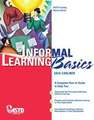
Informal Learning Basics has officially been published by ASTD Press. If you are an ASTD member, you might have received an announcement about the book through email. If not, here’s the notice.Informal Learning Basics explores one of the hottest topics in training today. It describes how training and development and other Human Resources professionals can better harness informal learning. By some accounts, informal learning—in which learners define some combination of the process, location, purpose, and content of learning and may or may not be conscious that learning occurred—provides as much as 70 percent of all learning in the workplace with little or no involvement of training and development professionals. So readers have realistic expectations and plans for the application of informal learning in the workplace, the book first describes how informal learning works and identifies how to use it effectively at key touch points in the life cycle of a job. Then, to help readers harness the power of informal learning, this book describes how readers can support 22 specific types of group and individual informal learning, how social, enterprise and other instructional technologies can assist in those efforts, and how to evaluate informal learning. Each chapter includes exercises that help readers apply the concepts presented in the book and worksheets that readers can use when planning informal learning efforts in their organizations. To find out what type of informal learner you are, check out the next post on this blog. To order, visit http://saulcarliner.blogspot.com/2012/05/order-books-including-informal-learning.html
Saul Carliner
.
Blog
.
<span class='date ' tip=''><i class='icon-time'></i> Jul 14, 2015 09:14am</span>
|
|
"Change is inevitable. Growth is optional." - John Maxwell
This has been a favorite quote of mine for some time… a good reminder to take advantage of the happenings around us and leverage them toward personal or professional development. But looking at it in the context of the 2014 workplace, I’m not sure that the last three words are as true, valid, or helpful as they once were.
In today’s hyper-competitive environment, growth is no longer optional; it’s non-negotiable. Treading water is not a valid strategy in fast-moving business currents. Maintaining the status quo - whether it’s your customer base, technology platform, or skill set - doesn’t keep you even; it actually means you’re moving backward…and fast. This applies to organizations and individuals.
Successful leaders recognize this reality and take conscious steps to make growth a priority… for themselves and those around them. They do it seamlessly by cultivating three key qualities - qualities that support business results as well as professional development: conversation, creativity, and curiosity.
Conversation
As my co-author, Beverly Kaye, and I wrote in Help Them Grow or Watch Them Go: Career Conversations Employees Want, careers are developed one conversation at a time… over time. Frequent, short conversations with employees about strengths, opportunities, interests, and goals are the lifeblood of development. They activate awareness and motivation. They are the connective tissue among events and occurrences, musings and reactions, and insights and action.
Leaders can help others grow by embedding development conversations into the flow of work. Lengthy individual development planning summits may no longer serve the needs of our time-starved environment. So it comes down to finding moments and opportunities for brief - even 90-second - conversations that help others reflect, connect, and grow.
Creativity
Growth is not the exclusive purview of the training department. Smart leaders are creative leaders. They know that powerful development happens organically and they constantly scan the environment for opportunities to make it happen. Where others see work that’s not getting done, they see a learning assignment. Where others see a tough business problem, they see an opportunity to stretch minds and skills. Where others see scarcity, they see a chance to become innovative.
In today’s flatter and more flat-out workplace, learning and development can’t depend upon transfers, promotions, or moves of any kind. Leaders and individuals alike must apply greater creativity to finding in-role assignments, activities, and responsibilities that will provide a stretch and challenge without making a move on the organizational chart.
Curiosity
Depending upon whom you ask, curiosity is defined as a competency, skill, quality, or emotion. It’s the capacity to demonstrate keen interest, an inquisitive spirit, an eager drive to understand, and an appetite for experimentation. And it’s an essential driver of growth and development.
Curious employees find opportunities for growth… and they find growth in the opportunities before them. Curious leaders model the way… asking insightful and probing questions of themselves and others. They take risks, step into uncharted territory, and always ask themselves what can be learned from their experiences (positive and negative).
Conversation, creativity, and curiosity are the key levers enabling growth in today’s workplace. Leaders and employees who value and practice them will find that development naturally follows.
So, no offense Mr. Maxwell… but let’s align your inspiring quote with the realities of 2014:
Change is inevitable. Growth is non-negotiable.
What about you? What fuels your own growth? What can you do to help those around you develop and grow?
The post Growth: It’s No Longer Optional appeared first on Julie Winkle Giulioni.
Julie Winkle Giulioni
.
Blog
.
<span class='date ' tip=''><i class='icon-time'></i> Jul 14, 2015 09:14am</span>
|
|
PresentationEventSponsorDate and LocationFor more Information What’s the Real Scoop on Online LearningThought Leader WebinareLearning GuildDecember 11, 2012www.elearningguild.com Host, Research-to-Practice Day and Presenter, Performance, and Perceptions: Research on Our Evolving RolesCSTD Conference and Trade ShowCanadian Society for Training and DevelopmentOctober 31, 2012www.cstd.ca Keynote Presentation: The Future of the Technical Communication BrandTCANZ ConferenceTechnical Communicators Association of New Zealand (TCANZ)October 25, 2012www.tcanz.org.nz Workshop: A Crash Course in Writing e-Learning Programs TCANZ ConferenceTechnical Communicators Association of New Zealand (TCANZ)October 25, 2012www.tcanz.org.nz Workshop: Practical Tips for Effective, Efficient Projects TCANZ ConferenceTechnical Communicators Association of New Zealand (TCANZ)October 25, 2012www.tcanz.org.nz Webinar. Evaluating Informal LearningASTD WebinarAmerican Society for Training and Development (ASTD) Learning and Development Community of PracticeSeptember 27, 2012http://www.astd.org/Communities-of-Practice/Learning-And-Development.aspx Webinar. Informal Learning Basics: So What Are the Basics?ASTD WebinarAmerican Society for Training and Development (ASTD) Learning and Development Community of PracticeJuly 17, 2012http://www.astd.org/Communities-of-Practice/Learning-And-Development.aspx Keynote Presentation. What the Research Says about Informal Learning (and Implications for Practicing Professionals)International Conference on eLearning in the WorkplaceInternational Conference on eLearning in the WorkplaceOctober 14, 2012www.icelw.org
Saul Carliner
.
Blog
.
<span class='date ' tip=''><i class='icon-time'></i> Jul 14, 2015 09:13am</span>
|
|
(Excerpted from my book, Informal Learning Basics (ASTD Press, 2012.)Before Training and Development professionals can effectively provide and promote informal learning for others in their workplaces, they need an awareness of their own interests in, and preferences for, informal learning. This activity, which is excerpted from the new ASTD Press book, Informal Learning Basics, is intended to help sensitize you to your informal learning preferences.Instructions: Answer these questions. For responses, see the answer key below.1. One morning when you start your e-mail program, everything looks unfamiliar. You quickly notice a special notice at the top of the screen, "We’ve unveiled a new look. Click here to learn more." What do you do first?a. Click where indicated to learn more about the changes to the program.b. Ask the person in the office next to yours to explain what’s going on. c. Ignore the invitation to click here and fumble your way through the interface. d. Sign up for a class to learn about the new e-mail interface.2. You’re the new coordinator of vendors for your department, which has never used vendors before but plans to start using them in the future. To prepare for this new role, what do you do first?Ask your friend in the Purchasing Department what to do.Find the company policies and procedures on managing vendor relationships on the Intranet.Sign up for a class on managing vendor relationships. Start the job and figure things out as you experience them.3. Your partner was recently diagnosed with pre-diabetes and the doctor has urged your partner to start eating a healthy diet. Although you thought you knew what healthy eating was, apparently your daily diet of bran muffin breakfasts and meat-potato-and-salad dinners isn’t producing healthy results. To learn about healthy diets, what do you do first?Continue cooking but remove fat and sugars from the diet. Join a local diabetes support group and ask for help with questions related to diet.Register for the "Diabetes Diet" class offered at the hospital. Visit a website or buy a book with dietary recommendations for pre-diabetes patients. 4. In a meeting this morning, the executive makes several comments related to the company’s most recent annual financial report. You’re embarrassed to admit this: you don’t know how to read a financial report. To correct this problem, what do you do first?Ask your friend in the Finance Department to give you a crash course in reading financial reports.Buy Financial Reports for Dummies at your nearest bookstore—and read it cover to cover.Read the report line-for-line and try to figure out what it’s saying. Take the e-learning course, How to Read a Financial Report, available through the library of e-learning courses in your company. 5. You have accepted the invitation to serve as webmaster for your neighborhood association for the next year. OK, so you have no experience with webmastering. To prepare for this new role, what do you do first?Ask the outgoing webmaster to provide step-by-step instructions.Start your job and figure things out as they arise.Take an introductory course for webmasters through your local continuing education department.Watch a series of videos on YouTube about how to be a webmaster.ScoringCompute your score using Table 1-B.Table 1-B: Scoring the Exercise Assign Points as Follows Tally Points Here 1--a-4, b-3, c-2, d-12--a-2, b-4, c-1, d-33--a-3, b-2, c-1, d-44--a-2, b-4, c-3, d-15--a-2, b-3, c-1, d-4 ______________________________ Total ______ Determine what your score by checking Table 1-C. Table 1-C: Interpreting Your Score If You Scored: You Are a: Which Means that: 5 or below A formal learner You generally prefer formal situations for your learning. 6 to 9 A social learner Although you're able to learn on your own, you often prefer to learn in groups or from other people11 to 14 A go-with-the-flow learner You use a variety of means to learn new skills, sometimes just trying things out to see how well you can perform. 15-16 A self-directed informal learner You develop new skills on your own, but to make sure that you correctly understand them, you frequently refer to outside sources to do so.With this awareness of your own preferences, you can begin to appreciate the different preferences of other informal learners. You can use that awareness to better identify which activities might work with which learners—and which ones won’t—so you can use informal learning to achieve given goals. To more about informal learning, check out the book Informal Learning Basics. For ordering information, visit http://saulcarliner.blogspot.com/2012/05/order-books-including-informal-learning.html.
Saul Carliner
.
Blog
.
<span class='date ' tip=''><i class='icon-time'></i> Jul 14, 2015 09:13am</span>
|
|
Social media has sparked interest in informal learning; the topic is addressed throughout Informal Learning Basics. I recently came across some articles online that clearly and effectively introduce some popular tools. Although the articles are written for members of the academic community, they’re actually valuable to anyone interested in learning more about these tools:Utilizing Pinterest as a Learning Tool by Rochelle McWhorter, published in the June 2012 issue of the Academy of Human Resource Development (AHRD) digest describes the excitement generated by Pinterest—a social bookmarking tool that McWhorter identifies as a "social bookmarking tool" and is the "third most-used social media [sic] behind Facebook and Twitter," then suggests ways that readers might use Pinterest. To see the article (membership might be required), visit http://ahrd.org/displaycommon.cfm?an=1&subarticlenbr=179. Why are you on Twitter? By Liz Meyer and published on the Freire Project blog, explains not only why Meyer uses Twitter, but then proceeds to provide a primer on how to use Twitter. She explains the @ and # symbols, how to organize tweets, and Twitter etiquette. View the blog post at http://www.freireproject.org/blogs/why-are-you-twitter.
Saul Carliner
.
Blog
.
<span class='date ' tip=''><i class='icon-time'></i> Jul 14, 2015 09:13am</span>
|
|
Simon Dudley's blog post was featuredIT and You: Role Reversal and Tech 'Consumerization'Enterprise IT is becoming a commodity. The cloud makes it easy for companies to provide updates and feature upgrades constantly, behind the scenes. As a result, the leaders in every technology category are starting to look the same - all selling the same basic services, all delivered using the same basic infrastructure.Truly, the main difference is becoming how easy technology vendors make it for customers to buy their product and start using it.I predict we can look for more enterprise-grade software and hardware being sold on consumer outlets. Amazon already has at least one listing for a multi-user license of enterprise "web-to-host network management" software. (That’s not even Amazon Web Services. That’s just plain Amazon.)What does consumerization of enterprise technology mean for business - and business workers?Consumerization Has shifted the IT-Worker Balance of PowerThe roles are reversed for IT departments and their customers. IT used to make all network and appliance decisions. Employees or other users had to adapt their way of working to whatever technology they were given.Think about the whole Bring Your Own Device movement. Originally, IT directors held off on integrating tablets and smartphones into their networks. Their argument was that personal devices couldn’t offer the security that businesses need.But the users decided. They demanded personal devices on corporate networks, and it’s happening, almost like fate. Standards allowed it to work, and by and large that was that.So it goes with a lot of technology today. As the Internet has matured, expectations of how and where you can work have changed. You are now just as likely to be in the driver’s seat as the IT department when it comes to choosing the technology you want for work.You’re still the customer, and IT’s still the provider - it’s just that the balance of power has shifted.Cloud Services Let IT departments Put User Experience FirstIt’s not unreasonable any more to expect IT to adapt to users’ technology - much of which is designed for the consumer market. It’s easier now than even five years ago.With Software-as-a-Service and Infrastructure-as-a-Service over the cloud, today’s IT leaders worry less about racks, equipment and networks. They can focus more on meeting user technology expectations. (And users expect to use their consumer devices and applications at work.)Even now, IT departments aren’t necessarily buying "technology"; they’re buying services, and letting consumers bring their own products to access those services.That’s why it’s not much of a leap to conclude that enterprise-class business technology of all kinds should soon be available on consumer shopping sites. Before long, you may be able to purchase sophisticated business collaboration software, the latest New York Times Best Seller and a Billboard Hot 100 album at the same time.You can probably download them all, too.Simon Dudley is the Video Evangelist for LifeSize. He is on Twitter @simondudley.See More
Jeff Fissel
.
Blog
.
<span class='date ' tip=''><i class='icon-time'></i> Jul 14, 2015 09:13am</span>
|
|
For those of you whom are university-level instructors, consider these titles as possible texts for your courses:BookDescriptionSuitable CoursesTraining Design Basics (ASTD Press)This book emphasizes the real-world nature of designing training programs, working with the time and resources available. Yes, trainers have to analyze needs and write objectives (after all, each trainer needs to know what they are training and why they are doing so). But often the time is limited to perform, so this book suggests ways to get the information even if they don’t have the time or access to all of the people who might be helpful. Similarly, although e-learning and other forms of instruction receive much attention in the professional literature, the bulk of training continues to be designed for the classroom. This book makes that assumption, and offers specific suggestions for preparing classroom courses and workbooks. Finally, after designing and developing courses, most trainers have responsibility for the successful launch and running of those courses. This book explores those issues, too, specifically identifying issues in administering, marketing, and supporting courses so that they are likely to be effective. Instructional DesignDesigning Training Programs Advanced Web-Based Training (by Margaret Driscoll and Saul Carliner, Pfeiffer)This book takes instructional designers to the next level in their design journeys. It provides instructional designers, e-learning developers, technical communicators, students, and others with strategies for addressing common challenges that arise when designing e-learning programs. Balancing educational theory with the practical realities of implementation, Driscoll and Carliner outline the benefits and limitations of each strategy, discuss the issues surrounding the implementation of these strategies, and illustrate each strategy with short scenarios drawn from real-world online learning programs representing a wide variety of fields including technology, financial services, health care, and government. Some of the specific design challenges this book addresses include learning theory for e-learning, m-learning, simulations and games, interactivity, communicating visually, writing for the screen, preparing introductions and closings, mentoring and coaching e-learners, and blended learning.Advanced Instructional DesignStudio courses in e-learningAdvanced Technical and Professional Communicatione-Learning Handbook (edited by Saul Carliner and Patti Shank, Pfeiffer)This book is an essential resource that is filled with original contributions from the world’s foremost e-learning experts including Jane Bozarth, Patrick Lambe, Tom Reeves, Marc Rosenberg, and Brent Wilson. The book offers a comprehensive and up-to-date review of the economic, technological, design, economic, evaluation, research, and philosophical issues underlying e-learning. Each chapter includes a chart that summarizes the key take-away points, contains questions that are useful for guiding discussions, and offers suggestions of related links, books, papers, reports, and articles. Advanced Instructional DesignSeminar in LearningTo order and receive more information, either contact your publisher’s representative or visit http://www.amazon.com/Saul-Carliner/e/B001H9RDXU/ref=ntt_athr_dp_pel_pop.
Saul Carliner
.
Blog
.
<span class='date ' tip=''><i class='icon-time'></i> Jul 14, 2015 09:13am</span>
|
|
How similar are technical communication and training? Although some characterize the two as nearly identical, a closer look at their occupational cultures suggests several subtle, but significant, differences exist. My recent article, Different Approaches to Similar Challenges: An Analysis of the Occupational Cultures of the Disciplines of Technical Communication and Training, published in the second quarter 2012 issue of the IEEE Transactions on Professional Communication, explores these differences. Here’s the abstract of the article:Problem: Perhaps it is presumptuous of Technical Communicators to assume that, because some of their skills that might be employed in developing and delivering training materials, that those skills alone are qualifications to work in training, much less the source by which the processes of Training might be examined. Using data from one survey and one interview-based studies of the work of Technical Communication and Training groups, as well as participation on committees responsible for certification examinations for Technical Communicators and Trainers, this tutorial analyzes differences in the occupational cultures of the two fields. Key Concepts: The work differs: Technical Communicators produce content that explains how to perform tasks; trainers produce programs that develop skills that a third party can verify. To do so, Technical Communicators follow a process that emphasizes writing and production; Trainers follow a process that emphasizes the analysis of intended goals and evaluation of whether those goals have been achieved. The guiding philosophy of Technical Communication is usability; the guiding philosophy of Training is performance. Although both disciplines are rooted in cognitive psychology, the primary intellectual roots of Technical Communication are in rhetoric and composition, while the primary intellectual roots are in education. The preferred research methods of Technical Communication are critical; the preferred research methods of Trainers are empirical qualitative and quantitative methods.Key Lessons: As a result, Technical Communication professionals and researchers who want to work in Training should approach the field in a culturally appropriate way by (1) recognizing distinctions between a communication product and a training program, (2) recognizing distinctions in work processes, (3) recognizing distinctions in language, (4) recognizing differences in values and (5) acknowledging that an academic discipline of training exists. To see the complete article, visit http://ieeexplore.ieee.org/xpl/RecentIssue.jsp?punumber=47. (Note: Only free to members of the IEEE Professional Communication Society and to those entering through university libraries with a subscription to IEEExplore.)
Saul Carliner
.
Blog
.
<span class='date ' tip=''><i class='icon-time'></i> Jul 14, 2015 09:13am</span>
|
|
For those of you whom are university-level instructors, consider these titles as possible texts for your courses:BookDescriptionSuitable Courses Training Design Basics (ASTD Press)This book emphasizes the real-world nature of designing training programs, working with the time and resources available. Yes, trainers have to analyze needs and write objectives (after all, each trainer needs to know what they are training and why they are doing so). But often the time is limited to perform, so this book suggests ways to get the information even if they don’t have the time or access to all of the people who might be helpful. Similarly, although e-learning and other forms of instruction receive much attention in the professional literature, the bulk of training continues to be designed for the classroom. This book makes that assumption, and offers specific suggestions for preparing classroom courses and workbooks. Finally, after designing and developing courses, most trainers have responsibility for the successful launch and running of those courses. This book explores those issues, too, specifically identifying issues in administering, marketing, and supporting courses so that they are likely to be effective. Instructional DesignDesigning Training ProgramsAdvanced Web-Based Training (by Margaret Driscoll and Saul Carliner, Pfeiffer)This book takes instructional designers to the next level in their design journeys. It provides instructional designers, e-learning developers, technical communicators, students, and others with strategies for addressing common challenges that arise when designing e-learning programs. Balancing educational theory with the practical realities of implementation, Driscoll and Carliner outline the benefits and limitations of each strategy, discuss the issues surrounding the implementation of these strategies, and illustrate each strategy with short scenarios drawn from real-world online learning programs representing a wide variety of fields including technology, financial services, health care, and government. Some of the specific design challenges this book addresses include learning theory for e-learning, m-learning, simulations and games, interactivity, communicating visually, writing for the screen, preparing introductions and closings, mentoring and coaching e-learners, and blended learning.Advanced Instructional DesignStudio courses in e-learningAdvanced Technical and Professional Communicatione-Learning Handbook (edited by Saul Carliner and Patti Shank, Pfeiffer)This book is an essential resource that is filled with original contributions from the world’s foremost e-learning experts including Jane Bozarth, Patrick Lambe, Tom Reeves, Marc Rosenberg, and Brent Wilson. The book offers a comprehensive and up-to-date review of the economic, technological, design, economic, evaluation, research, and philosophical issues underlying e-learning. Each chapter includes a chart that summarizes the key take-away points, contains questions that are useful for guiding discussions, and offers suggestions of related links, books, papers, reports, and articles. Advanced Instructional DesignSeminar in LearningTo order and receive more information, either contact your publisher’s representative or visit http://www.amazon.com/Saul-Carliner/e/B001H9RDXU/ref=ntt_athr_dp_pel_pop.
Saul Carliner
.
Blog
.
<span class='date ' tip=''><i class='icon-time'></i> Jul 14, 2015 09:13am</span>
|
|
In case you missed the webcast, Informal Learning: What ARE the Basics? here's a link to the slides: http://www.astd.org/Publications/Blogs/L-and-D-Blog/2012/07/Slides-from-Webcast-with-Saul-Carliner.aspx
Saul Carliner
.
Blog
.
<span class='date ' tip=''><i class='icon-time'></i> Jul 14, 2015 09:13am</span>
|