Blogs
|
So often, training is the fall guy when things aren’t going well.
"Our training is insufficient."
"Our employees just haven’t been trained well enough."
"We need more training!"
All of these may be true, but what often happens is oodles of resources are spent on new training or making existing training better, and when it’s all said and done it’s still not clear whether the training had much of an impact. Even if it did drive some improvement in the immediate aftermath, how do you know the improvements are for the long haul? And how do you know you can fully attribute them to the training?
When everything is subjective and qualitative, you can’t. You need to approach training the same way you approach any other business activity. It needs to demonstrably move the numbers. If you’re responsible for educating groups of people, it’s to your advantage to report up the ladder precisely how training has made a positive impact, and numbers are the universal language of the C-suite.
While each organization has success metrics unique to their industry and operations, many are universally useful:
% new business over a period of time
% retained business over a period of time
cost of sales
equipment downtime
repair costs
Of course, there are many more. If we can connect the dots between training efforts and KPIs (key performance indicators) we can prove training adds value and has a direct impact on organizational success.
So how do we do that?
Have a clear objective. We recently discussed the importance of learning objectives and how to create good ones. In order to determine whether training is successful, we have to know what the audience should be able to do after completing it.
Tie that objective to a KPI. If your audience begins doing what they were trained to do, in the way they were trained to do it, what impact would that have? Would repair and warranty costs decrease? Would the percentage of retained customers increase?
Make sure you have a direct, trackable link. The training department won’t always have access to the KPIs their work impacts. Work with a departmental manager who can help you track the numbers to identify success.
Don’t have too many variables.This might not always be within the control of the training team, but the fewer variables during your measurement period, the better. You want to be sure that training is making an impact on KPIs and not another internal initiative.
Training doesn’t have to be like blindly shooting fish in a barrel. It used to be harder to measure, but today’s technology makes it much simpler. It’s a matter of adequate planning from the beginning, and drawing a line from training to the critical KPIs of the organization not only informs the training team of what works, but catches the eye of upper-management and helps secure funding for future projects.
If you’re not sure where to start, get in touch. We can help you establish a clear learning objective and connect it to the relevant KPIs.
photo credit: J. McPherskesen
Expand Interactive Team
.
Blog
.
<span class='date ' tip=''><i class='icon-time'></i> Jul 15, 2015 12:46pm</span>
|
|
This week I’ve been thinking a lot about my participation in social learning activities - which is minimal at best. I want to participate more, but have yet to find the time! In any event, social learning is happening all the time, and it can be an easy way to learn from your peers.
What is social learning?
Traditionally, social learning emphasizes the fact that learning can be social, occurring through observation of behaviours. When I think about social learning, I think more about mobile or micro learning - why? Because social media has created a new venue for social learning. Just think of all of the Twitter chats that are occurring all over the place, or Reddit!
Drawing on the traditional definition, the modern definition might be defined as learning through social interactions where individuals can learn through their interactions in a collaborative and social environment. As in the traditional sense, individuals can learn desirable vs. undesirable behaviours based on reactions, and there is constant reciprocation.
Benefits and implications of social learning
To me, the benefits are obvious - we develop a means of engaging with individuals, socially, and through our interactions determine the ways in which we should (or should not) be engaging with individuals. However, social learning can be a double-edged sword. Just think of critical periods of development - teenagers make a great case study. In situations where individuals want to ‘fit in’ or feel popular, they may assume undesirable behaviours, mimicked after other individuals who are performing these behaviours (within the shared social sphere). Another example is the bystander effect - individuals don’t stop to help someone who appears to be in need of help, because they see others continually passing by, and assume that someone else will come to help.
So, social learning can certainly be a good thing, especially where micro learning is concerned, but it can also be a bad thing - as most things are capable of.
Resources
Instructionaldesign.org’s explanation of Social Learning Theory
Sense of Acceptance: Key Factor of Social Learning by H. Kawamichi, K. Yoshihara, R. Kitada, M. Matsunaga, A. Sasaki, Y. Yoshida, H. Takahashi, and N. Sadato
Social Learning in a Human Society: An Experimental Study by M. Hamdi, G. Solman, A. Kingsotone, and V. Krishnamurthy
The Role of Social Learning in Understanding Deviance by T. Rajasakran, S. Sinnappan, and S. S. Raja
Ashley Chiasson
.
Blog
.
<span class='date ' tip=''><i class='icon-time'></i> Jul 15, 2015 12:46pm</span>
|
|
"How much material can be covered in an eLearning module?"
We’re asked this question a lot. Many clients come to us with existing live training they’re considering converting to eLearning and need to understand how that would work.
Folks are often amazed at the time savings you get from doing a training in an on-demand format. It’s a fraction of the time it takes to do a live training, but the question is, what is that number?
We’ve found a simple formula you can use to estimate live-training-to-eLearning conversions. Here it is:
½ day of live training = 20 minutes of eLearning
Wondering how that’s possible? Here’s how are we able to compress four hours down to twenty minutes:
Eliminate distractions, allowing learners to view training where and when they are ready. They aren’t forced into it when they’d rather be doing something else.
Eliminate the added commentary, tangents and questions that always come with a live, classroom-style session.
Delivery becomes more concise and concepts can be explained more succinctly.
The pace is faster because learners can singly focus on what’s in front of them.
Repetition is built in because you have multiple learning modes at once and users can repeat sections as they wish.
No coffee breaks or bathroom breaks! These can take a lot time and it’s tough to get everyone reassembled and focused.
Something that would take employees out of their jobs for a week could essentially be taught in half a day, and they would have the option of viewing everything at once or breaking it up over the period of time that works best for them. Which is a better use of their time and your organization’s resources?
But Is It Effective?
Without a doubt. Not only is there a sizable cost savings over time—which we can help you calculate—but the flexibility and concise delivery leads to better retention.
In fact, we’ve spilled a lot of words on this blog explaining why eLearning is the best choice for training and knowledge sharing, so we don’t want to rehash too much. Instead, take a gander at a recently published infographic with compelling statistics favoring eLearning over other types of training delivery methods.
A Word of Caution - Condensed Content Has to Be Good
Not only is eLearning more efficient and cost-effective, employees appreciate the added flexibility and time saving, however, it’s unwise to assume that condensed training alone will improve buy-in and participation. Even a twenty minute training piece must be engaging and interactive. Audiences can be lost in five minutes without expert instructional design and high quality production effects.
Check out one of our work samples to see how we not only condensed material into an easily-consumable piece, but made it interactive and engaging.
photo credit: nan palmero
Expand Interactive Team
.
Blog
.
<span class='date ' tip=''><i class='icon-time'></i> Jul 15, 2015 12:45pm</span>
|
|
In light of recent events, I figured it might be appropriate to discuss some terminology I was introduced to during my graduate program - critical consciousness.
Critical Consciousness
Paulo Freire was heavily involved in discussions and research related to social relations, and indicated that dominant social relations or statuses were more often than not directly correlated with a culture of silence, wherein individuals at a lower social relation or status feel oppressed by the the inability to speak up or be heard. This realization is classified as "critical consciousness" - the individual realizes that the dominant social relations are creating this culture of silence. Now, I don’t necessarily think this is true in today’s society - folks seem to be a lot more outspoken than they once were, but there is still oppression occurring everywhere. Most of us likely encounter at least one small inkling of it every single day.
Critical consciousness is an educational concept that involves having a critical understanding of the world around us, including the social justices and injustices (or the contradictions therein), and being able to take action based on your understanding to construct or move toward positive social change and reducing oppression.
Resources
I encourage you to research more about critical consciousness; it’s certainly a higher-level of thinking than we do most days, and I implore you to become empowered to do something within your community to move toward positive social change.
Critical Pedagogy and the Knowledge Wars of the Twenty-First Century by J. L. Kincheloe
Centering Love, Hope, and Trust in the Community: Transformative Urban Leadership Informed by Paulo Freire by P. M. Miller, T. Brown, and R. Hopson
Humanism and Multiculturalism: An Evolutionary Alliance by L. Comas-Diaz
Towards a Framework of Critical Citizenship Education by L. Johnson and P. Morris
Ashley Chiasson
.
Blog
.
<span class='date ' tip=''><i class='icon-time'></i> Jul 15, 2015 12:45pm</span>
|
|
The Expand team is grateful for pumpkin pie, strong coffee and our blog readers! (That's you!)
Enjoy this funny clip from Joey "How You Doin'" Tribbiani.
photo credit: Sugar Daze
Expand Interactive Team
.
Blog
.
<span class='date ' tip=''><i class='icon-time'></i> Jul 15, 2015 12:45pm</span>
|
|
This week’s challenge was an easy one, which is probably why Im able to participate - hooray! Thank you, David!
The Concept
This week, the challenge was to design a poster, infographic, or list to share top tips with e-learning freelancers. As an e-learning freelancer, this challenge seemed right up my alley.
The Method
Well. First, I got a little ahead of myself and mistook it for Instructional Design tips and created a poster related to one of my very favourite quotes from a less than favourite military reviewer (and I say that jokingly…kind of) - "Bullets are too verbose."; the take away from that comment was to be more concise…which is tricky when you need to include sections of military publications verbatim into your courseware. GAH. That being said, I like to pride myself in being fairly concise within my e-learning projects.
Once I admired my handy work, I realized my mistake and began racking my brain for freelance tips. I thought this would be a lot easier than it was because 1) I’ve been an e-learning freelancer for several years now, 2) I’ve learned a lot about small business in this past year, and 3) I’m writing a book that’s almost related directly to just that. However, my brain was apparently converted into mashed potatoes last night and it took me several hours to come up with something worth recommending to other e-learning freelancers.
The Result
First, I’ll share my Instructional Design tip:
Next up, my top tip for e-learning freelancers:
Scope creep is a very real thing, so you should definitely heed my advice. I would also recommend having an air-tight contract. It’s always nice to go above and beyond for your clients, but you don’t want to give away the farm!
Ashley Chiasson
.
Blog
.
<span class='date ' tip=''><i class='icon-time'></i> Jul 15, 2015 12:45pm</span>
|
|
We’re 23 days away from Christmas, folks. Now, wait, before you start groaning and throwing tomatoes at me, I’m here to help! If you’re in the thick of holiday shopping and have some gifts left to pick up—or maybe want to pass along some ideas for yourself!—allow me to offer some suggestions!
A quick poll of the Expand gang produced the following collection of gift ideas for that techy special someone in your life. Take a gander!
For the Early Adopter
Amazon Echo After first watching Amazon’s promotional video for the Echo, I was immediately reminded of Vicki from Small Wonder. This is essentially like having a robot in your house, minus the walking around and startling the neighbors. Echo recognizes voice and speech so it can answer questions, make lists, play music and more.
Where to Get It: It’s available on Amazon’s website. There is a waiting list and special pricing for Amazon Prime members. $199 regular price, $99 Prime for a limited time.
For the DIYer With an Affinity for Clever Design
USB Outlet One of those great ideas you see on Pinterest, you can upgrade the outlets in your house to include a USB port for charging mobile devices. They sure can take up a lot of outlets!
Where to Get It: This item should be available at most hardware/home improvement stores; we found it at Home Depot for $27.99 each.
For Kids of All Ages
Hubsan X4 Quadcopter With HD 2MP Camera This remote control helicopter (or, for the less informed like myself, quadcopter, meaning there are four propellers) has two settings so it adapts to both amateur and advanced remote pilots. Famous for its precise control and attached HD camera, this is sure to be a hit for all the toy lovers in your life. Just don’t be a creeper and spy on your neighbors.
Where to Get It: Available on Amazon for 65% below retail at time of writing. $64.99
For the Music Lover
Wireless Headphones The days of spotting music lovers by their white Apple earbuds are numbered, as new, fancier options have flooded the market with great sound quality. Check out some of the wireless options, which you can get either in bud- or on-ear- format. Our Project Manager, Jess, has her eyes on a pair of Beats by Dre!
Where to Get It: Anywhere audio electronics are sold. These Powerbeats2 by Beats by Dre are $199.
For the Runner
Wireless Sports Headphones: Athletes and gym rats have special needs when it comes to listening to their jams during a workout. Headphones need to be durable and sweatproof, as well as weather-resistant, comfortable and secure.
Where to Get It: Your best bet is to look wherever athletic equipment is sold. We found these Yurbuds Liberty Wireless Earbuds on REI.com for $99.
For the Kids
Anki Drive Part video game, part remote control car, the Anki Drive Starter Kit gives you a racing track and 2 cars to get started. Download the corresponding app to a compatible device, like an iPhone, and that device becomes a remote control for the cars.
Where to Get It: The Starter Kit can be ordered right from the Anki Drive website for $149.99.
For Grown Ups
iPad Air 2 Apple’s latest iPad model is, of course, thinner, lighter and faster, making it even more convenient and eBook-friendly. It also boasts the best screen resolution, processor and battery than any model before it.
Where to Get It: If you buy it from the Apple store, you can have it engraved on the back for free. Nice to include an email address or phone number in case its ever misplaced and an honest person finds it. Models start at $499.
For the TV and Film Lover
Google Chromecast The Chromecast looks like a USB storage device, only it connects to the HDMI port on your TV and allows you to send any media from your laptop, tablet or smartphone to your TV screen. Chromecast apps include NetFlix, YouTube, Pandora, HBO Go and more.
Where to Get It: Anywhere small electronics are sold. $35 does not include subscriptions.
For the Biker/Adventurer
Garmin Edge Bike Computer Much more than a GPS, the Garmin Edge tracks and analyzes data from your rides. It also lets you connect and share with friends, is weather-resistant and has a handy touch screen.
Where to Get It: Anywhere sporting equipment or small electronics are sold, or you can order online from Garmin.com. $599.99
What's on your list this year? Leave us a comment below, and happy shopping!
photo credit: alli ♥
Expand Interactive Team
.
Blog
.
<span class='date ' tip=''><i class='icon-time'></i> Jul 15, 2015 12:45pm</span>
|
|
This week I’m going to talk about a term that a lot of folks find useful. I don’t really classify myself in that category of folk, but occasionally I can see the use in a mind map. I think this is because I often work alone and end up brainstorming with myself, so there’s really not a lot of point for me to visualize that for myself.
What is a mind map?
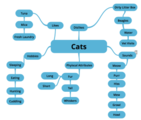
A mind map is essential a brainstorming session. Mind maps allow you to visually organize your ideas and are typically centred around one theme or concept. Remember when you used to brain storm in grade school? You would write down one central concept in the middle of your page and then draw lines coming from that central concept with related terms or concepts? It’s kind of like a visual word association. To illustrate the concept of a mind map, I drafted one for you:
Here, I have the central concept of cats (because 1 - I’m a crazy cat lady, and 2 - as I type this, I am being sandwiched between two) and from there I have sub-categories such as: sounds, physical attributes, hobbies, likes, and dislikes. From each of these sub-categories, I have listed related items that come to mind when I think of cats in relation to that category.
You can probably see how a mind map could be helpful, especially if you’re attempting to come up with a coherent e-learning module; in one of the workshops I participated in over the past year, we did a mind map to come up with some elements for a course. This type of mind map included a central topic, and from there we identified colour schemes, fonts, sounds, feelings the course might evoke, etc.
Outside of e-learning, mind maps can be useful for any project, especially if you’re working in a group. They allow for collaboration and can be effective when it comes to decision making and identifying what does and does not work with the central concept.
Intrigued? Here are some resources:
ExamTime - Create your own mind maps!
Top 5 Ways to Use Mind Maps For E-Learning by Andrea Leyden
Designing with Mind Maps by Connie Malamed
Case Study: Transition to the Next Generation of E-Learning: Using Mind Mapping and Accessible Web Pages as Part of a University’s Academic Staff Training by Anne Dickinson
Ashley Chiasson
.
Blog
.
<span class='date ' tip=''><i class='icon-time'></i> Jul 15, 2015 12:44pm</span>
|
|
Last week I spent some time working on a silly little Storyline project: Artie’s Christmas Surprise, and today I’m ready to share a little bit about it.
The Concept
I downloaded this rad set of Dog Infographic objects from Creative Market awhile back, and figured I had to use them for something, so I came up with a little story about Artie a dog who just became a single-parent and is strapped to come up with gift ideas for his 8 pups as the holidays fast approach. The pups get to play a little game of puppy plinko to determine their gifts, and then I link out to several of my favourite charities to donate to over the holiday season. There’s poop involved - I told you it was silly.
The Method
Inspired by the infographic set and some other icons (that I can’t quite remember where I downloaded them from…), I came up with the story. I sourced some audio and modified Artie a bit to suit my purposes.
On the intro slide, we meet Artie. He has a little oof and a wagging tail (created using motion paths).
On the second slide, we learn about Artie’s current situation, which makes use of some animations and audio.
On the third slide, we learn about Artie’s monthly income and expenses, using several of the infographic icons, a ton of animations, and A LOT of kibble (amen to grouping objects)!
On the fourth slide, we see that Artie has decked himself out in holiday cheer and come up with a great idea - puppy plinko!
On the fifth slide, the pups are all set up for puppy plinko - I mocked up the plinko board based on the ever popular game show game, and controlled all of the plinko chips (albeit their addresses were forced and not dynamic) using motion paths. I also added states to all of the pups and created some variables so that the slide would advance only after all pups had been visited and only after all of the motion path animations had been completed and changed to a value of True.
On the sixth slide, we see how Artie did with all of his gifts.
On the seventh slide, we link out to some charities, using buttons and hyperlinks.
I also created custom navigation buttons because I’m not the biggest fan of the default ones.
The Result
I think the result was pretty darn cute and it made me laugh (and simultaneously feel delirious), so hopefully it can garner a chuckle out of you!
Click here to view the full demo.
Ashley Chiasson
.
Blog
.
<span class='date ' tip=''><i class='icon-time'></i> Jul 15, 2015 12:44pm</span>
|
|
For those of you wondering how I set up the Puppy Plinko interaction for Artie’s Christmas Surprise, I decided to do a video demo (below).
First, I added a visited state to all of the pups, then added a trigger to each oval that would change the state of the appropriate pup to visited when the animation for the oval’s motion path was completed.
Then, I added a True/False variable for each oval, and added a trigger to each pup to adjust the variable of the oval to True when the motion path animation for the oval completed.
Finally, I added a trigger to Jump to next slide once all pup states were visited AND all ovals are True.
Confused? Yeah - I know. I’m sure some of you guys would have done things differently, but if you want to hear my sometimes confused ramblings about how I set up Puppy Plinko (or if you need more information), check out the video below:
Video Demo - Artie from Ashley Chiasson on Vimeo.
Ashley Chiasson
.
Blog
.
<span class='date ' tip=''><i class='icon-time'></i> Jul 15, 2015 12:44pm</span>
|