Blogs
|
Ellen Adolph is a "Teacher With Habitudes." Ellen Adolph teaches third grade at Woodward Academy, a school that values all Habitudes! She finds it rewarding to watch students learn life skills such as independence and responsibility. These lessons require self-awareness, perseverance, and adaptability sprinkled liberally with curiosity and imagination. She and her students travel a journey together as thinkers, problem solvers, and life-long learners.
Who doesn’t love third graders? They are the genuine article when it comes to learning, and I hoped to make our classroom the perfect playground for collaborative skills. Collaborative learning has always been part of many projects in my room. Previous years’ experience has shown that group tasks improve with every project, and our most successful collaborations didn’t usually take place until winter-spring. I was hopeful that with a new focus and lots of practice, we could build some momentum earlier in the calendar. So many life skills and Habitudes are the framework for successful group work.
The first step would be to first establish our classroom climate via class rules. The first week of school we spent time three, 45-minute periods at our class "Think Tank." This is a meeting area where we use giant tablets, clipboards, and sticky-notes to meet and think "aloud." Students brainstormed and created their rules, and we modeled "what these rules would look and sound like." It would be important to use an important lesson learned from Debbie Miller and Angela Maiers: the need to model the obvious. The kids had great fun modeling good and bad examples of listening or being considerate of classmates, and those activities were important to establishing class boundaries. We spent lots of time modeling different classroom skills and routines that would be important to successful group work. We were on our way as one large group to begin working in smaller groups with some very specific tasks.
Many lessons lend themselves easily to working in groups. Whether it’s sorting spelling words to rules or using manipulatives in math, there are often opportunities to practice collaboration. I provide ample time for questions so students are clear on the project at hand, and I use a giant Smart Board timer reminding children of time left in a task. We distinguish daily seat assignments from our "5 groups" or "3 groups" which yield improved productivity. The first half of the year, groups are purposefully organized to provide a balance of weak and strong, girl and boy. Our first group experiences provided successes and pitfalls, and we discuss examples of both. Time is never enough as group activities take longer than more traditional instruction. After these first activities, I know the children are ready to grow with some more challenging collaborations.
Using the children’s group learning experiences to date, (week 8) we met at the Think Tank to reflect on our group work. I asked them, "Why do we work in groups," and their answers reflect some astute points for third graders. Answers include, "it’s important to learn to cooperate and work with others," "we learn about new friends," and "to get excited about something new." One child made a connection to the fact that, "Our parents are in meetings at work all the time. That’s how adults discuss work." My favorite answer was, "You cooperate with each other and use teamwork. And when you appreciate each other you work harder." Wow.
Next, we talk about what successful group work looked like and sounded like. The kids began pouring out observations. The trending answers used the words talking and listening. Another important category was fairness. This included how groups decided who did what task or deciding on a path for the solution to a problem. Even if the children weren’t 100% successful at a collaborative task, they knew most steps to getting there.
Over the next weeks, using our novel Ramona Quimby, Age 8, the children practiced more challenging collaborative learning tasks. With our focus on developing stronger sequencing skills, the children worked in "5 groups" to sequence several chapters of the book. The first assignments were choppy with some disgruntlement about roles, but the sequencing was great. By the time we finished the book, they were pros. Our culminating activity for the novel was a literature circle. In their "3 groups," the children answered very open ended questions based on the novel. They were encouraged to present their answers using any creative format. They were efficient with deciding what they would do and collecting materials to start. Every group had a detailed plan, and four of the six groups decided on a script to help them be more organized. They were doing great!
The day of their presentations, I was so proud of their efforts. The class was engaged and attentive to their classmates’ work. Four of the five groups hit a home-run with their presentations. (The previous planning day, despite redirection about not being "on task," one group had decided to change their presentation, but all did not agree. One student worked, one pouted, and the third was just being silly. They learned important lessons about making group decisions and about trying to work together to solve a problem.) I could not have been more pleased with the thoroughly done work on a challenging task so early in the year.
So, where are the Habitudes in all this? Several Habitudes are the foundation skills for these collaborative tasks. With all our tasks, flexibility and adaptability are key pieces that third graders practice all year long. With the literature circle tasks, we saw curiosity and imagination. One group wanted to be a "living" advice letter to Ramona and asked to see how an envelope is folded so they could make a giant one as a costume. Excitement and passion are evident in the lengths the children went to show how much they understood Ramona and her problems. Courage was evident in accepting what your group decides even if you’re not completely in agreement. Courage was very evident with one child taking a huge step and donning a costume he was not comfortable about wearing. This child got over his hesitation and wore the envelope for his classmates. That’s live courage!
I am so excited about the progress my class has shown in only 10 weeks of school. I am even more excited about the life-long Habitudes my third graders are learning!
Angela Maiers
.
Blog
.
<span class='date ' tip=''><i class='icon-time'></i> Jul 16, 2015 09:37am</span>
|
|
Research by cognitive psychologists has suggested that motivation is often based on fundamental human needs, and that all are critical in factors in everyday life, such as job satisfaction, effective reward systems, team performance, and goal persistence.
Audio file: http://www.zenzebra.net/podcasts/motivation1-nash.mp3
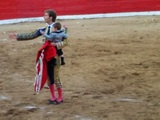
Bullfighter & son. What motivates people? Each person is different. (
Susan Smith Nash
.
Blog
.
<span class='date ' tip=''><i class='icon-time'></i> Jul 16, 2015 09:37am</span>
|
|
Jessica Parsons is a "Teacher with Habitudes." Jessica Parsons, a 7th grade Life science teacher, uses strategies and brain-based learning approaches to connect student interest to the core content. She strives to make science fun, engaging and relevant, while challenging students to think critically and make connections between the content and their everyday life experience.
Ralph Waldo Emerson said, "A man is what he thinks all day long."
In July, I had the great pleasure of attending one of Angela’s workshops, "You Matter: 2 Words Changing Learning and Lives," at the BLC12 in Boston. I was inspired by her talk and one of the keynotes asserting we, as educators, should re-examine "what we do in the first five days." A student-centered focus versus a content-centered introduction felt like the appropriate way to acclimate my new middle schoolers! Throughout the first five days, we discussed and evaluated the some of the characteristics of an effective learner.
Mid-August came quickly and the anticipation for the new school year mounted. The Self-Awareness chapter from Classroom Habitudes was the perfect guiding map. And on the first day, as the students nervously settled in their seats, I stressed that the first five days were going to be all about them. We discussed that "self-aware learners know how they learn best; are able to recognize their strengths and weaknesses, and most importantly, they monitor and control their own learning process" (Maiers, p. 55).
We, first, did a student search game so students could meet and greet the other learners they would collaborate with throughout the year. With a bingo-type worksheet in hand, students had to introduce themselves and ask several questions of each other to earn points. New students, and even shy students, were engrossed in questions and conversations amidst students that have known each other since kindergarten.
The next day, we began the conversation about effective learners. Students brainstormed ideas and posted to prompts about champion learners using Polleverywhere.com. We then discussed the research of Dr. Carol Dweck and value of a growth mindset, especially when our 7th graders are faced with the new and various challenges the Middle School has in store for them. Through a self-assessment, students discovered where they fell on the mindset spectrum. The Mindset graphic, by Nigel Holmes, also gave a visual summary about the fixed vs growth mindset and essentially describes how one can move from one mindset to the other.
It’s important for students to understand the anatomy and physiology behind the psychology. So we analyzed the article, "You Can Grow Your Intelligence," (NAIS). If students have a growth mindset, they apply effort in order to grow and persist through challenges. Our efforts and practice can literally change the physical connections of our neural pathways.
To help students further understand who they are as learners, we completed a learning style and preference quiz. Although it was not a comprehensive test meant to box students into categories, many felt the results rang true in summarizing their preferences and when they would be most productive while learning. My students seemed to appreciate the insight to their learning styles and how style-based strategies may be helpful when learning across all content and in co-curricular activities. Then we created a living document of Active study strategies for the various types of learning styles through a crowd-sourcing activity using iTouches. I urged the students to revisit this list when having to learn each night to find the study skills that would best suit them. Lastly, the students searched for the Characteristics of a Champion Learner (p.54) through a QR code scavenger hunt.
Hopefully, this established a foundation of familiar vocabulary, introspection, and expectations, as we continue this discussion throughout the year. Their success and confidence begins with a better understanding of themselves. And by explicitly having the conversation at the start of the year, I hope I conveyed my genuine interest in their success and that I value their differences as learners.
Angela Maiers
.
Blog
.
<span class='date ' tip=''><i class='icon-time'></i> Jul 16, 2015 09:37am</span>
|
|
Countries and communities that have the good fortune to be near areas of biodiversity and beautiful beaches, mountains, rivers, fields, and forests often cite nature tourism as a key strategy for preserving the integrity of natural resources and alleviating poverty. In doing so, they integrate conservation and development programs, and try to avoid the pitfalls that are often associated with
Susan Smith Nash
.
Blog
.
<span class='date ' tip=''><i class='icon-time'></i> Jul 16, 2015 09:37am</span>
|
|
Love this great post from the folks at Always Prepared entitled: ‘The 7 Habits of Highly Effective Teachers Who Use Technology‘ and the infographic it inspired from Mark Bates. Both highlight "The Habitudes" of educators who are effectively using technology to enhance and impact teaching and learning. Hat tip to Shawn McCusker for this awesome Twitter find!
Angela Maiers
.
Blog
.
<span class='date ' tip=''><i class='icon-time'></i> Jul 16, 2015 09:37am</span>
|
|
Imagine a group coming together to plan a new pet adoption center. They're working together as a team, and this project has a lot of moving parts, which include everything from the financing, design, permits, publicity, health and safety protocols, to finding the key personnel to make sure it's a sustainable enterprise.
The planning process is also a learning process, and it requires a clear
Susan Smith Nash
.
Blog
.
<span class='date ' tip=''><i class='icon-time'></i> Jul 16, 2015 09:37am</span>
|
|
Anne Weidert is a "Teacher with Habitudes." Anne Weidert is a third grade teacher at Woodward Academy’s Primary School. She teaches a self contained class of children who have special needs. She feels that the classroom habitudes empower her students to be more confident and passionate learners. She is excited to be a teacher of the Habitudes.
My goal is to let my third grade students know that they matter. Not only do I blatantly tell them "You matter," I make sure they understand that they are important to the world and to the work that we do every day in our classroom. When someone it absent, it matters! We miss their important contribution to our learning. We talk about how important being here and working hard every day is to become a passionate amazing learner and citizen of the world.
We also focus on one of the first things Angela talks about in Habitudes that success in the 21st century requires. "Understand your strengths and the discipline needed to improve your weaknesses." In my class that is made up of eight third graders, all of whom have special needs, we hear "I already knew that" and "I did that last year" when it is clear that they have not learned the concept and need much more work in the area. We talk about how every one of them has strengths and are very good at many things. However, we also need to recognize there are things we DON’T know and that those will take hard work and determination to master. We talk a lot about the fact that everyone has weaknesses they are working on. To improve them it takes discipline and focus.
Since we had been more generally talking about Angela’s ideas and not specifically concentrating on the Habitudes, I decided that we should do a lesson where we talked about the meaning of each of the Habitudes. I quickly found that my third graders did not know the definition of any of the words! The lesson I had planned to improve knowledge of the Habitudes ended up being a vocabulary exercise as well! We worked through what each one meant, we looked at the posters I found on her website and read definitions from the Habitudes book. Then, each child made a poster for one of the Habitudes with a picture that somehow related to that Habitude. Some are more loosely related that others but I think my students generally understood the idea behind the Habitude they chose. I am looking forward to many more Habitudes lessons and focusing on each of the geniuses in my class.
Angela Maiers
.
Blog
.
<span class='date ' tip=''><i class='icon-time'></i> Jul 16, 2015 09:36am</span>
|
|
Jenni's new approach for processing water from oil and gas wells was announced on the very same day that the Oklahoma Geological Survey stated that injecting produced water was causing the dramatic increase in damaging earthquakes in Oklahoma. So, her new approach was viewed as a potential solution to the problems.
Because Jenni's approach was so practical, a large number of people were
Susan Smith Nash
.
Blog
.
<span class='date ' tip=''><i class='icon-time'></i> Jul 16, 2015 09:36am</span>
|
|
This is why I LOVE, LOVE, LOVE TED talks and believe them to be one of the best sources on the web for learning, leadership, and personal development. Where else do you have access to the worlds most inspiring, informative, ingenious and innovative people talking about how they are going to do to change the world?
John Boswell — has created the "Symphony of Science" videos. Not to talk, but to listen and remix. Hear his mix of TED2012, with some classic TED moments mixed in.
http://www.youtube.com/watch?v=vDHET3aCI2U
Happy Monday!
Angela Maiers
.
Blog
.
<span class='date ' tip=''><i class='icon-time'></i> Jul 16, 2015 09:36am</span>
|
|
Rubén Darío’s (1867-1916) work spanned many years, and it contains very distinct themes. One of the most popular deals with the sense of the ineffable, the impossibility of explaining the human condition. In many ways, his work predates the sense of "thrownness" described by German philosopher Martin Heidegger.
In fact, Darío’s intensity has Romantic roots, although his prosody is firmly
Susan Smith Nash
.
Blog
.
<span class='date ' tip=''><i class='icon-time'></i> Jul 16, 2015 09:36am</span>
|