Blogs
|
There are many ways to learn, and one of the most dramatic approaches to situated, experiential learning is a field seminar or field trip. Welcome to an interview with Jason Terrell, Talent Attraction Manager, US University Relations, BP, who discusses BP's "Ultimate Field Trip Experience."
Q: What is the BP UFT competition?
The Ultimate Field Trip is a two-week global experience
Susan Smith Nash
.
Blog
.
<span class='date ' tip=''><i class='icon-time'></i> Jul 16, 2015 09:39am</span>
|
|
For the past several weeks, I have been preparing a series of workshops for school and community leaders who are ready to embrace social media and explore the powerful ways new social technologies and platforms can be used in classrooms and schools.
As I outlined, re-outlined and tweaked the schedule trying to craft the "perfect" day, I kept coming back to how I could frame the conversation beyond the content of the day and show how much it means and will mean for a leader to make a commitment to this work.
I wanted to share the following message not only to those attending the sessions, but to all school leaders ready to jump in and move their district and their communities to the next level.
Dear Leader,
First, let me say I’m thrilled that social media is on your radar as something you realize requires studying, experiencing and investigating. I’m ecstatic that you aren’t looking at social media as something that can be taught in one or two quick workshops or handed over to a third party that you hire to run your schools website or Twitter account.
I say these things with gratitude and as I know many of your colleagues still do not quite get why you are taking time off school to go "mess around with apps" and sign up for those "time-wasting sites" like Facebook and Twitter. I know you encounter many leaders, in and out of our field, who are not willing to ask the questions that you are asking
Questions like: (HT to Scott McLeod)
What can we do to increase the cognitive complexity of students’ day-to-day work so that they are more often doing deeper thinking and learning work?
What can we do to better incorporate digital technologies into students’ deeper thinking and learning work in ways that are authentic, relevant, meaningful, and powerful?
What can we do to give students more agency and ownership of what they learn, when they learn, how they learn, and how they show what they’ve learned?
What can we do to build the internal capacity of both individual educators and school systems to be better learners and faster change agents?
As we move toward more cognitively-complex, technology-suffused learning environments, how do we bring educators, board members, parents, communities, policymakers, and higher education along with us?
As we move toward more cognitively-complex, technology-suffused learning environments, how do we ensure that traditionally-underserved student and family populations aren’t further disadvantaged?
As we move toward more cognitively-complex, technology-suffused learning environments, what individual and societal mindsets - and local, state, and federal policy supports and/or barriers - need reconsideration?
What can we do to better recognize and assess when students’ deeper thinking and learning work is (or isn’t) occurring?
So getting to our agenda, our efforts this day are not only about how and in what ways you will use social media, but how you as a leader, a powerful and emerging brand, will discover a new level of leadership and learning capacity.
What do I mean by that.
You understand and embrace that you are the face of your school and represent the values and traditions that it is known for. Aside from that, YOU are a brand that represents brave and bold leadership. Who you are and what you model as a leader and learner can inspire and empower those you lead and serve. You have made the commitment to "TO BE" the change. By "going first" you are now in a position to say: I understand. I have been there. I know exactly what your feeling. Here’s what helped me.
Together we will spend a day exploring amazing tools and platforms, and more importantly how we can elevate and extend their use to:
Improve Relationships
Increase Productivity
Save Time and Money
Shoulder Burdens and Ease Insecurities
Work Smarter and Happier
STAY PASSIONATE
This will not be an easy day. You will find your self feeling overwhelmed, saturated with information and wondering how you are going to make sense of it all. It’s okay, because you do not have to make sense of it all. You have a network waiting to help you do exactly that. Leadership is lonely, and I can assure you that attempting this road alone is not a path I would recommend.
I am so looking forward to learning from you and beside you. I welcome and am energized by the challenges ahead and take comfort in knowing that I too am not going it alone.
Your Guide in Real Time!
Angela
Lets Do This R.I.G.H.T.
Getting technology r.i.g.h.t from Angela Maiers
Angela Maiers
.
Blog
.
<span class='date ' tip=''><i class='icon-time'></i> Jul 16, 2015 09:39am</span>
|
|
Creative writing, literature, as well as highly personal writing are catalysts in e-learning because they have the capacity to engage deep emotions. Welcome to an interview with Franklin Lafayette King, whose writing is haunting, emotionally compelling, and emotionally engaging. He has also been a trailblazer in elearning, pushing the envelope with technology and also emotionally-engaging,
Susan Smith Nash
.
Blog
.
<span class='date ' tip=''><i class='icon-time'></i> Jul 16, 2015 09:39am</span>
|
|
Happy Monday Friends!
I am excited to announce a new schedule for my blog, one that is sure to inspire and inform.
Teachers With The Habitudes is a new blog series celebrating and chronicling the learning and lives of talented educators from across the globe seeking to equip their students with the skills and strategies demanded in the 21st Century world and workforce.
When I started working on the first version of Classroom Habitudes, the 21st Century skills debate was in full swing. Despite numerous white papers, acts of legislation, and newly mandated curriculum, there was little practical application of how these lessons would actually look and feel inside real classrooms.
I set out on a quest to outline explicitly what lessons and conversations around the Habitudes of Curiosity, Imagination, Perseverance, Courage, Adaptability, Self Awareness and Passion looked and sounded like for teachers and students.
Four years and hundreds of lessons later, we have concrete examples of examples of schools, leaders and educators that have committed to implementing the Habitudes and can point to positive learning outcomes as a result of their passion and efforts. I am honored and thrilled to share their successes with all of you.
Every week on the blog, we will showcase a Teacher With the Habitudes. Through their story, you will see how and in what ways these lessons can be successfully integrated and implemented in your school and community.
For those of you new to the Habitudes, the following resources and ideas can get you started:
Click here to READ A SAMPLE CHAPTER and first hand how the lessons are organized.
If you are ready to see more, check out the HABITUDES RESOURCE WIKI.
Download any of the following FREE REPRODUCIBLES to help you in your lesson planning and implementation efforts.
These reproducibles include handouts to copy and share, as well as forms you can fill in electronically.
Defining the Habitudes
Definitions and Descriptions of the Habitudes
Dream Team Members
General Habitude Reflections
Genius Questions
See ALL REPRODUCIBLES FOR THE HABITUDES HERE.
You can ORDER YOUR OWN COPY NOW and explore first hand the over 60+ lessons and strategies.
This will be an interactive series so come back often to read the latest post, comment with your own stories and ideas and check out the latest lessons and ideas. And if YOU have the Habitudes, I would love to hear from you.
Share with us how your lesson went, how you customized it for your students, and what secret sauce you added to make it even better. Just follow the Guest Post Submission Guidelines and share your genius with the world!
For a complete list of the posts in this series, click the "Teacher With The Habitudes" tab on the right sidebar.
Angela Maiers
.
Blog
.
<span class='date ' tip=''><i class='icon-time'></i> Jul 16, 2015 09:39am</span>
|
|
Werewolves that feed on corpses in old cemeteries, shape-shifting creatures that kidnap children and turn them into dunces, and an Incubus creature that can slip in during siesta impregnate sleeping young women -- these are just a few of the very interesting Paraguayan mythological figures that populated the classic 90s television series, Sombras en la Noche. A stunning commercial success when it
Susan Smith Nash
.
Blog
.
<span class='date ' tip=''><i class='icon-time'></i> Jul 16, 2015 09:39am</span>
|
|
The 2012 Global Education Conference is November 12 - 17 this year, and if you haven’t been a part of this amazing, online, 5-day, 24-hour-a-day event, we sure hope you will join us this year! There’s lots of amazing news about the conference below (really), so skim down below and find that which is important to you:
1. The conference is free to attend. If you join the conference network, you’ll be kept informed of the details and new announcements.
2. You can still submit to present! The deadline to submit proposals for both the Global Education Conference and the affiliated iEARN Annual Conference and Youth Summit are October 29th. This is a highly inclusive event with a focus on participation-we’ll have hundreds of sessions from educators around the world, and even if you’ve never presented before, we hope you will consider sharing your experiences and expertise in connecting educators, classrooms, and students globally. You’ll be hard-pressed to find a conference more dedicated to peer professional development, so jump right in!
This also means that we have extended the deadline for film exhibition submissions. If you’ve got a digital film to share on a global topic, check out this post for more details.
3. Even though we are still accepting proposals to present, the current schedule of accepted sessions has been posted! You’ll find the hourly listing of sessions in any one of 36 times zones here. (We’re quite proud of how easy it is for anyone in the world to attend and participate in the conference in their own time zone!) More sessions are being added daily.
4. We’re starting our drive for volunteer moderators, which also means that we have our first training sessions for presenters and moderators starting next week. We love our volunteer moderators, and you don’t have to be an expert to help us with this crucial part of the conference program. To learn more or to sign up as a volunteer moderator, go here. To see the training sessions that are scheduled, go to the session schedule for your time zone.
5. Lucy Gray has done it again this year with another INCREDIBLE set of keynote speakers for the conference. Seriously, you are going to be blown away. Check them out here. Tell your friends. Email everyone you know. Really, the lineup is THAT SERIOUSLY AMAZING. I don’t want to diminish your excitement at seeing the whole list, but (I’m whispering): Dale Dogherty, Karen Cator, Larry Johnson, Dan Russell, and Tony Wagner just to start. Really. Go look…
6. We have a gaming strand this year! We’re thrilled to be working with BrainPOP to highlight game play within a global education context.
7. We’re also working with Cisco’s GETideas.org and EdSurge on a specialized conference strand that will focus on innovative and collaboration technologies with the potential to transform learning experiences for students around the globe. This strand will focus on companies offering tools and resources that support the mission of the conference and showcase global collaborations between groups.
8. We’re still accepting conference sponsors and non-profit partners. Organizations interested in financially supporting the conference, please email me at steve@hargadon.com. Potential non-profit partners can sign up here.
9. We depend on the community to help get the word out about the conference, since this is a free event and built by the community. So please do spread the word! Forward this email, blog or tweet about the conference (#globaled12), or send the conference website link (http://www.globaleducationconference.com) to your own mailing list. Global education has never been more important, and there’s really nothing quite like our free and highly-participative online conference to help make a difference in the lives of students, educators, administrators, parents, families, and communities.
This is a guest post by Steve Hargadon.
Angela Maiers
.
Blog
.
<span class='date ' tip=''><i class='icon-time'></i> Jul 16, 2015 09:38am</span>
|
|
Innovation in science and technology ties directly to the transfer of knowledge and distinct learning strategies. In many ways, scientific advancements are both the outcome and the foundation of ongoing research and development of breakthrough products and techniques. Welcome to an interview with Sofia Khan, NonLinear Seismic Imaging.In it, she describes her goal to help develop a new method of
Susan Smith Nash
.
Blog
.
<span class='date ' tip=''><i class='icon-time'></i> Jul 16, 2015 09:38am</span>
|
|
Debbie Stephens is a "Teacher of the Habitudes." Debbie is a sixth grade teacher of reading and social studies at Woodward Academy. She is a lifelong learner and is passionate about using the Habitudes in her classroom to enable her students to become active learners. Her goal every day is to encourage her students to tinker with and define strategies for problem solving and critical thinking through authentic learning opportunities.
Let’s find out how she makes sure NO genius is left behind.
I am truly blessed this year to be teaching an entire roomful of sixth grade geniuses. It is so exciting every day to wake up and know when I get to class that so many genius children will show up ready to explore another day of learning. It sounds like the perfect class in the perfect school with of course the perfect teacher because I am a genius too! You may wonder how I even know all this genius exists. I know because my students will tell you they are geniuses and they will reassure each other as well.
We began this year as any other greeting and meeting each other and acknowledging our desire to have a super incredible year. A genius knows how to take steps in this direction. We used our Imaginations to create a mind map designed to help us. It was not easy to imagine how we could solve a problem and make a plan but using a visual design tool like Bubbl.us made the process engaging. Genius showed up as each student helped another with ideas and even the technology involved in embedding these mind maps to our wiki pages.
Curiosity is one my favorite Habitudes of genius. It establishes an end to boredom in any class — anytime and anywhere. My class is committed to practicing curiosity by generating genius questions. Because my students are geniuses, the questions invigorate and empower them to go after any subject. I borrowed Angela’s idea of taking rocks from that "boring" moment to one of genius questions. Were my students really getting loud and exuberant over rocks? Check out the genius questions posted on our Wallwisher over one night.
The class not only believes in genius but it has seen genius at work as we exercise what they learn with each Habitude. As we begin our study of climate and landforms or as we read an autobiography of a Laotian refugee, the curiosity and imagination muscles work along with genius for real learning to occur.
We faced a new challenge for sixth graders last Monday afternoon though. Our principal and P.E. Coach, Eric Brown, needed us to solve the annual dilemma of what countries to include in our Olympic Field Day event. A genius knows that we not only must choose countries, but we needed to design a procedure for doing so. Wow. How else do we begin but by asking genius questions!? When else to collaborate and spend time in the discovery mode than in our period set aside each week for Genius Hour!? We went straight to work though the path of our challenge was anything but straight. A design was agreed upon and set in place. We then built a set of genius questions based on the premise of Empathy. Coach Brown and our principal played a crucial role in helping to bring out the genius as the "classroom of geniuses" began the next hours of inquiry. This messy but crucial list guided each group. Genius is messy and learning is messy and classrooms get messy when genius shows up!
My class, by the way, was like any other class before they passed by the quote at the entrance of my room: "You are a genius and the world needs your contribution." We have IQ’s from 98 to 150+ but no numbers or test scores change what we do every day as a group of geniuses at work empowered by the Habitudes.
Meet more Teachers with Habitudes.
Get your own Habitudes Journey Started Today.
Angela Maiers
.
Blog
.
<span class='date ' tip=''><i class='icon-time'></i> Jul 16, 2015 09:38am</span>
|
|
Becoming a more effective writer by means of interactive, cloud-based grammar and composition tools has become much easier as adaptive elearning-focused web applications have become more sophisticated. One of the leading innovators, Grammarly, has pioneered new algorithms and approaches for writing enhancement software which are of great use for anyone who must write reports, proposals, and
Susan Smith Nash
.
Blog
.
<span class='date ' tip=''><i class='icon-time'></i> Jul 16, 2015 09:38am</span>
|
|
Nicole Padoan is Teacher with Habitudes. Lets find out how Nicole uses lessons from Habitudes in her class.
I was so grateful for not having planned a lesson for the Monday following a trip to work with Angela Maiers and her thinking around the "Habitudes." I was traveling back from Boston with her words percolating in my brain….that if I didn’t secure the hearts of my students’ I didn’t have a shot at their brains. I wanted to do as Angela inspired, to reframe the way we think about learning by opening up an unarguable truth; that kids don’t need to prove what they’ve memorized, instead they need to prove their character as thinkers, readers and writers and leave me each day knowing that their work is worthy of the world.
Indeed, there was no other way. It was going to be my new unarguable truth. I began this work as Angela outlines in her book, by having my seventh grade students talk about, describe, compare, and understand what the terms of the habitudes mean to them both individually and collectively. (lessons one, two and four in the "Name It" stage)
The prep work was seamless. It took me less than 15 minutes to prepare the materials I would need and the thinking I would share with my class for lessons one and two. I modeled the work by thinking aloud what some of the habitudes looked like in my own life. I shared with my students that courage for me looks like my son coming home from 5th grade with his Accelerated Reader reading test leveled at 1.4 (equivalent to 1st grade), grabbing "Harry Potter" off of his bookshelf, curling up on his bed, and saying, "Mom, come and get me in an hour and I’ll tell you what I love about this book." I shared with them that imagination to me, sounds like silence because it’s what goes on in my head as I’m looking out the front window of my house.
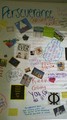
Then, working in triads or foursomes, my students talked about what the habitudes looked like, sounded like and felt like. We collected images, icons, symbols, graphics and quotes that defined the habitudes for us. We wrote "stories in the air" and "post-it memoirs" of times when we exhibited the habitudes. This word storming was created first on the defining the habitudes handouts (lesson one) and then on giant charts, (lesson 2) from the Classroom Habitudes book.
What surprised me is that by word storming, we created three dimensional depictions in our minds of these words - depictions which celebrated our thinking as a classroom community in terms of passion, perseverance, imagination, curiosity, self-awareness, creativity and adaptability. One chart for each team wasn’t enough. They wanted to share their collective thinking for all the words, for all the charts, so each group spent 5 minutes adding onto each habitude chart. The creation of these charts took one class period (about 50 minutes) In the end, we had this incredibly comprehensive, thoughtful, soulful "picture" of who we were as a learning family.
I was hoping they would gain an understanding of the habitudes and what they "meant." In hindsight, that was naïve. We gained our understanding, but more than that, we busted the doors off of our learning community that day. We became instantly vulnerable in talking about the habitudes in our lives, we defined our learning space as a space where we could take risks and where we wanted to come back to the next day. We learned about the words, yes, but to borrow a term from Martin Luther King, Jr., we learned more about the content of our character. The kids sat and lay on the newly carpeted floor, nose to nose, as only kids can do. We dared. We were courageous. We took risks. We were brilliant.
I can steadfastly say that the time spent in the "Name It" phase of the habitudes created a launch pad for how I may embed the habitudes into our work throughout the year. Not only will we be immersing ourselves in all seven habitudes per the book’s ideas, we’ll be using them as themes as we study world leaders and history and we’ll discover them in our heroes as we write our hero’s journeys and study the way stories go. We’ll do text set work in which we lay down our thinking and then watch our thinking evolve as we experience the habitudes in new and conflicting texts. But that’s all for another posting….
Meet more Teachers with Habitudes.
Get your own Habitudes Journey Started Today.
Angela Maiers
.
Blog
.
<span class='date ' tip=''><i class='icon-time'></i> Jul 16, 2015 09:38am</span>
|