Blogs
|
Practical modern learning
We’ve written quite a few blog posts, here and there, oh and here too about modernising L&D and what modern learning could look like. In this post, we have a real live example of modern learning in practice. We are even up for an award with our long-term clients eircom Business Friday 6th March!
What does modern learning look like?
Think about two key terms; self-service and devolved responsibility. The modern learner in today’s workplace, needs greater flexibility in when, where and how they learn. They need to be able to learn as they work - such is the pace of modern business. This ‘learning in the workflow’ is the holy grail of learning and is not that easy to achieve. In a recent project with eircom Business, we worked in partnership to design a truly modern learning experience. Let me tell you a bit about it. First, let’s look at the business challenge we needed to address.
Sales performance support system
eircom Business, which focuses on selling high-end telecoms solutions to large companies, employ 200+ sales people. Historically, sales staff were trained and certified as competent through a labour intensive, paper based performance development process. This process was a structured 18-month programme that all sales staff had to complete (either new staff or re-certifying existing staff) to become certified eircom sales professionals.
The problem was that the eircom L&D team had to support the entire process (for hundreds of sales people) manually. This meant a huge administrative effort with no modern systems to support it. Furthermore, the learners and their managers had little or no ownership in the process. The ethos of the move from paper to online was based on learner responsibility for their own training plan (with their manager’s support). The old process was quite inflexible; sales staff were overburdened with attending too many time consuming classroom events. This took them away from productive selling for too long.
The plans include blended learning programmes for induction, regulatory compliance and core product testing followed by a series of brand new and innovative activities called "Performance Reviews". The performance reviews allow the manger to assess on the job competencies, a feature unique to this solution and industry.
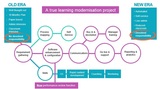
Now - let’s look at the modern learning design principles we started to think about to construct the solution. Our modern learning transformation process focussed on:
The reference to the old era is about how this process used to happen. It also shows how far the Learning and Development function has moved in most companies. The new era is where we work with most of our clients - its exciting and engaging and it delivers results for the business.
How does modern learning support staff and L&D?
What eircom needed was a more flexible and modern approach to develop high performing sales professionals (in the eircom way) that gave more ownership to the sales staff and their managers. They also needed to enable L&D staff to further develop their strategy, add value to the process and to significantly reduce administrative effort. This is a common challenge for most L&D teams - how to get away from just taking orders for training courses and doing training/learning admin and move towards adding value to the overall business performance.
How can you get started with modern learning?
We’ll be talking about this project in more detail in a upcoming Webinar - we’ll keep you posted and would love it if you could join us. In the meantime, here are 5 questions that might able to help you towards a more modern learning approach.
How much of your learning support is self-service where your staff can choose their own content, when, where and how THEY want to learn?
Do you encourage staff to tools such as social media and the Internet to support flexible ways to learn?
Who is responsible for making sure on the job performance is maintained and improved with learning, when needed?
How does your L&D function contribute to the overall business strategy and improving the business bottom line?
Do you have any projects in mind that could help you to achieve (4)
Perhaps you have already got started with modern learning - we’d love to hear from you so feel free to email us, or comment below.
Fiona Quigley, Director of Learning Innovation
Logicearth Learning Services specialise in designing, delivering and supporting modern workplace learning solutions, which brings results for individuals and organisations. We are learning technology experts and along with specialist interactive multi-device content development skills, we can provide a complete service for all your organisation’s modern learning needs. Logicearth has offices in Belfast and Dublin but deliver services worldwide, including Ireland, UK, USA and throughout Europe.
The post Modern learning example appeared first on e-Learning | Compliance | Training | LMS | Logicearth.
Logic Earth
.
Blog
.
<span class='date ' tip=''><i class='icon-time'></i> Jul 17, 2015 09:21am</span>
|
|
According to an estimate by the Cisco Visual Networking Index, 80% of the Internet’s total worldwide traffic will be video by 2019. It’s already around 65% of the web’s total bandwidth today, mostly as streaming entertainment content. Netflix alone accounted for 35% of all US Internet traffic in 2014, and it’s estimated that an additional
The post What If The Internet Was Completely Video? appeared first on Grovo Blog.
Alltop
.
Blog
.
<span class='date ' tip=''><i class='icon-time'></i> Jul 17, 2015 09:21am</span>
|
|
See around and you find how technology has changed the way life is today. The same is with technology in schools- it has opened up a lot of opportunities for sure. The adoption of technology in schools has a different picture to offer in different countries. While some developed countries like the United States are looking for more technology to integrate in their schools, countries from the lesser developed parts of the world are still struggling with how to integrate technology in schools. While, there are lot of opportunities that technology has to offer to education institutions at all stages, there are some shortcomings that’s preventing widespread acceptance of technology in schools all over the world.
Opportunities are wide for technology in schools
When you talk about the opportunities for integrating technology in schools, we can actually see how technology is already transforming the way teachers teach in schools- a drift from text-based learning to something that would involve and engage students in the best possible way. Opportunities are plenty; here, we talk about four such opportunities that have every potential to take education to the next level.
A global learning platform is surely one blessing bestowed with the introduction of technology in schools. Students can opt to learn foreign language from natives of the particular country through videoconferencing. A lot of websites have come up with this kind of learning sessions via video conferencing call, letting students experience educational benefits minus the travel cost involved.
A paperless classroom is on the way. Cloud-based apps and tools like Google Drive, Gmail, Google Docs have a smarter way to offer to students and teachers to carry on their daily classroom learning. A definitely affordable option to save more time than the traditional methods of classroom teaching.
A great opportunity for technology in schools lies in the form of virtual reality (put the backlink to our blog)in classroom. Virtual reality has the power to transform classroom into a practical field for students to experience real life applications in a virtual world.
E-books have huge potential to change the face of education in the coming days. A lot of schools from different parts of the world have already discovered the huge potential of e-books, yet, some schools remains unaware.
There are challenges too!
The introduction of technology in schools is surely not an easy road to success. It has its share of bad patches which are to be met with.
Coming out of the comfort zone and accepting technology in schools is perhaps one of the biggest challenge to face with. Most of the times, teachers and school authorities are reluctant to experiment with new technologies in classroom, for they consider these experimentations are beyond their job descriptions.
Technology in schools has another setback- most schools are hesitant to implement distance courses, unlike the universities who have already joined the bandwagon of online courses.
The costing factor is always a prominent challenge for the adoption of technology in schools. Most schools do not have the funding to support the use of technology in schools. There is an initial cost involved in the purchasing and installation of technology. Moreover, the cost of maintenance, upkeep and upgradation involves an ongoing cost, which is, at times, financially unsustainable for most K-12 schools.
There are challenges to face; but the biggest test is to face these challenges, overcome and accept technology in schools and revolutionize education with improved opportunities for students.
The post Technology in Schools: What are the Opportunities and Challenges appeared first on Fedena Blog.
Fedena
.
Blog
.
<span class='date ' tip=''><i class='icon-time'></i> Jul 17, 2015 09:21am</span>
|
|
Story listening NOT storytelling?
I’d like to dedicate this blog post to all the fantastic people in my life - family, friends and work colleagues who have let me learn through their stories.
I love stories. I was a voracious reader as a child and it has continued into adulthood. In my personal blog, I frequently review books and tell stories. Not so much in this ‘work’ blog though. But yet I learn more in the workplace from listening to stories and experiences than from any other form of learning. What about you?
Most blogs about storytelling in learning focus on using stories in eLearning courses; scenarios, examples, case studies etc. They use stories and storytelling to get across examples to explore the nuances of the content. There is nothing wrong with this, but if we only focus on using storytelling to transmit stories, we are missing a rich set of human experiences. I want to focus on the broader concept of storytelling. Stories are much more useful and can bring better results if you consider them outside of the boundaries of a structured course. Stories are also more useful if you think about story listening, not storytelling and this could have a much bigger impact on learning in the workplace.
Humans are storytellers
We experience our worlds - both new experiences and existing experiences by traversing links through a wide tapestry of stories mostly already known to us. We take on new experiences by storytelling to ourselves, adding to our existing stories and fitting them into our current values and beliefs. A powerful story has the ability to really break through existing connections and forge new links in a way that factual information does not.
Everyone has a favourite book or movie that has really changed how they think. What is yours? I have a few. Catcher in the Rye made me think hard about people and society and made me much more empathetic as a teenager. A recent book, albeit an old story, inspired me to overcome some challenges I was currently experiencing. You can read my review about it here. And a recent movie I saw, The Theory of Everything, reminded me of the importance of both perseverance and curiosity.
A great insight from a good friend and storyteller - Pat Kenny
"Stories are like the DNA of our lives. We understand our world and that of others in story form. This is one of the reasons it is nearly always possible to capture an audience’s attention by telling a story. Storytelling is how we communicate ideas and even philosophies. We recount events through the prism of our own experience. We hear stories through the prism of our experiences also. We have communicated this way since we first learned to communicate with each other. "
Story listening versus storytelling
Besides books and films (and now other people’s blogs), I get a lot from listening to other people’s stories. I’ve been lucky to have been involved in voluntary work since I was a university student that allowed me to listen to people’s stories and try to help them to solve problems. When you really listen to someone and also give them time to listen to their own story, it can have a powerful effect. How many of us actually get time to either tell our story or listen to other stories? Often, when we listen to others, we are ready to interrupt. We think more about the next thing we are going to say, rather than just listening. As my Scottish Granny would have said (she was a great storyteller), you have two ears and one mouth for a reason!
Storytelling in the workplace
So with this re-newed emphasis on story listening, rather than merely storytelling, how could it help you in the workplace?
Three ways you can use story listening in your organisation:
1. Re-discover listening
Re-affirm the power of listening in your organisation. Try this exercise:
2. Focus on experienced employees - some questions to ask:
How did you learn when you started here?
What has been your biggest career lesson to date (and tell me a story about it?)
How did you do x?
3. Focus on induction
Ask new employees to gather stories from specific people they might be working with. You can ask similar questions outlined in (2).
Removing barriers - storytelling performance
And I’m always asked - don’t we have to ‘train’ people to tell stories? My answer is always a definite no! Why are we continually putting up barriers when we can do things simply and naturally? It is true that some people are more natural ‘story performers’ than others. But performance is not what is important here. Just encourage people to tell their stories for now and I’ll talk about when performance matters more in later blog posts.
Story listening is something that a modern Learning & Development team could implement easily tomorrow. Try a lunchtime story listening session and just sit back and listen.
Get started with storytelling
Oh and if you didn’t know it, listening brings more benefits than you think. Even showing someone that you are listening to them is a great way of showing respect and building a relationship. In my next blog, I’ll talk about some simple techniques to capture and share stories throughout your organisation.
In the meantime, I’d love to hear your story. What has helped you to develop in your career or what recent challenges have you worked through?
Fiona Quigley, Director of Learning Innovation
Logicearth Learning Services specialise in designing, delivering and supporting modern workplace learning solutions, which brings results for individuals and organisations. We are learning technology experts and along with specialist interactive multi-device content development skills, we can provide a complete service for all your organisation’s modern learning needs. Logicearth has offices in Belfast and Dublin but deliver services worldwide, including Ireland, UK, USA and throughout Europe.
The post Story listening NOT storytelling appeared first on e-Learning | Compliance | Training | LMS | Logicearth.
Logic Earth
.
Blog
.
<span class='date ' tip=''><i class='icon-time'></i> Jul 17, 2015 09:20am</span>
|
|
Admission numbers are unique numbers allotted to students on their admission. No two students can have the same admission number in the institution, even if they are admitted to a different course or batch. Admission number may also be referred to as ‘Registration Number’, ‘Student ID’, or ‘Student Number’ in many institutions.
Where do I allot an admission number?
When admitting a student using the Student Admission form (Module access icon > Academics > Students > Student Admission), Admission number is the first field you will see at the top of the form. The Admission number field is a mandatory.
Auto Increment of Admission Numbers
Since every time a student is admitted an admission number must be allotted, institutions can choose to auto increment the admission number. This setting can be set by selecting the Enable auto increment of Student Admission No. checkbox on the General settings page. The first admission number will have to be manually entered according to the convention the institution intends to follow. From the next admission onwards, the number will be automatically incremented. For example:
If the first admission number is 1, the following admission numbers will be 2, 3, 4, and so on.
If the first admission number is A1, the following admission numbers will be A2, A3, A4,…A9, A10, A11, and so on. The alphabet ‘A’ will remain constant.
If the first admission number is 1A, the following admission numbers will be 1B, 1C,…1Y, 1Z, 2A, 2B…2Y, 2Z, 3A, 3B…3Y, 3Z, and so on.
If the first admission numbers is A, the following admission number will be B, C, D,…X, Y, Z, AA, AB,…AY, AZ, BA, BB…BY, BZ,…CA, CB,…CY, CZ, and so on.
If the Enable auto increment of Student Admission No. checkbox is not selected, you will have to manually enter the admission number every time a student is admitted.
Naming Convention
Institutions can follow a naming convention when creating admission numbers. Make note that admission numbers can only contain alphanumeric characters, underscores, and hyphens. Here are the conventions followed by some schools and colleges that use Fedena:
School 1 - Year of joining + a unique number. So the student admission numbers looked like this: 150001, 150002,…150067, 150068,…150666, 150667, and so on.
School 2 - School name abbreviated + a unique number. So the student admission numbers looked like this: DPA0001, DPA0002,…DPA0067, DPA0068,…DPA0666, DPA0667, and so on.
School 3 - School name abbreviated + a unique number. So the student admission numbers looked like this: DPA1, DPA2,…DPA67, DPA68, DPA666, DPA667, and so on.
College 1, for students of a particular course - Year of joining + Course name abbreviated + a unique number. So the student admission numbers looked like this: 03ZOO01, 03ZOO02,… 03ZOO44, 03ZOO45.
College 2, for students of a particular course - Year of joining + College code provided by the university it is affiliated to + a unique number. So the student admission numbers looked like this: 15045201, 15045202…15045244, 15045245.
Is there a quick way to allot student admission numbers?
The easiest and quickest way to create many student records in Fedena is to Custom Import the student admission records. When setting up the CSV file to be imported, enter the admission number for each student according to the naming convention your institution intends to follow.
Admission Number = Fedena Username
The student admission number is also the username that a student will use to log in to Fedena. It is important for students to remember their admission number. Many institutions may also ask the students to mention their admission number in any type of communication with the institution.
Can I change a student’s admission number?
Generally the admission number of a student remains unchanged till the student leaves the institution. However, if the admission number of a student needs to be changed, it can be done at any time from the student’s profile by the Administrator or a Privileged Employee. Students cannot change their admission number from their Fedena login.
Can I allot the admission number of a deleted student to a newly admitted student?
Yes, you can allot the admission number of a student who you have permanently deleted from Fedena to a newly admitted student.
Applicant Registration Plugin
The Applicant Registration plugin allows students to register to courses online. When a student is allotted to a batch of a course, the admission number is automatically allotted. The admission number follows the naming convention of the last admitted student, regardless of whether the last student was admitted to the same batch or to a batch of a different course.
Student Reports
Student admission numbers appear in all student reports including attendance reports, examination reports, course/batch reports, and fee receipts.
Searching Students
In Fedena, you can search for students from several areas based on your user role and privileges assigned. For example, you can search for students using the search bar at the top of your dashboard, when managing user accounts, when scheduling fee collections, when allotting transport, and many more. Apart from using the name of the student to search, you can also use the student’s admission number to search.
Let us know in the comment section if your institution uses a specific naming convention when allotting admission numbers.
The post All you need to know about student admission numbers in Fedena appeared first on Fedena Blog.
Fedena
.
Blog
.
<span class='date ' tip=''><i class='icon-time'></i> Jul 17, 2015 09:20am</span>
|
|
What is pain free learning and development?
We work with a lot of learning and development (L&D) folks - they are our core client-base, and over the last couple of years, we’ve had many hours of conversations and problem solving chats.
The L&D folks that we talk to are clearly under pressure to deliver - and it is that old chestnut; deliver more with less. It’s in my nature to help people solve problems (I’m a fixer), so I’d like to use this blog post to summarise some of these chats and pain points.
Let’s pull the sticking plaster away…
Where is the L&D pain?
Do more with less
Support the modern learner/worker
Devolve responsibility for learning and performance
Keep up with technology / make better use of it / capitalise on it
Adapt to modern business - network and social age, post-industrial age
Get taken seriously (by senior management)
Add value to the business
Fear of failure
Do all of these as quickly and efficiently as possible and know how/where to start!
Now, you might argue that L&D or training departments have always needed to address these challenges. The need for pain free learning and development isn’t anything new, I hear you say! And yes, that is true, but I’d argue that modern tools and learning techniques are now enabling staff and specific departments (marketing, products, IT etc) to by-pass L&D and JDIT (just do it themselves!). What’s interesting for us as a learning service provider is that we are getting contacted by more and more product and IT managers. IT and product managers seem more aware of the online world than the average L&Der. IT and product managers seem more likely to have cracked pain free learning and development.
Pain free learning and development roadmap
So now more than ever, L&D are in pain and in need of a few bandages… If you were triaging L&D, where would you start? Maybe there is a need for pain free learning and development roadmap?
Do you start by helping L&D to better talk the language of business - finance, return on investment (ROI), profit and loss? Or do you start with the staff and their managers? Are we still looking at L&D as people who just ‘book courses’? Do L&D need to work more with managers to devolve responsibility for learning and performance support back to the business? What is the difference to L&D that will make the difference?
Once of the most successful L&D change projects that Logicearth has had the pleasure of being involved with was this one. We firmly addressed old era L&D and helped the client move to new era. Of course that is just our perspective on the shift that is needed, and it worked for this client in this industry. I guess what is needed most is a conversation with lots more L&D folks to clarify the pain points and help solve them.
We’ll be sharing some of the resources (free) we use for this work in up coming blog posts, so I hope you stay with us.
p.s. - I love this blog from Jonathan Kettleborough - Six ingredients for great L&D communication (Twitter: @JKettleborough)
Fiona Quigley, Director of Learning Innovation
Logicearth Learning Services specialise in designing, delivering and supporting modern workplace learning solutions, which brings results for individuals and organisations. We are learning technology experts and along with specialist interactive multi-device content development skills, we can provide a complete service for all your organisation’s modern learning needs. Logicearth has offices in Belfast and Dublin but deliver services worldwide, including Ireland, UK, USA and throughout Europe.
The post Pain free learning & development appeared first on e-Learning | Compliance | Training | LMS | Logicearth.
Logic Earth
.
Blog
.
<span class='date ' tip=''><i class='icon-time'></i> Jul 17, 2015 09:19am</span>
|
|
Multi-course eLearning projects
If the eLearning project utopia ever existed, the process of working with subject matter experts (SMEs), steering committees and other stakeholders would be heavenly. As learning consultants/instructional designers, we generally love getting stuck into a new topic to see where we can bring it. It’s like a rush or a high in our day to day jobs. The yang to that ying is the communication process with the SMEs and wider stakeholders and I could write a book on where this falls down, adds too many complications and extends the project way over budget.
I think we would all agree, we all struggle to some extent in this regard, mostly on a course by course basis, but particularly where your eLearning project contains multiple courses.
Win the battle up front
Most battles are won or lost in the very early stages of an eLearning project, and this is just as true for large scale multi-course eLearning projects. You need to prepare for the worst outcome and set your strategy early. When so many people are involved, even agreeing simple terminology or who the real audience is, can prove difficult. When I say prove difficult, what I really mean is; it has the potential to destroy your eLearning project from the outset. Your clients will not respect your time and you will be involved in numerous meetings and rewrites of storyboards that you just wouldn’t expect.
To win the battle up front, my strategy from the outset is to be very clear with clients that each key milestone has to be fully agreed before the next one starts. That means:
1. Agree the course outlines and learning outcomes, and
2. Agree the storyboards in detail.
This sounds so simple yet in practice so difficult. Let’s explore this a bit more.
Be clear about the process
From the outset, it is best to involve the client’s eLearning project manager, their SMEs and their steering committee together in a meeting to lay out your predefined process. At Logicearth we have a 10 step process, and you will have your own - it is good to walk them through it. It is at this stage I use my main weapon in the fight to win the battle. Its very simple, I ask the question to all the SMEs:
"Each course may take between 5 days of your time or 45 days of your time, which would you like it to be?"
The answer is always the same. My response is, well if you want it to be that way then you must; provide your course outline and learning outcomes and decide who the learners are. Furthermore, each of you must agree your course outlines and outcomes with each other. We are not proceeding any further until this milestone has been completed in full with agreement across the SMEs AND the steering committee.
The storyboard versus the final build (grasping the concept that they are different)
This is a small but important tip. At the early stages of the storyboard build process, it is good to take one or two pages from your written storyboard and put them through the build process. Go to town on interaction design and graphic design. Most SMEs have little experience in eLearning projects. They need our help to visualise the content and to make that mental leap from the wordy, written, dry storyboard to its final construct. Going this extra mile at this point will help you win the small battle of the storyboard. SMEs need to understand that the storyboard is about words and potential construct. They don’t need to worry about how it will look in the end - this is our job, but they do need help.
Engaging the project manager and the steering committee
Its best to become friends with your client’s eLearning project manager; they may be your biggest source of help and support. You can prepare them well for the series of battles that are about to ensue. Work with them at the early stages to discuss ideas to keep the SMEs engaged and responsive. Think of incentives or a leader board to gently push them into providing content and reviews. Additionally, the client’s eLearning project manager will be your gateway to the steering committee. The steering committee will generally always include one very difficult person, one very articulate and clever person and one easy going person. It is good to find this out and find ways of getting the clever and/or the easy going member on your side.
Stop, meet, agree
Again, the biggest milestones are to agree the course objectives, outlines and outcomes and later down the line, to agree and sign off the eLearning project storyboards. At both points, insist that the steering committee meet and ask the SMEs to present each of their documents to the steering committee. This can prove to be vitally important and can save your days and days of rewrites. Fully understand and be prepared for hard , labourious meetings that discuss the documents in great detail. In my view, if you get this aspect right, you will save huge resources and will be well on your way to winning the war.
The treatment plan
When you go to the steering committee to sign off the storyboards, it is important to do two things.
1. Repeat the exercise of showing your storyboard with your sample built object. The steering committee also need to make this mental leap.
2. At the same time, prepare a treatment plan.
This plan should include a graphical representation of how the eLearning project courses will look in their final state (without having to build the courses). Include in the plan; a statement of understanding of their brand guidelines, a colour guide and why your are choosing them, example stock images of people and diversity, example interaction design, use of icons, scenarios and many more things. Again it is good to obtain their consensus.
Last minute build
Now that the outcomes, outlines, learners, storyboards and treatment plan are all agreed, build can start. I generally refuse to go to build before this consensus is complete. Sometimes this is not efficient as it can be better to build courses in parallel but where the project is complex and where there are many differing opinions, I much prefer to make sure that there is consensus across the board before proceeding to build.
We all have the scars of war on our back but I live with an optimistic outlook that SMEs and steering committee can be our foes and not our enemies.
Peter Carlin, Director, Logicearth Learning Services
Logicearth Learning Services specialise in designing, delivering and supporting modern workplace learning solutions, which brings results for individuals and organisations. We are learning technology experts and along with specialist interactive multi-device content development skills, we can provide a complete service for all your organisation’s modern learning needs. Logicearth has offices in Belfast and Dublin but deliver services worldwide, including Ireland, UK, USA and throughout Europe.
The post 7 steps to heavenly eLearning projects appeared first on e-Learning | Compliance | Training | LMS | Logicearth.
Logic Earth
.
Blog
.
<span class='date ' tip=''><i class='icon-time'></i> Jul 17, 2015 09:19am</span>
|
|
Planning fee collection schedules for hundreds of students is a time consuming process, but something that’s very important and cannot be avoided. To ease the process, many institutions at the beginning of the academic year, plan and decide the various types of fees each batch of students have to pay. All these fee types are then recorded in Fedena and the fee collection dates are scheduled for each batch. Each fee collection will consist of payment and discount heads or as Fedena calls it ‘fee particulars’ and ‘fee discounts’. When the fee collection dates draw near, often times institutions want to make changes to the scheduled fee collections. Institutions either want to remove certain fee particulars or fee discounts, or they want to add new fee particulars or fee discounts for a batch or for a particular student. Here’s how Fedena can handle this.
If you are using the Fedena version 3.4.1 or 3.4.2, the solution is simple. Use the Manage Fee Collections page to easily add or remove fee particulars and fee discounts from student fee collections.
Go to the Manage Fee Collections page (module access icon > Administration > Finance > Fees > Schedule Fee Collection Dates > Manage Fee Collections).
Select the batch and the fee collection.
If you select Particular, all fee particulars created for the batch, for a student, or for a student category are displayed.
If you select Discount, all fee discounts created for the batch, for a student, for a student category, or for a fee particular are displayed.
Select the checkboxes to assign or remove fee particulars and fee discounts.
Click the Update button.
A point to note, if a student has paid the fees towards a fee collection, newly created fee particulars and fee discounts cannot be assigned to that fee collection, neither can existing fee particulars nor fee discounts be removed from that fee collection.
If you are using a Fedena version 3.4 and older, the only solution is to delete the scheduled fee collections, create the new fee particulars and fee discounts or delete the ones that don’t apply, and then schedule the fee collections all over again. This process can get even more tedious if you’ve already started collecting fees from students.
So if you haven’t already upgraded to the latest Fedena version - do it now!
The post How to add or remove Fee Particulars and Fee Discounts from Student Fee Collections appeared first on Fedena Blog.
Fedena
.
Blog
.
<span class='date ' tip=''><i class='icon-time'></i> Jul 17, 2015 09:19am</span>
|
|
7 tips to boost the role of L&D staff
Following on from our #painfreeLnD series of posts here and here, I wanted to write a few about a few practical ideas that could start to shift how learning and development (L&D) is perceived in the business.
To move away from booking courses and organising classroom events, we must look at the whole spectrum of learning and performance. Boost the role of L&D staff by injecting a sparkle of enthusiasm for learning and performance throughout your organisation.
And find ways to do this simply, effectively and on a budget! Boost the role of L&D staff means - how can we begin to get the business to see L&D as the font of all knowledge for learning and performance?
Here are 7 tips to get you thinking - our clients are actively working on these and have reported good results on staff engagement and performance improvement.
Free the learning!
Does your organisation have a balance of formal and informal learning? Are staff encouraged to direct and organise their own learning, or does it all have to centrally come from L&D? To get to agile learning and therefore agile, more responsive business, staff need to be free to explore how they learn best. For most of us, that is informal learning from peers and managers as we do our jobs. Does your organisation have structures in place to support this? For example, do managers and their teams have time for regular feedback sessions and meetings? Do they have the right tools to share information quickly and effectively? To boost the role of L&D staff, you can do a lot of good by thinking about the infrastructure that could support and encourage people to learn using natural pathways.
Think for example, about how we learn outside the workplace - how could this be replicated in the workplace? There are lots of different workplace learning and performance models to explore too, for example:
Do you know what combination of behaviour influences are most likely to produce desired changes in behaviour?
Do you understand the different ways people learn in the workplace - 70:20:10?
Are you meeting all 5 moments of learning need?
Ask staff for ideas
It is no co-incidence that this is near the top of my list. Most of us hate being told what to do. Think about conducting an informal session or focus group to ask people how they can be supported. Ask staff what might help them to learn? Ask them what challenges they have on a day to day basis. Then arrange to follow up to share your ideas of how you might be able to help. Do this regularly - perhaps a monthly session, with different staff - work your way around the organisation. Boost the role of L&D staff by making a commitment to listen and live up to any ideas discussed.
Talk to managers about special project ideas
Based on the ideas generated in #2, talk specifically to managers. This is about starting to ease responsibility for learning and performance back to the people who naturally ‘own it’. Boost the role of L&D staff should also be about helping others to improve how they learn. Managers will have their own perspective on day-to-day challenges, so it is useful to reality check all ideas.
Think about a special project to kick start this process. For example, for one client, staff told us that the series of classroom training courses they were attending were just happening too slowly to help them in their jobs. By talking to staff, we suggested use of a coach/mentor in-between classroom sessions to keep momentum going. Staff then built up a series on on-going Frequently Asked Questions and other tips - learning out loud as they worked and sharing with everyone.
Start a learning campaign
The big lesson of modern learning is that we don’t learn effectively in one-off event. We need consistent reminders and on-going learning to really drive performance improvement. So, is there something in your organisation that really needs a focus to drive improvement? Areas like leadership and compliance are prime topics for this sort of approach. I’ll blog more about learning campaigns at a later date, but think about the advertising world - they use slogans, multi-media, posters and other ways of getting a clever message to stick. Boost the role of L&D staff by bringing modern learning and communication techniques to your organisation. If an advertiser can persuade me to buy something I don’t need, then us people of learning can support our staff to learn something that will help their careers - using the same techniques!
Collect stories
We blogged about storytelling before, but just to remind us all - we humans are storytellers. We understand our own experiences and that of others through stories and making connections. Think about who in your organisation you could collect stories from - who are your high performers and how did they get that way? How do they deal with challenges that we all have? Sit down and listen - use this blog for some ideas.
Look for quicker ways to share learning
How does your organisation currently share information quickly? For example, do you use video capture or podcasts or is everything written down? Do you have posters or reminders? Do you have any internal communication tools for quick fire questions and answers? Instant messaging tools are becoming common place - fast replacing email. Do you use informal and formal communication - for example instant messages versus internal newsletters? How does the progress of the business get communicated? Boost the role of L&D staff by offering to look at internal company communication. The same tools that are used for communication could also be used for learning. Can staff easily ask questions to people they don’t see that often? Perhaps a good role for L&D is to help set up a better communications infrastructure to support both fast and efficient formal and informal communication.
Review how email is used in your organisation
This probably seems like an odd one to have on a list about enthusiasm for learning! But building on #6, many organisations are starting to re-think their use of email. Endless ‘cc-ing and email trails is inefficient in today’s fast-paced business world. Email doesn’t seem like a useful agile tool for learning either. Here are ideas other organisations have come up with:
The rule of three - people tend to remember three things easily, so try to have no more points than this. Save the ‘war and peace’ emails for face to face chats.
Keep ‘cc-ing to a minimum - do you expect the people you ‘cc to read and/or take action? Be clear on why you are ‘cc-ing. We’ve all been included in email chains and perhaps missed some important information because we were only ‘cc’d.
Be careful with your wording - keep your tone neutral. People tend to take criticism over email more to heart as you are not there to mitigate or explain it. Tip: re-read your email in a cross voice, just to see if it would come across in anyway offensive!
Boost the role of L&D staff - what’s the scope?
So there you have it. Maybe you are surprised at some of these suggestions about where L&D can get involved. Think about L&D as a broad support to the business - not only helping to support learning but look for anywhere you can use your expertise to improve staff and business performance.
One further insight here, from Harvard Business Review- You don’t have to be the boss to to change how your company works.
Fiona Quigley, Director of Learning Innovation
Logicearth Learning Services specialise in designing, delivering and supporting modern workplace learning solutions, which brings results for individuals and organisations. We are learning technology experts and along with specialist interactive multi-device content development skills, we can provide a complete service for all your organisation’s modern learning needs. Logicearth has offices in Belfast and Dublin but deliver services worldwide, including Ireland, UK, USA and throughout Europe.
The post Boost the role of L&D staff to transform your business appeared first on e-Learning | Compliance | Training | LMS | Logicearth.
Logic Earth
.
Blog
.
<span class='date ' tip=''><i class='icon-time'></i> Jul 17, 2015 09:19am</span>
|
|
ERP implementation is now a crucial part of effective management of educational institution. All concerns right from the management of finance to attendance to exam to publish of results, can be a lot easier with the adoption of right ERP software. The education environment is changing; at a faster pace; new and advanced methods of learning have replaced the traditional forms. To keep up with the changing face of education, institutions have to be smart with the management part as well.
Opting for ERP implementation is a major undertaking and it just not ends with purchasing of the ERP software. Choosing the right ERP solution to planning and execution- everything has to be in the right place for a rewarding experience at the end. A well designed ERP implementation plan is the key. Here are the best practices:
Review the pre-installation scenarios. Do you at all need an ERP for your school?
ERP implementation should not be a decision in haste. Make sure you have enough knowledge about the benefits you’re going to get with an ERP implementation in your educational institution. It’s advisable to create a team with some teachers and non-teaching administrators who’ll be the end -users, to develop the objectives and chart out the entire plan. A complete analysis of the processes to be automated, the scope of implementation and well-defined objectives will surely pave way for a smooth implementation process.
What are your requirements? Choose an ERP software accordingly.
The functions of an ERP software is extensive; and there are a various types of ERP softwares available in the market. Before deciding on any ERP software, dedicate some days in intensive research of the various softwares available and match them with your requirements. Perhaps, the greatest reason for failure of ERP implementation is disparity between the capabilities of an ERP software and the institution’s processes and requirements. Perfect coordination between these two, can produce optimal results.
The ERP Implementation Steps
Once you are done with the process of buying the ERP software, then comes the implementation stage. The practices to follow are:
Create the database. Collect and store all necessary data.
Keep in mind: You cannot transfer or convert 100% data as there will be some really old and insignificant ones. A complete analysis of the currently available data has to be done to determine the important data to be included in the database. Create a spreadsheet/CSV file to properly segment and store data. A good ERP will allow an easy transfer or upload of data from spreadsheet to the database. Make sure all data transferred to the database is accurate and complete.
Training- An important step to successful ERP implementation
A very crucial step to ERP implementation, training of the staffs in the institution who’re going to use it is necessary to realize all the benefits of an ERP software. If the end-users don’t understand how the system works, the entire purpose of an ERP usage will go in vain. Training documents or any other additional tools required, must be provided to the team getting trained. Usually, the training part comes clubbed with the ERP from the provider. Once the training gets over, a pilot-run of the software in the institute with real data to consider any adjustments is needed.
Go live!
Perhaps, the most satisfying part of an ERP implementation process, going live on the system without any hiccups is always most welcoming. But going live shouldn’t overshadow an important aspect- post implementation matters. Proper utilization of the software and timely maintenance and upgradation are equally important as the ERP implementation.
Adopting the best practices for ERP implementation should be priority for the optimal utilization of an ERP software. If you are looking out for some helpful tips for successful ERP implementation in your institution, we have a write-up for you. Read here.
The post 5 Good Practices for Successful ERP Implementation in Educational Institution appeared first on Fedena Blog.
Fedena
.
Blog
.
<span class='date ' tip=''><i class='icon-time'></i> Jul 17, 2015 09:19am</span>
|