Blogs
|
By Patti Shank, PhD, CPT
www.learningpeaks.com
www.pattishank.com
[Portions of this work are from Patti’s workshops on performance analysis and articles on performance consulting.]
Us learning people (trainers, L&D practitioners, e-learning developers, etc.) often see ourselves as builders of instruction. We may deliver it in different ways than we used to—online via the virtual classroom, online via self-paced modules, via mobile web and mobile applications, or even (gasp!) in classrooms through training courses.
But designing training courses is only one of the things we can do to impact how people perform. We need to see that it’s certainly not enough to impact it fully, and the sooner we understand that the better. Many of the business people we deal with realise that training too often doesn’t deliver the needed results. We need to realise that too and provide a more well-rounded solution.
It’s not that your training courses don’t work, it’s that training alone is very rarely a total solution to the kinds of performance problems we see in our organizations. But when a training course is used with other needed performance solutions, training can provide excellent results.
We must stop seeing our role as providers of only instruction and start looking at ourselves as performance-problem preventers and solvers. Let me provide a few examples to give you an idea of what I mean.
Customer service training course?
Eva asked for a course to help her staff better handle angry customers because recent surveys showed that customers think that the customer service department provides bad service. But an analysis of the problem would show that the main issue is that customers often have to wait as long as an hour on hold to talk to a customer service agent. By this time, they are extremely angry. Training alone is not going to solve this problem! This process problem needs to be fixed. Making the service reps nicer is not the main issue here!
Data capture training course?
In another situation, Nolan thinks a course will help his people key more data because ‘some’ people in his department can key more data. An analysis of the situation would show that the few who key in more work at night, when the system isn’t bogged down. A training "course" would be a total waste of resources. And a system upgrade won’t be in the works for a few years.
Now that you see that a training course isn’t the right answer in some situations, or might be an answer but may need additional solutions as well, what can a trainer or L&D practitioner do? Here are 5 reasons that every one of us MUST think beyond the training course.
1. Training courses cost a lot to develop and don’t solve the entire range of performance issues.
If you’ve ever developed a course, you know how much effort goes into developing them. And yet research clearly shows they don’t solve the bulk of performance problems. Training typically only solves problems where people don’t have the skill to perform as desired. Training doesn’t solve these problems at all:
Inadequate tools and resources:
Such as poor or incorrect support materials, slow systems, and insufficient software
Unclear expectations:
Including no or indecisive feedback to know whether the job is being completed correctly
The wrong incentives:
For example, negative consequences for doing a good job and positive consequences for doing a poor job
Poor processes:
Including work processes that impede getting the work done
Bad Hiring:
Has the wrong person been hired to do the job?
You can read a lot more about these problems in Gilbert’s Six Boxes Model (http://www.sixboxes.com/Six-Boxes-Model.html).
If people created training courses for the examples I gave earlier, the courses wouldn’t work because the problems weren’t about skills, they were about a bad process and about a problem tool, respectively. And as I said earlier, training helps when people don’t have the skills to do the job.
2. Most training courses are generic solutions. Most performance problems have specific issues that generic solutions don’t solve.
Most training courses tend to be very generic, with lots of generic information. People who take them tend to think, "This doesn’t have a lot to do with my needs." They are in a rush to complete them because they have real work to do and the courses we build for them are often far too generic to meet their real needs. (Bless you if you create courses that meet the specific needs of a specific population of people. You are rare. Keep fighting to do what you do!) So the training courses tend to take up time and not meet real needs. Is this a solution or a problem?
3. Most training courses don’t involve the right type of analysis. Thus, #2.
Generally, someone tells us to develop a training course and we gather content and build it. Waaaaa! Generic course built for the needs of no-one. User rushing through (or only using the parts they want.) See #2.
What if the L&D people were to create a customer service training course for the customer service example I gave earlier, after they fixed the process? First they’d need to see if there were still angry customers. If not, no course would be needed! Problem solved!
If there were still angry customers, we’d first need to find out why they were angry, not just slam together a generic customer service course. It might be that it wasn’t a course needed but another performance problem to solve. See how applying some basic analysis frees the L&D folks to build only needed courses?
4. You can often solve performance problems using fewer resources than a course. Thus, #1.
If you look at all the reasons for performance problems, you come to see that solving the real reasons for them is faster, cheaper, and better than building training courses. Training is an expensive fix, even for skill-related problems. In those instances, there are many other, less expensive options such as using inexpensive performance support like job aids and using social media to help people get the answers they need. In many of today’s jobs, knowledge often changes too quickly to train people. If tomorrow’s answers are different than today’s, training is simply too expensive.
5. We MUST do better than this. You see why, right?
We must ask, "Why is this performance problem happening?" The easiest way to answer this question is to watch people work and ask a few simple questions about what they are doing.
Although stakeholders often ask us to build training courses, it isn’t wise to build courses without knowing whether courses are needed. Courses are ONLY wise when people are deficient in skills and those skills aren’t going to change for a long time. Otherwise:
1. Determine the root causes for the performance problem(s)
2. Find the solutions for those problems
3. If there are skill problems, see if they can be solved without a course
4. Only build a training course if the skills needs aren’t going to change quickly
Become a hero by saving money and time!
Additional Resources:
Binder C. (1998). The Six Boxes™: A descendent of Gilbert’s behavior engineering model. Performance Improvement, 37(6), 48-52.
Gilbert, T. (1996). Human competence; Engineering worthy performance, 2nd ed. Silver Spring, MD: International Society for Performance Improvement.
Gottfredson, C. & Mosher, B. (2010).Innovative performance support: Strategies and practices for learning in the workflow. McGraw Hill.
Mager, R.F. & Pipe, P. (1997). Analyzing performance problems. Atlanta: The Center for Effective Performance.
Robinson, D.G. & Robinson, J.C. (1996). Performance consulting: Moving beyond training. San Francisco: Berrett-Koehler Publishers.
Rossett, A. & Gautier-Downes, J.(1990). A handbook of job aids. San Francisco: Pfeiffer.
Rossett, Allison & Schafer, Lisa. (2006).Job Aids and Performance Support: Moving from Knowledge in the Classroom to Knowledge Everywhere, 2nd edition. Pfeiffer.
Rummler, G.A. & Brache, A.P. (1995). Improving performance: How to manage the white space in the organizational chart. San Francisco: Jossey-Bass.
The post 5 reasons to re-think training courses appeared first on Logicearth Learning Services.
Logic Earth
.
Blog
.
<span class='date ' tip=''><i class='icon-time'></i> Jul 17, 2015 09:28am</span>
|
|
This week’s blog post is a guest post from Ken Thomson of Dashboard Simulations, based in Northern Ireland. Over the past 5 years Dashboard Simulations® have been using dilemma based design to create a world class portfolio of comprehensive, realistic business simulation games.
Good learning design is around dilemmas not decisions
One of the challenges for a learning designer is how to work out which aspects of a topic will bring the most value to a community of learners. A technique called dilemma based learning design is particularly helpful if the learning topic is one which has grey areas such as influencing others or managing a business or team or department.
Dilemma based learning design suggests that in any job or team or organisation there will always be a small number of dilemmas which bring most of the challenges and good performance is largely down to how well the people resolve or square these dilemmas.
I sharply contrast dilemma resolution with decision-making: decision-making involves right and wrong answers, but in the case of dilemmas there is always some pain or compromise or trade-off involved no matter which option finally gets picked.
There are two types main of dilemma: Leadership dilemmas and Business dilemmas. Leadership dilemmas are nearly always present in a similar form whereas the specific Business dilemmas depend entirely on the nature of the role or organisation.
Dilemma based learning design in leadership
A good example of a Leadership dilemma is working as part of a collective team. You may have very strong views on something but sometimes you may have to run with a collective view of the team which is different from your own view. So you need to resolve the dilemma of whether you push a decision hard based on your experience or you back off based on your judgement that either the team know best. Or else, it does not really matter one way or the other at the end of the day! This applies whether you are a team member or the team leader.
Dilemma based learning design in business
A good example of a Business dilemma is Product Mix. Let’s imagine the market is starting to tell you they are less attracted to your old faithful Product A, but want more of your new Product B instead. It is not ideal for you to just switch, as you may have lots of Product A stock and production facilities, and it may be much more profitable than Product B. You have a dilemma!
You can either react to the market by switching towards Product B or you can try to lead the market by trying to change your customer preferences back towards Product A, through, for example, marketing and/or discounting. Which one will be effective depends on the interplay of a number of things, one of which is the degree to which your company is perceived to be a market leader or market follower in the product area. Market leaders can change behaviour much more easily than market followers!
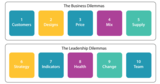
The diagram summarises the 5 Leadership dilemmas and 5 Business dilemmas that I most commonly encounter in my discussions with top practitioners and subject matter experts in organisations.
Creating dilemma based learning design content
In my world, I am typically looking to construct team business simulation games by combining 3 leadership dilemmas with 3 business dilemmas. I know from experience that if I design a game with fewer dilemmas than it will probably not be sufficiently realistic and challenging. On the other had if I have more dilemmas, for example, if I went mad and built in all 10 dilemmas then the game would be too complex. It would also lack cohesion - a bit like a film designed by committee with some romance, cowboys and science fiction. [Actually come to think of it just like the film "Cowboys and Aliens" with Daniel Craig].
So when you are talking with a practitioner or subject matter expert don’t just ask them what they do or even what decisions they have to make. Ask them what dilemmas and trade-offs keep them awake at night. If you can build the learning around this you are much more likely to create a totally engaging, valuable and enjoyable experience for them.
The post Dilemma based learning design appeared first on Logicearth Learning Services.
Logic Earth
.
Blog
.
<span class='date ' tip=''><i class='icon-time'></i> Jul 17, 2015 09:28am</span>
|
|
Learning and development excellence
Working in a heavily regulated industry, eircom, have been going through major change and modernisation programmes for a few years. This modernisation applies just as much to the Learning and Development function within the business. eircom’s Learning and development team were highly driven to adopt new technologies, processes, methodologies and learning styles to rise to this challenge.
Working with Logicearth over a number of years, we have demonstrated that while classroom training is still very important, a broader and modern approach to learning service provision has been hugely beneficial.
The modern learning approach means use of new technologies such as an accessible, web responsive and learner centric learning portal. eircom have used the portal to deliver and support all their training needs. The portal’s use has expanded from compliance and regulatory training to induction & sales certification, the use of off-the-shelf content for self service and now product based training.
Working with eircom’s learning and development team
Logicearth have helped eircom to develop their own eLearning content to be able to better respond to their internal and customer training needs. Joanne Harley, eircom’s Training and Quality manager has led the new approach to delivering training to their Customer Service Agents.
Joanne kindly provided some useful insights into her eLearning development journey. Previously, her team focussed on classroom delivery but after a comprehensive eLearning development support programme, they have reduced their classroom delivery by 50%. Logicearth provided:
1. Articulate Storyline training
2. Instructional design training
3. Graphic design/content presentation training
4. Basic audio and video editing training
All of this training is currently being followed up by a company-wide mentoring programme where Logicearth provides feedback on storyboards and built eLearning courses before they ‘go live’.
You can take a look at some sample screens from Joanne’s first eLearning course here and read her insights below.
What is different about how you now support your staff?
This first thing we are doing differently is that we are doing 50% of our learning through eLearning.It means that the same message is going out to all of the audience as opposed to different messages through different trainers.Learners are quite positive about it.It is a learning curve in that every eLearning Module we develop is an improvement on the last and we are making it more interactive as time goes by.
What training and support did you receive to do this?
Well when we started off eLearning, we did a 5 day course to learn how to design and develop the content. So the first few eLearning sessions we did were very Powerpoint orientated. I suppose in recent sessions we’ve been doing much more interactive work. And we got a lot of help from Logicearth in getting it interactive.
We started off with having maybe 15 to 20 slides that were hugely Powerpoint and now it is much more interactive and much more focussed on the learner.And this is why there is a lot of positivity coming back from the actual learners.
How has it impacted the learning experience for your staff?
I would advise other companies to definitely get involved in eLearning.As I think it definitely makes the learning experience much more positive.It makes it more positive in that our issue has always been that we do a train the trainer session, and then we let the trainers off to do training.
Which means that now, with eLearning all learners are getting the same message.And because we can do testing means that we can make sure that the message is getting through to the learners.And I suppose it is in their language - more fun and interactive.
How will you continue to develop your own eLearning content?
We use the classroom for 50% of our learning. For example, we did a module on soft skills. We did 15 minutes on soft skills using eLearning. And then we did the rest which was role-plays, in the classroom.eLearning is also good for short bursts of learning.
For example, we are doing Billing updates to remind people what they have already been trained on and to let them know of new stuff they need trained on.I think the learners are delighted with the fact that they can interact. So it is not just a trainer sitting there throwing information at them. They need to be involved - and the questions, tests, games etc, makes it much more fun for them to learn.
The post Client spotlight: learning and development appeared first on Logicearth Learning Services.
Logic Earth
.
Blog
.
<span class='date ' tip=''><i class='icon-time'></i> Jul 17, 2015 09:28am</span>
|
|
Using survey results from Towards Maturity we lay out some actions retail businesses can take to really benefit from eLearning, from embracing new technologies to prioritizing your learning objectives. Here is how you can take advantage of retail eLearning.
This post was first published on eLearning Industry.
Alltop
.
Blog
.
<span class='date ' tip=''><i class='icon-time'></i> Jul 17, 2015 09:28am</span>
|
|
A what? An L&D strategy?
Yes it is probably a bit early for this, but you know Santa’s elves get busier and busier every year. And those austerity measures even reach the North Pole. Mrs Claus is hopping mad that everyone can only have one mince pie each this year…
So what should L&D ask Santa for Christmas this year? Here’s our top 5 list - assuming we’re not in Santa’s naughty list!
Dear Santa,
I work in L&D and have done for the last 10 years. In that time, there has been so much change; from the YouTube generation, to social learning, mobile and gamification, each new buzzword was supposed to be the messiah coming to save everyone from us bad L&D people. We have been called all sorts - order takers, lazy, lacking business sense, and, AND imagine this - apparently, we only give people what they ask for! I mean, we deserved to be sacked for that alone!
But I digress Santa, and I’m sure you don’t want to hear my woes… So here’s what I think L&D need to move from the naughty L&D list to the nice list:
An L&D strategy
So let’s focus on:
Where we are at now,
Where we need to get to, and
How we are going to get there.
The CEO says he wants results, so I ask all managers and department heads to engage with us. We can’t have an L&D strategy without co-operation. Use our expertise. It might surprise you how much we already know about this business. And if you don’t come to us…watch out in the New Year! Be ready to share your KPIs!! An L&D strategy needs KPIs.
A key to unlock the walls of IT
Yea, yea, that old chestnut…but do you know how much this is holding us back? Outside of work, our staff use all sorts of technologies and run their lives perfectly well. But then they come into work and suddenly it is the dark ages. Can’t send emails >5mb? Can’t access YouTube or Facebook? Don’t trust staff with open Internet access? I bet even Santa uses Google for those hard to understand requests? Let’s talk about how we can get this working for everyone. Our L&D strategy will open doors and locks for lots of learning.
Tools to help people support their own development
And once the IT key is found, this follows on naturally. We don’t need to send staff on a course for everything. The average 10-year old can routinely learn from Google and YouTube, so why can’t we encourage this self-directed learning?
A plan to stop using compliance as an excuse for bad training
So we work in a regulated industry. The big bad regulator might come and take our toys away. So we ask people to sit through a two day classroom course, or worse still, click through 100 screens of eLearning to ‘prove’ they are compliant. Then when the regulator comes we can provide him/her with a lovely list of ticked off people (in more ways than one!).
There is a much better way to do this. So let’s talk and work it out together! Imagine if the L&D strategy was actually a learning strategy for everyone?
An injection of fun, enthusiasm and excitement for all things workplace learning
If people weren’t so bored going on unnecessary courses or taking boring eLearning, then we’d really go places. Imagine if you had the (learning) tools to progress your career, whenever you needed them? Imagine you could make choices about how YOU like to learn? And what impact would it have on your performance if you had support always in the form that you needed it? If we solve 1-4, then we are more likely to get 5! L&D can help you do all of this.
Thanks Santa. I hope you can see from my wish list that I’m not as stupid or as lazy as people think I am…come on, let’s rock 2015!
Yours,
Lonely and unloved in L&D
P.S. - managers, department heads, senior execs - if you see your friendly neighbourhood L&D staffer in the New Year, grab a coffee, have a chat! There is a better way!
The post All I want for Christmas is an L&D strategy appeared first on Logicearth Learning Services.
Logic Earth
.
Blog
.
<span class='date ' tip=''><i class='icon-time'></i> Jul 17, 2015 09:27am</span>
|
|
What does workplace learning and mountaineering have in common!?
Navigating Fisherfield 6, Scottish Highlands
So it’s a new year, and you’ll be glad to know that this isn’t going to be one of those resolutions or top ten predictions lists!
I’d like to just reflect on a very important topic - what do we mean by workplace learning? As we get ready to work on new projects and new clients, 2015 is looking like an exciting year for Logicearth. And before we get stuck into full delivery mode, I’d like to reflect on workplace learning in all its guises. I want to make sure that when we work with clients, we do our best to address the different ways learning can be supported in the workplace.
But people can organise workplace learning by themselves!
I’ve seen quite a few comments on social media recently - Twitter, LinkedIn and Facebook, especially, commenting on the fact that people will choose to learn, rather than learning being a formally organised thing. These comments also talk about learning being organic and something that happens inside an individual’s head. The not so veiled criticism is aimed mostly at L&D departments who try to formally organise learning without taking into consideration how their staff learn best. And we are not talking learning styles here - it is more about the topic. So for example, Leadership programmes have been criticised for being too formally organised. Sending people on 5 day courses to a plush leadership retreat just isn’t delivering results, not to mention it doesn’t deliver bang for bucks!
What does REAL learning look like?
Helen, one of our Senior Learning Consultants is a keen mountaineer and all-round outdoors type. She joined Logicearth two years ago and before she took up a post with us, she had mainly worked in the software industry. So she brought a bit of a fresh perspective to the business of learning that the rest of us had been engaged in for much longer. In essence, she has been a life-long learner, and when I asked her recently to define what she thought learning was - this is what she said:
"Navigating on a mountain is all about experience. It’s about getting it wrong 40 times and then remembering your mistakes in the future. It’s about following a compass bearing in the wind and rain with no visibility and realising you’ve walked 20 degrees out. It’s about not using a compass at all, but reading the aspect of slope instead. It’s about glancing at a map and knowing how far on it you’ve walked. It’s about smart route choice when there’s little on a map to help you, and you have to rely more on your gut instincts. It’s about identifying handrails, knowing when to follow them and when to leave them. It’s about breaking down lengthy complex routes into small steps and ticking each one off, each little success building your confidence so you know you’ll get there in the end…."
So in effect, learning is a natural process - as natural as walking or breathing. We learn everyday as it is just core to the human condition.
How do we set-up workplace learning as a natural process?
The big challenge is not to get in the way of learning. Recognise, just like with Helen, that failing is an important part of the learning process. If you work in a safety critical environment, you still need to allow for failure. For example, even when surgeons are training, there are plenty of fail-safe mechanisms to maintain patient safety. It is also important to realise that ‘learning’ is just not one thing; learning a new skill is very different to helping a more experienced staff member further develop their careers. Also, helping people to change habits/behaviours is very different to learning a set of facts that you will use infrequently (like much compliance training).
So if you work in an L&D department and you are looking at your learning initiatives for this year, here are three tips to get you started:
If you aren’t already, become more familiar with the 5 moments of learning need.
Think about your workplace learning culture - are there in-built opportunities for failing in a safe-way and receiving constructive feedback?
Ask your staff how they learn outside of work - you might be surprised by what they come up with!
Oh and happy new year to you all! We’ll talk more about boosting workplace learning in future blogs. If you have any other tips that have worked for you, we’d love to hear from you!
Fiona Quigley, Logicearth
Director of Learning Innovation
Logicearth Learning Services specialise in designing, delivering and supporting modern workplace learning solutions, which brings results for individuals and organisations. We are learning technology experts and along with specialist interactive multi-device content development skills, we can provide a complete service for all your organisation’s modern learning needs. Logicearth has offices in Belfast and Dublin but deliver services worldwide, including Ireland, UK, USA and throughout Europe.
The post 3 tips to boost workplace learning appeared first on Logicearth Learning Services.
Logic Earth
.
Blog
.
<span class='date ' tip=''><i class='icon-time'></i> Jul 17, 2015 09:27am</span>
|
|
According to a statistical report published by NASACT’s 2012 "Challenge of Change" and GFOA’s "Real Impact of ERP Systems in Public Sector", on the shortcomings of ERP implementation, 60% of organizations under the survey reported disappointment with their ERP system*
This is a common problem when it comes to adoption of ERP system, more specifically when it’s about ERP in school. Education institutions always have the pressure of maximizing performance with the least resources available. An ERP is what can help institution cope up with the demanding situation. ERP in schools is the road to an easy management of a whole lot of organizational issues, leading to a lot of saving of time and money.Accelerating an institution’s operations is a smart move to save time and invest it in what’s more important- educating the students.In our last article, we had talked about the advantages and limitations of an education ERP. Today, we will see what are the characteristics that should be considered while choosing an ERP for an institution.
Features of a good School ERP
Choosing an ERP for education institution is not easy and should not be done in a haste. Proper research work on the characteristics is important before taking the next step. We bring to you 6 important points to look out for in a school ERP.
A good ERP should be complete: Now, what do you mean by a ‘complete’ ERP system? First of all, you should be sure of all the requirements you have from an ERP system for your institution. An all-inclusive ERP system for an education system should be able to take charge of almost all of the functions of an institution. If an ERP is not able to fulfill the required promises and most of the functions has to be done manually, it’s surely a big ‘no-no’ for this kind of ERP in school.
Scalability: Most educational institutions cannot afford constant upgradation of the software. ERP in schools must be scalable and can be scaled up or down according to the demands of the institution.
A stable support system: While choosing a school erp, it’s highly important that the ERP provider company assures a good support system, mainly after the system is successfully installed in the institution. Constant upgradation and the timely updates are what makes part of a good support system.
Easy to adapt: The report by GFOA and NASACT, 2012 on the pain points of ERP implementation says that 62% of end-users had problem with adoption of the software and usage. An ideal ERP should be easily adaptable to the end-users. School authorities or administrators might not be highly fluent in the technical front and hence, complicated systems will come with the unfamiliarity and uncomfortability quotient with them.
Cost-effective and ROI benefits: The cost of erp in schools is not just about the purchasing and implementation cost, but it also includes the expenses in future for maintenance, upgradation, etc. An ERP system should offer a very clear picture of the expenses involved, minus any hidden cost which affects the targeted ROI of the institution.
A widely accepted school ERP: A widely accepted ERP would ensure adequate resources for implementation and support. Certified customers and partners stand as a guarantee for its authenticity and thus, offers maximum effective use. The more the number of customers, the greater the chances of effectiveness of the ERP.
There are quite a number of names in the industry to lure you with great offers and perks. But when it comes to your education institution, you shouldn’t take chances and a proper research work is always recommended. Always go for an ERP in school that consummate your institution’s needs and essentials.
*NASACT’s "Challenge of Change" and GFOA’s "Real Impact of ERP Systems in Public Sector" 2012 (in association with Microsoft Dynamics)
The post 6 Important Features of a School ERP to Look out for appeared first on Fedena Blog.
Fedena
.
Blog
.
<span class='date ' tip=''><i class='icon-time'></i> Jul 17, 2015 09:27am</span>
|
|
Coming to the end of the first working week of January and yet more reflections from me! This time it is about modern learning.
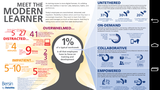
Over the holidays, I read a really interesting article about the ‘Learning Worker’ and also had previously come across a great infographic from Bersin on the ‘modern learner’.
The term modern learning/the modern learner seems to have been a big feature of 2014. And certainly those are terms that we use when talking to clients about how to improve their learning and support functions.
So what does modern learning really mean?
Some people argue that how we actually learn - the taking information in through our senses, filtering, making sense, encoding, adding to existing neural pathways, forging new neural pathways etc. won’t ever really change. But as we gain more understanding of important concepts in brain science, we become more aware of the impact that learning has on our lives. The ability for the modern human, and indeed the modern worker to learn, change and adapt is core to our survival. Terms like neuroplasticity, meta-learning and cognitive bias are becoming common parlance in the corporate world. The pace of change in business is so fast that ‘learning’ is just as core a skill as ‘communication’.
It is becoming obvious that an individual’s ability to learn and adapt is starting to outweigh their core experience that they might bring to a role. In the homogenous corporate world, where we are all competing with many of the same products and services, the ability to learn efficiently and deal with vast amounts of information is fast becoming a competitive advantage.
What can organisations do to better support modern learning workers?
I’ll blog more about this in the future, but for now, here are three ideas to get you started:
1. Dive into the area of brain science a bit deeper - if you haven’t already. Two good reads:
Brain rules by Professor John Medina
Thinking, Fast and Slow by Daniel Kahneman
2. Think of learning as a process rather than a one-off event. Encourage staff to really modernise their learning by using modern learning tools - social media, personal learning networks, communities of practice are becoming more widely used.
3. Adopt a ‘Learning out loud’ policy - as people learn, encourage them to share their journey. The need for all of us to move away from the ‘knowledge is power mind-set’ has never been more important.
Learn more about modern learning
In future blogs, I’ll talk about using tools and techniques such as social media and personal learning networks to support the modern learner. In the meantime, maybe you’d like to share what the term ‘modern learner’ means to you? Do you learn any differently now, than say, 10 years ago?
I’ll leave you with an article that, if you haven’t already read, might just spark your interest in this subject!
Fiona Quigley, Director of Learning Innovation
Logicearth Learning Services specialise in designing, delivering and supporting modern workplace learning solutions, which brings results for individuals and organisations. We are learning technology experts and along with specialist interactive multi-device content development skills, we can provide a complete service for all your organisation’s modern learning needs. Logicearth has offices in Belfast and Dublin but deliver services worldwide, including Ireland, UK, USA and throughout Europe.
The post Modern learning appeared first on Logicearth Learning Services.
Logic Earth
.
Blog
.
<span class='date ' tip=''><i class='icon-time'></i> Jul 17, 2015 09:27am</span>
|
|
With an information management system as detailed as Fedena, you are going to have all kinds of data coming from different parts of your institution. This can sometimes make tracking and reviewing of information difficult, especially when certain types of information needs to be monitored frequently. So make things easier for you, we introduced Dashlets.
So what exactly is a dashlet? A dashlet gives you a quick overview of the information that matters most to you—like your institution’s income and expenses, the timetable for the day, the exam scheduled for the day, and more. The Fedena dashboard features a collection of dashlets that display only the important information generated from its complementary page.
Now, we never stopped there. With the release of Fedena 3.4, we made dashlets even cooler by adding clickable links that take you right to that specific Fedena page, allowing you to act immediately.
List of dashlets and information users can access
The table below explains what each type of Fedena user can see and do with their dashlets.
NA - Dashlet not available for that user role.
Dashlet
Administrator / Privileged Employee
Student
Parent
Absent Students
View the names of absent students. Click a student name to view the student’s profile.
NA
NA
Admitted Employees
View the names of admitted employees. Click an employee name to view the employee’s profile.
NA
NA
Admitted Students
View the names of admitted students. Click a student name to view the student’s profile.
NA
NA
Birthdays
View the names of students and employees celebrating their birthday. Click on a name to view their profile.
Can only view the names of students and employees celebrating their birthday.
NA
Blogs
View the title and author of the blog posts. Click the title to read the blog post and comment.
View the title and author of the blog posts. Click the title to read the blog post and comment.
NA
Book Return Due
View the names and details of books you must return. Click the name of the book to go to the View Books page and reserve the book.
View the names and details of books you must return. Click the name of the book to go to your profile and view all the books borrowed with their due dates.
NA
Discussions
View the title of the discussion and name of the user who initiated the discussion. Click the title to join the discussion and comment.
View the title of the discussion and name of the user who initiated the discussion. Click the title to join the discussion and comment.
NA
Employees on Leave
View the names of employees who are on leave. Click an employee name to view the employee’s profile.
NA
NA
Events
Can only view the event details.
Can only view the event details.
Can only view the event details.
Examinations
View the exam details. Click on the exam name to go to the View Exam Groups page.
Can only view the exam details.
Only view the exam details.
Fees Due
Can only view the scheduled fee collection details.
View the scheduled fee collection details. Click on the fee name to pay the fees.
View the scheduled fee collection details. Click on the fee name to pay the fees.
Finance
View the institution’s income and expenses for the day. Click on the link to view all transactions for the day.
NA
NA
Leave Applications
View the names of employees who have applied for leave. Click an employee name to approve or deny the leave.
NA
NA
News
View the news title. Click the title to view and comment on the news.
View the news title. Click the title to view and comment on the news.
View the news title. Click the title to view and comment on the news.
Photos Added
View the title and a thumbnail of the photo shared. Click the title to view the photo(s).
View the title and a thumbnail of the photo shared. Click the title to view the photo(s).
NA
Placements
View the placement details. Click the title of the placement to view the complete placement details.
View the placement details. Click the title of the placement to view the complete placement details.
View the placement details. Click the title of the placement to view the complete placement details.
Polls
View the poll title and the number of votes. Click the title to give your vote.
View the poll title and the number of votes. Click the title to give your vote.
View the poll title and the number of votes. Click the title to give your vote.
Relieved Students
View the names of archived students. Click a student name to view the archived student profile.
NA
NA
Removed Employees
View the names of archived employees. Click an employee name to view the archived employee profile.
NA
NA
SMS Sent
View the recipients’ contact numbers and the message that was sent. Click on a contact number to view the SMS log.
NA
NA
Tasks Due
View the title of the task. Click the title to view the complete task details and reply.
View the title of the task. Click the title to view the complete task details and reply.
NA
Timetable
View the timetable for the day. Click a subject to view the complete timetable for a batch.
View the timetable for the day.
View the timetable for the day.
A dashlet is only worth the value of the information it displays. Take a look at your dashlets and let us know if the information they display is helpful to you, or if it can be improved.
The post Interactive Dashlets - Instant access to the information that matters most appeared first on Fedena Blog.
Fedena
.
Blog
.
<span class='date ' tip=''><i class='icon-time'></i> Jul 17, 2015 09:26am</span>
|
|
Systems training shouldn’t be boring!
On the face of it, systems training can seem like one of the most straight forward sections of a training programme to design. There is a company system, it performs functions x, y and z, learners need to know these functions to perform their jobs. Simple? Show them, tell them how it works then let them practice. So easy I don’t need to blog about it…right?!
Well not quite. Systems training can more often than not be one of the more ‘boring’ topics to design. From personal experience, it is a challenge trying to keep a classroom of even the most eager learners engaged whilst you wax lyrical about the functionality and importance of the company’s main system…incidentally the system they will be using the majority of their working day!
Learner centric systems training
So…can we can make systems training fun, learner centric and less frustrating?
Well, I believe we can! And what’s more, it can all be done through modern eLearning. Some might wince at the thought, but hear me out…
Recently I adopted a three step process to bringing systems training to life via modern eLearning, which I feel incorporates all the main elements required for a successful outcome:
1. Get beyond show and tell
Replace the monotonous lecture style show and tell with some context setting exercises that are interactive, fun and stimulate thinking. The learner will eventually disengage if they are treated to a long explanation of the context, so try to involve them throughout the process, and not just at the ‘practical’ stage.
2. Focussed task analysis for key demonstrations
With our clients, we perform a task analysis at project planning stage to make sure we only create learning content that the learner really needs in their everyday job. We then record a series of short 1-2 minute videos with clear voiceover. At Logicearth, we use tools such as Camtasia Studio to demonstrate how to perform a task on the system. For example, this could be demonstrating how to create a new user on a Learning Management System, or processing a credit card payment on a company accounts system. Short videos like this can be recorded for each topic - the key thing is, they are short and stay ‘on message’.
3. Practice makes perfect
And finally, we come to the practical element. Now that the user has had some interactive context and seen how the task is performed, they need to do it themselves. Using tools such as Adobe Captivate, you can create a simulation which allows the learner to interact with an exact replica of the system and perform the action described in the demo. Not only is it engaging, but it captures how much the learner has absorbed at steps 2 and 3.
Try our systems training demo
These three steps can remove a lot of the barriers to systems training and provide a great deal of flexibility in what is a tough topic to both teach and learn. So why not give it a go - try bringing your systems training into the 21st Century and replace the monotony with some fun!
To try our systems training demo, click here
We’d love to hear from you if you have used or created your own systems training. You can comment below or email us here.
Mark Gourley, Senior Learning Consultant
Logicearth Learning Services specialise in designing, delivering and supporting modern workplace learning solutions, which brings results for individuals and organisations. We are learning technology experts and along with specialist interactive multi-device content development skills, we can provide a complete service for all your organisation’s modern learning needs. Logicearth has offices in Belfast and Dublin but deliver services worldwide, including Ireland, UK, USA and throughout Europe.
The post 3 steps to fun systems training appeared first on Logicearth Learning Services.
Logic Earth
.
Blog
.
<span class='date ' tip=''><i class='icon-time'></i> Jul 17, 2015 09:26am</span>
|