Blogs
|
Important dates:Abstract Submission Deadline: March 26th, 2015. Notification of Acceptance/Rejection: April 20th, 2015.Final Paper Submission Deadline: May 21st, 2015. Registration deadline for authors: May 21st, 2015. Conference Dates: Barcelona (Spain), July 6th-7th-8th, 2015.See the conference topics. Among them, gamification and serious games:
Education & eLearning Blog
.
Blog
.
<span class='date ' tip=''><i class='icon-time'></i> Jul 20, 2015 12:08pm</span>
|
|
If we've ever corresponded online, I'd love to have the opportunity to put a face to your name. Please do get in touch and say hi -- I'm looking forward to networking with a lot of learning professionals at the conference. See you there!© Sumeet Moghe, 2009
Sumeet Moghe
.
Blog
.
<span class='date ' tip=''><i class='icon-time'></i> Jul 20, 2015 12:08pm</span>
|
|
The Second International Workshop on Gamification for Information Retrieval (GamifIR’15) focuses on the challenges and opportunities that gamification can present for the IR community.Important Dates:Submission: 2 February 2015Notification: 20 February 2015Camera-ready: 27 February 2015Workshop: 29 March 2015Topics of Interest: Gamification approaches in a variety of contexts, including document annotation and ground-truth generation; interface design; information seeking; user modelling; knowledge sharingGamification designApplied game principles, elements and mechanicsGamification analytics Long-term engagementUser engagement and motivational factors of gamificationPlayer types, contests, cooperative gamificationSearch challenges and gamificationGame based work and crowdsourcingApplications and prototypes
Education & eLearning Blog
.
Blog
.
<span class='date ' tip=''><i class='icon-time'></i> Jul 20, 2015 12:08pm</span>
|
|
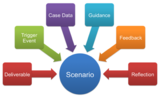
Today was my second day at DevLearn 2009 and I must say its been a great investment this far. If not for anything else, its been a great opportunity to meet a lot of great learning professionals not just from the United States, but from all across the world. The ideas and thoughts that we've shared will be of great value to my work back in Bangalore, India. Today I sat through the workshop by Ruth Clark on the topic of "Scenario Based Learning" and I thought I could do a quick report on some things I learnt from the experience.What did I learn? Scenario based learning can be described as follows:What: Scenario based learning uses simulated, real life scenarios to trigger the acquisition and simultaneous application of a skill. It gives the learner the opportunity for Whole-task practice. Whole task practice involves being able to combine various non-integrated parts of skills and information to put together a real-world, real-life performance. An example of whole task practice is the ability to put together a budget in Excel as against the part-tasks of editing cells, creating formulae, etc. Scenario based learning also allows for better Far transfer of learning as against the procedural near transfer.When:Scenario based learning is effective in to simulate situations that are rare, strange, high-risk or impractical to simulate in a classroom or in the workplace.Who: Scenario based learning is best suited for Novices and Apprentices. The experts are perhaps the people that can help design this learning!There's empirical evidence to suggest that Scenario based elearning benefits the most from rich multimedia additions, such as real life videos.As with every other teaching strategy, its best not to use this as a silver bullet - consider your subject and your audience carefully before you deploy this approach. Lastly, I learnt that to build a learning scenario, you need to consider and plan six factors in your design:Task Deliverable: What will the learner do to demonstrate competence?Trigger Event: How the task or problem normally initiates in the job setting.Case Data: What background information is needed to solve the case? Guidance: How will learners get assistance when solving the case?Feedback: How will the learners receive intrinsic feedback as the scenario plays out? How will they receive traditional, instructional feedback a.k.a Teaching Moments?Reflection: What opportunities will the learner have to review their actions/ decisions and consider alternatives?Overall, I think the workshop brought out some really interesting discussion and I think the various perspectives and styles that people applied to their own design situations was particularly amazing. I'll recommend Ruth's session to anyone that has the opportunity to attend in the future.© Sumeet Moghe, 2009
Sumeet Moghe
.
Blog
.
<span class='date ' tip=''><i class='icon-time'></i> Jul 20, 2015 12:08pm</span>
|
|
I just sat through a session called "Actions Speak Louder than words - Creating Meaningful e-Learning Interactions", by Ethan Edwards of Allen Interactions. The session was about interactions that create mental stimulation to eventually improve workplace performance. Ethan explained that an interaction has four aspects to it; namely Context, Challenge, Activity and Feedback. The focus of the session was on crafting and implementing meaningful challenges and activities for elearning.What did I learn?Ethan's session provided a balance of detail between instruction and demonstration. Here are a few things I'll remember. A different style of presentations: Show and tell -- Ethan didn't just talk about his work, he actually showed real life examples of the interactions he's worked on. He embedded these as clickable links into the presentation and that made the entire experience almost seamless.It helps to have some time aside to answer questions as a conference speaker. Ethan did pretty well to set aside almost 20 minutes for QnA. On the content front, my big takeaway was Ethan's rules for elearning interaction design: Measure an observable action. The interaction should need attention and thought. This I feel is particularly important since a lot of elearning seems to be just a lot of click and turn! The interaction should have relevance and meaning in the real world. The interaction should allow the learner to model real world performance. The interaction should require effort to complete. And lastly, in keeping with my philosophy of "a safe environment to fail fast and learn from mistakes", the activity should be reversible. If a learner makes a mistake in elearning, it isn't the end of the world and we shouldn't be making the learner feel that way either!© Sumeet Moghe, 2009
Sumeet Moghe
.
Blog
.
<span class='date ' tip=''><i class='icon-time'></i> Jul 20, 2015 12:08pm</span>
|
|
Motivar através de desafios e incentivos é essencial na Formação, dinamizando a aprendizagem.A GAMIFICAÇÃO aplica elementos característicos dos jogos a ambientes não lúdicos, como é o caso da formação e-learning, potenciando a aprendizagem.Este e-curso focará técnicas e estratégias de gamificação, ou elementos de jogos, que, combinados, podem contribuir para que os cursos online sejam mais motivadores e envolventes, tornando-os mais eficazes.Objetivos:Compreender o conceito de gamificação e a sua aplicação na formação e ensino;Conhecer as principais técnicas e estratégias de aplicação do conceito em situações reais de formação;Desenvolver capacidade para conceber atividades pedagógicas gamificadas com o auxílio de plataformas de apoio à aprendizagem e de ferramentas digitais de gamificação.Início: 26 de fevereiro.Duração: 30 horas (2 horas presenciais, 5 síncronas e 23 assíncronas).Conteúdo Programático: Módulo 0: Introdução ao curso e ao ambiente e-learning - 2h presenciais Módulo 1: Dos Jogos à Gamificação - 1h assíncrona, 5h assíncronas Módulo 2: Elementos de Jogos - 1h síncrona, 5h assíncronas Módulo 3: Psicologia e Gamificação - 1h síncrona, 5h assíncronas Módulo 4: Cenários de Aplicação - 2h síncronas, 9h assíncronasFormador: Jorge Simões »» Informações adicionais e inscrições disponíveis aqui «« TecMinho - interface da Universidade do MinhoCentro e-Learning - elearning@tecminho.uminho.pt Tlf: 253 510 590www.tecminho.uminho.pt/elearning
Education & eLearning Blog
.
Blog
.
<span class='date ' tip=''><i class='icon-time'></i> Jul 20, 2015 12:07pm</span>
|
|
This morning I sat through the most awesome keynote by Andrew McAfee - author of Enterprise 2.0: New Collaborative Tools for Your Organization's Toughest Challenges. Andrew is one of the 100 most influential people in IT. His talk was not just informative and eye-opening, it was immensely entertaining. In short it was a privilege.What did I learn?Andrew's talk deserves a fairly long post (though with very random thoughts). His address was in 3 parts; the definition of Enterprise 2.0, the "state of the art" as he saw it and the things to avoid ("how to snatch defeat from the jaws of victory")The Definition of Enterprise 2.0Involves use of emergent technology or new uses of technology or social software;Solves business problems and answers business goalsThe State of the ArtAndrew defined the state of the art of Enterprise 2.0 under 6 major headings:AltruismPeople want to help each otherEnterprise software needs to be people centric not document centricThe paranoia about risks is not senseless, but overrated. Most risks never materialise because in the enterprise, you don't have the luxury of being anonymous like on the web. People are unlikely to do the "wrong" things. In fact they never do it.The entry barrier for people to want to help each other, needs to be low -- eg: Twitter. People can help each other and do that within just 140 characters!ProcessThere's rarely one best way to do things in today's business world -- the era of best practices is dying.People need to have the ability to self select and self organise when contributing content and deciding how and when to collaborate. We need to limit workflow - it can't take several levels of approval to do something simple. Structure shouldn't be imposed. Tools need to facilitate structure and structure should develop over time.InnovationExample: Innocentive, the idea of crowdsourced innovation, where its only a matter of getting a different person to take a look at your problem and solve it for much less than the solution is really worth!Getting more eyeballs to look at a problem often generates more solutions. Expertise is emergent, not identified. Anyone can be an expert and people are recognised for their contribution and not their position/ credentials. Communities should be the one that people want. Nothing should be imposed. (Something someone said "Communities of interest" vs "Communities of Practice")IntelligenceHarness the collective. The wisdom of crowds makes decision making really powerful. Peer decision making, peer reviews, peer innovation and peer feedback make ultimate sense (given the number of eyeballs looking at the issue!)Andrew gave the example of the prediction market's analysis of the Obama campaign where crowdsourced probabilities resulted in a more accurate prediction of the election results than the most sophisticated analysis by expert statisticians.BenefitsEnterprise 2.0 gives you the opportunity to "narrate your work" to the extent that you can all of a sudden demonstrate your expertise.It creates for better social connections. You are connected to the right people sooner. It offers the opportunity to benefit from varied perspectives on a certain topic.ImpactResults of a McKinsey study about web 2.0 tools shows:Access to knowledge 68%Access to internal experts 43%Employee satisfaction 35%Increased innovation 25%Increased customer satisfaction 43% Its a bad idea to sit out the Web 2.0 phenomenon. We need to look at technology with a fresh set of eyes. We can't go back to "business as usual" after this recession. Businesses need to leverage technology as one of its key components.Things to AvoidDon't try to replace email: Instead think of things that email cant do. Don't accentuate the negatives: Instead point out risks while accentuating the huge business benefits. Don't fall in love with features: Start simple, iterate through the solution Don't declare war on the enterprise: Its a bad sales strategy to alienate the very people that'll sponsor such a thing. Organisations need structure to functionDon't build walled gardens: Instead allow multiple groups to flourish in the same place. Moving between groups needs to be seamless.Don't overuse the word "social": It creates the wrong connotations for the business; especially in a time when we're seeking tangible results.© Sumeet Moghe, 2009
Sumeet Moghe
.
Blog
.
<span class='date ' tip=''><i class='icon-time'></i> Jul 20, 2015 12:07pm</span>
|
|
The first concurrent session that I attended this morning was Ruth Clark's talk about Evidence based Training. Ruth talked about moving from fads and fiction to facts about the use of multimedia in training and education. Ruth as usual was her confident, articulate self and displayed some wonderful research and evidence that contradicts a lot of traditional wisdomWhat did I learn?Learning styles are overrated and a waste of time. There's no relationship between someone's learning style and their eventual performance on the job. eg: being a visual learner doesn't mean that you will have a high recall of an image. Liking a session has no correlation to an individual's learning in the session. A highly rated session may not be the most effective.People need the bare minimum detail to apply the learning. Extraneous detail is confusing (war stories, anecdotes, etc) and while immensely likeable, can hurt learning.Tips for use of multimedia in elearning and training:Graphics with text create the highest impact learning because of the dual encoding phenomenon. This is a great mode for novices and apprentices. Audio narration is proven as the most effective method of providing descriptions to graphics. This should be the default on elearning courses, with the ability to pause, and turn off. Simple line drawings are much easier to recall than complex 3D pictures. Stills are often more effective than animation, to explain how things work. In such situations, animations put the brain in a passive state and create extraneous mental load Videos are proven to be effective in teaching social skills and motor skills and to show examples.© Sumeet Moghe, 2009
Sumeet Moghe
.
Blog
.
<span class='date ' tip=''><i class='icon-time'></i> Jul 20, 2015 12:07pm</span>
|
|
ICERI2015, the 8th annual International Conference of Education, Research and Innovation will be held in Seville (Spain), on the 16th, 17th and 18th of November, 2015. Important dates: Abstract Submission Deadline: July 16th, 2015. (included)Final Paper Submission Deadline: October 1st, 2015. (included) Registration deadline for authors: October 1st, 2015. (included) Conference Dates: Seville (Spain), November 16th-17th-18th, 2015.Game-based learning and Gamification are some of the conference topics.
Education & eLearning Blog
.
Blog
.
<span class='date ' tip=''><i class='icon-time'></i> Jul 20, 2015 12:06pm</span>
|
|
The last session I attended today was Kim Ziprik's short talk on "Business Alignment: Focus on the Workplace ...Not the Classroom!". Kim took aim at the tendency of training departments to "train their way out" of a performance problem and how that has very little impact on actual workplace performance. She went onto talk about approaches that may be useful to bring the focus back to the workplace, where most learning happens.What did I learn?There are tremendous challenges that training teams are facing as a consequence of the changing pace of businsess:performance variables; learner motivation; change of business situation; retention drops drastically a short time after a training event. training doesn't address the entire value stream and looks at localised optimisations training is a cost based exercise that traditionally doesn't focus on workpplace performance whereas we should be investing in learning which is geared at solving challenges in the workplaceKim talked about creating "Learning Wells and not Training Dams": drive what people need via their experience levels. She gave tips very similar to the ones I used in my older post about the Dreyfus ModelLeverage performance based tools like: Job Aids (Standard Work?); Employee Performance and Support Systems; Self Assessments; Coaching; Communities; Career based curriculum Integrate learning into the workplace - create continuous learning opportunities. Redesign your Learning Architecture. Rethink the roles your training team plays, the places where training happens, the measures for effectiveness, technologies assisting learning and the culture that surrounds these experiences. Reduce the dependency on a single source of information. Harness the power of the collective - people together are far smarter than you can ever be.© Sumeet Moghe, 2009
Sumeet Moghe
.
Blog
.
<span class='date ' tip=''><i class='icon-time'></i> Jul 20, 2015 12:06pm</span>
|