Blogs
|
I recently changed my job and have been busy getting adjusted to the new environment, learning new technologies and picking up some Articulate skills. This is the first time I am actually using the tool and I experienced a shorter learning curve.
While the tool is very easy to use, there are issues that crop up every now and then and the issues are varied. In this post, I would like to talk about a recent issue that I faced while using Articulate 09 and show a way to resolve the issue. I sent a mail to the Articulate team and they quickly sent me a fix.
Let’s talk about the issues and the fixes now. I faced two major issues while publishing my e-learning course:
Issue with the label of slide number in progress bar
Solution
Select Player Templates->Text Labels. Set the Language to "English".
Select Close button and save changes and republish your content.
Email icon didn’t show up after publishing the course
Articulate applications are not currently supported using a large DPI setting. If you are using 120 DPI some symptoms are:
Elements of the application appear misplaced or distorted.
The published output is distorted or does not display correctly.
Solution
You can resolve this issue by following the steps outlined in the Knowledge Base article below.
Presenter ’09:
http://www.articulate.com/support/presenter09/kb/?p=188
Hope you found this post useful. Stay tuned for more posts.
Rupa Rajagopalan
.
Blog
.
<span class='date ' tip=''><i class='icon-time'></i> Jul 20, 2015 12:09pm</span>
|
|
Its been ages since I blogged and am I really feeling bad about it? I still can’t figure out. I was just wondering why I stopped blogging:
New job
New stuff to do
Bored of blogging
Unwillingness to write full length posts
Am running out of ideas
Nothing new to share
Blogging is not helping me in any way or
Simply lazy
Reasons could be many. But then I don’t want to stop sharing stuff here. Probably I should start writing snippets - a few lines or a paragraph about something that I want to share. What do you think?
Rupa Rajagopalan
.
Blog
.
<span class='date ' tip=''><i class='icon-time'></i> Jul 20, 2015 12:09pm</span>
|
|
Ask 3 different people, the question : What is Instructional Design? Now compare and contrast the responses. I am sure you will be amazed at the different perspectives you get. As far as I know, Instructional Design exists in different forms and Instructional Design might mean different things to different people.
How you perceive/describe Instructional Design depends on your:
Location/Context
Nature of work you do
Here are 3 scenarios to illustrate this:
PS: Some scenarios here may apply only to Indian workplaces.
Scenario 1
Instructional Designers working in a company catering to e-learning/training requirements of various organizations work on various subjects (soft skills, K12, technology), and develop e-learning courses/training programs for varied audience. In such a situation, they do extensive needs analysis, audience analysis, come up with new ways to engage learners for every project because every project is unique. The requirements, strategies to design the training, budget and so many other factors differ with every project.
Scenario 2
An Instructional Designer has to create a new learning environment (game based learning program on mobile devices) for underprivileged kids residing in some remote village in India. Now this is a highly challenging task. This would require lot of research skills, creativity, time and budget more than anything else. This kind of work is more analytical and creative.
Scenario 3
Instructional Designers working in a software product company mostly catering to internal training requirements may not be paying too much attention to learning needs analysis, audience analysis, design strategies for every project because the audience and their needs are fixed.
The objective in this case is to release all the required technical training material in a short time for learners to consume quickly. It is more important to provide the right information, in an understandable language in a short time than anything else just to help learners do their job. This kind of work demands creativity within limitations.
To serve the purpose, Instructional Designers work on low budget rapid e-learning courses, mostly text based with little interactivities. Simulations and demonstrations are used when necessary. Standard e-learning templates and course developments guidelines are available. These templates are designed keeping learning needs and learners in mind . Improvements to the course development process or templates happen after every release based on learner feedback. Following any other approach other than this will mean waste of time and money for the organization.
You could call this content development. Yet the content itself might be of great instructional value.
Scenario 4
A trainer delivering a training on some topic may or may not be the one who actually designed the program. He/she might actually do a brilliant job without even knowing Instructional Design principles or theories.
Now here is a question for you:
Where are you located? What is Instructional Design to you? Please leave your thoughts in the Comments section. I would like to hear from you.
Rupa Rajagopalan
.
Blog
.
<span class='date ' tip=''><i class='icon-time'></i> Jul 20, 2015 12:09pm</span>
|
|
I downloaded the trial version of Articulate Storyline and have been playing with it. The best thing about Storyline is that Try Me Simulations are automated. You just need to open any web application and perform the tasks as you record your screen and then insert the slides as Try mode steps. Your job is done. All your mouse clicks/text entries are captured and when you preview, the same actions are available for the learner/user to try out.
Isn’t that cool? But there are still some things, I am trying to figure. I see that not all actions get converted to Try mode. For example I captured a screen where I moved sliders to set image quality. Storyline captured these actions but these appeared as a demonstration after publishing. Also the caption appears only when you click on a button or you place your cursor on a text field. I want to move the caption before the hotspot appears, but haven’t been able to do. Still figuring out.
So that’s all I have to share for today. More later.
Rupa Rajagopalan
.
Blog
.
<span class='date ' tip=''><i class='icon-time'></i> Jul 20, 2015 12:09pm</span>
|
|
A bit late but now fully available: Proceedings of the PLE Conference 2013 are now online and can be used as Open Resources under CC-Licence.The 4th PLE Conference focused on the theme of "Learning and Diversity in the Cities of the Future", among others addressing the issue of smart cities, one of the key research priorities worldwide and the strategic direction of Beuth University of Applied Sciences Berlin.Papers on "PLE and Gamification":Using Gamification to Improve Participation in
a Social Learning Environment
Jorge Simões, Rebeca Redondo, Ana Vilas, Ademar Aguiar Gamifying Quantified Self Approaches for Learning:
An Experiment with the Live Interest Meter
Benedikt S. Morschheuser, Verónica Rivera-Pelayo, Athanasios Mazarakis, Valentin ZachariasDecentralized badges in educational contexts: the
integration of Open Badges in SAPO Campus
Carlos Santos, Luís Pedro, Sara Almeida & Mónica ArestaSocial badges dynamics in institutional supported
platforms
Carlos Santos, Luís Pedro, Sara Almeida, Mónica Aresta
Education & eLearning Blog
.
Blog
.
<span class='date ' tip=''><i class='icon-time'></i> Jul 20, 2015 12:09pm</span>
|
|
This is one of the best instructional videos that I have come across. Some highlights of this video:
Focuses on a single learning point
Has a storyline
Has humour
Is instructionally sound
Focuses on real life situations
Demonstrates practical application of skills
The best way to open a sales talk - Explania
Rupa Rajagopalan
.
Blog
.
<span class='date ' tip=''><i class='icon-time'></i> Jul 20, 2015 12:09pm</span>
|
|
Está em fase de lançamento e pré-registo, a plataforma EuProf, uma nova plataforma web, centrada no professor e para o professor, em português.Porque o professor é um profissional especial e existe para além da instituição onde leciona hoje.Porque precisa focar-se no importante, ensinar, suportado por uma infraestrutura sólida que suporte a sua atividade complexa.A plataforma assenta em quatro pilares fundamentais: Preparar e Organizar Gerir o dia a dia Analisar e Avaliar Reaproveitar O pré registo, com acesso a condições especiais, pode ser feito até 31 de agosto. Para já, está apenas disponível o site associado à plataforma. A plataforma em si está prevista para ser lançada em setembro.Ver também: https://www.facebook.com/euprof(declaração de interesses: sou consultor e parceiro do projeto)
Education & eLearning Blog
.
Blog
.
<span class='date ' tip=''><i class='icon-time'></i> Jul 20, 2015 12:09pm</span>
|
|
I was a complete novice when I entered the world of Instructional Design. I wasn’t a technical writer before (as is common notion that technical writers graduate to become Instructional Designers) nor was I working in another company. I was a fresher. Yes, a fresher.
Working with complex technologies and understanding the nuances of Instructional Design is an art. As with other art forms, it can be honed by constant practice on the job. Initially, I was overwhelmed by the processes and strategies that abound the world of Instructional Design but beyond the initial jitters, it is a highly satisfying job.
Hiring freshers in Instructional Design is a good thing, contrary to the corporate thinking. Here are some reasons:
Open mindset: Freshers plunge headlong into this field with an open mindset, willing to learn and understand the nuances of instructional design. For me, it was about offering a fresh perspective into what works in training and what doesn’t, as I had already been exposed to different forms of training in college.
Ability to spot problems in the process: A fresher is a good judge of processes or training methodologies that work. As a fresher, I always think beyond rules and regulations that constrain an experienced person.
High risk taking capacity: Freshers are not bound by barriers. They are not drilled into long-standing systems, long-held assumptions and regulations. They have a high sense of enthusiasm and are always willing to try new things. This enables them to identify highly creative solutions to difficult problems undeterred by potential roadblocks in the implementation process.
Highly creative: Since freshers aren’t constrained by rules, regulations and processes of Instructional Design (yet!), they are usually good at projects that require creativity and enthusiasm.
High energy levels: Freshers are more energetic and proactively jump into learning new skills, processes and methodologies. They improve group dynamics that lead to a better, happier, and more energetic workplace.
As an ex-fresher (I have been one year in the system now), I would say that beyond the initial jitters and the time taken to understand the system . . . there is a world that you would love to be in - A world of creativity and innovation.
Hope you liked this post. Stay tuned for more.
Do share your thoughts on this post in the Comments section. I would love to hear from you.
About the Writer
Vishnu Vardhan is an Instructional Designer by profession and a poet, cricketer, and explorer by passion. He loves meeting new people, learning new technologies, and creating amazing courses. He is specially inclined towards Gamification in eLearning.
Rupa Rajagopalan
.
Blog
.
<span class='date ' tip=''><i class='icon-time'></i> Jul 20, 2015 12:08pm</span>
|
|
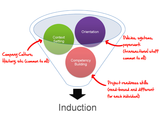
One of my latest challenges is to redesign our induction program for experienced hires across the globe. While I'm working on this problem, I've had a few thoughts that I'd like to share on this blog. To give you some context, we're a consulting firm -- consulting being a bit of a generative domain, people join us at various levels of experience and as a consequence, with a huge variety of training expectations. I can imagine that for other organisations operating in such a domain as versatile and diverse as this, challenges could be similar. So here are some of my thoughts about designing induction programs.The components of an induction programTo me induction programs are about "making new hires comfortable" in an organisation. To feel comfortable, a new hire needs the following things. I'm sure you will recognise these steps in an induction program though I'm guess different organisations label these steps differently.OrientationEvery organisation has a set of policies and procedures that people need to know about. Everyone needs to know about the systems that keep the lights on, and the people that keep the engine running. These are pieces of information that define how the organisation works. Fortunately enough these are so black and white at most times, that it perhaps makes sense to take the facilitator out of the picture and consider the approach of conveying this information through some online learning. That said, this part of the induction experience is common to everyone, you have the economies of scale working in your favour and you can actually choose to do this with a bunch of people in a room, with a facilitator leading the session. That it is extremely boring to sit through a series of "Powerpoints" conveying nothing but facts, is a separate issue to consider.Context SettingThere are other aspects of an organisation that lend themselves to more generative discussion. A company's purpose, mission, values and the rationale behind them; their business model and the surrounding challenges; the career development framework and the surrounding support systems, all merit significant discussion. It makes a lot of sense to get people together, either in a synchronous, online environment or preferably, in a colocated environment with a specialist business representative in attendance. Again, this is the part of the induction experience common to everyone, so doing this together with everyone makes perfect sense.Competency BuildingOrientation and context setting aside, the bulk of most induction programs is the part around project readiness. Unless you're hiring people in purely transactional roles, there's very little chance that you can achieve the economy of scale to get a fair number of people in the same room to train them on a specific set of skills. An analyst with 2 years of experience will have significantly different training needs from a developer with a decade's experience. In the same way the training needs for a senior project manager could be significantly different from that of a fairly senior quality assurance analyst. This is where the challenge comes in designing the 'right' induction experience. How do you design an induction program that absorbs the variation in training needs for such a diverse audience. Obviously, a one-size-fits-all program will fit nobody.Competency Building - how about a pull-based approach?Learning is a process, not an event. Malcolm Gladwell's book - The Outliers, explains how it takes 10,000 hours of practice to become good at something. Many months back, Tom Kulhmann wrote about how learning happens over time. Often out of the dozen skills an individual needs to perform her job, there's only one or two skills that one needs to 'get started' at their job. This is key. There's a common tendency to throw the kitchen sink at the induction program. Trainers, designers, SME's and the business will say - "but they need to know X as well!" My belief OTOH is that your induction should serve the purpose of kick-starting an individual's learning process. From that point on, its upto the individual to seek out continuous learning opportunities as the need comes by. Learning is a process, not an event (and yes, I know I'm repeating myself).What other opportunities do people need to learn? So, its easy to say that its upto the individual to seek out continuous learning opportunites. 'What may these continuous learning opportunities be?' and 'How should the individual seek out the bare minimum training they need?' Let me answer the second question first. Here's where I see a great role for elearning. If a training department can create a bouquet of online training programs that are bite-sized to the extent that they help people perform specific actions, then new hires can pick exactly what they think they need. There's an obvious question that comes up when I talk about this. What if a new hire needs more than what they think they need?I feel this is valid question -- you can't expect everyone to be a 100% self aware. This said, if you can create a culture of feedback then no error in judgement is an error for very long. Its only until someone gets feedback that the 'mistake' remains a 'mistake'. In a culture of failing fast and learning from one's mistakes, the ability to choose the learning resources you need puts the power right back in the hands of the learner. Yet again the power of online, self-paced learning is the fact that individuals can exploit them the way they deem fit. They can access the resources as many times as they want and they can access only as many resources as they want.So with the second question answered, lets get back to the first question - "What constitutes continuous learning opportunities?" Let's look at the picture above. There are a number of ways to create continuous learning. Of course there's elearning -- but you'll see some other modes up in the picture. Many of us know about learning lunches and some of you may have read my previous article on the role of social media and why synchronous learning makes so much sense today. The fact is that if people can choose to attend some of the more formal training events, based on a need they perceive, it lends a great deal of effectiveness to the training program itself. Every facilitator knows how much fun it is to train a group of people that are motivated to learn. Above all, the best way to foster a culture of continuous learning and improvement, is to foster a culture of continuous feedback. Pat Kua knows something about that, and I recently aggregated some of his posts here. The last part of continuous learning in an induction experience is the hugely underestimated part around project onboarding. If projects can learn how to practise lightweight, onboarding practices then very early in their career in your company, it helps new hires develop an awareness about what it will take for them to be successful on their first project.So what I was trying to say in this blogpost was this -- how about an induction program that is colocated only to the extent of providing an orientation and setting context about the organisation? You can't need any more than a few days for this. How about, from that point people pull every piece of training that they need, by themselves? How about you put the power back into the hand of your learners?Let me know what you think. I'm sure your thoughts will help me focus my thinking for my own project. Post your comments liberally and write to me if you need to.© Sumeet Moghe, 2009
Sumeet Moghe
.
Blog
.
<span class='date ' tip=''><i class='icon-time'></i> Jul 20, 2015 12:08pm</span>
|
|
Have you ever had a time when you got slammed in the face with a huge plate of food which you just couldn't say no to? I have. Picture the above meal -- for some it might just be the tastiest thing they could imagine. For me, while I find it difficult to say no sometimes and even if I only want a little, I have to labour through the entire meal. I just got off a five hour flight to Hong Kong, and I've had a bit of an epiphany. Let me tell you the story first. This flight left Bangalore at about 2:35 AM -- a time at which I'm usually fast asleep. So what I really wanted on this flight was some sleep. That said, airlines have a strange sense of hospitality so at about 3:30 AM they made me put my seat back upright, turned on the lights and gave me some food to eat. Well I can't say no to food, so I ate. They then kept the lights on at full-blast; don't know why, but they did. If that snack wasn't enough, at about 6:30 AM they shook me up and asked, "Vegetarian or Non-vegetarian". My instinctive response is "Non-vegetarian" and well I got what I asked for while being half asleep, but really I didn't need a big breakfast with beans, tomatoes, sausages, an omelette, potatoes, yoghurt, fruits, cheesy bread and juice. I really just wanted some sleep. A part of me wondered if it was ever going to be possible for me to tailor my flight experience for the next several years that I travel economy! And then, all of a sudden I thought about training (like I always do!).Most training experiences push learning to the learnerRegardless of our good intentions, many of the courses we design tend to take a whole bunch of learning objectives which we then push onto the learner. We keep asking ourselves the question of whether something needs to go into a course and then we say, "But they really need to know this..." and we slam that topic right into the training. While some learners enjoy it and others endure it, we need to ask ourselves if this is really effective. Research proves that human brains work very sensibly in these situations -- we stay conscious only about the pieces of knowledge or the skills that we will need/use on our immediate work. The rest slips into the subconscious and we incubate those bits of information until we need it at a later time. John Medina's Brain Rules, explain these phenomena in great detail. So if people are only going to retain what they will use, why contaminate that message with the surrounding nice-to-have stuff?Learners need to be self awarePeople learn from experience and most learning sinks in, on the job. People learn from feedback and feedback comes not only from peers and coaches, it also comes from your environment. When you keep attempting something and get a result that you didn't expect, you're getting some feedback. The key is that as people progress on the job, they get feedback from various sources and become more and more self-aware about where they are and where they'd like to be. A safe environment to fail fast and learn from mistakes is critical to this self-awareness. So I often think that while training is important, its more important for organisations to provide a safe environment that's conducive to learning. Only then can you develop people that are truly in control of their development and have the awareness they need to succeed.Self aware learners can pull the learning they needOnce you're self aware, you automatically know what resources you need to learn. The key is that different people learn differently. Some people learn by reading a book, others by attending a course, a lot of people can learn effectively online and there are others who learn by networking and socialising with people. The key to being a learning organisation is in providing these learning opportunities throughout someone's career. There are many ways to create these opportunities. Here are some I can think of:Design your instructor led courses to be no more than 90 minutes each with a targeted set of objectives for each 90 minute chunk. This way, you increase your flexibility to run them on-demandDesign your elearning to be in the form of small coursels (like morsels in case of food). Think of bite-sized chunks no longer than 10 minutes. Adopt a how-to approach. Invest in Enterprise Social Software for your firm, so that people can crowdsource learning. After all, most learning happens by talking to the guy that sits beside you, or over that cup of coffee. Most importantly this opens up opportunities for your learners to network with people they never knew Facilitate informal events, like Hack Nights, Lunch and Learns (people bring in food and sit in a session over lunch), Pecha-Kucha nights and Ignite evenings. Institute other forms of support such as a book budget where people have the opportunity to spend money on something they feel can help their learning. I'm sure there are dozens of other, non-intrusive ways to create opportunities for continuous learning. What has your experience been with things such as this? Feel free to share your thoughts liberally in the comments section of the post and if you'd like to, please write to me.(Photograph in this post taken from cocomo7's Flickr stream)© Sumeet Moghe, 2009
Sumeet Moghe
.
Blog
.
<span class='date ' tip=''><i class='icon-time'></i> Jul 20, 2015 12:08pm</span>
|