Blogs
|
Bow Master is a sport game. In this game you need to hit targets using the bow and arrow. You just need to drag the arrow using your mouse and simply click to release the arrow. The controls are very simple and easy to use.
I liked the 3D effects in this game and it really makes a good impact.
The game has different levels of challenges and you need to clear each level to move on to the next.
I cleared 2 levels and still playing
Play the game now!
Rupa Rajagopalan
.
Blog
.
<span class='date ' tip=''><i class='icon-time'></i> Jul 20, 2015 12:59pm</span>
|
|
Ao que parece, em 2012, começa a ter força uma nova tendência no uso de tecnologias na educação (ver What Teachers Need to Know about BYOD (Bring Your Own Device) Trend in Education partilhado por @pgsimoes).
"Bring Your Own Device" (BYOD), ou seja, algo que podemos traduzir por "cada um traz o seu próprio equipamento". O que isto quer dizer é cada aluno leva para a escola os equipamentos necessários (computador portátil, tablet ou smartphone). Faz todo o sentido se assumirmos que os alunos já possuem estes equipamentos e portanto será natural que na escola não usem outros. Para as escolas a vantagem é económica. Menos dinheiro gasto em equipamentos, bastando assegurar a infraestrutura de comunicações e os espaços físicos que não serão mais do que a sala de aula normal.
Em Portugal, graças aos programas de incentivo dos últimos anos, muitos dos alunos do secundário (e mesmo do básico) já têm os seus portáteis (que muitas vezes duram após a entrada no ensino superior). O portátil é cada vez mais uma ferramenta que as famílias já consideram como fazendo parte do material escolar dos alunos. Mais difícil será o acesso a smartphones e, sobretudo, aos tablets. Com estes dois últimos, é possível criar experiências pedagógicas muito interessantes mas é necessário que todos os alunos os possuam. Ainda não é essa, para já, a realidade.
A generalização do BYOD terá vantagens para todas as partes envolvidas (escolas, alunos e famílias). A tendência segue a linha da visão da geração atual de alunos como sendo constituída por nativos digitais. Se estes já possuem e usam a tecnologia desde sempre (se calhar antes de começarem a andar), faz todo o sentido que a usem na escola. Trata-de de algo que já faz naturalmente parte da vida como sempre a conheceram. Proibir o uso de telemóveis na escola ou barrar o acesso a redes sociais cada vez mais deixa de fazer sentido.
Mas esta é a visão mais romântica e otimista do BYOD. Apesar das vantagens, a tecnologia é uma fonte de distração. Usar os mesmos equipamentos e tecnologias na escola e para o lazer torna mais difícil aos alunos distinguirem quando as devem usar para um fim ou para outro. Tudo bem se as usarem fora da escola para continuarem as suas tarefas académicas mas mais complicado quando na escola as usam para jogar ou para atualizar o Facebook com conteúdos que não tenham a ver com escola. Também há o argumento oposto: fora da escola também as usam para fins académicos.
Este será provavelmente o grande desafio para a aplicação do BYOD: encontrar o equilíbrio certo no uso das mesmas tecnologias para aprender e para socializar e lazer. O "quando" e "como" usar as tecnologias será a chave deste desafio.
Education & eLearning Blog
.
Blog
.
<span class='date ' tip=''><i class='icon-time'></i> Jul 20, 2015 12:59pm</span>
|
|
No dia 9 de julho terá lugar mais um dia aberto do Projecto Escolinhas Criativas, uma iniciativa da Tecla Colorida, a empresa promotora da plataforma Schoooools.com. Destaque para a participação de Graham Attwell. Ver mais no blogue do Schoooools.com.
Education & eLearning Blog
.
Blog
.
<span class='date ' tip=''><i class='icon-time'></i> Jul 20, 2015 12:59pm</span>
|
|
by ruparajgo | Create your own Cartoon at www.toondoo.com
The Instructional Designers Community of India is hosting its third meetup in Bangalore.
Time: June 27, 2009 from 10 AM to 1 PM
Venue: Adobe India Pvt Ltd, Salarpuria Infinity, 3rd Floor, #5 Bannerghatta Road
Session Title: Managing Talent Through Informal Learning
Session Objectives
At the end of this session, participants will be able to:
Distinguish between formal and informal learning
Define various forms of informal learning practices in vogue today
Recognize the value of informal learning in the current knowledge economy
Explain the role of technology in implementing informal learning in the modern day enterprises
About the Speaker
Simhadri Ramarao has 14 plus years of experience in different spheres of learning.
He has worked as a lecturer, instructional designer, e-learning product manager, ID Lead, and currently managing the delivery of technical curriculum in the IT organization of Cisco.
He has done Masters in Science and M.Phil in Instrumentation and a Postgraduate Diploma in Computer Science.
What you can do?
RSVP for the meetup here
Share your knowlege about Social Learning during the meetup
In case you cannot make it to Bangalore
The following will be made available after the meetup:
Podcasts
Minutes of the meetup
Video recordings may also be available. However this fully depends on the camcorder that we are trying to get for the meetup.
Note:
The survey result here says that majority of you want to attend the meeting online via webex or adobe connect. Sorry we could not arrange an online meeting this time. This will definitely happen in the near future.
Rupa Rajagopalan
.
Blog
.
<span class='date ' tip=''><i class='icon-time'></i> Jul 20, 2015 12:59pm</span>
|
|
A propósito do post publicado aqui - "Bring Your Own Device" Trend - Graham Attwell, referiu ontem, no Dia Aberto do projecto Escolinhas Criativas, que teve lugar no UPTEC PINC, que considera o BYOD como uma das principais tendências com impacto na educação para os próximos anos.
(Graham Attwell)
Attwell colocou um post sobre o tema no blogue da organização a que pertence - Pontydysgu. Neste post, está incluída uma apresentação de Sam Gloksman (entre outras coisas, fundador do website iPads in Education) que apresenta um plano tecnológico para as instituições de ensino onde realça as vantagens do BYOD.
(ver aqui os slides da apresentação)
As vantagens económicas para as instituições de ensino são óbvias e este tipo de estratégia vai ao encontro daquilo que se pretende que sejam os ambientes de aprendizagem do século XXI.
Ver também este post de Sam Gloksman.
Education & eLearning Blog
.
Blog
.
<span class='date ' tip=''><i class='icon-time'></i> Jul 20, 2015 12:59pm</span>
|
|
The third Instructional Designers Meetup was conducted by IDCI on June 27th, 2009. The meetup was sponsored by Adobe and happened in the Adobe office for around 2 hours.
This time, there were some new participants, also a non-learning professional, with great interest to get into the field of learning and development.
The participant list goes on like this:
Ram
Rupa
Prem Kumar
Mayank
Puja
Miriam
Shameer
Gaurav Maheshwari
Hareesh
David
Christine
Sharad Single
Sadhana
Malini
Nilanjana
The June session was about informal learning or social learning. Well, most of us keep hearing about informal learning or social learning. However how many of us actually know what it implies.
Ram’s session was an instant hit with the participants because it was at the beginner level and threw light on what is informal learning and how does it work.
Ram used a short interactive exercise to explain what is informal learning. He used some scenarios and asked the audience to choose the best response. For example one of the scenarios was : What would you do if your printer at office got repaired?
The response choices were: Call technical support, Read the instructions next to the printer, Ask a colleague etc
The audience unanimously said they would try finding some written instructions or ask their colleauge for steps to fix the printer.
Ram’s scenarios and the audience response drove the point home that informal learning is part and parcel of everyday life.
Ram continued to talk about the different forms of learning and distinguished between formal and informal learning.
He also spoke about the role of Web 2.0 in promoting informal learning. Why informal learning is relevant today was also talked about and discussed.
Ram used a CISCO Telepresence commercial to explain how informal learning works very well using new tools and technologies.
The participants completely enjoyed watching the commercial and the commercial was not just about technology. It was about how informal learning or social learning works.
There were discussions on how difficult it is to measure informal learning, challenges with respect to getting people to collaborate and some ways in which you can get people to collaborate in organizations.
The session ended with feedback and suggestions. The participants showed lot of enthusiasm and asked for more such face to face meetups and knowledge sharing sessions.
Here is a snapshot of the feedback cards:
The June session was recorded. Thanks to Hareesh for getting the camcorder. The video clippings will be made available soon.
Watch out the IDCI site for more news on July meetup.
Rupa Rajagopalan
.
Blog
.
<span class='date ' tip=''><i class='icon-time'></i> Jul 20, 2015 12:59pm</span>
|
|
Artigo publicado na revista Computers in Human Behavior em co-autoria com Rebeca Redondo e Ana Vilas da Universidade de Vigo:
Article title: A Social Gamification Framework for a K-6 Learning PlatformReference: CHB1881Journal title: Computers in Human BehaviorCorresponding author: Dr. Rebeca Díaz RedondoFirst author: Dr. Jorge SimoesOnline publication complete: 5-JUL-2012DOI information: 10.1016/j.chb.2012.06.007
Impact Factor: 2,293
Disponível em http://dx.doi.org/10.1016/j.chb.2012.06.007
Abstract:
As video games, particularly, social games are growing in popularity and
number of users, there has been an increasing interest in its potential
as innovative teaching tools. Gamification is a new concept intending
to use elements from video games in non-game applications. Education is
an area with high potential for application of this concept since it
seeks to promote people’s motivation and engagement. The research in
progress will try to find how to apply social gamification in education,
testing and validating the results of that application. To fulfil these
objectives, this paper presents the guidelines and main features of a
social gamification framework to be applied in an existent K-6 social
learning environment.
Versão estendida do artigo publicado na Tech Education 2012 (ver este post).
Education & eLearning Blog
.
Blog
.
<span class='date ' tip=''><i class='icon-time'></i> Jul 20, 2015 12:58pm</span>
|
|
China 2008 is a sport game. This game reminds you of Olympics where athletes participate in a series of events such as hurdles, javelin, long jump, high jump and so on. The athlete gets medals based on how he/she performs in each event.
China 2008 gives you a feel of participating in Olympics. In this game you need to play a series of games, one after the other and you get scores based on your performance. You can choose to undergo training before you actually play the real game.
You just need to use X and Z keyboard keys to play the game.
It is really challenging to use the keys effeciently. But then its fun to play even if you do not fair so well.
What I liked about the game
3D Graphics and animations
Background score
Training
The concept
Easy game controls
Play the game now and share your experiences by leaving a comment.
Rupa Rajagopalan
.
Blog
.
<span class='date ' tip=''><i class='icon-time'></i> Jul 20, 2015 12:58pm</span>
|
|
Três vídeos com Constance Steinkuehler em conversa com John Seely Brown(ver este link). Nestes vídeos, Constance Steinkuehler responde às questões seguintes:
Por que é importante investir em saber mais sobre jogos e educação?
De que forma os jogos podem afetar a socialização?
Como saber o que é um "bom jogo"?
Estes vídeos defendem a importância da Aprendizagem Baseada em Jogos e por que é que vale a pena apostar nesta forma de educar.
Outra visão, que vai no mesmo sentido é a do Professor João Mattar que no vídeo seguinte faz uma apresentação sobre a Aprendizagem Baseada em Jogos ou Game-based Learning. Na sua definição sobre o que consiste a aprendizagem baseada em jogos está presente a possibilidade usar elementos de game design na educação que não é mais do que a aplicação de gamification na educação.
O vídeo inclui vários exemplos de como usar jogos em sala de aula.
Uma extensa lista de vídeos e outros recursos sobre este tema podem também ser encontrados em Games in Education 2012 - SAGA.
A
partir da popularidade dos jogos sociais (Facebook games), Jesse Schell
faz uma apresentação, muito polémica, sobre a generalização de game thinking:
A terminar, um vídeo de Paul Andersen com o relato de uma experiência concreta de aplicação gamification em sala de aula (ver também este link que refere elementos de jogos que podem ser aplicados em educação):
Education & eLearning Blog
.
Blog
.
<span class='date ' tip=''><i class='icon-time'></i> Jul 20, 2015 12:58pm</span>
|
|
I do not think learning how to use a tool is a big challenge. But I guess you need to know how to work with a tool efficiently. Otherwise it might happen that you keep struggling to use the tool.
When you are in an organization, you may not have a choice with respect to using the tool, you are comfortable with or you love to work with. You have to use the tool for which the organization has bought license.
In such a situation it is best to get accustomed to the tool and quickly figure out how to work well with the tool.
I have not worked with many rapid e-learning tools. I have tried Captivate and have always talked in favour of this tool because I have not faced many problems creating quick tutorials for software product using Captivate.
When it comes to Camtasia vs Captivate, I always go for Captivate only because editing is very easy with Captivate. I have heard people say that Captivate generates massive slides and deleting all unwanted slides could be really painful. I have created only short tutorials using Captivate and I have found the tool effective and easy to use.
I like Captivate because it is easy to adjust timelines and callout durations. You can also adjust mouse transitions.
Recently I started using Camtasia and I must say I was flustered the first 2 days when I tried creating a tutorial video. I will not say Camtasia is a bad tool. I would rather say it is not easy to work with and I was not sure how to work with it.
This is what I did
I recorded all the screens
I tried editing the video and adding call outs later
Result
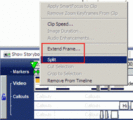
I had to split and extend frames leading to whole lot of items in the timeline.
I was not able to adjust the time frame of the call out after I split the frames. So I had to copy callouts onto the extended frames.
It was too much work splitting and extending frames.
What I learnt
I discovered that instead of spending so much time on editing, I must reshoot the entire video giving enough time for every call out and every text I was to put in the tutorial video. I wanted the call out with instruction to appear first and then the mouse action to happen. I kept this in mind and gave enough time for everything.
Deleting portions of the video is easy in Camtasia. So I reshot the whole video giving 10 to 15 secs time for every action, keeping in mind the time the user would take to read text and see the actions performed on screen. You can estimate time by keeping an eye on timer as shown below:
It was very easy after this because after I shot the whole video, all I did was delete portions of the video and insert call outs in appropriate locations. I did not have to extend or split frames because I shot the video in parts and not in one go.
To sum up here are my two top tips to work with Camtasia:
Always plan your video before you start recording
Create a storyboard with every little detail including the time needed for each callout and each action on screen
I am novice when it comes to Camtasia. I am sure there must be better ways to work with Camtasia. In case you are a camtasia expert, please share useful tips to work with the tool.
Rupa Rajagopalan
.
Blog
.
<span class='date ' tip=''><i class='icon-time'></i> Jul 20, 2015 12:58pm</span>
|