Blogs
|
Robotic food service is replacing lower level workers. I am currently reading Rise of the Robots by Martin Ford. Martin is a software development entrepreneur who has been in computer design and software development over 25 years. Working in Silicon Valley he has seen the effect of automation and robotics on the world of work. The subtitle of his book is Technology and the Threat of a Jobless Future. As you might imagine he does not have an optimistic outlook....
SHRM
.
Blog
.
<span class='date ' tip=''><i class='icon-time'></i> Jul 27, 2015 11:37am</span>
|
|
I am Rebecca Reznik-Zellen from the Lamar Soutter Library at the University of Massachusetts Medical School. In my work, Open Access (OA) is an issue that I encounter regularly. But OA is becoming a familiar term to many. We hear it from publishers, funders, and research institutions about scientific and scholarly publication. For some, OA conjures ideals of democratizing access to research by removing subscription barriers that keep important findings away from public, industry, and government entities. For others, OA inspires concerns about article processing charges, predatory publishers, and inconvenient processes for bureaucratic mandates. Which inclination is correct?
By definition, OA is the free and unrestricted online access to scientific and scholarly work. It enables broad and rapid dissemination of research, informs the public, and expedites the scientific process. When research articles are available to be downloaded, read, and reused, they demonstrate greater impact than articles locked behind subscriptions.
OA has been growing steadily since the Budapest Open Access Initiative and the Berlin Declaration defined and formalized it in the early 2000s. The Directory of Open Access Journals lists over 10,000 individual titles that publish research openly, comprising approximately one-third of all scholarly publications. Members of the Open Access Scholarly Publishers Association agree, by virtue of membership, that OA is an established approach to scientific publishing.
But while OA has become more established, it is still a communication model undergoing transformation. Determining the actual costs of publication is more difficult than it might seem, so the article processing fees designed to recoup these costs are highly variable. Unethical publishers who take advantage of an author’s desire to publish openly have emerged. And the complexities of complying with the NIH’s Public Access Policy can detract from the perceived value of OA.
So, both characterizations of OA are correct: OA IS a democratizing force in an otherwise unbalanced scholarly publishing system, AND the practicalities of implementation are challenging. OA will improve only if the producers and consumers of scholarship participate. This means actively engaging in the publishing process, calling out predatory practices, and taking the time to comply with funder mandates. Open Access is a goal worth pursuing.
Rad Resources to learn more about Open Access:
UNESCO’s OA Curriculum for Researchers
Lamar Soutter Library’s OA LibGuide
Guide for Evaluating OA Journals
SPARC Resources on OA
Do you have questions, concerns, kudos, or content to extend this aea365 contribution? Please add them in the comments section for this post on the aea365 webpage so that we may enrich our community of practice. Would you like to submit an aea365 Tip? Please send a note of interest to aea365@eval.org . aea365 is sponsored by the American Evaluation Association and provides a Tip-a-Day by and for evaluators.
AEA365
.
Blog
.
<span class='date ' tip=''><i class='icon-time'></i> Jul 27, 2015 11:37am</span>
|
|
Hello! I’m Siobhan Cooney, an internal evaluator at the College Board and member of the Eastern Evaluation Research Society’s Board of Directors. In this post I share information on one of my favorite features of Excel - the RAND function - and how it can be used in a random selection process.
Evaluators at times need to randomly select individual study participants or groups of participants. In random assignment studies, we select teachers, schools, neighborhoods and the like to form our treatment and control groups. Or, we might randomly select individuals from a large population in an attempt to achieve a smaller but representative sample. And, when offering incentives to study participants, we might give them each an equal chance of winning one of five iPads, for example; in this case, we want to randomly select five names from a full list of participants.
Hot Tip: Sophisticated software is not required to complete a random selection process. When you need to choose one of two options, I recommend flipping a coin. For many other cases, Excel works well.
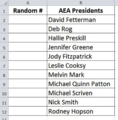
Cool Trick: Let’s suppose we want to randomly select two AEA past-presidents for a research study. Eleven past-presidents have agreed to be part of our research, if selected.
(1) In an Excel file containing the list of 11 AEA presidents, we first create a column in which we will tell Excel to generate random numbers.
(2) We then type "=RAND()" into the first empty cell in this new column. This function will return a random number between 0 and 1. We then click the cursor on the bottom right corner of that cell and pull down to apply the same function to other cells in the column.
(3) We have decided a priori that we will select the two AEA presidents with the lowest random numbers. Therefore, we want sort our cases from the smallest random number to the largest one. However, Excel’s typical set-up tells it to automatically recalculate our random values when we sort cases. For this reason, we first need to copy our list of names and numbers and paste it in a new sheet. Importantly, we need to "Paste Values" so that only our values are pasted, not our formulas as well.
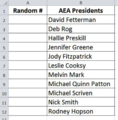
(4) We can then select our list of names and numbers and sort them (Data > Sort > Sort by Random # on Values with Order Smallest to Largest). Our end result indicates that Nick Smith and Mel Mark have been randomly selected for our research.
Rad Resources: YouTube and Ann Emery’s Excel blog contain a wealth of resources on using Excel’s features to your advantage.
Do you have questions, concerns, kudos, or content to extend this aea365 contribution? Please add them in the comments section for this post on the aea365 webpage so that we may enrich our community of practice. Would you like to submit an aea365 Tip? Please send a note of interest to aea365@eval.org . aea365 is sponsored by the American Evaluation Association and provides a Tip-a-Day by and for evaluators.
AEA365
.
Blog
.
<span class='date ' tip=''><i class='icon-time'></i> Jul 27, 2015 11:37am</span>
|
|
Tweet The FLSA and the move to workplace flexibility will be tugging at workers and management. In early July the US Department of Labor announced changes in the Fair Labor Standards Act that will radically alter the number of workers who will no longer be considered exempt. As of the moment the projected minimum salary level is anticipated to be $50,440. (You can learn more here.) At the...
SHRM
.
Blog
.
<span class='date ' tip=''><i class='icon-time'></i> Jul 27, 2015 11:37am</span>
|
|
¡Hola! from Kirsten Büchner of Insight Evaluation Services in Fairfax, Virginia. I am a bilingual evaluation consultant working with museums and informal learning organizations in the cultural sector. As a native Spanish speaker, I get asked to participate on projects that have components designed for Spanish-speaking audiences, so part of my job includes making sure Spanish-language consent forms and instruments accurately reflect the original English-language versions. Here are a few things to keep in mind when converting documents to another language.
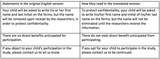
Hot Tip: Whether you use a free service like Google Translate or engage a translation firm, it is always a good idea to have a native speaker with professional level experience or education review your documents and verify they are correct and make sense. Check out these examples from a consent form I recently was asked to look over:
Lesson Learned: The client had already received IRB approval for both English and Spanish forms, but the latter had to be resubmitted given the number of revisions needed. Considering the energy we evaluators put into developing valid and reliable instruments, making sure they are clear and understandable in all target languages is worth the extra effort.
Hot Tip: Translators should have current knowledge of the region(s) your respondents are from. Spanish is spoken in 20+ countries, and while we all understand the same basic language (what I like to call "broadcast Spanish", such as what is spoken on Univision and other Spanish-language television stations), there can be important differences in vocabulary, phrasing, or how we address someone. For example, in some Central American countries and parts of Colombia, "usted" (formal you) is used when speaking with someone we are meeting for the first time or do not know well, as well as with people who are older or of higher rank; however, in Spain, Mexico and Puerto Rico, "tu" (informal you) is more commonly used.
Lesson Learned: The AEA Statement on Cultural Competence in Evaluation defines culture as "the shared experiences of people, including their languages, values, customs, beliefs, and mores. It also includes worldviews, ways of knowing, and ways of communicating." Taking into account the way a given cultural group communicates helps us earn respect and establish trust among the members of that group, which in turn allows us to produce a higher quality evaluation.
Rad Resource: The American Translators Association lists translators by the language combination desired with advanced options to help narrow your search by specific criteria, such as education, experience and areas of expertise.
Google Translate
AEA Statement on Cultural Competence in Evaluation
American Translators Association
Do you have questions, concerns, kudos, or content to extend this aea365 contribution? Please add them in the comments section for this post on the aea365 webpage so that we may enrich our community of practice. Would you like to submit an aea365 Tip? Please send a note of interest to aea365@eval.org . aea365 is sponsored by the American Evaluation Association and provides a Tip-a-Day by and for evaluators.
AEA365
.
Blog
.
<span class='date ' tip=''><i class='icon-time'></i> Jul 27, 2015 11:36am</span>
|
|
I am Tom Wolff, independent consultant with Tom Wolff & Associates. A recent Boston Globe article, "Trials aim to keep recurring patients from hospitalization" by Sabrina Tavernise, described the work of the $10 billion Innovation Center that is part of the Affordable Care Act. As they attempt to manage the most expensive patients the article notes, "They raise a new question for health care systems: What is its role in tackling problems of poverty?" As a community psychologist this is hardly a new notion. That people’s behavior and health is a function of their environment is basic to our field. We are all interdependent and interconnected. However, this premise makes for very complex program development and evaluation question; when we consider the full environment that impacts people’s health (often labeled Social Determinants of Health) we are dealing with a myriad of variables and multiple sectors of the community.
Rad Resource: The New England Racial Justice and Health Equity Collaborative (NERJC) is an action and learning network across 12 communities in three states. These communities are working to promote racial justice and health equity. The goals of the coalitions and programs are to create policy changes to address systemic racism in the social determinants of health (e.g. food access, educational disparities). How does the history of systemic racism in housing, education , transportation impact people’s health? As the brilliant film "Unnatural Causes" notes, our zip code may be more important for our health than our genetic code. You can learn more about the model NERJC used in this article. Although the link between health disparities and racism may seem obvious, in practice most efforts to address health disparities in the U.S.do not focus on racism. Thus, if they are addressing diabetes rates in Black men they will offer classes on nutrition to Black men, rather than work to change the food desert where Black men reside.
The NERJC meets regularly through the year on a totally unfunded voluntary basis to provide support (both emotional and skill based) to these social justice activists who brings this racial justice perspective to their work in addressing health disparities and reaching for health equity. Creating an ongoing learning environment where participants can gain new techniques to take back to their communities which will lead to creating changes in local programs, policies and practices consistent with a racial justice perspective
Lesson Learned: As a white man who has experienced all the benefits of white privilege I have felt a responsibility to help the NERJC start up, and thrive and survive. I see our work on this frontier as an example of community engaged scholarship. What do you think? What can you do?
Do you have questions, concerns, kudos, or content to extend this aea365 contribution? Please add them in the comments section for this post on the aea365 webpage so that we may enrich our community of practice. Would you like to submit an aea365 Tip? Please send a note of interest to aea365@eval.org . aea365 is sponsored by the American Evaluation Association and provides a Tip-a-Day by and for evaluators.
AEA365
.
Blog
.
<span class='date ' tip=''><i class='icon-time'></i> Jul 27, 2015 11:36am</span>
|
|
If you attended the 2015 SHRM Annual Conference & Exposition in June (or followed our SHRM bloggers), you probably heard a lot of buzz about leadership, coaching and developing great teams—especially from keynote speakers Mike Krzyzewski and Marcus Buckingham. While "Coach K" challenged HR to make every employee feel important and to implement guiding standards over rules, Marcus Buckingham emphasized the critical importance of the team leader in organizations. HR—Focus on Your Teams Traditional management models have always focused on the top-tier leaders. Progressive organizations in the new world of work, however, are directing their energy, attention...
SHRM
.
Blog
.
<span class='date ' tip=''><i class='icon-time'></i> Jul 27, 2015 11:35am</span>
|
|
Greetings! I’m Sheila B Robinson, aea365’s Lead Curator and sometimes Saturday contributor. Recently, Sara Vaca shared her 3 most remarkable evaluation moments and challenged the rest of us to share ours, so here are my 3 moments!
Life isn’t a matter of milestones, but of moments. - Rose Kennedy
1. Program evalu-what? My doctoral work in Educational Leadership was focused on Professional Development. One day, a classmate mentioned something she learned in her "program evaluation" course. I had never heard that term but was intrigued. I enrolled in the course the following semester and was hooked from Day 1 (the first article we read was Building the Evaluation Capacity of a School District by Jean King). At the same time, my university created a Certificate in Program Evaluation and I’m proud to be among the first to have earned it. I’ve now been teaching Program Evaluation courses there for 8 years, one of my favorite and most rewarding experiences.
2. Tweet-endipity? Within a month of becoming a blogger and active tweeter, I answered a tweet from Kim Firth Leonard, who was looking for a collaborator to co-author blog posts on survey design. I didn’t know Kim, but was excited by her invitation and share her interests in both survey design and blogging, so I took a chance. That was over two years ago, and despite living on opposite coasts in different time zones, we’ve co-authored several blog articles (here, here, here, and here) and co-presented what turned out to be a standing-room-only skill-building session on survey design at Evaluation 2015 in Denver, CO where we met in person for the first time! We now have even bigger collaborative projects in the works. I’m truly honored to have the pleasure of working with Kim.
3. We’re go for launch! On December 31, 2009, John LaVelle welcomed loyal readers (well, there weren’t really readers quite yet) to aea365 Tip-A-Day By and For Evaluators. I just happened to look at AEA’s website that day and noticed it. Y’know that feeling you get when you see something new and you just know it will have an deep and lasting impact? Yeah, that’s the feeling I got. I became a daily reader, and have learned more about evaluation from these (nearly 2000!) brief articles and links to other evaluation-related sites than any other single source I can name. I couldn’t be more excited about the opportunity to be the Lead Curator (big shout out to Susan Kistler for that!) so that not only do I get an insider’s early peek at all posts, but it has put me in touch with some of the most interesting, gifted, and and generous authors in this field. When I tell people this is a labor of love, I mean it.
What are YOUR 3 moments? Please consider sharing them in an aea365 post!
Do you have questions, concerns, kudos, or content to extend this aea365 contribution? Please add them in the comments section for this post on the aea365 webpage so that we may enrich our community of practice. Would you like to submit an aea365 Tip? Please send a note of interest to aea365@eval.org . aea365 is sponsored by the American Evaluation Association and provides a Tip-a-Day by and for evaluators.
AEA365
.
Blog
.
<span class='date ' tip=''><i class='icon-time'></i> Jul 27, 2015 11:34am</span>
|
|
Hey there! I’m Johanna Morariu, a Director of Innovation Network and the Co-Chair of the Data Visualization and Reporting TIG. The DVRTIG works to improve the quality of communications through better data visualization and improved approaches to reporting evaluation findings.
What is Visual Reporting? Dataviz, data placemats, infographics, slide reports, and more! Visual reporting differs from traditional reporting by making increased use of shapes and colors to convey information.
Make Your Data Count: New, Visual Approaches to Evaluation Reporting from Innovation Network
Why Visual Reporting? We use visual reporting to grab attention—they focus our audience on what matters. We use visual reporting to clearly communicate. By design, good visual reporting conveys a succinct message and reinforces it with data. Findings are front and center, instead of buried in long, dense text. And we use visual reporting to be engaging in the reporting phase, increasing audience participation when discussing implications and deciding on recommendations.
What are the five elements of Visual Reporting?
Pick a purpose: Clarifying the purpose of your report, including audience and delivery. What is the visual report meant to do? Who is the visual report meant for? Will the visual report be presented or will it speak for itself?
Make a blueprint: Before we dive into putting titles, text, and data on a page, we need to know how it will all fit together. When you make a blueprint, you are sketching out the content and layout of information.
Do good design: We need to pay attention to font, color, contrast, and white space. Good design helps you clearly communicate your data and findings. Use clean, uncomplicated sans serif fonts. Use a color scheme consistently throughout the visual report or visual element. Use headers to use font size consistently and to give the audience a navigation system.
Test: Share your draft with colleagues or friends. Are they able to pick out the main points? Is there information that is unclear to them? What elements could be clarified or improved?
Refine: Before sharing your report with your audience, make sure it is as clean and shiny as possible! Copy edit, format, align, and check all aspects of your design. Do all of your charts use the same size font? Is everything lined up that should be lined up? Is your spacing between elements or paragraphs consistent?
Now you’re ready to share your beautiful, clear visual report!
Rad Resource: Check out our visual report resource guide!
The American Evaluation Association is celebrating Data Visualization and Reporting (DVR) Week with our colleagues in the DVR Topical Interest Group. The contributions all this week to aea365 come from DVR TIG members. Do you have questions, concerns, kudos, or content to extend this aea365 contribution? Please add them in the comments section for this post on the aea365 webpage so that we may enrich our community of practice. Would you like to submit an aea365 Tip? Please send a note of interest to aea365@eval.org. aea365 is sponsored by the American Evaluation Association and provides a Tip-a-Day by and for evaluators.
AEA365
.
Blog
.
<span class='date ' tip=''><i class='icon-time'></i> Jul 27, 2015 11:34am</span>
|
|
Hello! I am Jill Lipski Cain with the Improve Group. This blog post promotes the use of a style guide to make a report both purposeful and aesthetically-pleasing. I think of a style guide as a thoughtful plan that considers best practices in data visualization, delivery tone, and highlighting the important information. I’ll be using the example of a report our team recently developed for MNsure, Minnesota’s marketplace for choosing health insurance coverage. This 100-page report includes qualitative and quantitative findings, special treatment to specific content, and a robust appendix. Because of the report’s comprehensiveness, I needed a plan for how all of these bits and pieces would create a semblance of a whole, while at the same time giving the reader breathing room through negative space and use of photos. So, before you find yourself sweating over font choices at the 11th hour, consider the following:
Hot Tips:
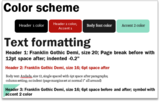
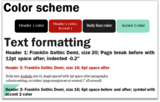
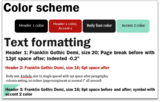
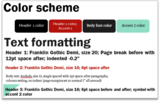
Choose a tone for the look and feel. This includes up to three colors and two fonts, header and body styles, spacing, portrait or landscape, margins, and use of columns (if any). For MNsure, I created two style guides: one with an earthy-soft feel and another with a bold, modern flavor of mint green, cherry red, and dark grey (we chose this option). Here is an example of how to layout these reporting elements:
Determine how to distinguish content. Reports with multiple types of content (quotes, stories, findings, recommendations, etc.) need forethought as to how to inform the reader of the change in content and allow them quick access to specific content she or he is interested. Below is an example of how we treated text, quotes, and special callouts we captioned as a "Promising Practice" accompanied by a unique icon.
Lessons Learned: TEAMWORK!
Teamwork with roles and communication is paramount to pulling off a beautiful and functional deliverable. As the designer, it was essential to know the content and context; otherwise, the design and choice of images would have missed an opportunity to bolster the messages, or worse, misrepresented the content. As a team, for example, we brainstormed key words and situations that best represented the content of the report sections. From there, I was able to narrow my photo search and come up with a lot of good options for the team to choose from.
And by communicating as a team, my colleagues were able to inform me as to which bars in the charts should standout (i.e. filled in a red among gray bars) to avoid the default of highlighting the most extreme bar on a chart. The design has to direct the reader to what is important, otherwise it falls short of the message.
The American Evaluation Association is celebrating Data Visualization and Reporting (DVR) Week with our colleagues in the DVR Topical Interest Group. The contributions all this week to aea365 come from DVR TIG members. Do you have questions, concerns, kudos, or content to extend this aea365 contribution? Please add them in the comments section for this post on the aea365 webpage so that we may enrich our community of practice. Would you like to submit an aea365 Tip? Please send a note of interest to aea365@eval.org. aea365 is sponsored by the American Evaluation Association and provides a Tip-a-Day by and for evaluators.
AEA365
.
Blog
.
<span class='date ' tip=''><i class='icon-time'></i> Jul 27, 2015 11:32am</span>
|