Blogs
|
Jane McConnell published her 9th annual report on The Organization in the Digital Age last month. Jane recently posted 10 key findings from the nearly 300 organizations surveyed.
"4. Finding People "Who Know" Is Winning Over Finding "The Information I Need"
Enterprise search is stuck at a low level of satisfaction with results. Organizations are prioritizing their efforts between finding information or finding people and the latter is the more frequent choice.
Lack of good information management practices is a concern because the high performers in the learning, customer and knowledge scenarios cite information management as a key success factor."
While one way to interpret this finding is to say that information management practices should be improved, another perspective is that people are adapting to information abundance by relying more on human relationships than official explicit knowledge. This mirrors my own professional development over the past decade where I am relying more on my network of trusted colleagues than any particular source of information. As Dion Hinchcliffe recommended, today we should let the network do the work.
In the practice of personal knowledge mastery, I strongly encourage people to build their networks around people, not information sources. In my online workshop, PKM in 40 days, we dedicate one week to ‘networks & communities’ and another week to ‘finding the right people’. Another finding in Jane’s report is that few of the organizations reported that it was "very easy for people to learn in flow of work". Those that found it easy had more communities and social networks available for knowledge sharing. The bottom line, in my opinion: it’s all about connecting people.
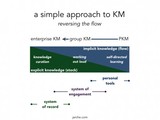
This is why I advocate reversing the traditional flow of knowledge in the enterprise. Instead of top-down information flow, organizations should support bottom-up communication flow. By encouraging conversations between connected colleagues & customers, the organization then has a natural resource from which to encourage working out loud [this is international WOL week], and can use enterprise resources to curate these knowledge flows for later use. Knowledge artisans first need to choose their personal productivity tools. Systems of engagement, like online communities of practice, or enterprise social networks (ESN) can then be the bridges that connect personal sense-making with organizational knowledge, while collaborating in teams and groups. Finally, the enterprise can maintain systems of record (e.g. Sharepoint) as institutional memory.
Harold Jarche
.
Blog
.
<span class='date ' tip=''><i class='icon-time'></i> Aug 23, 2015 08:14am</span>
|
|
Every fortnight I curate some of the observations and insights that were shared on social media. I call these Friday’s Finds.
"Structure drives behaviour. And most of the structures organizations have today were designed for yesterday. - @SamiHonkinen" - via @hharjula
"Complexity should be in the work, not in the organizational structure", according to @JosdeBlok in this video (9 minutes)
"I believe we can just go ahead & say it: Networks are more valuable than strategy. Tech startups have proved that.- @dhinchcliffe"
"Thanks to all its robots, ‘Chinese factory jobs may … be poised to evaporate at an even faster pace’ than in the U.S. - @RWartzman
According to one analysis, fully 43 percent of Chinese workers already consider themselves to be overeducated for their current positions. As software automation and artificial intelligence increasingly affect knowledge-based occupations, especially at the entry level, it may well become even more difficult for the Chinese economy to absorb workers who seek to climb the skills ladder. - NYTimes
Driverless Trucks Replacing $200,000/yr Operators - via @ResonNtegrity
"It’s not fantasy," Suncor’s chief financial officer Alister Cowan told investors at an RBC Capital Markets conference in New York last week. He said the company is working to replace its fleet of heavy haulers with automated trucks "by the end of the decade."
"That will take 800 people off our site," Cowan said of the trucks. "At an average (salary) of $200,000 per person, you can see the savings we’re going to get from an operations perspective."
Triangles by @ValdisKrebs [more on closing triangles]
Image: Valdis Krebs
Harold Jarche
.
Blog
.
<span class='date ' tip=''><i class='icon-time'></i> Aug 23, 2015 08:13am</span>
|
|
In tribal societies, your family is your source of power. In institutions, it is your position in the hierarchy. In markets, dominance is through competition. We are a tri-form society: Tribal + Institution + Markets. The latter currently dominates how we organize as a society. It is competitive. School is competitive, with individual grades. Work is competitive, with many more applicants than positions available. Individual performance reviews dominate in the workplace. We are told that we have to create our personal brands, because the world is competitive.
As networks replace markets as the primary organizational form, will competition continue to be the best way for us to work? It is said that our parents had a job for life and we will have six jobs - but our children will have six jobs at once. For example, in the US there are already over 50 million freelancers. The salaried worker with a job is becoming rare. One new perspective on work is not to focus on jobs, or even roles, but tasks, in order to fragment work so that it can be distributed to many people.
"AppMakr is a real company and it has tossed out the notion of full-time jobs in a single location, in favour of having free agents, anywhere in the world, working on specific tasks which last for anywhere from a couple of hours to a couple of years. All this is made possible in large part by a talent platform: Upwork." - David Creelman
In such a world, where routine work is automated, specialized work is fragmented, and only highly creative work is valued, what is the best organizational strategy for work? From today’s perspective, one might say that everyone has to be highly competitive. But the long term effects of hyper-competition will decrease the value of any network. A value network consists of both tangible and intangible asset transactions. Trust is an intangible asset. It enables knowledge to flow. People do not share with those they do not trust. Imagine a network where people change tasks and roles frequently. They have to continuously form and re-form teams. A competitive strategy may work in the short term, but eventually the network will deny trust to such people. In the end, the competitors will become disconnected from the rest of the network. Like the prisoner’s dilemma, in networks it is best to start with trust.
We can already see this with a social network like Twitter. Unless you are already famous, you have to give in order for people to follow you. The more interesting or informative you are, the more connections you will get. These connections will increase your social reach and inform you of things you did not know, increasing the possibility of serendipitous encounters. Instead of competing with everyone on Twitter, you are cooperating to make the network of more value to everyone. As our organizations move to network models, cooperation (freely sharing without expectation of direct recompense) becomes the best long term strategy for work.
Neither our education systems nor our workplaces are preparing people to work in a networked and cooperative manner. But as the middle class, with its full-time jobs, continues to shrink, individuals will be forced to do the equivalent of six jobs at once. It will not be the technology, nor the platform capitalists who determine how we will work together. It will be us, collectively.
"Our one confident prediction is that digital technologies will bring the world into an era of more wealth and abundance and less drudgery and toil. But there’s no guarantee that everyone will share in the bounty, and that leaves many people justifiably apprehensive. The outcome—shared prosperity or increasing inequality—will be determined not by technologies but by the choices we make as individuals, organizations, and societies. If we fumble that future — if we build economies and societies that exclude many people from the cycle of prosperity — shame on us." - Erik Brynjolfsson
As organizational leadership grapples with the implications of the changes to a network society, individuals can start to prepare now. Take a look at your networks. Where do you get trusted information? Is your network diverse enough? If you lost your job today, would your network help you find meaningful work? If not, then it’s time to start cooperating, for you, and for the rest of us.
Harold Jarche
.
Blog
.
<span class='date ' tip=''><i class='icon-time'></i> Aug 23, 2015 08:13am</span>
|
|
What are fundamental changes necessary to shift the dominant organizational model toward stronger networks and temporary, mutually negotiated hierarchies?
Yesterday I spoke with the founders of a small start-up that has seen good growth and is looking at how best to structure for the future. They realized that most existing management models did not make sense for their case, as they have both for-profit and non-profit divisions, and while small, have operations on two continents. They have been provided with a lot of advice around business models from local government and industry, but they have not seen any models that reflect the reality of the network era: post-job, global, digital, mobile, complex, creative, agile, self-managing, etc.
I said that in my experience, nobody has really figured this out. Frédéric Laloux has found some commonalities for what he calls Teal organizations, and Niels Pflaeging has established some solid principles to organize for complexity. Neither of these approaches is widespread or tested at scale. My advice was that they need to build their own model, based on some general principles, within their specific complex context, which only they can understand.
Jarche’s Principles of Networked Unmanagement*
It is only through innovative and contextual methods, the self-selection of the most appropriate tools and work conditions, and willing cooperation that more creative work can be fostered. The duty of being transparent in our work and sharing our knowledge rests with all workers, especially management.
1. "innovative & contextual methods" = in the network era work and jobs cannot be standardized, which means first getting rid of job descriptions and individual performance appraisals and shifting to simpler ways in order to organize for complexity.
2. "self-selection of tools" - moving away from standardized enterprise tools toward an open platform in which workers, many of which are part-time or contracted, can use their own tools in order to be knowledge artisans.
3. "willing cooperation" = lessening the emphasis on teamwork and collaboration and encouraging wider cooperation.
4. "duty of being transparent" = shifting from ‘need to know’ to ‘need to share’ especially for those with leadership responsibilities, who must understand that in the network era, management is a role, not a career. Transparency is probably the biggest challenge for organizations today, and it can start with salary transparency.
5. "sharing our knowledge" = changing the environment so that sharing one’s knowledge does not put that person in a weaker organizational position. An effective knowledge worker is engaged individual with the freedom to act. For example, rewarding individuals for ideas, such as patent royalty sharing, means that sharing information could lead to another person benefiting from what you have shared. Rewarding the organization (network) is better than rewarding the individual, but only if people feel empowered and can be actively engaged in decision-making. Intrinsic, not extrinsic, motivation is necessary for complex and creative work.
* Principles of Scientific Management (1911)
Harold Jarche
.
Blog
.
<span class='date ' tip=''><i class='icon-time'></i> Aug 23, 2015 08:13am</span>
|
|
"When a society is too grouped, people do not have any social contact with people from other groups," [University of Pennsylvania’s] Centola said. "People with the same job all attended the same school, live in the same neighborhood and frequent the same clubs. Their networks do not expand beyond that group."
Loosening these tight group boundaries means that people’s next-door neighbors may have different jobs or levels of education, but they may still have similar politics or recreational activities. These similarities allow people in different social groups to encourage the adoption of a new complex idea, take neighborhood recycling as an example, which can then spread to other neighborhoods and social groups.
But when group boundaries are eliminated entirely, people have almost nothing in common with their neighbors and therefore very little influence over one another, making it impossible to spread complex ideas. - PhysOrg
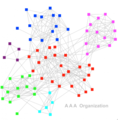
The Triple A Organization (Awareness, Alternatives, Action) by Valdis Krebs takes this into consideration, promoting organizational dynamics that connect unique group boundaries but do not destroy them.
Image - Valdis Krebs
In the network era, the quality of our professional connections becomes a prime source of our influence and value. However, our network connections do not negate the influence of our close family and team ties, nor do they replace the influence of our larger work groups in our organizations and institutions. We need to understand how our various strong and loose social ties can help us learn, get work done, and be better citizens. We need to balance our perspectives, sometimes focused on complex work requiring not just our attention but trust that is developed over time. But this is not enough, we also have to get away from our work, families, and teams and look at the bigger picture, capturing glimpses of new ideas from a diverse social network.
In 1936, the author F. Scott Fitzgerald wrote that, "The test of a first-rate intelligence is the ability to hold two opposed ideas in the mind at the same time, and still retain the ability to function." In today’s networked world, our test will be to hold multiple opposing views at the same time. We can do this by using our social networks to find these viewpoints. Engaging in communities of practice, where connections are tighter, gives us a place to play with these ideas. Finally, we have to test out emergent ideas amongst those we trust.
Successful AAA organizations will enable the flow of opposing ideas, as well as the space and time to test new ideas. Understanding our communication and knowledge flows, through social and organizational network analysis, such as that provided by Valdis, gives us the visualization necessary to ensure that we have the foundation for working in the network era. Balance in the network era will be achieved in a constant dance of engaging people and ideas. This continuous cognitive movement will ensure that people and organizations can adapt to the new challenges brought through our increasing connectivity.
Harold Jarche
.
Blog
.
<span class='date ' tip=''><i class='icon-time'></i> Aug 23, 2015 08:13am</span>
|
|
The Network Wall at Up To All of Us.2014 Thanks Craig for the pic.-------------I wrote this back in May 2014 and never posted it. There has been a lot of personal ground covered since that time - which explains the recent quiet.Figured this could serve as an introduction to what's coming next :)----------------My job has been changing over the past year or so.I'm doing a lot less eLearning instructional design and development.A lot less instructional delivery. A lot less of the stuff I've been doing the past 14 years.I'm doing more strategy, systems design, thinking, talking.I'm trying to provide an environment that allows people to find what they need and collaborate easily.Over the past couple of weeks, I've become convinced that "learning" happens whenever someone reaches out for information or reaches out to another to connect.How do I create an environment that allows that to happen?Or at the very least, doesn't make it hard to do?---------------------When I was talking to Aaron about what to put up there to identify myself, he said "Be an Information Architect. It's way cooler than Learning Architect and in the wider world you will get more traction."Did some surface digging as to what this was. Yeah...it sounded better and felt righter than anything else I had been toying with.- Business Analyst - I've seen it defined as "process change manager." In practice, it is often requirements management. I do a lot of this. In Learning and Development, we call this Needs Assessment. But it is far from the only thing I do.- Program Manager - managing a collection of projects related to a program or service. I'm kinda doing that, but it is more keeping track of what is going on that touches my world. I initiate very few projects - mostly linked to my LMS. The rest is other IT projects with products I might be able to leverage in my own ecosystem. I'm not terribly interested in building a parallel "learning environment". So that's not quite right.- Knowledge Manager - encouraging folks to share knowledge with the greater organization. Yeah...I do that and am working on that, but again it is a piece of what I am doing. ---------------------And then, there are the "architects". - Information Architect - I do a lot of curation and looking at how to make it easier to find information in our environment. But again, it is not the only thing I am doing. And the digital focus isn't quite it either, because a lot of information is housed in people. See Knowledge Manager. - Business Architecture - Seems to be another "Process Improver" type role - attempting to map tools / technologies to solving problems. What problem are we trying to solve? What is the process in place to solve the problem now (if there is one)? What changes need to be made? What tools exist to help us? What tools need to be put in place? Seems to require an understanding of the culture, the individual people that make up the culture, and the tools/technologies available (or needed) as well as an understanding of the problem (which is often tied up with the people and culture). I like the idea of solving problems vs. just identifying problems.- Learning / Performance Architect - This is Gary Wise's title for himself. I've been adopted by the SWAT team as a bit of a mascot / translator between them and the end users. This might be the closest "title" / discipline. But I think Gary has this area cornered. I'd feel a bit fake if I claimed this for myself.I also wonder if "architect", as a concept, implies a level of permanence that doesn't exist.---------------------- On my drive between Monticello, FL (visiting my uncle) and Orlando - it dawned on me that I am really an Ecosystem Tender. Nursing an ecosystem to be its healthiest state.In my case, I'm really a "Learning Ecosystem Tender." In this case, what I have defined as the learning environment - or "where people go when they think they want to learn something, even though they are learning stuff each time they talk to someone or look for information..." Problem is - that's not really a discipline. Neither is "Other Duties as Needed".Generalists get such a bad rap.But these are the folks who can play in the spaces.Relate unrelated things.Find solutions that may fall between recognized disciplines.Maybe we should make up a "discipline" of generalists.Codify what makes us folks tick and turn it into a "trainable" field. With mastery paths and such.Though that feels like that defeats the purpose.Meanwhile...I'll keep playing.
Wendy Wickham
.
Blog
.
<span class='date ' tip=''><i class='icon-time'></i> Aug 23, 2015 08:12am</span>
|
|
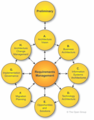
Notice that big circle in the middle?Requirements.EVERYTHING in the ecosystem SHOULD map to requirements.You may have noticed that the Capability Matrices in the previous posts sorta-kinda did.In an ideal world (which I don't happen to live in right now), the order in which things would go would be:- Problem definition- Requirements collection- Solution design and development based on requirements and guided by architectural principles- Did it solve the problem yes/no?The capability matrix for the resulting solution set would be based on the requirements collected. The next series of posts will demonstrate how to create a capability matrix in my personal utopian fantasyland. And talk about requirements and requirements collection.-----------------------------In TOGAF, when they talk about requirements, they are talking about the requirements for the entire architecture.These requirements are shaped / guided by the principles underlying your architecture.As more requirements surface, the principles of the architecture may shift.For the time being, the 2 principles we are using to guide our Learning Architecture still work.- As needed performance support- Continuous professional developmentWhen we put together our requirements for any solution in the Learning Ecosystem, we will be keeping those 2 principles in mind.Side note: Some other organizations use the requirements they have collected over the years to help define their Architecture Principles. That works too. Requirements collection in our organization is still very immature.
Wendy Wickham
.
Blog
.
<span class='date ' tip=''><i class='icon-time'></i> Aug 23, 2015 08:12am</span>
|
|
To do this requires a system.Your system should be built based on requirements. Image from National Association of Women in Construction.--------------------Karl E. Wiegers, in his book Software Requirements (2nd ed, 2003), identified the following requirement types.I'm breaking them out further (with thanks to Steve Corlew, the TOGAF certification trainer I worked with) into 2 sections...General Requirements and IT Requirements. We are going to use purchasing a new presentation development tool as an example.Because everyone hates PowerPoint (apparently). Examples (or the types of things you are likely to hear) are in italics. General Requirements - these will be guided by the Architecture PrinciplesBusiness Requirements - what the business is trying to achieve"The business needs new presentation software that allows us to reduce presentation development time and automates presentation hosting to our website" User Requirements - what the users need to be able to doExample: "Users need to be able to edit a presentation built in the solution" Functional Requirements - what the solution (software / hardware / network / other) needs to be able to do to allow the users to do what they need to do (User Requirements) and help the business achieve it's goals (Business Requirement). The details of what the solution needs to do.Example: "Upon publication, the presentation will automatically upload to our web server."Functional requirements for a system are often broken down into the different components of that system.Example: if the system to automate presentation hosting to the website includes the presentation tool, a tool allowing upload to the web server, and the web server...the Functional Requirements will contain 3 different sections. One for the Presentation tool, one for the upload tool, and one for the web server The sections separating out the different components will then be further broken down into Features - or the collection of "logically-related" functional requirements that provides a capability so the user can do what he/she needs to do and to help satisfy a business objective.Example: Submission of Presentation to Web (incomplete, but you get the gist...)Requirement 1: The tool will allow the user to save a presentation without submitting it for approval.Requirement 2: The tool will provide the ability to notify a designated "approver" that a presentation is ready to publish to the web siteRequirement 3: The tool will allow the approver to click a button and post the presentation to a designated location in the web siteSystem Requirements - the top-level requirements of the entire system. When everything is put together, what does the system do?"But,Wendy - we just want new presentation software! I'm not worried about a system!" As soon as you are interfacing with anything else - you have a system.Are you trying to display the presentation on your device onto a screen in a conference room? You are working with a system that includes the actual presentation software you selectedthe device you are using (Mac, PC, iPad, Kindle, Smartphone whatever)the projector in the room you want to use and any cableingany application you are using so that your device can broadcast to the projector (if it is not already built into the operating system)any System requirement = Users can show the presentation through a projector onto a wall. Sounds simple, but how many times have you found yourself scrambling for converters (Mac or alternate device users who don't have built-in VGA ports) or fought with the wi-fi/bluetooth settings on either your laptop or the projector. Or is that just me....----------------------------- IT Requirements - what your IT developers need to help build the system of your dreamsBusiness Rules - corporate policies, government regulations, industry standards, definitions of particular terms (eg. a "student" is an individual who is registered for at least one University course offered through the Registrar's office.).A good resource for helping you determine what business rules you need to collect will be the Business Analysts housed in the IT Department. The more refined you are able to make the business rules, the more the IT folks can help you."Who will have access to the presentation tool?" Business rules will help define the access.Quality Attributes - these attributes are essentially further detail for each of the Functional Requirements. Acceptable time between screen refreshes, readability of buttons, that sort of thing. The questions your IT developers will ask during the course of the project as they build out the solution will likely be about quality attributes."How quickly do you need the presentation to show up on the website? Does it have to be immediately or can it be the next morning?"External Interfaces - the interface between this system and other systems. "How does the presentation I developed using the Presentation software show up on Slideshare?" Slideshare is the external interface.Constraints - what in the existing system can't be changed. "Everyone we work with still uses PowerPoint. Therefore, the Presentation application we choose has to be editable in PowerPoint." Unless you can somehow get everyone you share presentations with EVER to switch to your tool - this is likely a constraint.------------------------------I know this seems like a lot...but the time spent fleshing out requirements helps make sure you are actually building a solution that solves your problem and gives you a better shot of selecting pieces that fit your needs (vs fitting your needs to the pieces).Even better, when we are ready to re-evaluate parts of our Ecosystem, we already have a baseline to start with!
Wendy Wickham
.
Blog
.
<span class='date ' tip=''><i class='icon-time'></i> Aug 23, 2015 08:12am</span>
|
|
Learning TRENDS by Elliott Masie - September 9, 2011.#683 - Updates on Learning, Business & Technology.55,453 Readers - http://www.masie.com - The MASIE Center.Host of Learning 2011 - Over 1,107 Colleagues Registered!
Special Note: 9/11 Learning Perspectives from 2001 - Covey, Blanchard, Peters & More.
In the days right after 9/11, I reached out to several key business authors and thought leaders to ask them for perspectives on what a manager might do (or not do) with their teams in that emotional and uncertain time.
We posted 2 - 4 minute audio podcasts from Steven Covey, Tom Peters, Herman Cain, Ken Blanchard, Scott O’Grady, Diane Hessen, Marshall Goldsmith and others. Every author I called gladly did these unrehearsed perspectives and tens of thousands of colleagues around the globe listened to these clips. I have re-published the page and would encourage you to listen to a few of these "in the moment" perspectives from those raw moments in 2001:
http://www.masie.com/perspectives
Yours in Learning,
Elliott Masie.email: emasie@masie.com
MASIE Center Seminars, Events and Services:* Learning 2011 - Nov 6 to 9, 2011 - Orlando, Florida.* Membership in The Learning CONSORTIUMInfo and Registration: http://www.masie.com
Elliott Massie
.
Blog
.
<span class='date ' tip=''><i class='icon-time'></i> Aug 23, 2015 08:12am</span>
|
|
Learning TRENDS by Elliott Masie - September 14, 2011.#684 - Updates on Learning, Business & Technology.55,459 Readers - http://www.masie.com - The MASIE Center.Host of Learning 2011 - Over 1,193 Colleagues Registered!
201 Learning Sessions List Published
We have just published the list of 201+ Sessions to be presented at Learning 2011 (Nov 6 to 9 - Orlando, Florida):
http://www.learning2011.com/sessions
Yours in Learning,
Elliott Masie.email: emasie@masie.com
MASIE Center Seminars, Events and Services:* Learning 2011 - Nov 6 to 9, 2011 - Orlando, Florida.* Membership in The Learning CONSORTIUMInfo and Registration: http://www.masie.com
Elliott Massie
.
Blog
.
<span class='date ' tip=''><i class='icon-time'></i> Aug 23, 2015 08:12am</span>
|