Blogs
|
Here are some observations and insights that were shared on social media this past fortnight. I call these Friday’s Finds.
"We don’t see something until we have the right metaphor to let us perceive it." - Thomas Kuhn - via @tobiasmeyer
"Humans require the difficult and messy social routing protocol of trust." - Valdis Krebs @orgnet - via @voinonen
"What if sucessful projects having a plan is just survivior bias?" - @drunkcod
Half-baked ideas - by @kmpinner #PKMastery
Just because you know how to do something doesn’t mean you should: It’s rewarding to give other people a chance to shine.
The value of the collective is sometimes better than the value of the individual: What was returned to me was far better than what I would have created myself.
Creativity needs space: If you provide someone the solution they never really have a chance to think outside the box and innovate.
It’s hard work getting over yourself: I have to remind myself daily that I do not need to have all the answers, that I can be imperfect, and that if I don’t take the chance to fail then I will never truly learn.
Be wary of Experts: In a study of 64K expert predictions over 16yrs, experts didn’t know better than a monkey throwing a dart at a board - via @rwartzman #PKMastery
Managing the information overload is a real challenge. Our default faced with the overload is to actually what I call narrow-cast — to kind of hunker down and focus in on fewer sources than ever — you know, the analyst who we always got our information from, the newsletter that we always read. But we lose in that process a lot of new forms of information that can be very useful.
So whether that’s crowdsourced information emerging out of social media, or whether it’s information that challenges our pre-existing beliefs, I think we need to consciously seek out diverse and different points of view — some points that do challenge our beliefs, because that’s another thing that we’re prone to be drawn to: information that confirms what we already believe. … We’ve got to push against that natural bias, because there’s so much research now that supports the importance of gathering different and diverse points of view and bringing those into the equation.
Data Enslavement - by @ballantine70
What didn’t get a mention was how the analytics arms race results in the best STEM graduates today being sucked out of the world of engineering, and into the world of financial services, lured by salaries that are totally out of proportion to what other industries can afford to invest. We end up deploying great minds to (tiny) marginal improvements, rather than risky step changes in how we do things. Polishing rather than building…
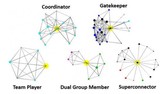
The social graph structures of coordinators, gatekeepers, team players, super-connectors - via @gramleth & @dhinchcliffe
Harold Jarche
.
Blog
.
<span class='date ' tip=''><i class='icon-time'></i> Aug 23, 2015 08:17am</span>
|
|
This is the synopsis of a webinar for TP3 Australia I presented last evening (my time).
Three major external forces and trends are influencing the future of work:
Technology is changing Expectations … of what is possible
Globalization is changing Value Creation … from tangible to intangible, as culture gets digitized
Social Media are changing Relationships … to a ubiquitously connected and pervasively proximate world
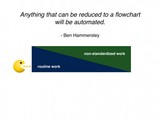
Automation is ending the industrial era. Examples include lawyers replaced by software, bank staff replaced by websites, travel agents replaced by apps, and soon drivers will be replaced by robots. Workplaces are finding themselves at a break-point between the industrial era and the network era, with industrial era systems and structures unable to adapt to a world of mostly non-standardized, non-repeatable work processes.
What used to be valued traits in the workforce - obedience, diligence, intelligence - are not those required to do non-standardized work, which will soon be the only work that humans will be needed for. Gary Hamel identified initiative, creativity, and passion as the traits needed in a creative economy. I call these three traits - Talent, which cannot be automated. For individuals to thrive in the new workplace, and for organizations to succeed, they need to focus on developing Talent.
Creating intangible value is not like producing tangible goods. The Return on Investment is not obvious. Developing a trusted relationship with a client by doing something extraordinary does not always produce the same results, but sometimes it can be significant. How do you measure the value of a free umbrella in a rainstorm? It could be exceptional if the recipient happens to be a well-connected customer experience expert.
Intangible value is much more volatile, as witnessed by the shifts in the market over the past few decades. Only one original member of the Dow Jones is still on it. Intangible value of the S&P 500 is over 85%. This is stuff that cannot really be measured, yet it drives most of the economy.
Creative, non-standardized work is difficult to learn. It requires informal, peer-assisted, cooperative learning, which does not happen in a classroom, as artists have known for millennia. Knowledge to do this work is not easily captured. You cannot take a recipe book and create a chef. Sharing implicit knowledge is not as simple as "knowledge-transfer’. The only way humans have figured out how to share implicit knowledge is through conversations. Lots of conversations.
You would not manage a project on Facebook, and would probably not organize your family and love life using project management software. However, we learn from our social networks which are often disconnected from our work lives. As work becomes more non-standardized, we will need more insights, serendipity, and connections to be creative. In a creative economy, cooperation is as important as collaboration was in the information economy. So how can we connect knowledge flows between our wide social networks and the more focused areas of getting work done? How do we deal with time and resource constraints as well as confidentiality issues?
Teams need to share complex knowledge, usually in a deadline-driven environment. Research shows that sharing complex knowledge requires trusted relationships. These take time, so we cannot form teams on the fly and expect them to be creative. But high-functioning teams can develop group think. They need places to test ideas in a trusted space. This is what communities of practice can enable, if supported and guided appropriately. CoP’s are where organizational learning & development departments should be focusing the majority of their efforts. CoP’s can also be the connector between work teams and social networks, enabling a flow of diverse opinions and perspectives to continuously permeate the organizational boundaries.
In the 20th century, work was rather separate from training and education, with the office apart from the classroom. Most web-based training is separate from the work being done. Today, work is learning, and learning is the work. This requires a new perspective on how we think about organizational learning.
Improving organizational performance consists of reducing errors and improving insights. Most organizations have highly structured ways to reduce errors, such a Six Sigma. But most really on luck to improve insights. But reducing errors only looks backwards, at what has been done, while insights look forward at what can be done. Many organizations are driving into the future while looking in the rear-view mirror, to paraphrase Marshall McLuhan.
Gary Klein looked at over 100 cases of how new insights occurred in organizations and categorized them as five main types. Three of these can be enhanced through the practice of personal knowledge mastery:
Making better and more diverse professional and social connections.
Increasing the chances for coincidences though social networks.
Practising curiosity through new experiences.
PKM is a set of processes, individually constructed, to help each of us make sense of our world and work more effectively.
We need to find ways of recreating what workers used to do - sit around and tell stories so they could learn. Sharing implicit knowledge is critical in fast-moving networked, creative economy. As the operational speed increases, this type of sharing becomes critical.
PKM adds an important foundation to Group and Organizational KM, which have not been as effective as promised 20 years ago. PKM makes each individual responsible for seeking, sense-making, and sharing knowledge. Groups and teams support this by working out loud, and the organization then focuses on curation, not creation of knowledge artifacts. In order to make this work, the organization must give up control, and treat workers as adults and co-developers of organizational knowledge.
With PKM, we seek new ideas from our social networks and then filter them through more focused conversations with our communities of practice, where we have trusted relationships. We make sense of these embryonic ideas by doing new things, either ourselves, or with our work teams. We later share our creations, first with our teams and perhaps later with our communities of practice or even our networks. We use our understanding of our communities and networks to discern with whom and when to share our knowledge.
It’s like constantly breathing in and out.
If you only seek information, you are just a consumer. If you seek and share, then you are a re-broadcaster, adding little value. If seek and make sense of information, without sharing, you are missing out out on opportunities to learn and connect. While we cannot seek, sense, share in all aspects of our lives, there are some areas where it it is important to do so. Understanding knowledge networks and developing practices that work for you take time, but will ensure that you are valued as non-standardized "Talent" and not perceived as replaceable and routine "Labour".
There are many layers under the SEEK > SENSE > SHARE framework, which can be supported through a wide variety of practices and disciplines. PKM is a journey to self-discipline.
The PKM in 40 Days online workshop is one way to get started on the journey.
Harold Jarche
.
Blog
.
<span class='date ' tip=''><i class='icon-time'></i> Aug 23, 2015 08:17am</span>
|
|
The way we manage our organizations is largely ineffective for the complex challenges we face, whether driven by the environment, demographics, economics, or politics.
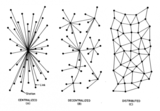
Hierarchies assume that management knows best and that the higher up the hierarchy, the more competent and knowledgeable that person is. But hierarchies are merely centralized networks. They work well when information flows mostly in one direction: down. Hierarchies are good for command and control. They are handy to get things done in small groups. But hierarchies are rather useless to create, innovate, or change. Hierarchies are ineffective when things get complex.
Source: Paul Baran, "On Distributed Communications: MEMORANDUM: RM-3420-PR" AUGUST 1964, the Rand Corporation
Distributed networks are in a state of perpetual Beta. Unlike hierarchies, they can more easily change shape, size, and connections, without the need for a formal reorganization, as there are no central control nodes. In a fast evolving environment, management thinking needs to continuously change as well. This means letting go of control. Hierarchies are essentially a solution to a communications problem. They are artifacts of a time when information was scarce and hard to share, and when connections with others were difficult to make. That time is over.
The Internet has highly connected markets, competitors, customers, and suppliers. With an external environment that is highly connected, organizations have to get connected inside. A networked enterprise needs to be organized more like the Internet, and less like a tightly controlled machine. While hierarchies are practical to get work done, they should not be the overarching structure for the organization. There is still a need for responsibility and accountability, but authority has to be distributed to deal with complex problems.
Complex problems cannot be solved alone. They require the sharing of tacit knowledge, which cannot easily be put into a manual. In addition, tacit knowledge flows best in trusted networks. This trust also promotes individual autonomy and can become a foundation for organizational learning, as knowledge is freely shared. Without trust, few people are willing to share their knowledge.
Organizations have to become knowledge networks. An effective knowledge network cultivates the diversity and autonomy of each worker. Networked leaders foster deeper connections, developed through ongoing and meaningful conversations. They understand the importance of tacit knowledge in solving complex problems. Networked leaders know they are just nodes in the knowledge network and not a special position in a hierarchy.
What does a post-hierarchical organization look like?
It will be one that provides a sense of belonging like a tribe, but with more diversity and room for personal growth. It will have the institutional structure to manage the basic systems so people can focus on customers and community, not merely running the organization. It will have market type competition, but without a winner-take-all approach. Finally, it will promote cooperative actions that add to the long-term value of the ecosystem and community, not just short-term collaboration to get the next project done or achieve some arbitrary quarterly results. Making the networked organization more resilient will help everyone in it, not just a few central nodes. The networked organization takes the long view.
#ITASHARE
Harold Jarche
.
Blog
.
<span class='date ' tip=''><i class='icon-time'></i> Aug 23, 2015 08:17am</span>
|
|
When NASA released the photograph of the earth as seen from space, known as the blue marble, it gave new impetus to the environmental movement, showing our planet as a small dot in a black void. Seeing is believing. Visualization can be a very powerful tool in sharing complex knowledge. The visualization of social network analysis (SNA) can give us significant new perspectives, not available from looking at a series of data points. For instance, Valdis Krebs examined data on the trust levels of various news sources around the world and how these were perceived by ideological groups. The data table originally provided by PEW Research Center tell part of the story, but the SNA conducted by Valdis clearly shows how conservative media are completely separate from all other media. A similar study of pro-Israeli and pro-Palestinian news outlets showed that only one was trusted by both sides, but Haaretz.com is getting squeezed by taking a moderate position. Seeing this polarization may help to understand it.
The added value of using a sense-making tool like SNA to further examine information is the core of PKM. Adding value to the information in our fields helps make our knowledge networks smarter and this is how we can collectively deal with more complex problems. Visualization, and new metaphors, are essential for systemic change to happen. They give us new ways to describe and discuss phenomena. In business, visualizing network relationships can give the initial leverage of getting complex new ideas accepted into general management thinking.
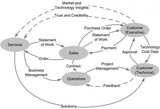
I once used value network analysis to help a company’s research steering group see their internal community of practice in a new light. For the first time, they saw it mapped as a value network, not a hierarchy. They immediately realized that they were pushing solutions instead of listening to their community. This was obvious when all arrows pointed toward the user community, and no tangible [solid] or intangible [dotted] value arrows pointed out. As a result, they decided to change their Charter and develop more network-centric practices. Thinking in terms of networks enabled them to see their community with new eyes.
Value Network Analysis (example) by Patti Anklam
There are many ways to use visualization to understand data better. The real value of big data is using it to ask better questions. Visualization can be a conversation accelerator. Here are 10 more sites showing how visualization just might change your world view.
The Blue Marble
Harold Jarche
.
Blog
.
<span class='date ' tip=''><i class='icon-time'></i> Aug 23, 2015 08:16am</span>
|
|
I wrote my first Friday Find in May, 2009. It was an attempt to make my finds on Twitter more explicit, as I noticed I was sharing and viewing a lot of information but not doing anything with it. My current practice is to summarize what I have found on various social media platforms (Twitter, Google+, LinkedIn, private channels) and create a blog post every two weeks.
With Twitter, I use the ‘favourite’ function (star) to mark any tweets I wish to review for later. Some of these are saved for later reading, others get reviewed fortnightly. On review, some make the cut for the Friday’s Finds post, though these are the minority. Any I wish to keep for later are added to my social bookmarks and categorized for easier search and retrieval.
I use the Twitter fave function in a very deliberate manner. A recent research report, More than Liking and Bookmarking? Towards understanding Twitter Favouriting Behaviour (PDF) shows that this is not common behaviour. Of 606 survey respondents, only 395 knew of the Twitter favourite function and 290 made use of it. The researchers found 25 motivations for favouriting among the 48% of respondents who used it. They then grouped these into two major categories: Response and Purpose.
Using the favourite function for a purpose is one of the behaviours I promote with personal knowledge mastery. It is about being explicit in our sense-making and knowledge-sharing. Bookmarking is one key method.
"Along with [Liking], the bookmarking category was the most dominant reason recorded, used 75 times. Bookmarking is the second official use case for favouriting, according to Twitter (Twitter 2013). After favouriting a tweet, the tweet is kept in the user’s public favourites list, which can be reviewed from their profile. Consequently the concept of future use was well represented in the bookmarking category. Within this concept, we can differentiate between sub-codes in their concreteness of the action to come: "later", "use later" or "again" . The common activities mentioned in these reasons were to read, to show, to view, to search or to re-find: "I want to read them again", "I use the favourite feature like a bookmark feature; tweets i like so i can see them again later." or "I want to find it again easily", and "[…]I generally favourite things that I think I will want to re-find again in the future. This is extremely difficult to do using the Twitter search system." [This respondent] highlights that re-finding is a common need users have with tweets. Further, it illuminates concerns that re-finding is perhaps poorly supported by the Twitter search feature. While some reasons were vague about their intended reuse, some also explicitly stated for which activity the favourited tweet will be used: "I am a foodie and a fitness fanatic! i favourite workout routines or recipes to try later. also, motivational pics and sayings to inspire me when i need it" and "So i can use it when i work out". - page 6
The reason I created Friday’s Finds was 1) due to the poor search functionality in Twitter at the time, 2) as a reflective thinking process, and 3) to put it on a platform I could control, my blog. It is obvious many others have similar issues with retrieving information from social media platforms like Twitter. What do you do? Do you have a method? If you are using social media for any professional purposes at all, it would make sense to develop a method to learn from what you do.
With all these social media platforms, we seem to constantly go through a process of looking at bits of information and trying to make sense of them. We can learn by adding these to our existing knowledge or testing out new patterns in our sense-making efforts. Social media give us more ways to connect with others in our learning but many people only see the information overload aspect of them. Effective learning is the difference between surfing the waves or being drowned by them.
Liking and bookmarking are lower order learning skills but they can form the foundation for higher order elaborative learning skills. Elaborative learning relies on observing, studying, challenging, and evaluating what we see and experience. Synthesizing information can be combined with drawing inferences, forming tentative opinions, and challenging arguments. Critical thinking - the questioning of underlying assumptions, including our own - is becoming all-important as we have to make our own way in the network era. Critical thinking can be looked at as four main activities:
Observing and studying our fields
Participating in professional communities
Building tentative opinions
Challenging and evaluating ideas
Twitter can be one small part of this. It is also an easy place to begin. Go ahead and tweet this post, favourite it, and then come back and review your favourites in two weeks.
Harold Jarche
.
Blog
.
<span class='date ' tip=''><i class='icon-time'></i> Aug 23, 2015 08:16am</span>
|
|
Three billion people around the world are now connected with ubiquitous digital technologies that keep improving. They also keep getting cheaper. History shows that technology can be an enabler of democracy. Distributed communications subvert gatekeepers. John Gilmore said that, "The Net interprets censorship as damage and routes around it." As networks become the new companies, we may be moving toward a more democratic future of work, with authority distributed throughout the network. One significant counter to this trend is the emergence of platform capitalism.
The robber barons of the 21st-century are the platform owners. They have combined the power of network effects with a 20th-century corporate capitalist, winner takes all approach. Amazon is choking the book publishing industry, Google is dominating advertising, and telecommunications companies are using their control of the pipes to directly compete with service providers. Über is going after the taxi and car rental industries, getting to be larger than established rental car brands, with none of the overhead. These companies do not distribute wealth but hoard it at the top. All of these companies provide initially good services to customers. But over time their monopolistic tendencies may kill competition and the entire ecosystem of innovation. Business practices like platform capitalism may also destroy workplace democracy.
Democracy is messy and has redundancies, which is why it is perfect for a complex society and economy. Gwynne Dyer says that, "Modern democracy first appeared in the West only because the West was the first part of the world to develop mass communications." With global access to new digital technologies, workplace democracy can appear anywhere.
Will workplace democracy start in countries that dominate the current economic environment or in nations that have a more social culture to begin with? If the globally-connected can work anywhere, people may vote with their electronic feet and join more open workplaces. The platform capitalists may get what is left over. The tables can turn quickly in a connected economy.
If networks have an advantage in constantly changing economic environments, then democratic companies may be the future of work. But if we do not enable this new type of work, through legislation and practice, then economically advanced countries may see their advantage slip very quickly. Looking at the example of Canada’s resource sector, we see little democratic control of oil extraction, with most profits going to the extractor. This year, Norway had one trillion dollars in its oil fund, while Alberta had 17 billion dollars, which is not being added to. Democratization of wealth can ensure resilience in volatile economic times. Are we ready for such a shift in business attitudes? Are some countries doomed to become the next rust-belts as they cling to old economic and business models, no longer viable in the network era?
Will we become the next rust-belt?
Harold Jarche
.
Blog
.
<span class='date ' tip=''><i class='icon-time'></i> Aug 23, 2015 08:16am</span>
|
|
One of the potential downsides of a network society is that deception, especially by those with power over the communications platforms, will become all-too-common. John Pilger takes a look at this, focusing much of the blame on professional journalists in War by media and the triumph of propaganda.
Why has so much journalism succumbed to propaganda? Why are censorship and distortion standard practice? Why is the BBC so often a mouthpiece of rapacious power? Why do the New York Times and the Washington Post deceive their readers?
Why are young journalists not taught to understand media agendas and to challenge the high claims and low purpose of fake objectivity? And why are they not taught that the essence of so much of what’s called the mainstream media is not information, but power?
Note: It is not just Pilger making this assessment, as Robert Parry explains in NYT shows how propaganda works.
I concluded in seeking perpetual beta that we are shifting to the network era, requiring new models to do what what our institutions and markets are incapable of. I recently rewrote and reposted that conclusion, as it is the starting point for my next ebook, finding perpetual beta, which will be out this month. We are all together in our global village.
Avoiding societal deception in the network era requires an aggressively intelligent citizenry and workers actively engaged in all aspects of democratic enterprises. Continuing to collaborate in hierarchies, with gatekeepers and other control mechanisms, will not transform us into a well-functioning networked society. In the network era, collaboration is outdated. We need to learn how to work cooperatively to deal with the complex problems facing us that cannot be addressed through our existing tribal, institutional, or market structures.
In the network era, we are the media, if we want to be. If we, the citizenry, give up our capability to inform each other, we have no one to blame but ourselves. This is the foundation of personal knowledge mastery: critical thinking. It is coupled with disciplined practice and strengthened by sharing with our fellow global citizens. Pilger may have found fault with the fourth estate, but we are the only ones capable of creating a fifth estate for the next stage of society.
"What we need is a Fifth Estate: a journalism that monitors, deconstructs and counters propaganda and teaches the young to be agents of people, not power. We need what the Russians called perestroika - an insurrection of subjugated knowledge. I would call it real journalism."
We can create a fifth estate that is not an institution, nor a slave to the markets, but a true network. We need to become real networked citizens. It means thinking for ourselves. We are not alone. Three billion of us are connected by the technology that could deceive us. Let’s not let it. We can either work to build a civil society or live in the emerging panopticon. Media in a networked society are much too big to be left to the journalists.
Harold Jarche
.
Blog
.
<span class='date ' tip=''><i class='icon-time'></i> Aug 23, 2015 08:16am</span>
|
|
Here are some observations and insights that were shared on social media this past fortnight. I call these Friday’s Finds.
"as soon as a company has a Chief Innovation Officer you know that company has a problem" - Tim Cook - via @BrunoGebarski
@C4LPT - "You don’t get "big data" in workplace learning - only "little data". But beware - it is usually incomplete."
@mintzberg141 - "Mike—you should have been here yesterday."
"In practice … all strategy-making walks on two feet, one deliberate, the other emergent. For just as purely deliberate strategy-making precludes learning, so purely emergent strategy-making precludes control. Pushed to the limit, neither approach makes much sense."
Leveraging Social Networks to Drive Collaboration & Improve Execution
Participating executives explored the power of building relationships across divisions, functions, and levels and the benefits of different types of networks. For example,
Sparse networks are useful for efficiently gathering and disseminating information
Dense networks are useful for effectively coordinating work in a cohesive group
This is powerful learning for leaders of an organization that is committed to innovation. For example, someone with a large and sparse network is more likely to see innovation opportunities across the organization and promote the possibilities. These "superconnectors." have networks that are
Large, in the sense that many other people cite them as contacts
Sparse, in the sense that they are connected to people in disparate parts of the organization, who are not otherwise linked to each other
Integrative, in the sense that they bring together contacts across divisional boundaries
@SebastianOlma - Never Mind the Sharing Economy: Here’s Platform Capitalism
The Sharing Economy: A Dumb Term that Deserves to Die!
The truth of the matter, though, as Nathan Schneider writes on Al-Jazeera America, is that "the sharing sector of the conventional economy built on venture capital and exploited labor is a multibillion dollar business, while the idea of a real sharing economy based on cooperatives, worker solidarity and democratic governance remains too much of an afterthought. If the sharing movement really wants to disrupt economic injustice, these should be its first priorities."
@NielsPflaeging - Every organization knows 3 types of power: hierarchy (formal), influence (informal) and reputation (value). Org Physics Explained [note 70:20:10 ratio]
Beta Organizations
Harold Jarche
.
Blog
.
<span class='date ' tip=''><i class='icon-time'></i> Aug 23, 2015 08:16am</span>
|
|
Knowledge management, for me, is personal.
A big conceit of the knowledge management (KM) field is that knowledge can be transferred, but unlike information or data, it cannot. Knowledge is personal. While knowledge cannot really be transferred, our experiences can be shared. Perhaps that is why we love stories. They are a glimpse into others’ knowledge, more nuanced than any other communication medium.
Stories make us human, and the best people to learn from are those who are able to admit that they mismanaged, botched, or bungled something. Of course, this can be a real challenge in organizations that do not discuss failure. Is failure an option in your organization? If not, how can you learn from it? Research shows that our memories get worse over time, but our stories, as we remember them, become much clearer. We have a propensity for self-delusion, something every jury member should always keep in mind. Fiction (story) is much more powerful than non-fiction. Would it not be more effective if we shared knowledge as stories, in education and at work? We hear a lot about the importance of curation in the digital workplace today, but what if our curators were also story tellers? Explicit knowledge (decisions, events, procedures, etc.) is relatively easy to capture, so that is often what gets attention and funding for technologies like document management systems. But stories provide the additional context that makes implicit knowledge stick in our memories. In good stories there are no answers, making them even stickier in our minds. Consider how this differs from case studies and best practices which often populate the corporate Intranet.
Implicit knowledge requires interpretation and engagement to make sense of it. Data and information may be gathered by the organization, but knowledge and stories are personal. Stories can help share implicit knowledge. Think about how much time do we spend telling stories in our official work. Compare that to our leisure time when stories are often the main mode of communication.
"Every amateur epistemologist knows that knowledge cannot be managed. Education has always assumed that knowledge can be transferred and that we can carefully control the process through education. That is a grand illusion." - David Jonassen
Individually we can manage information flows, make sense of them, and share with others. This should be the core of KM. Sharing is important for our own sense-making. It grounds our thinking in reality. Nobody can steal our knowledge anyway. As each person seeks information, makes sense of it through reflection and articulation, and then shares it through conversation, a distributed base of knowledge can be created. It’s messier and looser than traditional KM, but it’s also more robust. This is what many of us already do, with blogs and social media.
There is a lot of knowledge in an organization, some of it easy to codify, but most of it is difficult to do so. Thinking about knowledge as nothing more than content for a repository is a mistake. Like electricity, knowledge is both particles and current, or stock and flow. However, the particles are useless if they do not flow.
KM should be focused on enabling knowledge flow between people. This can be supported through easy capture tools (e.g. video) and systems that enable curation (adding value through indexing, validating, categorizing, etc.). Making it easier for people to tell stories is better KM. Giving space and time to share stories is also needed.
My story
A decade ago, I was a mid-career professional and lost my job. Actually, I was dismissed, but the company went bankrupt a few months later. I live in a rural area with high unemployment and I knew it would be difficult to find a job, especially at my age. So I became a free-agent. Every day I would go on the Web and learn what was happening in my field. I read journals and news sources and, most importantly, I started my own blog. I wrote about my profession, new technologies, and how I saw that work was changing in the 21st-century.
One day, after spending a lot of time on my blog, my wife asked how would I ever get any clients if I was giving away all my knowledge for free? I said that I believed it was more important to be known in this new connected economy than to horde my knowledge. How would people take the time to get to know who I was, if I did not give them something of value first? Of course, I did not know for sure this would work. I think my experience as a military officer for 20 years gave me some added confidence to go into no-man’s land.
Ten years later and I am now an international consultant and speaker. My blog, which was my way of sharing stories and thoughts, gave me everything. It allowed me to connect with other like-minded people all over the world. I learned that the more I gave, the more I got in return. But what I received was never directly connected to any single thing I did. Any reciprocity was usually indirect, and often a chance connection.
I was able to build a reputation as someone who can distill complex subjects to their essence. I "simplified the complexity" as one client put it. I was able to build a trusted network that has referred my work to others. Because of this sharing and developing trusted networked connections, I now travel across the world, speaking in Rome, Sydney, San Francisco, Paris, London, and many other venues.
During that decade, I took control of my learning and my future. I tried many web tools and services, testing out hundreds of these. I created a simple model (PKM) for myself, to make sure I could stay current in my field and sense what the future might bring. I shared this model with clients who then adopted it. One was a bank, another a multinational restaurant chain. They saw great value in this model. I then tested out other ways to help people do what I had been able to do. I later developed an online workshop so that hundreds of professionals from many countries could begin to learn in networks. One of my long-time trusted connections online is Australian futurist Ross Dawson, who also understands the need for everyone to be actively engaged in learning and preparing for an uncertain future: "The role of thinking effectively about the future cannot be outsourced. Not just leaders in business, government, and society, but all of us must actively engage with the extraordinary challenges of the future, so we can act better today."
Managing my knowledge by sharing my thoughts and engaging with others around the world has been a very personal experience and has helped me see with new eyes.
Harold Jarche
.
Blog
.
<span class='date ' tip=''><i class='icon-time'></i> Aug 23, 2015 08:16am</span>
|
|
My second ebook, finding perpetual beta, is now available. Scroll down to read a description of the contents. You will receive a nicely formatted and edited 75-page book, that is also copy-protection free so you can read it on any device, share it with friends, or print it. The ebook is available for $24. If you want to share it with all your colleagues at work, you can purchase an organizational license for $119. This ebook contains a series of reflections on the themes originally presented in seeking perpetual beta, published in April, 2014. The aim of finding perpetual beta is to dig deeper into the issues. This is a continuing exploration of how society, technology, work, and education are changing. It questions the status quo of organizational structures and hierarchies. In addition, there is an expanded section on personal knowledge mastery (PKM), a foundational discipline for working in the network era and a creative economy.
Purchasing my ebooks is one way you can support this blog (+2,600 posts) which has been online since 2004.
license
individual $24.00 USDorganizational $119.00 USD
The 500 KB DRM-free PDF will be emailed within 12 hours (usually much faster) to the address provided.
"I love the book Finding Perpetual Beta: It is more of a thoughtful treatise than a how-to manual. Readers will find it delivers sharp insights and a large amount of pristine mental models." - Niels Pflaeging
"Full of detail, research & new ideas." - Charles Jennings
"A perfect reflective read for the holidays." - Todd Hoskins
Highlights
The digital world is bumping against the analog world and we are currently caught in-between.
With an external environment that is highly connected, organizations have to get connected inside.
Faster market feedback challenges the organization’s ability to act.
The solutions are staring us in the face. We just have to stop looking in the rear-view mirror and see the many possible roads ahead.
Hierarchies do not need to be the natural organizational model. People can work in self-managing networks.
Reorganization has to be part of an organization, not something done to it.
If those who are educated, knowledgeable, and experienced do not push for a better world of work, then who will?
An effective knowledge network cultivates the diversity and autonomy of each worker.
Knowledge networks function best when each person can choose with whom and when they connect.
Solving problems together is becoming the real business challenge.
Complex problems require the sharing of tacit knowledge, which cannot easily be put into a manual.
Tacit knowledge flows best in trusted networks.
Sharing knowledge in trusted networks does not happen overnight.
Sharing makes us think more about what we publish, knowing it will be seen by others.
Personal Knowledge Mastery is a framework for individuals to take control of their professional development.
The test of personal knowledge mastery is whether it works for you.
Table of Contents
Our Global Village (read article on Medium.com)
Introduction
Part 1: The Network Era [high-level view]
The Work Shift
The Shrinking Middle Class
From Hierarchies to Networks
Human Networks
Networked Workplaces
Three Major Changes
Organizations and Learning
New Skills
New Work Tools
Beyond Hierarchies
Part 2: Personal Knowledge Mastery [practical applications]
PKM Revisited
Seek > Sense > Share
Seek
Sense
Share
PKM Tips
Learning is the Work
PKM and the Future of Work
Production & graphics by Chris Mackay.
Harold Jarche
.
Blog
.
<span class='date ' tip=''><i class='icon-time'></i> Aug 23, 2015 08:16am</span>
|