Blogs
|
For generations, community colleges have served as the gateway to higher education for millions of Americans. Their commitment to open access coupled with financial support from local funds have stimulated local economies and made dreams come true for people who would have otherwise never imagined college to be a reality. The same holds true today -- but for fewer students each year. Budget cuts across the nation are resulting in a rationing of enrollments and who will be admitted to community colleges in the future is a hot topic today.A report released yesterday from the Center for the Future of Higher Education, Closing the Door, Increasing the Gap, stresses the importance of critically examining who could be left out if access to higher education is rationed and what encourages us to ponder the effects that the rationing process would have on society longterm. The report states, "We are living in a time of growing gaps between the rich and the rest - gaps that have not been seen since the Great Depression. Since the largest growth in traditional age students is among lower-income, first-generation, students of color, and immigrants, they will be impacted the most. Rationing college by social class and ethnicity results in a higher education system that will increase the gap between the 1% and the rest in ever more extreme ways."I invite you to share your story about how your life has been affected by a community college. If you're new to VoiceThread, it's easy. Just follow the instructions typed at the bottom of the slide or listen to them by playing the first comment.Please share this VoiceThread using this link: http://voicethread.com/share/2927210/
Michelle Pacansky-Brock
.
Blog
.
<span class='date ' tip=''><i class='icon-time'></i> Aug 26, 2015 05:01pm</span>
|
|
Each month, I write a sponsored blog post for Cisco's GETInsight blog, which is part of the GETideas community. Each post delves into a topical conversation about transforming education, particularly through the use of technology. This month's post isn't focused on technology but it is one that will shape both the future of the United States and affect the lives of millions of people for generations to come. And you or someone you care about may very likely be one of those people. The topic is the historic commitment that community colleges have made to open access to higher education. That commitment is being threatened as colleges across the nation, particularly in extremely deprived economic states like California, struggle to imagine how to serve students with pennies instead of dollars. Community colleges are always there for us. We have come to rely upon them to serve an array of functions in our lives. As a result, the array of ways that community colleges have supported students' academic and personal success and contributed to local and regional economies is immeasurable. I hope you'll take a moment, first, to read the post, and two, to share your story in the VoiceThread about how your life has been touched, helped, transformed, or improved by a community college. The VoiceThread is embedded below and also appears on the GETInsight blog. You are warmly invited to leave a comment by following the instructions at the bottom of the slide.Please share this VoiceThread and encourage your friends, family, colleagues to share their story. Thank you! Use this link to share: http://voicethread.com/share/2927210/Click here to read "Community Colleges’ Commitment to Open Access: Sharing Your Story at a Defining Moment."
Michelle Pacansky-Brock
.
Blog
.
<span class='date ' tip=''><i class='icon-time'></i> Aug 26, 2015 04:59pm</span>
|
|
The VoiceThread College Innovator Webinar Series, hosted by Michelle Pacansky-BrockAre you curious about how to use VoiceThread in your foreign language or ESL classes? Or are you looking for some new ideas? Get together with your colleagues and join us for an hour of sharing on April 20th!This webinar will feature the teaching innovations of:David ThompsonAssociate Professor of Spanish, Luther CollegeDavid will show you how he uses VoiceThread for a digital storytelling exercise in which students narrate a photo story with the imperfect and preterit tenses in Spanish.Vicki CurtisAssociate Professor of ESL, Ohlone CollegeVicki will demonstrate how she uses VoiceThread to conduct a virtual writing conference with her beginning writing ESL students and explain how VoiceThread has played a key role in the development of her online reading and writing upper intermediate ESL class -- a feat that many said was "impossible!"Date/Time: Friday, April 20th at 12pm PDT/ 3pm EDTRegister here! Michelle's April VoiceThread Office Hour -For one hour a month, Michelle and a VoiceThread team member are "in the office" and available for live questions and discussion about using VoiceThread in education. Bring all of your questions and comments!Date/time: Thursday, April 26th at 12pm PDT/ 3pm EDTRegister for the office hour
Michelle Pacansky-Brock
.
Blog
.
<span class='date ' tip=''><i class='icon-time'></i> Aug 26, 2015 04:59pm</span>
|
|
One of the most powerful but least used features of VoiceThread is its ability to play video, uploaded as central media (compared to a video comment recorded with a webcam). I'd love to see a collection of "teaching ideas" that explore the variety of ways videos can be used to support student learning with VoiceThread. I find that most instructors immediately want to link to YouTube videos (not created by them) but this isn't an option, as the videos in a VoiceThread must be either uploaded from your computer or you must identify a url that points directly to the hosted video file (this means the url must end in the video file extension type and YouTube videos are not direct links to the hosted files).I like to encourage faculty to think about ways to use screencasting to create their own instructional videos and upload them into a VoiceThread. Below, you will see two examples of how this approach could be applied (of course, there are many more!).Idea #1: Instructional ActivityShare link: http://voicethread.com/share/2915637/ Students complete this VoiceThread activity after reading a chapter in their book and viewing a small collection of YouTube videos that augment the topics from the textbook. Within this VoiceThread, there are three types of slides:Directions: how to, grading information, criteria, etc. Video: A 7-minute instructional video (Slide 5) which I recorded using Screenflow (a Mac-only screencasting software).Interactive Slides: these slides contain prompts to which students respond. Idea #2: Asynchronous Office Hours or Group Tutor SpacesShare link: http://voicethread.com/share/2953545/ This VoiceThread was made using three web-based tools (all of which can be used for free, by the way). First, the online whiteboard demo'd in the video is Scribblar.com and the video that I recorded and uploaded into the VoiceThread was made using Screencast-o-matic. As I explain in the video, I preset the screen recording size in Screencast-o-matic to 600x450, as that is the precise aspect ratio of the VoiceThread player. While it condenses my whiteboard space, the end result is a small file size which allows me to create a longer video! (Keep in mind, if you have a free VoiceThread account, each individual file you upload into your VoiceThread will be limited to 25 MB. If you have a PRO account (which is provided with most premium accounts including site wide and department licenses), that file size increases to 100 MB.)Take a peek and feel free to leave a comment in the VoiceThread. I encourage you to leave a voice or video comment and play the video as you're commenting. Few people realize that you can actually capture your playback of the video as you record a comment in a VoiceThread --- and that includes using the Doodle tool! Give it a try! Do you have another idea for how you could use screencasting in a VoiceThread to support teaching and learning? Let's hear it ... or better yet, please share a link to an example!
Michelle Pacansky-Brock
.
Blog
.
<span class='date ' tip=''><i class='icon-time'></i> Aug 26, 2015 04:59pm</span>
|
|
I'm in the middle of reading a chapter from Senge's Schools that Learn and felt compelled to share a few thoughts on my mind. It probably isn't earth shattering to any reader of this blog to realize the striking similarities between the educational system in the United States and the assembly line of the industrial age -- which is, after all, the inspiration for how we educate our children. Assembly lines are valued for being efficient and efficiency is measured by how much the products they produce are alike. In fact, when we see great degrees of variety in the products of assembly lines, this signals a problem. I could go on and on about this but here's one specific point that Senge makes that I think is invaluable to educators, parents, and students (who bear the internalized pain of being labeled stupid, slow, or failure through our mechanized approach to learning):"What we call 'disability' is in truth a description of mismatch between educational process and person. Why not label the educational process as 'disabled,' instead of the person? Moreover, what does it mean to an individual to be labeled as having 'a disability?' How does that label shape an individual’s sense of self through his or her lifetime? Are we losing our ability to distinguish between appreciating our differences versus seeing ourselves, mad each other, as disabled?" (Senge, p. 40)The human brain has not changed much in a very, very, very long time (insert a large number here followed by many zeroes). Humans have always learned in a variety of ways. Industrial age learning systems, built upon assembly line values, embrace skills, logic, teaching, and assessment that can be measured quickly and objectively. This favors books, lectures, and specific cognitive functioning -- like reading and writing -- while denying the importance of other diverse learning activities like playing or listening to music, making or looking at art, playing dodgeball or soccer, building a castle out of Legos, designing a blueprint, etc. Mastery of some skills is easier to measure than others. But all contribute to making us human beings and support our personal fulfillment, our curiosity about life, our wander about the world, and our endless journey to understand what it is that we have to offer this world that sets us apart from others. A disability is only a disability to us because it rubs against the grain of how we have organized and prioritized learning. A learning disability is really nothing more than one of the many rich colors in the diverse rainbow that represents how we learn. I am making a conscious effort to use the term "learning difference" instead, although it won't make sense in most educational contexts, I realize. Assembly line learning prevents us from being human. I see this in my children who ache mentally and physically every morning as they leave the house for school carrying their backpacks that are filled with big, heavy books -- ironic, as I sit here looking at my paper free desk on which I work full-time and am a doctoral student. They're immersed in the most active, creative, dynamic, interconnected, society ever and, still, they are organized into groups of 30 kids all of similar age, situated in rows at small desks, expected to sit still and quiet for hours at a time, do what their teacher says, and demonstrate the skills listed on that unit's checklist before it's time for the conveyor belt to move on to the next unit. And then come home and do an hour of homework.Today's young people are reflecting on how they learn more than any generation before. They are observing when things work and when things don't. The things that had been undiscussable about education for generations are now becoming part of conversations. "Mom, why can't we learn on iPads instead of carry five books?" "Mom, why do we need to use paper and pencil for everything at school when we never use them outside of school?" "Mom, why can't I move around at school?" "Mom, why do my teachers think recess is a privilege? Don't they know we're kids and we have to run around a little bit?" I believe our technological society -- the infusion of videos, audio books, phones that provide access to taking photos and videos, and the ease of sharing content online -- is creating a generation of students who, without realizing it, are more engaged in metacognition. They are thinking about how they learn -- and it's the significant gap between how they learn outside of school and how they learn in the classroom that triggers this reflection.In a century when divergent thinking is needed more than ever, we continue to strip away creativity as a core skill, in favor of producing sameness. How different would education be if this value were flipped? How different would classrooms look? How differently would online learning be valued -- and different would an online class look? How much more would gaming be valued in education (including college, by the way)? And how differently would kids feel about their contributions if they were valued for their uniqueness, rather than their conformity? Who would rise to the top and succeed? And how would this change the future of our society? And who is going to show us the way?
Michelle Pacansky-Brock
.
Blog
.
<span class='date ' tip=''><i class='icon-time'></i> Aug 26, 2015 04:58pm</span>
|
|
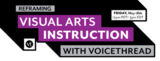
Have you pondered the possibilities of using VoiceThread to demonstrate art techniques in video, explain complex studio projects, and create secure group critiques? Have you wondered what new curricular opportunities exist when you teach with a technology that empowers students to visually document, share, and discuss their reflections from anywhere?Then join me for this free webinar!Reinventing Visual Arts Instruction with VoiceThread Friday, May 18th12:00 PDT/ 3:00 EDTRegister Here: https://www2.gotomeeting.com/register/944411626I will be joined in this webinar by: Heidi UptonAssistant Professor, Core Studies, Discover New YorkSt. John’s UniversityHeidi will share how she uses Voicethread with students in Discover New York, a freshman transition course that uses New York City as a text for the building of aesthetic literacy skills and social awareness.Tammy LockettLead Faculty, FoundationsThe Art Institute of Pittsburgh's Online DivisionTammy will share how she incorporates VoiceThread into eCollege assignment threads for fundamental art courses to provide group critiques, asynchronous, lectures and video demonstrations.Excerpts from class VoiceThreads will be shown, links to sample VoiceThreads will be shared, and your questions will be answered.Are you a college instructor using VoiceThread to move learning beyond the traditional lecture? Please share with me here: http://goo.gl/Z0l1o
Michelle Pacansky-Brock
.
Blog
.
<span class='date ' tip=''><i class='icon-time'></i> Aug 26, 2015 04:58pm</span>
|
|
Back in January I shared a post titled "Breaking the Ice with a Collaborative Google Prez," in which I explained how I've been using a Google Presentation, shared with anyone who has the link to have edit access, as the foundation for a social "ice breaker" and reflection activity in my online class. That original post with provide you with more context about the activity, including a sample of the template I provide to students (i.e. what the presentation looks like before they edit it).This week I took some time to create a guide to explain the steps involved with creating this type of activity. The guide, however, is written with an in-class activity in mind but if you're interested in understanding the nuts' n bolts of how to set up a Google Presentation with the most effective sharing settings for this type of activity, I think you'll find it helpful.Click here to open the guide in a new page (then click "download" to save it as a PDF) or view it below. This document is shared with a BY-NC Creative Commons license to promote sharing, learning, and innovation in teaching and learning.
Michelle Pacansky-Brock
.
Blog
.
<span class='date ' tip=''><i class='icon-time'></i> Aug 26, 2015 04:58pm</span>
|
|
I find that many college instructors shy away from using VoiceThread because of security concerns. I wanted to share a simple tip that I think some may find helpful. VoiceThread has a Group feature available to all users with a PRO account and above that allows for you create a secure environment for class interactions.Once you create a Group, VoiceThread provides you with a join link that you can email to the people you'd like to join or simply include in your course management system, behind the authentication ensuring that only your enrolled students will have access to it. I make joining our VoiceThread group a required activity the first week of our class. When a student clicks on the link, s/he is taken to a page that asks them to Sign In or Register for VoiceThread. If they already have a VT account, they can access their existing account and they're automatically made a member. If they're new to VoiceThread, they just click on "Register," complete the form and in a single swoop, their account is created and they become a group member. I can easily check to see who has joined the group by accessing the group list from within my VoiceThread account too. Each week, as I prepare my content for the next unit I simply share our VoiceThread activity with the class group and embed it in my course management system. Students click on square button included in the embedded VoiceThread that says "Sign in or Register" which allows them to authenticate into their own VT account without leaving the CMS. Doing so makes the embedded VT visible and lifts the message, "You do not have permission to view this VoiceThread," which is what a non-authenticated user sees." Using the group feature is an easy way to ensure the content remains secure and prevents students from sharing content with non-enrolled students. Now, I am fully aware that there is a very good argument for requring our students to participate in the open web -- and I do support that argument. But if we have the interest in supporting student privacy, for institutional reasons or due to the nature of the content being discussed in the class, understanding how to manage it effectively is an important part of teaching with emerging technologies.Learn more about VoiceThread groups here. Below is a brief video that illustrates how and why to create a VoiceThread group:
Michelle Pacansky-Brock
.
Blog
.
<span class='date ' tip=''><i class='icon-time'></i> Aug 26, 2015 04:57pm</span>
|
|
This month in my GETInsight blog post* explores the value of unlearning in changing education. Like fish swimming fluidly through water, we become so accustomed to the patterns that inform our educational processes that we are unable to see them. Without the ability to see them, we are paralyzed and unable to change them. This post examines connections -- difficult to accept at times -- between the assembly line thinking that inspired the United States' educational system in the industrial age and the same schools, classrooms, assignments, and tests our students engage with each day. I hope the post stirs you enough to see and maybe even ask a question, make a comment, send it to a colleague, or reflect on it in solitude. Go to the Learning to Unlearn post on GETIdeas.org.*Each month I write one GETInsight blog post which is sponsored by GETIdeas.org.
Michelle Pacansky-Brock
.
Blog
.
<span class='date ' tip=''><i class='icon-time'></i> Aug 26, 2015 04:57pm</span>
|
|
I authored an article for the Spring issue of OnCUE magazine, which is available only to members of CUE. But the great folks at CUE (thanks, Sara Armstrong!) have provided me with a PDF of the article to make it more accessible to my educational network. I hope you enjoy it. It's written from the heart and I welcome your comments. :)I hope this article will engage a broad audience, K12 and higher ed, in a conversation about some of the ways emerging technologies -- web 2.0, social media, and mobile learning -- are flattening the learning landscape and empowering more learners to see that they too can learn, despite what their formalized educational experiences may teach them. Enjoy.Click here to access the document on a separate page (then click the "download" button to save the PDF).
Michelle Pacansky-Brock
.
Blog
.
<span class='date ' tip=''><i class='icon-time'></i> Aug 26, 2015 04:57pm</span>
|