Blogs
|
I was joined today in my VoiceThread office hour by Heidi Upton who teaches at St. John's University in New York. She teaches a course called Discover New York which is a mandatory course for first year students at her institution. It's really pretty wonderful and I wanted to share it with you all!The course "is an introduction to New York City through the lens of a particular subject discipline." Various faculty members teach the class and apply their own expertise to the curriculum, allowing students to explore various cultural aspects of New York including "immigration, race/ethnicity, religion, wealth and poverty, and the environment." Taking a non-traditional college approach, the city is engaged as text and students actively and critical interpret its landscape as a learning community. I keep thinking about what an extraordinary model this is for colleges in or near any city. And what an enriching learning experience this would be. Are there other colleges you know about who integrate a course like this into their required curriculum? If so, let me know!In Heidi's inaugural semester teaching the class, she took her students on trips through the city streets to experience the visual arts of New York. As they walked, Heidi and her students used photography to document things that intrigued or inspired them. Then they shared their visual recordings in a VoiceThread. Here is the VoiceThread Heidi created and shared with her students. Here, in her voice comments, she models the practice of and interpreting her visual experiences and is then joined by her students in a collaborative online learning environment.Following this modeling exercise, each of Heidi's students created his/her own VoiceThread in which they shared their photographs and interpreting their discoveries in their own comments. A great project to support a great class! Thanks for sharing, Heidi!
Michelle Pacansky-Brock
.
Blog
.
<span class='date ' tip=''><i class='icon-time'></i> Aug 26, 2015 05:11pm</span>
|
|
Register here: https://www2.gotomeeting.com/register/592394922Tips for Supporting Student Success with VoiceThreadFriday, December 9th 12:00pm PT/3:00pm ETMichelle Pacansky-Brock, an award winning community college instructor, will share tips and strategies for using VoiceThread in your class. This includes strategies for managing student privacy, developing a technology profile of your students, fostering a community, and scaffolding your students’ use of VoiceThread so their focus stays on "learning" rather than "technology." Participants will receive a collection of web-based resources to support your own professional development.
Michelle Pacansky-Brock
.
Blog
.
<span class='date ' tip=''><i class='icon-time'></i> Aug 26, 2015 05:09pm</span>
|
|
Last week I shared a status update on Facebook requesting the help of "friends" to solve a family mystery. I have an old postcard that was written by my great grandmother, Elise, in 1915 in Germany to her husband, Theodore, while he was away at war. The letters on it are incomprehensible to me and my immediate family and I've always wanted it translated. I tagged several friends in my post, including two relatives from Germany (who I have never had the opportunity to meet). Along with the post, I included a link to a VoiceThread I had created with a picture of the postcard (front and back) and my questions in voice and text (to help with translation). You can view that VoiceThread above. (By the way, additional photos have since been added to the VoiceThread in response to the dialogue -- a couple of which I had never seen before. The VoiceThread is becoming a family archive and I hope to continue adding voice descriptions and stories to it. Imagine the relevance this will have to my own grandchildren.) The postcard is a family relic and I had been told by my mother that it contains a message from my grandmother, who was home caring for her five daughters (one of them my grandmother, Ella), while her husband was away on the battlefields of World War One. I wanted to know more than that though -- especially what the red text on the right side of the postcard said. The meaning of the postcard had been conveyed to me through my mother through oral stories but what did the postcard really say? Within 12 hours of the status update, a dynamic exchange had ensued between my cousin, Thomas, in Germany, and a close family friend, Lore, who lives in the US but is from Germany. A high school friend, who I haven't talked to in more than 20 years but now lives in Germany, assisted with identifying the type of script used on the postcard too. The script, apparently, is not German but Suetterlin. This is one of the reasons why it's been so hard to translate over the years. Lore, apparently, had received instruction in reading and writing in Suetterlin when she was young. The writing on the left side of the postcard, by Elise, shares her happiness upon hearing recent news that Theodore was healthy (we assume she had received a note from him not long before this was written). The postcard is date stamped 8-16-1915. But there is a handwritten phrase in red dated 8-25-1915. This phrase says, "killed in action." I had understood that the postcard had been returned to my grandmother with this handwritten mark upon it. However, my Facebook community keenly identified that the red letters are in ballpoint pen, indicating that it was written much more recently than the Suetterlin text which was made with a fountain pen.The death of my great grandfather has been verified by another of my relatives in Germany who has located a photograph of Theodore's grave -- on which the date 8-23-1915 in inscribed (matching the red text on the postcard). Since I posted this on Facebook, I have also received never seen before pictures of Elise's parents (my great, great grandparents) including one of them standing in front of their own porcelain shop (these have been added to the VoiceThread). My cousin has also shared stories with me about Elise which I've never heard before -- she said that her husband had volunteered for the war but soon thereafter was "shot in the head." She was a strong woman, up until her death at age 99.The postcard is a precious family relic to me. It is a metaphor of love, loss, and the incredible courage and human commitment of both Theodore, who voluntarily left for the war, and Elise, who raised five young daughters alone in early 20th century Germany. With the combined help of Facebook and VoiceThread, a new layer of family history has been revealed and more keep coming. I'm very grateful to be alive right now. We have an unparalled opportunity to leverage social technologies to learn about and tell our own stories. We are all experts in something -- and when we have the opportunity to share those gifts with others, the power of social technologies is felt. That is part of our quest in this century, I believe -- to identify our passion and area of expertise and share it with the world. This empowers each of us to give something back to the world and leave our mark.Finally, as an educator, I'm realizing the significance of this "moment" and how important it is to weave these opportunities into our students' learning experiences. Doing so would illuminate the deeper relevance of social media to our students to open up their own stories -- and encourage teachers to move away from our reliance on textbooks to facilitate learning. Mashable shared a related story today about how social media is informing world history events. How many history professors are working this concept into their curriculum, I wonder. I remember how difficult it was for me to connect with history when I was young -- I can't imagine how different my academic experience would have been if I were introduced to history through an opportunity to tell my own story and share it with the entire world.As a result, I'm thinking about integrated a project into my online History of Photography class that requires students to "tell a story" involving a photograph and a defining family event. This project would include a research stage in which social media would be used to reveal new bits of information and the story would be shared in a student-generated VoiceThread. I really can't think of a more valuable learning experience. What do you think? History is yours. What's your story?
Michelle Pacansky-Brock
.
Blog
.
<span class='date ' tip=''><i class='icon-time'></i> Aug 26, 2015 05:09pm</span>
|
|
David Pogue wrote an article for the NY Times about how Apple's iPhone 4S's AssistiveTouch feature supports blind users more effectively by empowering users to control the phone through complex hand gestures and interactive voice. I don't have an iPhone 4S so it's hard for me to describe these features in detail but this article has me thinking... As emerging technologies have begun to be used more in college classes for learning activities and increased participation, the concerns about their accessibility for disabled students, particularly those with vision challenges, have escalated. For background, please refer to this article and this article.With the increasing sales of smartphones, we are seeing more and more emerging tools develop a mobile app. As smartphones continue to become more accessible to blind students, more of them are purchasing the devices. So, it seems that professors should be including mobile support as one of the factors used when evaluating a tool for use in a classroom. This is really fascinating to me, as I can recall sitting in a presentation at a conference three and a half years ago listening to a Bill Rankin talk about Abilene Christian's mobile initiative, now called ACU Connected. At the time, I was excited about the experimentation at ACU but I remember seeing red accessibility flags pop up in my peripheral vision. But now, the tables seem to be turning and smart phones appear to be transitioning into a gateway to support disabled students, rather than another obstacle. This requires professors and administrators to view and value mobile devices very differently.Do you know of any colleges or universities who are experimenting with smartphones as an assistive technology device to accommodate students with particular learning challenges? I'd love to hear from you if you do. This is a topic I'm interested in weaving into my forthcoming book. Thank you!
Michelle Pacansky-Brock
.
Blog
.
<span class='date ' tip=''><i class='icon-time'></i> Aug 26, 2015 05:09pm</span>
|
|
Join Michelle Pacansky-Brock for a conversation with Matt Meyer, Sr. Instructional Designer at Penn State University, to learn about how and why Penn State adopted a sitewide VoiceThread license for all faculty, students and staff. Matt will share the collaborative approach Penn State used to implement and adopt VoiceThread as well as the resulting resources they developed to support faculty. He will also provide advice for other institutions, and answer your questions.Integrating VoiceThread Into Your Campus-Wide Teaching ToolkitSpace is limited! Thursday, January 12th3pm ET/12pm PTRegister here: http://goo.gl/nZr4t
Michelle Pacansky-Brock
.
Blog
.
<span class='date ' tip=''><i class='icon-time'></i> Aug 26, 2015 05:08pm</span>
|
|
Rainbows are incredible to me. I can be in the midst of a crummy day, stuck in gridlock traffic, or taking out a bag of garbage but when I see a rainbow, I stop everything and marvel at it -- I call my kids over, I point them out to strangers nearby, or just sit and stare in solitude. Despite the fact that there is a clear, scientific reason for a rainbow's appearance, to me, when I see one it represents possibilities and puts the world in order for me.Today as I think about the end of 2011 and the dawn of 2012, I feel much the same way. It's really just another day but tonight we all will celebrate the turn of a clock, the emergence of one more year. If there's one thing I learned in 2011, it's the simple fact that I have no idea what I'll be doing one year from today. Life is strange, unpredictable, quirky, snarky, wretched, beautiful, and marvelous. Happy new year to you all -- join me in embracing the possibilities 2012 holds for each of us. And as you formulate your resolutions, here's one to consider: take a risk. When you do, it may not turn out the way you want, it may be difficult, or it could be phenomenally fabulous -- regardless, you'll learn more about yourself than you could ever imagine.Cheers.
Michelle Pacansky-Brock
.
Blog
.
<span class='date ' tip=''><i class='icon-time'></i> Aug 26, 2015 05:08pm</span>
|
|
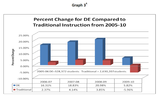
If anyone out there has been following the recent statewide dialogue in California about identifying strategies to improve the success of California community college students, you may be interested in reading the "Draft Recommendations Report" which was recently made public on the Chancellor's website.I've just begun trudging through it and have been a bit stunned to see that due to "time restraints," the task force did not directly address "distance education" in the report (p. 11). I feel compelled to take a step back right now and point out that the continual lumping of online courses in with our face-to-face courses continues to hurt California community college students. Online classes are unique and the strategies necessary for increasing the success of students in online programs as well as those who enroll in both online and face-to-face coursework needs to be addressed directly. General communications from the Chancellor's office shared in articles throughout the year with the public typically report important data, like enrollment, in lump figures and the data for distance learning is traditionally reported in a separate report every two years. This reporting process, in my opinion, makes the realities of the impact that online learning is having on the landscape of the CCC system murky, at best. And, as a result, the significant role that online learning plays throughout California's 112 community colleges -- which support 2.6 million students, more than any other system of higher education in the nation -- is not positioned as a statewide priority and the unique needs that online learning brings to the system are often not realized. The 2011 distance education report can be found here and in it you will see some information that may surprise you. It surprised me and I consider myself pretty well informed about online learning in California. The graph below illustrates the past four years of enrollment changes -- distance education is represented in blue and traditional, face-to-face, classes are represented in red. As the data illustrated above makes clear, the future of California community colleges is a blended future. Between academic years 2006-2010, traditional enrollments remained relatively stagnant year over year or declined, while online enrollments have soared, even in the face of severe budget cuts. Lower Success Rates for Online CCC Students The report also provides evidence that online course success rates trail traditional success rates by 10-12% over the four year period measured in the report (course success defined as the % of enrolled students who end the term with an A, B, or C). This isn't groundbreaking news but is certainly a significant point to consider. These success rates can be improved significantly with the proper strategies but will not be improved if online classes are not understood and valued as unique. Online students who learn in solitude with little to no human connection are at a greater risk of failing -- especially when they're academically challenged and/or their courses are designed with cold, text-based information and void of a sense of relatedness to one's instructor and peers. One of the most important elements of supporting student success online is professional development and faculty training. An intriguing recent study at Cabrillo College has revealed that online success is even lower for Latino students. The online success gap for Latino students is 44% greater than white students, according to the study. This may be due to the strong role of human-to-human contact and relationships in the latino culture that are undercut by flat online course design. Raymond Kaupp, director of workforce development at Cabrillo argues that the low success rates for online Latino students is likely rooted in Latino attitudes toward education. "Relationships are important to Latino student learning." Community colleges need to foster online community, just as they foster face-to-face community -- within a class, within a department, across a program, and an entire campus. In our mobile, interconnected world driven by video technologies that are now free to low cost, it's a failure to create cold, isolating online learning experiences. Online classes can be vibrant, dynamic and highly personalized if they're designed effective and integrate pedagogies that support active and constructivist learning through the application of emerging technologies, and faculty are supported to ensure content is accessible to all students. One model that has been proven effective at increasing online student success is the Human Presence Learning Environment used at Santa Barbara Community College. Warm, High-Touch, Community-Oriented Online LearningIn the teaching I've done over the years for @One's Online Teaching Certification Program, I've seen hundreds of faculty be inspired and amazed at what they can do for their students to create more social, community-oriented learning experiences for their students with a higher sense of social presence -- through the use of technology that would otherwise be absent from their teaching approaches. When the framework embraced for evaluating student success does not view online as a unique entity, these essential pillars of online student success are rendered absent (and they aren't, by any means, the only pillars). I look forward to watching the lively discussion about the report evolve and am hopeful there will be more advocacy from faculty, staff, students, and the community about the importance of stressing the uniqueness of online learning, the central role it will continue to play in the future of California community colleges and our students.
Michelle Pacansky-Brock
.
Blog
.
<span class='date ' tip=''><i class='icon-time'></i> Aug 26, 2015 05:07pm</span>
|
|
There's a great little article by Nick DeSantis today over at the Wired Campus blog that showcases how Donnelyn Curtis, director of research collections and services at at University of Nevada at Reno, is using Facebook to portray the life of two historical figures.Using archives and permission from family members, she generated a Facebook profile for Joe McDonnel and Leola Lewis, two former college students who graduated in 1913 and were married not long after. The profiles include photographs of the two attending college events together, like the "sophonore hop," and status updates reflecting their favorite activities and the realities of early 20th century college life. This historical "role playing" with Facebook is a creative way to melt history into our students' contemporary technological landscape. And I think this is a terrific idea to keep in mind for learning activities too.Blogging About Dead PeopleIn my History of Photography class, my students each have their own blog in our private class Ning network. Most weeks they write a blog post in response to one of two prompts I assign them. I like to give options, as students respond more favorably to assignments when they have a choice and I really like to contrast the prompts too. While they both will align with the weekly learning objectives, I like offering one creative writing option and one that is more objective.In an early unit focused on The Popularization and Socialization of the Daguerreotype (1840s), students are pointed to the Daguerreobase website which provides them with a collection of digitized daguerreotypes. They are expected to select one from the database that is either a traditional portrait of one or more people or a death portrait, representing the popular genre of post-mortem portraiture. In their blog post they role play either one of the people sitting for the portrait or the family of the deceased person, usually a child, represented in the post-mortem portrait. Clearly, not all students get intrigued about the idea of writing about a photograph of a dead child but some students are really intrigued about how this phenomenon was considered "normal" in the 19th century; which, of course, is a big part of the "point" of the assignment -- to get students to grasp that the way we value and respond to particular types of phtotographic images is socially constructed. Both posts require students to include factual information about the daguerreotype process, including the studio experience, the exposure time, how it felt wearing mechanical devices that were used to hold a person still during the long exposure time, and the magical feeling of seeing the photographic image unveiled before them.In our 1880s-90s: Birth of Kodak and the Rise of Snapshots unit, students are given the option to locate two early Kodak ads and analyze them or to locate a historical 'snapshot' and write a blog post that fictitiously role plays the experiences of the person who took to photograph. Both posts require students to include important contextual details, from our learning unit, but each allows students to draw upon their particular styles. Some students l-o-v-e the creative writing options and others feel more comfortable moving into the analytical writing assignment. By sharing their work on their blogs, they have the opportunity to reach out and read what each other has written, increasing their exposure to unique ideas. It's fun to see them comment with encouraging insights the next week.I have shared both of these blog post activities with Creative Commons licenses and you may view them on the History of Photography page of my blog.I love engaging students in history through role playing and hope these examples inspire you think about a unique way to use social media to make history come alive for your own students.
Michelle Pacansky-Brock
.
Blog
.
<span class='date ' tip=''><i class='icon-time'></i> Aug 26, 2015 05:07pm</span>
|
|
I recently posted about a creative use of Facebook by a librarian at the University of Nevada, Reno that embraced social media to make history come alive. Today, the Chronicle reported that Facebook has deleted the accounts representing each of the historical figures due to a violation of its terms of use. As much as I loved the idea, I completely understand why Facebook enforced its rule that users may not "provide any false personal information on Facebook, or create an account for anyone other than yourself without permission." There is a common trend among young users of Facebook to create false profiles of real people and post erroneous, inflammatory comments about them. Maintaining integrity in social media is important. The Chronicle article reports that the pages received thousands of friend requests after the project hit the blogosphere and Twitterverse. So, the good news is that people are interested in learning about historical figures through creative applications of emerging tools. And the article also suggests that creating a Facebook Page about each of the historical figures may fall within the Facebook rules. We'll see.Experimentation is good. This is how we learn to define the boundaries of our of new digital landscape and understand how we can apply it to learning.
Michelle Pacansky-Brock
.
Blog
.
<span class='date ' tip=''><i class='icon-time'></i> Aug 26, 2015 05:06pm</span>
|
|
This is the first week of my online History of Photography class. I am gently guiding my students into our class which is peppered with emerging technologies including Google Apps, Ning, and VoiceThread. To get them started this week, I have a fun, simple activity that they engage in.The activity is titled My Favorite Photograph and the objectives are:To help students get to know their peers on a personal level and start to form the early threads of community.To examine the subjective and personal nature of the meaning of a photographic image.I created a presentation using Google Docs (click Create and select Presentation, create the presentation, change the share settings to "Anyone with a link" and "Can edit."). A copy of the presentation is embedded below so you can take a close look at the precise instructions and sample I have provided them with. I used this activity last semester and had zero questions -- so I'm pretty excited about it! Click here for a larger view. Here's how it works. Week 1: Students click on the link that takes them out to the Google Presentation (exactly like the one you see below but the one they see includes dozens of blank pages, each titled with a student's name).They read the instructions on slide two and, if necessary, view the video embedded on slide three (which shows the steps for editing the presentation that are explained in text on slide two).They view the sample slide I created for them.Then they locate the slide with their name on it and upload their photograph and text (explaining why it's their favorite photograph).Week 2: I embed the completed Google Presentation in our Ning network (which is private and open only to my students).The students are instructed to review the entire presentation, reflect on the images and the justifications the students wrote for why they selected the image. This is really more empowering than it sounds, as students share some very compelling images including loved ones who are away at war, deceased family members, picturesque scenes of nature, artistic masterpieces, and beloved family pets. All in all, they're learning how diverse "photography" can be.Then before the week is over, they write their first blog post which is an analysis of what they learned from participating in and viewing the collaborative presentation. They are asked to reflect on what they learned about the nature of photographic meaning, as well as to select one photograph from the presentation that stands out in their mind and explain why.As the blog posts come in, students read each others' posts. Many see their contributions referenced and can read what their image means to their peer, some find a peer who references the same photo they selected, or see an entirely new perspective that they hadn't considered.
Michelle Pacansky-Brock
.
Blog
.
<span class='date ' tip=''><i class='icon-time'></i> Aug 26, 2015 05:06pm</span>
|