Search Results for ""
|
Is it possible to blend tried and true theories of instructional design while meeting the needs of your learner population and stakeholders who are begging for games? Does gamification of eLearning even make sense for your organization or the needs of your learners?
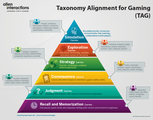
In the webinar "Aligning eLearning Game Designs to Bloom’s Taxonomy", Angel Green will provide a sneak peek to Allen Interactions’ Taxonomy Alignment for Gaming (TAG) —based on Bloom’s Taxonomy— to help instructional designers in their quest to incorporate gaming into their learning designs.
You're welcome to download this complimentary infographic, but please also join us for the webinar. See below.
|
|
"If you're trying to persuade people to do something, or buy something, it seems to me you should use their language, the language they use every day, the language in which they think." David Ogilvy
David Ogilvy, the famous marketing and sales executive, said it this way, "If you're trying to persuade people to do something, or buy something, it seems to me you should use their language, the language they use every day, the language in which they think." Nelson Mandela said it like this: "If you talk to [people] in a language [they] understand, that goes to [their] heads. If you talk to [them] in [their] language, that goes to [their] heart."
The ability to communicate—whether to persuade or just to understand—goes beyond using words well; it requires the ability to use words in a way that has meaning for those with whom you are speaking. The ability to talk with someone in his or her native language isn’t just about them understanding you; it’s about you understanding them—their experiences, their thinking, their beliefs, and their values. While definitions lie in words, meaning lies in the people who use them.
|
|
Engagement, the employee’s commitment to their organization and their willingness to perform beyond expectations, has become a focus area for management. Engagement is more than mere job satisfaction; fully engaged employees are motivated and dedicated to making the organization a success. At the most simplistic level engaged employees lead to happy, loyal customers and repeat business. Importantly engagement also leads to improvement in retention levels. In short, it impacts the bottom line.
Dale Carnegie Training asked MSW Research to undertake a benchmark nationwide, cross industry study of 1500 employees to explore engagement in the workplace. The study discovered that although there are multiple factors affecting engagement, the personal relationships between a manager and his or her direct reports is the most influential.
|
|
Sales Enablement: How do we do it?
The phrase sales enablement has become a standard term in the language of those who support sales performance. There are currently 37 LinkedIn groups with this phrase in their titles. There are software companies, products, consultancies, and all kinds of online resources that include sales enablement in their names, descriptions, or value propositions. It's a great descriptive phrase for marketing products and services, but, like many such catch phrases, means different things to different people.
This free white paper from Dr. Carl Binder, originator of The Six Boxes®, will help your sales leadership team understand and implement these concepts and - yes - enable your sales team to perform at its highest potential.
|
|
It’s a debate that’s raging throughout the digital content world, from content marketers to eLearning professionals:
"What is the ideal online medium for conveying my message?"
The contenders? A flurry of tactics, ranging from ebooks to white papers to webinars to blogs to infographics to social media. Each has its own
strengths and weaknesses. Each has gained favor in segments of the marketing and eLearning worlds.
Conscious of the weaknesses of these alternatives, content creators continue to seek new and more effective media for their messages. Ask them to describe an ideal medium, and you’ll hear something like this:
It would be up-to-date, like a live webinar
It would be multisensory, like a video
It would be navigable, like a white paper or e-book
It would be actionable and trackable, like a landing page
It would be interactive, like a website
It would be sharable, like a social update
It would be deeply engaging, like a video game
It would be searchable and discoverable, like a blog
It would be simple to follow, like a slideshow
|
|
Where are you as you read this - home, office, taxicab? What kind of device are you using - mobile, laptop, printed version?
The fact that there are so many possible answers to those questions is an indication of how our work lives - and indeed our private lives as well - have become increasingly mobile, global, networked and virtual.
Download this white paper for the latest numbers, trends and insights into how they can be used to leverage virtual learning environments to meet today's critical talent needs.
|
|
Successful sales organizations weather tough times with thoughtful initiatives, skilled salespeople, and healthy client relationships.
Are We There Yet?
If not, it sure feels like it. Housing is so bad that your mortgage is upside down. Credit is so tight that you can't borrow a garden hoe. The dollar is so weak that a pint in London sets you back a day's pay.
So, is it a "technical recession"? Who cares, really, because for reasons of their own, customers and prospects are sitting on their checkbooks.
And what's the impact on you of this excruciating state of suspended compensation?
Sales cycles longer than the River Nile.
Client conversations that move smoothly from price, to price, and finally on to price.
Formerly friendly clients who won't give you an Altoid.
And, of course, the invasion of the tirekickers.
You say you've done everything obvious and nothing works?
Maybe it's time to narrow your focus.
|
|
New technology promises to take e-Learning out of the traditional, classroom-based paradigm and into a true "digital native" context. These new e-Learning tools will allow employees to engage in more active and realistic training activities, and they will incorporate emerging social learning and informal learning methods. Download this white paper to discover the implications of these next-generation e-Learning trends and answer these
Three Fundamental questions:
What unique traits set today's cutting-edge e-Learning tools apart from their predecessors?
What are some specific examples of next-generation e-Learning tools?
How can these tools increase e-Learning ROI and enterprise productivity?
|
|
All of the assumptions in our "Common-Sense" article are based upon a well-tested psychological principle, such as Maslow's heirarchy of needs, the Yerkes-Dodson law, psychology's law of effect, the Hawthorne effect, Herzbergs's two-factor theory, and even a few well-tested hypotheses of our own. But don't let the names intimidate you. These are simple, verifiable, ideas—the kind of assumptions you make everyday about the people you supervise.
Each of the concepts we discuss is an example of what we call tested common sense assumptions made about human nature that have been empirically verified through psychological research or through actual application in the "real world" of the workplace.
|
|
Microlearning is a new kind of training for the digital age. This playbook offers strategies for applying this methodology to your own curriculum - a positive step in gaining back lost productivity and finding affordable, effective training for a more digitally capable workforce.
|