Blogs
|
Yes, you read that right! We’ve been recognised by Training Industry in their Top 20 Gamification Companies List, making us a certified world-leader!
We could not be happier about this announcement! After all, gamification is something of a specialist subject for us.
And the Top 20 aren’t ranked in any particular order, so for all we know, we could actually be number one (we like to think we are!).
Of course, the reason we’ve made the list is our focus on building gamification features into our engaging learning products, namely our gamified, social Academy LMS and Genie, our game-based content authoring tool.
Here’s what the judges were looking for:
Features and capabilities of the gamification products/services
Company size and growth potential
Quality and number of clients/users
Geographic reach
Awards, recognition and competitive differentiation
After dedicating more than a decade to transforming the world of online learning, our Managing Director, Juliette Denny, was almost brought to tears of joy when she heard we’d made the list!
We calmed her down enough to grab a few words: "Making this list is a dream come true! More and more organisations are turning to gamification to engage their workforce with their learning and development, so being recognised as an industry leader is a huge testament to our hard work and expertise in this field!"
We love sharing our gamification expertise, which is why we’ve put together two white papers, both absolutely free to download!
First up is ‘Fun in Learning’ which explains what gamification is and how you can apply it to your learning. Second is ‘The Business Case for Gamification’ which delves deeper into the incredible ROI gamified learning can deliver to an organisation.
And if you’d like to find out first-hand why we’re a world-leader when it comes to gamification, why not take a free tour of our Academy LMS to see what makes us stand out?
The post We’re one of the Top 20 Gamification companies in the world! appeared first on Growth Engineering.
Growth Engineering Blog
.
Blog
.
<span class='date ' tip=''><i class='icon-time'></i> Dec 05, 2015 02:25pm</span>
|
|
We all love a good eLearning unit (unless you happen to be a heartless, unfeeling monster). But here’s the issue - it takes time (and buckets full of effort) to produce high quality online learning content. Instructional Designers are often driven mad by the sheer complexity, intricacy and difficulty of the projects they embark on.
Awesomely effective, super-engaging eLearning doesn’t happen by itself - it takes a team of eLearning superheroes to make dreams a reality.
But what if you don’t have a huge team? What if you’ve got a ton of eLearning units to produce for a new product launch in a month’s time? What are you going to do!?
Well, I’m willing to bet that you’re going to Google something like "make eLearning quickly" and when you do that, you’ll probably find out about Rapid eLearning.
‘What is Rapid eLearning?’…
…is likely to be the next thing you Google. And if you’re expecting a definite answer to this, you’ll be a little bit disappointed. There are several definitions of Rapid eLearning out there, but they usually tick the following boxes:
Rapid eLearning is usually created within 2-3 weeks
Rapid eLearning projects are usually handled by subject matter experts (SME)
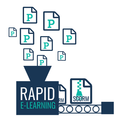
The process usually involves converting slideshows into SCORM-compliant eLearning
Sounds like a dream-come-true, doesn’t it, but is Rapid eLearning a Holy Grail or a poisoned chalice? We’ve done a taste test for you, so let’s find out:
THE PROS
So, firstly let’s look at the advantages of Rapid eLearning.
It’s rapid (duh)! Sometimes you just need the content. You could make it really pretty if you had… no - I just need it now. But with a little extra resource, you could… I don’t have time for that! That’s sometimes the reality of Learning and Development - sometimes you need to ditch the frills and just get some reportable content in front of the learners.
In these cases, a Rapid eLearning solution lets you create a functioning eLearning unit out of your existing assets (Like a Power Point presentation, for example).
It’s newbie-friendly! What good is a rapid authoring tool that takes a month to figure out how to use? Rapid eLearning should let you cut corners at every turn and the last thing you need is a steep learning curve appearing out of nowhere.
The beauty of Rapid eLearning is that anybody can jump in and create a reasonably useful eLearning unit, without any coding background at all.
It’s cost-effective! You’re saving time on eLearning production, and you no longer need to pay a team of eLearning developers - result! There’s no doubt about it - Rapid eLearning is cheap, cheap, cheap!
If savings were the be-all and end-all of learning and development, then Rapid eLearning would be the only choice. Unfortunately, Rapid eLearning is not without its weaknesses…
THE CONS
Slideshow in - Slideshow out: You can save yourself a lot of time by converting a presentation document into an eLearning unit using a rapid authoring tool. The only problem with this (and it’s a pretty big one) is that your eLearning will now be about as engaging as this month’s P&L report.
Generally speaking, the functionalities of Rapid eLearning are limited to basic interactions. Of course, at the beginning, your learners will think they’ve got an interesting new eLearning unit, but after the first half-dozen "Click here to continue" buttons, the novelty will have worn off.
Worst case scenario, your learners will rise up in outrage and start a riot, but in all likelihood, they’ll just disengage their brains and click through to the end. That’ll leave your reports with 100% completion and 0% retention - in short, a waste of time.
SMEs aren’t instructional designers: It takes a really special breed of learning-nerd to figure out how to hack people’s brains for maximum retention. Your product gurus might be the number 1 authority on your latest range of Wi-Fi -enabled shaving mirrors, but do they know the first thing about effective learning methodologies?
It’s not super-likely, is it?
The beauty of collaborative eLearning production is that it lets both IDs and SMEs use their respective talents to create something that’s greater than the sum of its parts. Without this kind of collaboration, you’ll have your eLearning in no time at all, but it might not be as effective as you’d hoped.
SMEs aren’t graphic designers: Last week, Juliette, our MD, wrote this article on the importance of beauty in eLearning. She discovered that 45% of consumers will judge your content based on the aesthetics alone, and they’ll do this in just over 3 seconds.
With enough time and resources, an eLearning team can produce learning assets that are as beautiful as they are effective. If you’re using a Rapid eLearning solution, however, the chances are you don’t have the luxury of time at your fingertips. Furthermore, if your SMEs don’t have the requisite eye for UI, you could find yourself with some informative, yet woefully ugly eLearning content.
It would be a real shame to lose learner engagement on the grounds of something so shallow, but sadly, that’s the world we live in!
So there it is - Rapid eLearning is indeed a useful tool when you’re up against it, but it’s not without its drawbacks. What you really need is something that lets you create eLearning units quickly, without being ugly or dull. You need some level of collaboration so that everyone can lend their own unique skills. And most of all, you need something that’s actually going to engage your learners.
We’ve developed Genie, a content authoring tool that lets you produce engaging, game-based eLearning content quickly and without the need of a whole team of eLearning developers. You’re not just rattling out a bunch of slideshows-in-disguise - instead you’re crafting learning journeys that your learners won’t forget!
Don’t just take our word for it though - take Genie on a test-drive today and bask in the wonder of game-based eLearning for yourself!
Click here to become more awesome!
The post Rapid eLearning - Holy Grail or Poisoned Chalice? appeared first on Growth Engineering.
Growth Engineering Blog
.
Blog
.
<span class='date ' tip=''><i class='icon-time'></i> Dec 05, 2015 02:24pm</span>
|
|
You know what it’s like, right? You’re walking around Sydney and you’ve got nothing fun to do! All you’ve got to entertain yourself is some weird spaceship in the harbour (they say it’s an ‘opera house’ but we all know the truth…).
Well, guys - don’t despair! Your mates at Growth Engineering are here to bring you the essential guide to having a bonzer time in Sydney! It’s not a big guide - it’s only got one event in it - but that’s all it needs, because this shindig is a real beaut!
The Learning@Work Conference and expo, 2015 kicks off on the 27th of October and spills over into the 28th. Growth Engineering, the ass-kickingest renegades of the online learning world, will be busting out the badges on stand #4.
Don’t be a flamin’ gallah! Pop along and find out about what’s new and exciting in L&D and you (yes, YOU!) can pick up a badge of your very own!
What’s that? You can’t make it to Sydney on time? Not to worry - you can satisfy your need for the latest and greatest learning tech right here, right now!
Click here to book a tour of our gamified social learning management system, the Academy LMS!
Or, if content creation is your bag, sign up for a free trial of Genie, our revolutionary new game-based content authoring tool!
The post Growth Engineering Down Under! appeared first on Growth Engineering.
Growth Engineering Blog
.
Blog
.
<span class='date ' tip=''><i class='icon-time'></i> Dec 05, 2015 02:24pm</span>
|
|
Hey talent management aficionados! This post is the first of a series of articles we’ll be producing over the coming weeks that focuses on the world of workplace performance management. If you like what you read, then please subscribe to our blog using the sidebar to the right, or follow us on Twitter for regular updates!
Imagine a world where you can enable your workforce to grow professionally, and can effectively guide them to reach their potential and deliver results for your organisation. This magical world is exactly what performance management is intended to engineer!
It’s about keeping track of how each employee is performing, nurturing the talent already present within a business, and pinpointing areas for development.
You’re like a gardener with a pack of seeds. You can scatter them in the soil and cross your fingers, or you can carefully manage the process, nurture them where possible and provide them with the nourishment they need to thrive. Soon enough, your talent will blossom into a truly effective force within your organisation.
It’s good news for employees because they grow professionally, and it’s good news for employers because their staff are more productive and deliver better results!
Performance appraisal systems
Mention performance management to people and a lot of them will immediately think of appraisals. Appraisals are actually just one part of the process, namely the evaluation of performance, though of course this is crucial for discovering where improvement needs to be made.
Many approaches are used to help measure performance. Here are just a few:
Objective management
This is one of the most common ways to keep performance on track, and one that you’re probably familiar with! It involves an employee and their manager agreeing on targets, which should be completed within a certain timeframe.
It’s intended to be an objective form of management, since it’s based on facts and results. A disgruntled employee can’t complain that their manager just doesn’t like them if it’s clear that they’re way off meeting their quota!
Behavioural checklists
This is where an employer will decide on a list of behaviours or skills they consider essential to a particular job role. This means that each specific role will have a checklist which is relevant to it.
The manager will then rate each employee’s proficiency in each behaviour. This is a great way to flag up any clear gaps in their skill-sets, helping a manager to prioritise training and turn everyone into well-rounded performance powerhouses!
360-Degree feedback
This takes the idea of two heads being better than one to its extreme. It’s where an employer will ask for reviews from an employee’s colleagues, managers, other departments they may work with, and potentially even their customers.
The idea is to scrutinise someone from every possible angle, hence the 360-degrees. This can give you a much more rounded view of an employee and how they interact with other areas of the business.
There are countless other ways to approach appraisals, and an organisation will generally combine a number of them to get the best results. As they reveal the strengths and weaknesses of each individual employee, the organisation can then target their learning and development resources to maximise their impact!
Why take performance management online?
Though we’re well into the 21st Century now, a frankly staggering of organisations still handle their performance management offline. To put this into perspective, in 2014 the Employer’s Resource Council surveyed its members and found that just 30% use online performance management systems!
But there are clear benefits to taking your performance management online, such as:
Save time and money - Paper-based records take an enormous amount of time to put together, and as we all know, time is money! Once an online system is set up, it’s easy to manage, cutting down costs.
Easier reporting - Have you ever tried to gather data from hundreds of paper records? It’s a nightmare, plain and simple. But online you can generate reports based on the performance of thousands of employees within seconds. Who wouldn’t want that?
Full visibility for everyone - After a traditional appraisal, there can be a tendency to forget about everything until the next one. But with an online system as a constant record, everyone can keep focused on maximising their potential!
Real-time information - Another problem with traditional appraisals is that they’re often infrequent, maybe even just once or twice a year. But an online system can be updated in real-time, meaning a manager can dip in regularly to see how their staff are getting on.
Reach remote employees - In our hyper-connected world, lots of people work remotely, making it difficult to keep an eye on what they’re up to. An online system can be accessed from anywhere, meaning you can track the performance of someone anywhere on the planet!
And this is before we even consider marrying up a performance management system with a learning management system! This brings an extra level of benefits, and makes it easy to deliver the perfect training content to maximise an employee’s development.
Funnily enough, our Performance Centre does just that, as it’s fully integrated with our social, gamified Academy LMS! If you’d like to find out more about it, why not take a completely free tour?
The post Performance Centre Series: What is performance management? appeared first on Growth Engineering.
Growth Engineering Blog
.
Blog
.
<span class='date ' tip=''><i class='icon-time'></i> Dec 05, 2015 02:23pm</span>
|
|
Wouldn’t it be nice to have a bottomless budget and an army of eLearning cyborgs tirelessly developing content 24 hours a day. On the other hand, that’d be a bit too easy. There’s no thrill of the chase, no epic quest, no glory.
But then again, you’re probably busy enough without turning your working day into an action extravaganza. Chances are you’re working with prohibitive funds and limited resources.
Well, don’t throw in the towel just yet - there’s plenty you can do to stretch what you have to the max. You just need to be a little more creative.
As the learning company that never stops giving, here are a few things to help you get the more with less when it comes to your training.
Rapid eLearning
So you want to deliver training material to your learners, but you’re lacking one small detail: an eLearning department. It’s not the end of the world - you don’t actually need an eLearning department!
With a Rapid eLearning solution, you can turn your existing content into an effective eLearning unit. Instead of pushing documents and slideshows to your learners, you can incorporate these assets into a fully functional piece of eLearning. You can also add questions within the units to add an extra level of engagement
Aside from being more engaging, these units have the added bonus of being reportable. In conjunction with a learning management system, you can have full visibility over who is completing the units which is essential if you want to gauge how effective they are.
More effective eLearning
The best White Paper you’ll download today!
It’s one thing to combine your learning assets into an eLearning unit, but it’s quite another to ensure that your learners retain this information. The major challenge with online learning today is securing learner engagement. Even learners with the best intentions will lose concentration when faced with a boring eLearning unit.
The way to get the best ROI from your eLearning is to give your learners something that they want to do. When you create something that’s more like a game than a piece of compliance training, you’ll trigger off a whole galaxy of natural reactions. They’ll want to beat the game, they’ll want to collect the prizes and they’ll do whatever it takes to get what they want!
Check out our white paper on gamification to find out how to hack your learners’ brains and make them love learning again!
Better Collaboration
Let’s say you’re not a lone ranger, battling the odds on your own. Maybe you have a team at your disposal but somehow still end up fretting yourself into a tizzy with every approaching deadline. Sure, life would indeed be easier with a bigger crew at the helm, but until your next recruitment drive, you’re going to have to make do with what you’ve got.
Ask yourself this - are you making the most of the team you have? In a lot of cases, the reason your deadlines seem so scary is that you’re just not working effectively enough. It just takes one silly miscommunication to throw a project off and give you another unexpected problem to fix.
Guys, trust us on this: collaboration is the key to effective project management. You can’t afford to segment your team and isolate them in tiny cubicles away from each other.
Give your team thorough visibility over the whole project, from start to finish, and they’ll have a greater sense of what their contribution means to its’ success.
For more ways to boost collaboration in your eLearning development, check out these handy tips.
User Generated Content
Imagine if your learners created their own learning assets - wouldn’t that just save you a whole bunch of time? Let me introduce you to a little thing we like to call ‘informal learning’.
‘Formal learning’ covers all of the material you create for your learners to consume and it makes up only 10% of everything they learn at work. This gives the learners a good foundation but what about the other 90%? This they’ll pick up from actually doing their jobs and (here’s the important part) interacting with their colleagues.
You see, there’s knowledge flying around in your workplace right now! It’s everywhere you turn - you just need to find a way to harness it. If you’ll excuse the shameless plug for a moment, our Academy LMS is designed to do just that. We’ve included ‘insight groups’ which are like virtual water coolers where your learners can congregate and discuss the nerdy minutiae of their jobs.
When you give your learners a platform (real or virtual) to discuss the things that matter to them, it’s like planting a seed in the ground. Over time this seed grows into a huge repository of information that should be accessible to everyone. Not only that, you’ll be able to identify experts within your company - and what are experts..? Why they’re honorary members of the L&D team that can do your job for you!
So the next time you find yourself on your own in a bathroom cubicle, silently crying to yourself in desperation - just take a deep breath, look at what you have, and figure out how to get the most out of it.
Tantalised at the thought of effective eLearning that engages your learners?
Why not give Genie a go?
Our game-based authoring tool is completely collaborative and lets your whole team come together to craft awesome learning journeys that your learners will love!
Start your free trial today by visiting unleashthegenie.com.
The post 4 Creative Ways to Get the Most from your eLearning Content appeared first on Growth Engineering.
Growth Engineering Blog
.
Blog
.
<span class='date ' tip=''><i class='icon-time'></i> Dec 05, 2015 02:22pm</span>
|
|
Calling all talent management lovers! This is the second part of our series on the wonderful world of workplace performance management. If you like what you read, then please subscribe to our blog using the sidebar to the right, or follow us on Twitter for regular updates!
Pop your head inside any organisation and you’re likely to overhear managers talking about objectives and KPIs. Also coming under the broader umbrella terms of ‘goals’ or ‘targets’, they’re intended to keep every employee more focused on their tasks than a cat on a laser pointer.
For decades it was thought that a Harvard study had found that people who write down their objectives can be up to 10x more successful than those who don’t! In reality, it turned out that this study never actually happened (whoops!). Thankfully, a real study by Gail Matthews at Dominican University found that committing to written goals and regularly updating your progress towards them really does let you accomplish a lot more.
Objectives and KPIs
Before we go any further, let’s just make sure we’re crystal clear on exactly what we’re talking about!
Objectives are your overarching goals, the big things you need to achieve. So an objective for a salesperson would likely involve increasing sales revenue by a certain amount.
KPIs are Key Performance Indicators. These are the individual tasks which need to be completed in order to reach your general objective. So to return to our salesperson, they won’t be able to increase sales revenue without making a certain number of prospecting calls, or by upselling a certain number of new products to existing customers.
Let’s look at an example:
Objective - Decrease employee turnover rate by 25% over the next quarter.
KPI1 - Increase training hours per annum/per employee by 15%
KPI2 - Increase number of employees who can articulate organisational values to 75%
KPI3 - Reduce time to respond to an internal complaint to 48 hours
Of course, it’s useful to set objectives and KPIs for every individual, so that they have a clear idea of exactly what they should be working towards. But don’t neglect departments, or even the organisation as a whole! Setting objectives for these shows which direction the team should be heading towards, and gives everyone visibility of how their work is making an impact.
Think SMART
Notice anything about the wording of the objectives and KPIs in our examples above? You’re very clever if you do, because they were all written to be SMART!
This little acronym is one to remember, as it will make sure that any objectives you set will actually be useful. So they need to be:
Specific - Make them clear and unambiguous
Measurable - Make sure you can track your progress, and put a number on your success
Achievable - They should stretch you, but they won’t be out of reach
Realistic - You’ll have the resources and the skills to get them done
Time bound - You’ll have a deadline to get them done by
So let’s look at the example from before - Decrease employee turnover rate by 25% over the next quarter
This is specific because it focuses on employee turnover. It’s measurable because this is something which can be tracked. It’s achievable because it will require hard work, but it’s not out of reach. It’s realistic because you already have the plans in place. It’s time bound because it needs to be completed over the next quarter.
SMART goals turn everyone into well-oiled task-completing machines, incapable of leaving a job half-done!
So how do we do it?
We’re glad you asked! With our robust Performance Centre, we’re taking performance management online! And what performance management tool would be complete without an Objectives and KPIs section?
Using our system, an employee can set their own individual objectives and KPIs. If they’re not up to scratch, their manager can send them back with a comment attached, to make sure that only useful targets are being set!
The employees then update their progress as they go along, so a manager can dip in whenever they want and get a real-time assessment of how their staff are getting on.
You can also keep track of departmental and organisational objectives. These are visible to everyone so that they can see how their own Objectives alight with those of the business. There’s even a swanky dashboard so that everyone can keep an eye on their progress at a glance.
Keen to find out more about our Performance Centre? Why not take a free tour today?
The post Performance Centre Series: What are Objectives and KPIs? appeared first on Growth Engineering.
Growth Engineering Blog
.
Blog
.
<span class='date ' tip=''><i class='icon-time'></i> Dec 05, 2015 02:22pm</span>
|
|
Just when you think the awards season is dying down, yet another announcement rekindles the fire.
This time we’ve found out that we’ve made the finals of the informatively named Learning Awards! We’re in the running for the coveted ‘Learning Provider of the Year’ title.
Of course, we’ve earned our place in the finals for our gamified, social Learning Management System - The Academy LMS - and our game-based content authoring tool - Genie. And let’s not forget the close partnerships we build with every one of our clients, as well as the return on investment we help them deliver, which were critical factors in making the shortlist!
‘But what are The Learning Awards?’ Well, they’re hosted by The Learning and Performance Institute, the UK’s leading institute for workplace learning professionals. They’re intended to recognise outstanding examples of high standards, best practice, innovation and excellence in Learning and Development.
This year saw more than 300 entries, more than ever before! In our ‘Learning Provider of the Year’ category, the submissions were whittled down until just six organisations remained as finalists.
Colin Steed, LPI Chief Executive, had some nice words to say: "With such a large number of entries the competition is fierce, making the achievement of our shortlisted entries all the more impressive. The 2016 Learning Awards is shaping up to be a hotly-contested event - just to make the finals is a tremendous achievement for which the organisations and the individuals should be truly proud."
Our Managing Director, Juliette Denny, is on the other side of the planet giving a presentation in Australia, but we could hear her celebrating from here in Windsor!
Here’s what she had to say: "This news is simply staggering! To be one of just six organisations to make the final cut is a real honour! We’re going to be bringing our A-game to the judges to show them exactly what we’re all about!"
So what next? We’ll be heading to London Town on November 18 to impress the judges in person, then on February 4 we’ll be heading to a swanky awards ceremony at The Dorchester.
We can’t wait!
Fancy finding out just why we keep winning awards? Take a free tour of our Academy LMS today and see our unique approach to learning first-hand!
The post We’ve made the 2016 Learning Awards finals! appeared first on Growth Engineering.
Growth Engineering Blog
.
Blog
.
<span class='date ' tip=''><i class='icon-time'></i> Dec 05, 2015 02:21pm</span>
|
|
You’re a turbo-charged, unstoppable eLearning professional, so you don’t need us to tell you how to choose the right questions to ask your learners.
If you’re an instructional designer who’s putting a storyboard together, you already know what the learning objective is. You know what knowledge your learners need to have and, most of all, you know which questions will be effective and which ones won’t.
We can’t help you be more awesome than you already are…
…or can we?
Genie is our game-based authoring tool that lets instructional design superstars like you create eLearning that knocks your learners’ socks off. Today, we’re going to look at how Genie can help you make the most out of your questions and go a step beyond the typical, average, every-day authoring tools out there.
Question Types
Let’s be fair - you’d get a little bored if you were doing the same thing for too long. The same is true for eLearning questions. After the first few ‘true-or-false’ questions, learners tend to get bored and lose their concentration. As a conductor of the Philharmonic eLearning Orchestra , you need to mix things up a little and give your learners a bit of variety.
With Genie, you can add:
Multiple Choice Questions
This firm favourite of instructional design gives the learner a few options and lets them choose the right one. Of course, not everything is black-and-white, so you can assign more than one correct answer to cover that grey area.
Text Entry Questions
When you take away all of the options, the question becomes a lot more difficult. If you want your learners to really work for it, this question type will ensure that they have a challenge worthy of a true learning superstar!
Discovery Method Questions
Genie also features our own introspective learning methodology - the Discovery Method. In this question type, there is no right or wrong answer. The learner is asked to examine their own experience and to apply it to the lesson at hand. This sends them on a more personalised learning journey that’s ultimately more rewarding!
FEEDBACK
So, what happens once your learners have answered your well thought-out questions?
Assets pushed on incorrect answer
Incorrect answer feedback
When a learner gets a question wrong, you could just prevent them from getting full marks at the end of the unit - but you’re missing an opportunity to address their knowledge gap at the appropriate time. With Genie, you can provide a simple text output for incorrect answers, but you can also push them a relevant learning asset that deals specifically with the topic in question. In so doing, you can nip any issues in the bud before they become bad habits!
Correct answer feedback
As with the incorrect answer feedback, the positive feedback lets you enter a short congratulatory message. You can expand on this even further and explain why the given answer was correct or, you can go off-piste completely and reward the learner with a fun fact!
Badges are another form of positive feedback unique to Genie. Genie’s badges can be triggered by various actions within the eLearning (like opening or closing a slide, etc), but awarding them for correct answers is by far the most useful and relevant application.
The learners have full visibility over their badge cabinet which adds an extra will to succeed. They’ll try even harder to answer all of the questions correctly, just so they don’t end up with an embarrassing gap in their trophy cabinet where a badge should be!
So, as you can see, Genie offers a great range of applications when it comes to testing your learners. But a fine selection of questioning options is just the start of it - Genie also lets you turn every unit into a game!
Want to check it out for yourself?
Pop over to unleashthegenie.com and take it for a free test drive!
The post eLearning Questions in Genie - Overview appeared first on Growth Engineering.
Growth Engineering Blog
.
Blog
.
<span class='date ' tip=''><i class='icon-time'></i> Dec 05, 2015 02:21pm</span>
|
|
After finding out on Monday that we’ve made the finals of the Learning Awards, we mentioned that the Awards fire had been rekindled. Well it seems we were right because we’ve now found out that we’ve also made the finals of BESMA 2016 for the ‘Training Centre of the Year’ category!
We’re almost at celebration overload here in the office! But what exactly is BESMA?
It actually stands for British Excellence in Sales and Marketing Awards, and they’re organised by another acronym - the ISMM (that’s the Institute of Sales and Marketing Management).
The idea behind the awards is to reward the efforts of the individuals and teams that drive company performance and to recognise the roles sales professionals play in driving the UK economy forward.
So why did we get shortlisted? It’s thanks to our library of fully online ISMM-accredited sales and marketing training content. We developed it to meet the ISMM’s strict standards, and of course we deliver it all through our gamified, social Academy LMS! We even used our unique Discovery Method to build the content to be as engaging as possible!
We license this sales training to our Academy LMS clients. But we want to share it with the whole world, so we offer it to everyone through our beloved sister site - Sales Superstars.
More than 1,000 salespeople have now engaged with our sales training, including 250 on the other side of the planet, in Australia!
If you fancy finding out about the incredible ROI it’s helping our clients to deliver, why not check out our case studies of Aggregate Industries, Holcim Australia or Tech Data Corporation?
Our Managing Director, Juliette Denny, is absolutely chuffed: "Hearing this news was an absolute joy! We’ve provided one of the biggest ever roll-outs of quality ISMM-accredited sales training thanks to our 100% online approach, so it’s fantastic to get some recognition. Now we just have to prove to the judges that we deserve to win!"
Our next step will be telling the judges just how good we are, then on March 9 we’ll be off for a delightful awards ceremony at Grosvenor House Hotel in London!
Want to know why we just can’t stop winning awards? Take a free tour of our Academy LMS today!
The post We’re finalists at BESMA 2016! appeared first on Growth Engineering.
Growth Engineering Blog
.
Blog
.
<span class='date ' tip=''><i class='icon-time'></i> Dec 05, 2015 02:20pm</span>
|
|
Greetings performance management lovers! This is the third part of our series on the fascinating world of workplace performance management. If you like what you read, then please subscribe to our blog using the sidebar to the right, or follow us on Twitter for regular updates!
Think about any job role and try to imagine the perfect employee. Chances are you’re not trying to picture what they look like, or what they’re called, or what their favourite era of David Bowie is. Instead, you’ll be thinking about the ideal skills and behaviours they’re going to be bringing to the table - their competencies!
When we looked at objectives and KPIs, we were looking at ways to measure attainment, or what an employee has achieved. When looking at competencies, we’re tracking how they achieved what they did.
Of course, the types of competencies an employee needs depend entirely on their role. So a developer might need to be competent at Java and PHP, whereas a salesperson is more likely to need good communication and research skills.
The case for competencies
A 2006 study by Bersin & Associates found that a whopping 86% of HR managers find competency management to be either important or critical to performance management success. Despite this, the same study also found that 45% feel that important competencies are either spotty or non-existent in their organisation!
Tracking competencies can be a powerful way to manage performance. It lets you pinpoint an employee’s strengths and weaknesses, so that you can focus training and development efforts on the weaker areas. But there are also other benefits.
For example, it’s a great way to make clear exactly what is expected from a job role. So you can be sure that Gary in Accounts definitely knows that he needs to have a decent grasp of finance!
It’s also useful for the employer, as it gives them the opportunity to think carefully about exactly what they want from someone in this role. Taking the time to map this out will help future recruitment efforts, as the employer can make sure to only bring in people with the right competencies, or with the potential to develop them.
So how do we do it?
Our robust Performance Centre has taken the world of performance management online! The dedicated competencies area is designed to let employees and managers keep track of an individual’s strengths and weaknesses, so that they can target their development to the areas which need more work.
At the top is the employee’s job description, which is there to remind them of their responsibilities and what accomplishments they should be working towards. Then the different competencies this role requires are laid out clearly in front of them. If they want to read more about exactly what is meant by each one, they simply click the help button.
To make things as user-friendly as possible, each competency is followed by three colourful sliders. The first slider lets and employee self-assess their ability in that area, from ‘foundation’ to ‘exemplary’. The second bar is used by their manager to give their own assessment of that individual’s ability, and they can attach comments to explain any disagreements. The final bar is the target level, which someone in that job role should be reaching.
Keeping an eye on this page is an easy way for an employee to make sure they’re focusing their efforts into building up their weaker areas, making them a much stronger asset for the company!
You can’t complain about that!
Fancy taking a first-hand peek at everything our Performance Centre can do? Take a free tour today!
The post Performance Centre Series: What are Competencies? appeared first on Growth Engineering.
Growth Engineering Blog
.
Blog
.
<span class='date ' tip=''><i class='icon-time'></i> Dec 05, 2015 02:20pm</span>
|