Blogs
|
When learning a new topic our brains act in mysterious ways. To give you an example, answer this question (without Googling the answer): Why do product warnings results in an increase in product sales ? Take a few seconds to think about that and come up with an answer. You can’t say, "I don’t know." If […]
Vicki Kunkel
.
Blog
.
<span class='date ' tip=''><i class='icon-time'></i> Dec 06, 2015 12:20am</span>
|
|
I’d like to personally thank all of the friends, colleagues, clients, and contractors of Digital Wits for the pleasure of your association throughout the year. Best wishes to all in 2014.
The post Happy Holidays from Digital Wits appeared first on Digital Wits.
Vicki Kunkel
.
Blog
.
<span class='date ' tip=''><i class='icon-time'></i> Dec 06, 2015 12:19am</span>
|
|
Short on time? Don’t have the budget to hire an illustrator to do those cool graphic novel images? You know just enough about Photoshop to be dangerous? Don’t worry. We have a quick-and-dirty way to use Photoshop to create graphic novel images. Now, while these aren’t as slick as those created by a professional cartoon […]
The post Create a Graphic Novel Look for Your eLearning Images appeared first on Digital Wits.
Vicki Kunkel
.
Blog
.
<span class='date ' tip=''><i class='icon-time'></i> Dec 06, 2015 12:19am</span>
|
|
In striving to create a new blueprint to the future for E-Learning, the operative word becomes "transformation" and the necessary questions that need to be asked are:" What transformations need to take place to create a needed evolution in E-Learning as we presently understand it?"Credit: www.vignettestraining.blogspot.com"If we know the vision that we aspire to with respect to creating an enriching, sustained learning experience for the learner, what will the map look like?" E-Learning Educators and Trainers Transformation of the E-Learning educator and corporate trainer is an essential part of a new blueprint and is a building block for the development of global learning networks ascribing to the vision of being agents of change in our societies.For the corporate community this is one of the ingredients for helping to develop systemic innovation within the business community. For the E-Learning educators this means breaking with the way that they were trained as educators. Most educators received formal training at faculties of education attached to universities that subscribed to the industrial model of education. They were trained with the idea that their professional purpose in life was to train students to be efficient, obedient workers and to teach them to accept that their mission in life was to get a job that gave them purchasing power so that they would find fulfillment as life long consumers. Don't get me wrong, there is nothing wrong with being a consumer. The problem arises when you are told that this is what gives meaning to life. Every commercial and paper ad that came out bombarded students and educators alike with that blatant message. Educators who even suggested that perhaps students should be thinkers who could effectively bring about change in society were often labelled as radicals bringing back visions of the 1960's and therefore should not be taken seriously.Credit: www.qzabteachers.wikispaces.comSo, what transformations are needed for the present E-Learning educators?The following changes should be considered :1. Educator-Learner Relationship: The past roles followed by the educator and student under the old model of education stated that the educator was the source of all knowledge, skills and wisdom and that the student came to the educator's class as essentially a "tabula rasa". The skills and knowledge of the educator were never to be disregarded or questioned by the student on the penalty of being disciplined. Discipline was designed to enforce conformity and re-focusing. This was in the truest sense "assembly line education" where students moved from educator to educator and much like rats in a maze, the rules of behaviourism were judiciously applied. Students who didn't comply on a consistent basis were relegated to the "drop out" pile.The new relationship that should be developed between educator and learner could best be described as a "mentor relationship". In this relationship, the educator is not seen as the fountain of all knowledge and skills but instead could be compared to a conductor of a world class orchestra.Credit: www.phys.org In such a role, the educator recognizes that there is a great diversity of unique gifts and talents in all the students that he or she instructs and that in an online environment, his or her role is to be intimately familiar with all of the resources and avenues that are available to a student to pursue a personal learning path for their lives. His or her role is to help the student bring into alignment all the elements that are available from potential technology uses to networks of disciplines that can be used as a resource. The educator would also seek contacts within the web where students can showcase new knowledge and skill sets before those who are on the leading edge of their respective disciplines. A close analogy to this concept would be the apprentice(learner)-master(mentor) relationship that existed in the guild system of the Middle Ages. Students can and should be creators of new knowledge and skill sets with the guidance of the educators as mentor.2. Educators As Design Thinkers: The quality of the learning experiences in a digital age requires that there be a focus on engaging the student in their learning in a sustained manner. We live in an age of distraction and one of the great myths of this age is that the more you are able to multitask and balance a number of commitments at once, the better all things will turn out. IMHO, the experience of attempting this results in many tasks being competed with a large measure of mediocrity.We can learn much that is of value by watching university students in a lecture hall in the 21st century. What is their level of engagement in what is being presented? How many are using their mobile devices to supplement and enrich what they are being taught during that lesson and how many have already disengaged from the presentation a few minutes after it has started and are using their mobile devices to simply "fly away"."As design thinkers, how can we take what we learn from student cyber distractions and change them into student engagement through our instructional design?"Next---Transformation and Corporate Trainers...
Ken Turner
.
Blog
.
<span class='date ' tip=''><i class='icon-time'></i> Dec 06, 2015 12:19am</span>
|
|
If under a new model of education the purpose is to educate digital learners to become creators of new knowledge and skill sets, to truly usher in an age and culture of innovation by being agents of change, we need to help mentor learners in a new way of thinking about solving real world problems. One step in changing the pattern of thinking for these digital E-Learners is to introduce them to a habit of the mind I called "practiced discernment". Discernment was defined as:"...the ability to obtain sharp perceptions. It involves going past mere perception of something and making nuanced judgments about its properties or qualities.."Discernment is not a skill set that comes naturally to everybody, especially the young digital natives of this century. It requires guided mentoring and practice in order to overcome the patterns of thinking orchestrated by the industrial model of education. Some of the great minds of history such as Leonardo da Vinci possessed this habit of practiced discernment as he was able to see the world around him with heightened perceptions and from this clarity, some of his greatest works came to light.Credit: www.amsterdam-ftv-blog.com The Problems Faced By E-LearnersSome of the problems faced by this generation of digital e-learners whose purpose is to use the web to further their education are the following:Learners need to understand that not everything posted to the web is necessarily valid. They need to understand how postings on the web need to be evaluated and examined for bias and unsubstantiated pointsCredit: Lee DiGeorgeConsider the complicity of social media in compounding this problem for the E-learner. For example, an idea that is first tweeted on Twitter in social media can be re-tweeted many times in an uncritical fashion and reach many people globally. Something repeated enough times without first being critically examined for validity can be postulated as fact rather than conjecture." In 2014, it was reported that Twitter had 64 million tweets a day!"Social media when focused on social issues ranging from school bullying to hot button environmental issues can be used to not only put forth uncritically examined positions but also force acceptance through such tactics as:Censoring the right of others to express contrary points of viewUsing ad hominem argumentationUsing emotionally charged language to dismiss opposing points of viewUncritically examined ideas can be "dressed up" in flashy visuals, charts and authentic looking logos but when probed below the surface, can be revealed as fraud. With the use of multimedia tools of the web, fraud can look pretty authentic.This is what the "cut and paste" generation of E-Learners face. This in not thoughtful engagement and in order to encourage thoughtful engagement, practiced discernment as a critical literacy skill set is essential!"So, for the E-Learning student, what would practiced discernment look like?"The following is a suggested pattern of thinking to introduce and nurture practiced discernment for the E-Learner: Setting a Clearly Defined Task: Given the nature of the World Wide Web, the opportunities for distraction are great in number. We live in a time period where the people of many societies are highly distracted. The ability to focus on a clearly defined task has been hindered by a myth that multitasking is a worthwhile way of approaching the completion of tasks. I have found from experience that multitasking leads to mediocrity in all tasks attempted and students do not have the self-discipline to recognize that some tasks are of such great importance and value as to require a single minded devotion to arriving at solutions that are excellent.E-Learners Need to Be Mentored On How to Ask the Right Questions: When E-Learners have a clearly defined purpose to guide their research, it is not enough just to Google to retrieve results. Many E-Learners have poor skills in understanding how to refine and focus their search to arrive at truly relevant results. Once they find sites, they need to proceed with the same tenacity as an investigative journalist. "Students need to be taught how to ask the right questions when they come across information on the web. the search for the truth value of information must be a focused probing".Using Blooms' Revised Taxononmy in the context of E-Learning will take them into many different databases that exist in the web. They must be able to harness skill sets from many disciplines in order to effectively solve real world problems.Credit: www.Kristinahollis.wordpress.comNext post---Continuing the thinking pattern
Ken Turner
.
Blog
.
<span class='date ' tip=''><i class='icon-time'></i> Dec 06, 2015 12:18am</span>
|
|
One stark realization that all educators need to come to terms with is that education in the 21st century is not about teaching learners all the content that we know. The simple truth is that learners can find more knowledge on the Internet on most subjects than we can teach them in several lifetimes. What we need to do is to educate or mentor them on how to learn in an online world where they could easily drown in information.Credit: www.wiziq.comThis is the reason why mentoring learners so that they develop the skillset of practiced discernment is such an important critical literacy in the 21st century. One of the skills of practiced discernment is the ability of the learner to probe information that they come across on the Internet to see if it is authenticate and accurate. If the goal is to accumulate truthful information that allows for a balanced and accurate picture of a real world problem, then the student needs to be mentored on how to ask the right questions. If we fail to make this mentoring effort, then we cast students adrift in a sea of information in which they will drown in and be unable to contribute to new knowledge and skill sets in meaningful ways.Credit: Slate photos/Thinkstock & Anton SokolovA learner can only ask the right questions if the mentor or instructor himself or herself is a practitioner of this skill. Unfortunately, this is a skill set that does not come naturally to adults as well as younger learners. This is the "tipping point" of this argument."It is not enough that a mentor has a sound grounding in learning principles, they also need to have developed a mastery of practiced discernment themselves."This probing mindset understands that information on the web is NOT the same as knowledge on the web and that they should not be used as interchangeable terms.So, what are some examples of these "probing questions"?Instructors who educate students with regards to critical thinking skills will recognize and relate to these questions. It is not that instructors have not tried to instill such questioning skills but it is the fact that these skills have not been integrated into the way learners think about Internet information and knowledge. Some examples are as follows:Is this information that is being presented opinion or fact? There are still many adults who do not know the difference between these two concepts!Does the author(s) of the information have the expertise to speak with authority on the issue presented?Does the author have a specific bias in the selection of information and its presentation or does the author make a valid attempt to objectively present both sides of the issue described? Is the evidence offered on both sides of the issue complete and stated accurately?Are the arguments presented by the author supported by verifiable evidence? Is the evidence offered directly germane to the issue? Is the evidence current or or is it dated and has been declared invalid by peers in the discipline?These examples are by no means complete but they do show the required probing that learners need to develop as a skill set when dealing with the Internet. In order for learners to take such skill sets seriously they need to see that they have a personal stake in seeking the truth. If we expect learners to become agents of change and create new knowledge and skillsets, then they need to know how to interpret, analyze, synthesize and create through discerning what is useful and valid on the Internet and what is not.Distraction is a problem that needs to be dealt with because as the following graphic illustrates, the magnitude of distractive influences is much larger than we would imagine.Credit: www.creativityland.caObviously, there are other skills that complement practiced discernment and you will probably see other possibilities. Feel free to suggest them.Next... The Evolution of E-Learning---Bold But Necessary Steps?
Ken Turner
.
Blog
.
<span class='date ' tip=''><i class='icon-time'></i> Dec 06, 2015 12:18am</span>
|
|
In the previous post, it was suggested that one way to bring order to E-Learning would be to create irresistibly engaging learning experiences by using hybrids of the different versions of E-Learning that are often mentioned. The hybrid mentioned in the previous post was the combination of project based learning with problem based learning but as postulated it is incomplete. In order to have a level of engagement for the learner that leads to deeper sustained learning, it should be linked to a form of learning experience that is really coming into its own in the online world and that is the simulation.Simulations are not new. They have been used to train aircraft pilots, medical personnel and shuttle Astronauts for years. However, with the great advancement of technology as it relates to the online world, more and more disciplines are using virtual reality simulations in order to engage their members in essential learning and refinement of skill sets. It is within this type of environment, that both problem solving based learning and project based learning can be employed as a part of the previously mentioned hybrid. Besides the need to assess developing skill sets for members, other elements that come into play in order to complete individualized profiles are:Measures of individual and group emotional responses and group collaborative efforts when confronted with an unexpected event.Measures of innovative thinking in solving a problem.Measures of recovery time in the resolution of a challenging problem in which primary solutions failed.The more realistic the immersive simulation is the more authentic the responses will be.Credit: www.acm-sigsim-mskr.orgReturn to the Kobyashi Maru Simulation--Cheating or Innovative Thinking? One of the keys to the use of such a hybrid learning experience is effective and focused collaboration on the problem that is presented in the simulation. This means the coordinating of the talents of each collaborator to arrive at an effective solution. In such a situation, divergent thinking is to be encouraged because solutions to challenging problems are not all arrived at by taking the same path. This is where ingenuity can lead to an innovative solution to a problem."Unfortunately, in many of our societies our education systems have stressed and rewarded conformity rather than individual ingenuity which has been seen as an oddity and often pushed to the side."In the digital age where a culture of innovation is the "gold ring" that business and education organizations are striving for, individual ingenuity is something that should be nurtured and prized rather than conformity to paths that have always been followed. Consider a lesson on ingenuity and innovation from the science fiction movie, Star Trek. In the movie, as well as in the earlier t.v. series, a problem solving scenario was presented in the form of a simulation called the "Kobyashi Maru" simulation. The Kobyashi Maru TestThe KM is a test given to all command-track cadets in Starfleet. The test takes place in a simulated version of the USS Enterprise’s bridge. The test candidate assumes the role of captain for the duration of the simulation. The simulated scenario is as follows. The Enterprise is on patrol near the neutral zone between the Federation and the Klingon Empire. It receives a distress call from a civilian freighter named The Kobayashi Maru. The freighter, which is located within the neutral zone, has struck a gravitic mine and needs to be rescued, otherwise the crew and passengers will perish. While rescuing the ship is what every commander would like to do, the problem is that entering the neutral zone risks a confrontation with the Klingons. Sure enough, this is exactly what happens: when the Enterprise enters the neutral zone, three Klingon battle cruisers decloak and attack. The test is programmed in such a way that, once you enter the neutral zone, there is no way to "win". In other words, there is no way to successfully rescue the Kobayashi Maru while at the same time avoiding death at the hands of the Klingons. Everyone is supposed to fail the test, at least superficially. So, the question is, given the stakes set in the simulation, did Kirk in fact cheat or did he in fact demonstrate a high level of ingenuity and innovative thinking in finding a solution in a test that no one was suppose to pass? I would suggest to you that the conformity viewpoint would be that he cheated because everyone is expected to conform to rules that favour a no win scenario.Is this the type of thinking, the conformist viewpoint that pervades our education systems, the path to solving complex real world problems both in business organizations and in education and ultimately in our societies?The hybrid combination of project based learning, problem based learning and simulations in online environments is a recipe for irresistibly engaging learning experiences that will enable learners both in education and business to change a stagnant, dying learning culture that is out of synch with this digital age. As instructional designers, instructors, corporate trainers, learning principles leaders and life long learners we have a great opportunity to nurture the ingenuity and innovation that we have seen glimpses of in the likes of Leonardo da Vinci, Tesler and others if we collaborate in the effective design of such learning experiences by using our own creativity and the tools that are readily available online. E-learning can take on a completely new an exciting dimension in a world in need of ingenious solutions to complex problems.Next.....Other possible learning experiences that promote intense engagement.
Ken Turner
.
Blog
.
<span class='date ' tip=''><i class='icon-time'></i> Dec 06, 2015 12:17am</span>
|
|
One of the main thrusts of prior posts on this site is that whether or not we are talking about a corporate or educational organization, we want learners to become creators of new knowledge and skill sets, and to work collaboratively as agents of change. This goal not only benefits corporate and educational organizations but ultimately our societies are enriched and new generations are inspired in a positive fashion. Skeptics might dismiss this as a "Pollyanna Principle" at work but adapting a skeptics mindset very often results in paralysis of the will to see beyond self-imposed limitations and maintaining the status quo.Credit: www.dashe.comThis change requires a radical but obtainable and sustainable change in mindset. Simulations and problem based learning are means by which we can build irresistible engagement into designed learning experiences and nurture this mindset until it becomes a part of the natural thinking patterns of corporate and educational organizations.Credit: http://commons.wikimedia.org/Another means by which such a mindset may be fostered is through the designed use of online scenarios and branching scenarios.The Nature of E-Learning Scenarios One of the great benefits of online learning is the power that gives the learner and ID to create, experiment and change behaviors of learners in a non-threatening environment. It is similar to what happens to "gamers" who play online video games. When your character makes a serious error during game play, dies or is eliminated, he or she knows that they can be "re-started" at a point prior to where the error was made and take a different approach to the confronted problem. Even "gamers" are given pause after such an event to consider their mistake and think about another course of action that will allow them to avoid a repetition of the same fate. Some are quick to re-consider a new path and some take more time. This mirrors individualized learners in corporate and educational organizations. However, unlike the video gamer, a learner in a corporate or educational setting, might have limited extra chances to get it right.Credit: www.conflictdynamics.org Important Design Elements in E-Learning ScenariosIn building irresistible engagement through E-Learning scenarios, certain key design elements that speak to effective pedagogy should be considered. The following elements, although not exhaustive, should be considered as those having the greatest impact:Focus: In order to covey to learners that they are involved in a meaningful, relevant experience, the design should focus on relevant real world problems and issues. The design should allow connections to be drawn by the learner to their own personalized learning situation.Story Telling: It is important that a realistic and personally relatable story be told. If the goal is to create an irresistibly engaging learning experience, the story telling must not treat the learner as a passive observer. In this we can take a lesson from great fiction novels in which the author crafts his or her novel in such a way that the reader feels that he or she is part of the developing story. Engagement is more than an intellectual exercise but should involve the emotional and sensory aspects as well. In such a "flow", you not only anticipate what you would do as a participant in the unfolding story, you are driven to see if your own thinking in the situation results in the consequences you anticipate. In an effective E-Learning scenario, the learner operates as a dynamic entity interacting with his or her new environment. Real time for the learner stands still when in a state of flow.Collaborative: You have often heard it said by instructors and presenters that it is important to know your audience. This is a truism that trainers take as matter of great importance but in E-Learning this takes on a more expansive dimension. It is not enough to know basic data about the audience. It is important to know the learning profiles of the people involved and especially their openness to collaborating with others. Collaboration among learners tasked to arrive at solutions in problem based scenarios requires an awareness of what each collaborator brings to the table to help to arrive at a solution. Collaboration is a key skill set for 21st century learners.Immediate Feedback: Just as in gaming, immediate, relevant, instructive feedback is required on the decisions that are made both individually and collaboratively during the scenario. Too often such experiments fail because instructors give feedback at the conclusion of the experience instead of during the experience. This is important because it is an influence in the path taken during branching scenarios. It is a dynamic process! It is from plausible consequences that we learn, re-think, re-group and move towards a solution. It is also in these crucial moments that ingenuity and innovation have opportunity to surface.In using scenarios as part of a hybrid approach to E-learning, what starts to emerge is what the future of E-Learning holds. As what one author postulated, we will see an "Immersive E-Learning" appear on the immediate horizon. The technological aspects are, as we write, being put strategically in place.Credit: Robert PennNext---More scenario elements, branching scenarios and innovative pedagogy.
Ken Turner
.
Blog
.
<span class='date ' tip=''><i class='icon-time'></i> Dec 06, 2015 12:16am</span>
|
|
In the previous post, I suggested some of the necessary qualities that should be part of the design of E-Learning scenarios in order for them to be effective.One design element that should be in place is the means to enable skill development and tracking for the learner. This suggests that in order for this to happen, we need to look at learning objectives and assessment in a different light.Today as in the past, learning objectives are stated at the beginning of a E-Learning course . Usually, if it was higher end thinking skills that we wished to assess in the learner, we used Bloom's Taxonomy or the Revised Bloom's Taxonomy to help compose effective objectives and then a completed assessment was done at the end.Learning Objectives and Assessment in an Immersive E-Learning Environment One of the changes to E-Learning is the emergence of immersive E-Learning environments.When we use scenarios in an immersive E-Learning format, learning objectives may not remain static but instead may evolve as learners progress through the scenario learning experience. They in fact become adaptive. Here is the logic behind this:" As learners make decisions while progressing through a scenario, they receive immediate feedback concerning their decisions. This I will refer to as 'just-in-time data'. This data not only addresses future decisions made by the learners but also impacts learning objectives forcing them to adapt and evolve to the progression of skill development of the learners. Since skill development is a dynamic process, it also forces learning objectives to be adaptive and agile."In this, we start to see true individualization of learning. Ruth Clark (2013) had the following to say about scenario based E-Learning: "Scenario-based e-learning is a pre-planned guided inductive learning environment designed to accelerate expertise in which the learner assumes the role of an actor responding to a work realistic assignment or challenge, which in turn responds to reflect the learner's choices" (Clark, 2013).As you can see, this process is not a one-way process.This brings up a reasonable and obvious question: "How can we possibly measure or assess such a process?" Next segment--Use of branching scenarios and linkages to novel scenarios.
Ken Turner
.
Blog
.
<span class='date ' tip=''><i class='icon-time'></i> Dec 06, 2015 12:16am</span>
|
|
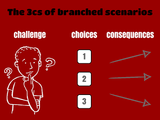
In the previous post, the case was made that within an immersive E-Learning environment that learning objectives might be transformed from being a static element to a dynamic and adaptive element that reflects "real time" change in skill development. In order for this process of change to be measured accurately, assessment can not just be the assessment done at the end of the course. Also, the emphasis shifts from being less assessment of learning to more assessment for learning. This assessment for learning occurs during the movement through the scenario learning experience, both on an individual and collaborative level. The means to accumulating "just in time data" can effectively obtained through the use of branching scenarios.Credit: www.nwlink.comBranching scenarios are a means by which we see and assess decision making among learners. These types of scenarios are ones in which the decisions made by the learner changes how the story or narrative develops and also the potential outcomes. Branching scenarios that involve telling a story in which the learner is a main character have the following benefits:Stories or narratives have more power to engage than non-narrative communication in which the learner is a passive spectator.Stories or narratives can create a sense of self-efficacy which is a crucial building block for leadership development.Stories or narratives make attitude change more persistent by engaging the cognitive and affective level of the learner.Making wrong or bad decisions in character in a non-threatening environment is educationally usefulStories or narratives can create para-social relationships that are conducive to future learner collaboration within a corporate environment or educational organization.Branching scenario development also bring with them certain cautions to be aware of:Narrative branching scenarios should carefully consider the number of branches that will be used. Too many branches can lead to confusion and be unproductive.In the design of branching scenarios it is advisable, when developing the story, to make use of story boarding and flow charting. Programs such as Articulate to name one are useful in helping to plan out and test ideas.The following is a simple example of a decision making tree:Credit: Debbie Richards (NAC)I would suggest, partially tongue firmly in cheek, that if you really want to see branching scenarios at work in a collaborative, online environment, get involved in an online collaborative video game. In such an instance you will experience how immediate feedback changes decision making and impacts learning objectives. The skill development becomes self-evident when the "gamer" or learner is exposed to a novel unfamiliar scenario.Novel Scenario Linkages and AssessmentOne problem that needs to be addressed is how do learners who progress through an irresistibly engaging scenario test their new skill development in order to establish confidence that these skills can be transferred to the reality which is their work place? They need a testing ground. No matter how many branching scenarios you use, when learners are successful in making their way through the scenario, the last task should be the proving or testing ground. The last link in the scenario should lead them to a completely new scenario that they have never seen before in which they are tasked with a challenge where their newly developed skill sets will be called upon in a mission critical situation. The instructor or trainer in the blended learning situation should have the ability during the scenario to introduce into the scenario unexpected variables which requires the learners to re-think strategy. In such a theater, assessment can happen on many levels which helps build the learning profile of learners and speaks to adjustments to be made in future designs.Next.....Maximizing Immersive E-Learning Through Virtual Technology.
Ken Turner
.
Blog
.
<span class='date ' tip=''><i class='icon-time'></i> Dec 06, 2015 12:15am</span>
|