Blogs
|
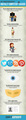
I came across a great post titled ‘The 7 Habits of Highly Effective Teachers Who Use Technology‘ as well as an accompanying infographic by Mark Bates (see below) that highlights the profile of an educators who are effectively using technology in their teaching.
The habits mentioned include:
They always start with the why.
They are malleable and can easily adapt.
They embrace change.
They share, share, and then share some more.
They think win-win-win-win.
They are extremely thorough and think two steps ahead.
They actively care.
What other habits would you add to this list?
Jason Rhode
.
Blog
.
<span class='date ' tip=''><i class='icon-time'></i> Dec 06, 2015 01:04am</span>
|
|
If you are looking for an elegant way on your mobile device to follow ET4Online conversations on Twitter, consider creating a custom section on Flipboard for following the saved Twitter searche #et4online. Here’s a quick tutorial on how to do so.
Jason Rhode
.
Blog
.
<span class='date ' tip=''><i class='icon-time'></i> Dec 06, 2015 01:04am</span>
|
|
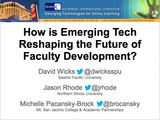
During this panel presentation at Sloan Consortium’s 6th Annual International Symposium on Emerging Technologies for Online Learning on Tue, 4/10, 2:30PM (Wilshire A), learn how three faculty from different institutions use podcasts, eBooks, online courses, and Google+ Hangouts to reinvent "faculty development" into a community of learning.
Slides are available here.
Jason Rhode
.
Blog
.
<span class='date ' tip=''><i class='icon-time'></i> Dec 06, 2015 01:04am</span>
|
|
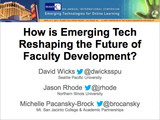
jrhode posted a photo:
title slide of panel presentation by David Wicks, Jason Rhode, and Michele Pacansky-Brock at 2013 Sloan Consortium International Symposium on Emerging Technology for Online Learning, presentation slides at docs.google.com/presentation/d/1xUUV5I-tFoWfGbwc1uOhA_pZH...
Jason Rhode
.
Blog
.
<span class='date ' tip=''><i class='icon-time'></i> Dec 06, 2015 01:04am</span>
|
|
For the very first time, Northern Illinois University offered a fully-online teaching effectiveness institute in January 2013 utilizing a combination of Blackboard Learn, Blackboard Collaborate, and Blackboard Mobile platforms. This cross-platform approach has proven to be very successful and provides a model for faculty to incorporate an integrated approach for implementing all three platforms in their teaching. In this session led by Jason Rhode and Jeff Geronimo at the 2013 Blackboard Never Stop Learning Tour in Chicago we shared NIU’s cross-platform strategy, practices, and lessons learned that can be applied to any online professional development initiative. | slides
Jason Rhode
.
Blog
.
<span class='date ' tip=''><i class='icon-time'></i> Dec 06, 2015 01:04am</span>
|
|
Jason Rhode
.
Blog
.
<span class='date ' tip=''><i class='icon-time'></i> Dec 06, 2015 01:04am</span>
|
|
This past summer, I was invited to teach a 10-week, accelerated graduate course online for the Department of Educational Technology, Research and Assessment within the College of Education at Northern Illinois University (NIU). This course, ETT 510: Instructional Media & Technology, happens to be a required first-semester course for in-service teachers pursuing a Master’s Degree in Instructional Technology with a K-12 tech specialist endorsement. While I had taught this subject matter previously, this happened to be the first opportunity for me to teach this course at NIU and I would be the first instructor to teach this course in the online, accelerated format in Blackboard (previously, this course and program had been taught in another LMS).
Embracing this opportunity, I set out to design, develop, and teach this course for this first time in Blackboard following the recommended best practices contained in the Blackboard Exemplary Course Program Rubric.
While I was provided with an existing syllabus with learning objectives, required text, etc. that I needed to stick for the course I was asked to teach, I had the freedom to design and develop the course as I wished. I chose to follow the online quality recommendations outlined in the Blackboard Exemplary Course Program Rubric in hopes of developing a course that would not only meet the "exemplary" standards for quality established by Blackboard but also to develop a sample course that I can share with other faculty and administrators looking for example, high-quality online courses that can be patterned after. I plan to submit the course for review and I hope I’ll be able to report sometime in Spring 2014 that the course has been deemed "exemplary." I’ve also volunteered to serve as a reviewer in the program, as I’m always eager to gather new ideas and inspiration for my own online teaching.
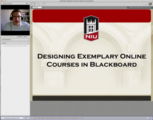
During the online workshop I offered 12/17/13 for NIU faculty, we explored suggested best practices included in the Blackboard Exemplary Course Program Rubric for designing engaging online courses. I shared practical tips from my experience for building a course in Blackboard that meets the established quality benchmarks and links to sample award-winning course tours were provided. We also covered the steps and associated deadlines for faculty interested in submitting their course for consideration as a Blackboard Exemplary Course. This workshop was geared toward an audience already familiar with the basic online teaching tools available in Blackboard. The workshop archive may be viewed below, along with the slides.
The following resources were mentioned during the workshop:
Blackboard Exemplary Course Program
Blackboard Exemplary Course Program Rubric (November 2013)
Blackboard Exemplary Course Program Winners Course Tours (2013)
Blackboard Exemplary Course Program Winners Gallery
Blackboard Exemplary Course Program Reviewer Sign-up
For more details on the Blackboard Exemplary Course Program, visit blackboard.com/ecp
Jason Rhode
.
Blog
.
<span class='date ' tip=''><i class='icon-time'></i> Dec 06, 2015 01:03am</span>
|
|
Geri E. McArdle, in his book Training Design and Delivery, encourages training professionals to become familiar with 7 principles and them in their delivery of education. These principles certainly also apply to online instruction:
Part or Whole Learning
Spaced Learning
Active Learning
Feedback
Overlearning
Primacy and Recency
Transfer of Learning
Source: e-Learning Infographics
Additional commentary on these 7 principles is available here.
Jason Rhode
.
Blog
.
<span class='date ' tip=''><i class='icon-time'></i> Dec 06, 2015 01:03am</span>
|
|
Photo courtesy Todd DaileyWith the interest expressed among my students in my summer course, ETT 511: Instructional Media and Technology, to learn more about designing "good" online courses as well as the frequent requests I receive from faculty on suggested resources for those getting started online teaching, I thought I’d share here a few of my favorite resources for those interested in learning more about the basics of designing and teaching online courses. While there are MANY different models to online course development, from individual "do it yourself" approaches where instructor designs and builds the course to more systematized and standardized production models where instructor works alongside instructional designers and other media development specialists, the following resources should be helpful to anyone interested in learning more about the mechanics of designing and teaching courses online.
Quality Standards
A good place to begin exploring online course quality is to look at some of the available quality standards that have been developed and adopted by institutions. While there are widely-accepted competencies for instructional designers as well as competencies for online instructors, a number of different online quality standards are available, a few of which include:
Blackboard Exemplary Course Program Rubric
iNACOL National Standards for Quality Online Courses
Quality Assurance e-Learning Design Standards - Penn State
Rubric for Online Instruction - CSU Chico
Quality Online Course Initiative - Illinois Online Network
Quality Matters
Books
Here are a few of my favorite books for beginners desiring "nuts and bolts" assistance getting started designing and teaching online:
Vai, M. & Sosulski, K. (2011). Essentials of online course design: A standards-based guide. New York: Routledge. ISBN: 0415873002
Smith, R. M. (2008). Conquering the content: A step-by-step guide to online course design. San Franciso: Jossey-Bass. ISBN: 0787994421
Thormann, J. & Zimmerman, I. K. (2012). The complete step-by-step guide to designing and teaching online courses. New York: Teacher’s College Press. ISBN: 0807753092
Elbaum, B., McIntyre, C., & Smith, A. (2002). Essential elements: Prepare, design, and teach your online course. Madison, WI: Atwood. ISBN: 1891859404
Palloff, R. M. & Pratt, K. (2007). Building online learning communities: Effective strategies for the virtual classroom. 2nd ed. San Francisco: Jossey-Bass. ISBN: 978078798825-8
Jossey-Bass has a fantastic book series, "Guides to Online Teaching and Learning" with titles on specific aspects of online teaching, listed at http://www.wiley.com/WileyCDA/Section/id-814784.html
Tanya Joosten has compiled a resource list of additional books on online teaching here.
Online Courses
For those serious about embarking in the journey of online teaching, I highly recommend taking an online course where you can not only be exposed to online teaching technology but also pedagogical approaches that work well in the online learning environment. Here are a few of the available online courses and you might consider enrolling in:
BlendKit 2014: Becoming a Blended Learning Designer (4/21/14-7/8/14)
Foundations of Virtual Instruction (begins 6/30/14)
Teaching Online: Reflections and Practice (6/23/14-8/12/14)
Workshops
My colleagues and I with the Faculty Development and Instructional Design Center at Northern Illinois University offer a number of workshops for NIU faculty related to online teaching. These online workshops are archived and shared on YouTube here. A few notable workshop archives related to online teaching that you may find of interest include:
Best Practices in Online Teaching
Redesigning Course Materials for Online Delivery
Designing Exemplary Online Courses in Blackboard
Other professional organizations devoted to quality online teaching, such as Illinois Online Network and Sloan Consortium, also offer workshops and short online courses worth checking out.
Miscellaneous
Here are a few additional resources that I highly recommend checking-out and bookmarking:
NEA’s Guide to Teaching Online Courses
Tips for Managing the Online Workload - video podcast with 50+ tips, each shared as separate podcast episode; see the video introduction from Larry Ragan
I highly recommend following the University of Central Florida Center for Distributed Learning for fantastic tips and resources, such as their faculty seminars in online teaching, teaching online community, and teaching online pedagogical repository (TOPR).
There you have it…a few of my favorite resources for online teaching. What resources do you recommend? Leave a comment with your suggestions!
Jason Rhode
.
Blog
.
<span class='date ' tip=''><i class='icon-time'></i> Dec 06, 2015 01:02am</span>
|
|
You can integrate digital skills into everyday life: digital skills are transferable.
You have a balanced attitude: you are a teacher not a techie.
You are open to using and trying new stuff: find digital tools and explore how they work.
You are a digital communicator: you can use email and social media with ease.
You know how to do a digital assessment: you’re a sound judge of the quality of information, apps and tools.
You understand and respect privacy: you treat personal data with the respect it deserves.
You are a digital citizen: you know how to behave online appropriately and you’ll pass it on to your pupils.
Source: DailyGenius
Do you agree with this list of characteristics for a digitally competent teacher? What additional characteristics would you add to this list? Leave a comment with your ideas!
Jason Rhode
.
Blog
.
<span class='date ' tip=''><i class='icon-time'></i> Dec 06, 2015 01:02am</span>
|