Blogs
|
At a Stanford education conference this morning, speakers made presentation after presentation without once involving the audience, not even asking for questions. For the first couple of hours there was zero audience participation. Finally, following a panel session, we were invited to stand at a microphone if we had questions. Naturally, I was first in line.
I explained that I came to this event as an outsider. I am not an academic. In fact, my corporate title is "Chief Unlearning Officer." A speaker had mentioned silos, referring to departments at schools. I said I felt like I was in a college silo. It’s as if the world outside didn’t exist.
Take STEM (Science, tech, engineering, math). All of these folks are vitally interested in STEM. After all, that’s what the Gates Foundation, the NSF, and the other benefactors are paying them hundreds of millions to produce. I said I don’t get it. The shelf life of STEM knowledge is about the same as for French mustard, several years. After that, the mustard begins to smell funny and the STEM knowledge is obsolete.
I didn’t mention my suspicion that STEM dumbs down education. It’s explicit knowledge. Life’s grand lessons are largely tacit. Besides, isn’t STEM often the algorithmic knowledge that robots are going to being doing in a few years? When that happens, lots of STEM grads may find themselves in the position of John Henry, the steel-drivin’ man. Nobody here was talking about liberal arts and continuing the culture.
Consider the role of STEM education in someone’s career arc. A career is a marathon. College teaches people to run the first 100 yards. Running the rest of the race is the individual’s problem.
"But we are working with industry," replied the panel. Oh yeah? People have been touting big data as the ultimate quality control and planning tool in education. Are any of you looking at big data on people outside your walls? Correlating education with what happens after graduation? No; it’s a closed system.
Big data can help Arizona State University refine their algebra course to near perfection, but unless they go off campus to look at the world of work, no data will tell them whether algebra is worth studying at all. (I love Roger Schank’s putdown of the quadratic equation. When’s the last time you had to solve for AX2 + BX +C = 0?)
How’s the water?
It was troubling to hear one person after another lecture about learning more about how people learn whlle violating most of the principles we already know. Aside from the Push format, problems included no hashtag, no Tweeting, no backchannel, no power outlets, inoperable wi-fi (for me, at least), slow wi-fi at the podium cut several presentations short, weak visuals overall, and no encouragement to network online (although many probably already know one another). I don’t know how someone as astute at Peter Norvig could sit through an entire day of this stuff.
A few highlights. The president of Capella talked of converting their curriculum to competencies. Competencies can be counted up after the fact to give credit for courses. I suggested he wasn’t going for enough. Who needs courses? He wisely pointed out that accrediting bodies have a fixed mindset on this one.
Arizona State has put an entire first year curriculum on line. For free. Pass a course, no matter how many tries it takes, and you can pay a fee for credits. He sees no reason the entire four years shouldn’t go online this way. (And the guy from Capella suggested that as in the UK, we could probably have three-year bachelor degrees without losing that much.)
True to form, the LMS vendor supporting the show twisted the definition of "informal learning" so it could claim to have some:
What’s informal about purpose-built content? Most people probably missed this because next up was a hip-hop singer who claimed to be a customer of the LMS (he lists his tracks there). Naturally, he had put together a song for us. As he began his incomprehensible lyric, the batteries on my hearing aids ran out and I bailed out from the event.
The other attendees seemed quite satisfied, even impressed. "Brilliant presentations." I guess events like this are de rigueur.
The Stanford campus is beautiful, the weather cooperated perfectly, and nobody was keeping score.
Original linkOriginal author: Jay Cross
Michelle Maldonado
.
Blog
.
<span class='date ' tip=''><i class='icon-time'></i> Jul 14, 2015 09:38am</span>
|
|
The Enterprise Learning! Conference 2015 Online will offers new free and premium access registration, plus advanced online features, fames and interaction.
Corona, CA June 2, 2015 - Elearning! Media Group will hold its second Virtual event of 2015 at the Enterprise Learning! Conference Online on July 16-17th from 7 am PT to 5 pm PT. The Virtual event will host live sessions only on July 16th. The event’s new platform will offer two registration types: free access and premium. Attendees selecting free registration can access all live sessions on July 16th. Premium access attendees can view not only the sessions on July 16th, but also new sessions on July 17th and gain On-Demand access to all sessions and content for 90 days after the event through October 15th, 2015.
Learn more...
Michelle Maldonado
.
Blog
.
<span class='date ' tip=''><i class='icon-time'></i> Jul 14, 2015 09:38am</span>
|
|
Greetings from 37,000 feet. As I write these words, I am on my way from San
Francisco, California, to Boston, Massachusetts, to participate in a two-day
workshop at Harvard, sponsored by the OECD (Organisation for Economic Co-
operation and Development), to look at what should go into the math tests that
will be administered to children around the world for PISA 2021.PISA, the Programme for International Student Assessment, gets such extensive
press coverage each time one of its reports is published, that it really needs no
introduction. Americans have grown used to the depressing fact that US school
children invariably perform dismally, ranked near the bottom of the international
league tables, with countries like Japan and Finland jostling around at the top.But chances are you have not heard of PIACC - the Programme for the
International Assessment of Adult Competencies. The OECD introduced this new
program a few years ago to investigate the nation-based adult skillsets that are
most significant to national prosperity in a modern society: literacy, numeracy,
and problem solving in a technology-rich environment (PS-TRE).Whereas the PISA surveys focus on specific age-groups of school students,
PIAAC studied adults across the entire age range 16 to 65.The first report based on the PIAAC study was published in fall 2013: OECD Skills Outlook 2013: First Results from the Survey of Adult Skills.A subsequent OECD report focused on PIACC data for US adults. The report’s
title, Time for the U.S. to Reskill, gives the depressing-for-Americans headline
that warns you of its contents. The skill levels of American adults compared to
those of 21 other participating OECD countries were found to be dismal right
across the board. The authors summarized US performance as "weak on
literacy, very poor on numeracy," and slightly below average on PS-TRE."Broadly speaking, the weakness affects the entire skills distribution, so that the
US has proportionately more people with weak skills than some other countries
and fewer people with strong skills," the report concluded.I have not read either OECD report. As happened when I never was able to
watch the movie Schindler’s List, it is one of those things I feel I ought to read but
cannot face the depression it would inevitably lead to. Rather, for airplane
reading on my flight from Stanford to Harvard, I took with me a recently released
(January 2015) report from the Princeton, NJ-based Educational Testing Service
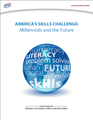
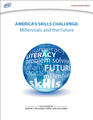
(ETS), titled AMERICA’S SKILLS CHALLENGE: Millennials and the Future.The ETS report disaggregates the PIAAC US data for millennials—the
generation born after 1980, who were 16-34 years of age at the time of the
assessment.The millennial generation has attained more years of schooling than any previous
cohort in American history. Moreover, America spends more per student on
primary through tertiary education than any other OECD nation. Surely then, this
report would not depress me? I would find things to celebrate. Did I? Read on.This month’s column is distilled from the notes I made as I read through the ETS
report. (These are summarizing notes. I did not bother to quote exactly, or even
to use quotation marks when lifting a passage straight from the report. The
originals of all the reports cited here are all freely available on the Web, so
please go to the source documents to see what was originally written.)A central message emerging from the ETS report is that, despite all the costly
and extensive education, US millennials on average demonstrate relatively weak
skills in literacy, numeracy, and problem solving in technology-rich environments,
compared to their international peers. Sigh.And this is not just true for millennials overall, it also holds for our best performing
and most educated young adults, for those who are native born, and for those
from the highest socioeconomic background. Moreover, the report’s findings
indicate a decrease in literacy and numeracy skills for US adults when compared
with results from previous adult surveys.Some of the data highlights:
In literacy, US millennials scored lower than 15 of the 22 participating countries.
In numeracy, US millennials ranked last.
In PS-TRE, US millennials also ranked last.
The youngest segment of the US millennial cohort (16- to 24-year-olds), who
will be in the labor force for the next 50 years, ranked last in numeracy and
among the bottom countries in PS-TRE.
Even worse for those of us in higher education, this dismal picture holds for those
with higher education:US millennials with a four-year bachelor’s degree scored third from bottom in
numeracy.
US millennials with a master’s or research degree were fourth from bottom.
All very depressing. I fear that this state of affairs will continue all the time US
education continues to be treated as a political football, with our nation’s children
and their teachers treated as pawns while various groups fight political battles,
and make decisions, based not on learning research (of which there is now a
copious amount, much of it generated in US universities) but on uninformed
beliefs and political ideology. [You were surely waiting for me to throw in my two
cents worth of opinion. There it is.]To finish on a high note, we Americans famously like winners. So let’s raise a
glass to the nations that came out on top in the rankings (in order, top first):Literacy: Japan, Finland, NetherlandsNumeracy: Japan, Finland, BelgiumPS-TRE: Japan, Finland, AustraliaIn their own way, each of these countries seems to be doing education better
than we are.Yet here’s the fascinating thing. I’ve spent time in all of those countries. They
each have a lot to offer, and I like them all. I also was born and grew up in the
UK, moving to the US as an adult in 1987. I am a lifelong educator. But for all its
faults (and its education system is just one of a legion of things America does
poorly) I’d rather live where I do now, in the USA, with Italy in second place. But
that’s another story. A complicated story. (If you think California is a separate
nation, and in many ways it is, then my preference statement needs further
parsing.) Doing well on global tests of educational attainment is just one factor that we can use to measure quality of life.
Original author: Mathematical Association of America
Michelle Maldonado
.
Blog
.
<span class='date ' tip=''><i class='icon-time'></i> Jul 14, 2015 09:37am</span>
|
|
Two-Day Virtual Event Opens With All New Live Sessions on July 16th
Corona, CA June 3, 2015 - Elearning! Media Group announced the Enterprise Learning! Conference Online 2015 (ELC15 Online) will host all new live sessions on July 16th and new on-demand sessions on July 17th. The live virtual event will open from 6:30 am - 5:00 pm PT and learning professionals and executives can choose from two registration types at: https://presentations.inxpo.com/Shows/ELearning/Microsite/home.htm
Learn more...
Michelle Maldonado
.
Blog
.
<span class='date ' tip=''><i class='icon-time'></i> Jul 14, 2015 09:37am</span>
|
|
A dozen days from now, Uta and I will pack the dogs into the car and drive the 1800 miles from Berkeley to Kansas City, Missouri. After ten days at our son’s new house, we’ll drive the long way back via Mount Rushmore, Yellowstone, and Grand Tetons.
Like most coastal Americans, we hardly know the interior of our country. I haven’t been in a car on this route since I was four years old.
We’ll be whizzing right along, my daredevil co-pilot at the wheel while I ride shotgun. I’d hate to miss a cool trading post or natural site or place to eat because I didn’t ask about it. Help us find the best stuff to do.
What are your favorite things along our easterly route from Berkeley, across Nevada, Utah, Wyoming, Nebraska to Kansas City?
Similarly, what should we not miss among the National Parks and natural wonders on the trip back? Food tips, off road suggestions, lodging, anything that put a smile on your face?
Dogs. Flirt (left) and Azure (squirms too much to get picture) are geriatric miniature longhaired dachshunds. Ten pounds apiece. They will ride in a car cage on the back seat. This will force us to pace ourselves as well; breaks every two-three hours.
Any pet friendly suggestions for us?
Diet. When we moved to San Francisco in the mid 70s, I was impressed by the Californians’ dedication to preserving historic buildings. The next time I visited New York, Philly, and Washington, I found that historic preservation was a national phenomenon.
I have my fingers crossed on finding healthy food I want to eat. Hello, triple-D. (I have not eaten at a McDonalds, Wendy’s, KFC, PizzaHut, Burger Chef, or ChickFilla in over twenty years.) I usually find some local specialty to sustain myself; Uta is vegetarian.
Please comment on Facebook.
Original linkOriginal author: Jay Cross
Michelle Maldonado
.
Blog
.
<span class='date ' tip=''><i class='icon-time'></i> Jul 14, 2015 09:37am</span>
|
|
As of June 1, 2015, my blog has moved to: http://michaelsunnarborg.com/blog/
Please join me there and continue following the stories, insights, and coaching tips for finding better balance and happiness in your work, relationships, and life. To Our Better Balance!Michael Thomas Sunnarborg
Original linkOriginal author: Michael
Michelle Maldonado
.
Blog
.
<span class='date ' tip=''><i class='icon-time'></i> Jul 14, 2015 09:37am</span>
|
|
Monday morning. Flirt, the happiest miniature longhaired dachshund in the world, shakes all over with tail-flapping enthusiasm to wake me up. On auto-pilot, I arise, brush my teeth, and take the garbage and recycling out to the curb. I brew a cup of tea.
Undoubtedly email has arrived overnight. Phone messages await my pick-up. The day’s New York Times has interesting stories to read. I sip my tea. I write these words. I contemplate what I want to accomplish today. The interruptions can wait.
Each of us has a choice of what we think about, what we learn, and what we do. Our minds are an inner sanctuary to which we alone possess the key. No one else will ever see what’s inside. It’s ours alone. Private.
"each of us is at the center of the universe
so is everyone else"
e.e. cummings
Less than 99% of the light, sound, taste, and touch that bombard our senses ever make it into our consciousness. Behind the curtain of awareness, our minds take a snippet of this and a smidgen of that, connect the dots, and play the internal movie we experience as reality. Your mind’s eye and mine see different worlds. Reality is all in our heads.
"Reality is an illusion, albeit a persistent one."
Albert Einstein
Listen to what’s going on in your head at this moment. There’s a conversation in there. It’s about that inner movie.
You can listen in or you can join the conversation. You can let the inner voice prattle on, making comments sparked by your inner movie. Or, if you like, you can actively participate in the conversation.
We’re working with neurons here, not film. You can influence the script writer, make suggestions to the director, and edit out things you don’t want to see.
Young thoughts need shelter from the elements to grow. I nurture my thoughts in the morning, before the cacophany of ringing phones, flashing lights, and FedEx trucks tries to make me a passive listener in my inner conversation.
Asked whether he didn’t hate the Chinese, the Dalai Lama responded, "They have taken my country. Why should I let them take my mind?"
There are few absolutes in life. Success requires balancing your inner self and new sensations.
You don’t want to shut out all the interrupters knocking on the door. The hot stove may not be what you think, but don’t put your hand on the burner.
You must revere your inner mind and believe that you are more than a mere pebble in the stream. If you don’t know where you’re going, you’re unlikely to reach an enjoyable destination.
That’s what the Aha! book will be about, help for people to get better, faster.
Original link
Original author: Jay Cross
Michelle Maldonado
.
Blog
.
<span class='date ' tip=''><i class='icon-time'></i> Jul 14, 2015 09:36am</span>
|
|
All I wanted to do was use Frequent Flier miles to buy tickets from San Francisco to Mallorca to Athens and home from Istanbul. Business class.
I spent 45 minutes on the phone with United Mileage Plus and ended up with oddball flights I would never have purchased for myself, e.g. depart SFO at 7:24 in the morning, twiddle thumbs for 3 hours in Houston, spend five hours in Munich awaiting for flight to Palma. Later, fly Palma to Athens via Copenhagen, along with a six hour wait at the Copenhagen airport. Depart Istanbul at 6:20 in the morning, spend more than three hours at Munich Airport and then another three hours at O’Hare. A monkey could pick more convenient flights.
I requested all Lufthansa flights but ended up on United (which I hate) and SAS (which routes through Copenhagen no matter what) except for two short legs.
Route after route had no seats available even though I was booking three months in advance. Business class. We will have to fly coach within Europe. Premium Economy was the best we could do for the return flight; seat upgrades and taxes cost an additional $786.
The clerk at Mileage Plus was saddled with an ineffective system. We spent a bit of time waiting for the screen to refresh. Rather than select from a menu, she had to check everything manually. "Could you go a day earlier? Two days earlier?"
For 360,000 miles and $786, I ended up with tickets that would cost $18,000 out of pocket, so I’ll keep accumulating miles. (Virtually everything we spend goes through a credit card that rewards miles.)
What I fail to understand is how United managed to set up a system that is so aggravating. People in other industries have gone to jail for bait-and-switch tactics that are everyday practice at United. I dread speaking with Mileage Plus because I know they’ll let me down. It’s bad enough when United pisses off regular customers (charging for luggage, serving pricey junk food, and an attitude of no can do.) That they cull out frequent fliers, the profit-making travelers, and hassle them with what are supposed to be rewards in unconscionable. It’s plain stupid.
Week before last, our flight from Germany to SFO arrived a few minutes early, but it took the better part of an hour for our luggage to show up on the baggage carousel.
I suggest the FAA and others change the definition of what makes a flight on time. It should include time to pick up your baggage. Alaska Air gets the suitcases off in minutes; why can’t the other airlines follow suit?
Original link
Original author: Jay Cross
Michelle Maldonado
.
Blog
.
<span class='date ' tip=''><i class='icon-time'></i> Jul 14, 2015 09:36am</span>
|
|
Exclusive Users Choice Awards Celebrates 11th Year
Elearning! and Government Elearning! magazines, today announced that the Best of Elearning! balloting is now open. Celebrating 11 years of success, The Best of Elearning! Awards recognizes best-in-class solutions for e-learning products and services across 27 product and services categories. Executives leveraging learning and workplace technologies, including readers, practitioners, and community members from both the private and public sectors, are invited to cast their vote for best-in-class solutions starting June 24, 2015.
The Voting Process
Readers, practitioners and community members are invited to nominate and vote for products and solutions via Elearning! Media Group’s online ballot. The nomination period is June 23, 2015 through October 15, 2015 and ballots can be cast at the 2015 Best of Elearning! Ballot.
Learn more....
Michelle Maldonado
.
Blog
.
<span class='date ' tip=''><i class='icon-time'></i> Jul 14, 2015 09:35am</span>
|
|
Philanthropists are giving Human Resources a good name.According to reporter Stephanie Strom, some major philanthropists are requiring that the leaders of organizations they fund participate in management training as a condition of the funding. Although many nonprofit executives rightfully resist such intrusion of donors on everyday operations, many of those interviewed by Strom appreciated this type of advice. The donors recognized that, although the organizations they fund are passionate about their goals, some minimize the role of management practices and principles in achieving those goals. As Strom writes:"People in this sector, just like scientists and doctors, get promoted because of their issue expertise and then no one really ever teaches them how to manage," said Jerry Hauser, the center’s chief executive and a former consultant at McKinsey & Company. "Then it becomes a vicious cycle, where the next generation coming up in an organization comes up under someone who doesn’t know how to manage."Following training, the nonprofit executives gained new insights into their operations and devised new ways to more effectively achieve goals and prepare for the future. To read the entire article--and learn about some specialized sources of management training for nonprofit executives--visit http://www.nytimes.com/2011/07/30/business/philanthropists-start-requiring-management-courses-to-keep-nonprofits-productive.html?ref=business&pagewanted=all.
Saul Carliner
.
Blog
.
<span class='date ' tip=''><i class='icon-time'></i> Jul 14, 2015 09:34am</span>
|