Blogs
|
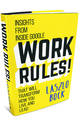
I’ve been eagerly awaiting this book for some time.
Not in the literal sense. After all, Amazon delivered a hardcopy version to my front door in what must have been 37 seconds.
No, I’m referring to my anticipation in a more figurative way.
Nine years ago, Laszlo Bock became head of People Operations at Google.
Nine days ago, Laszlo’s book, Work Rules! Insights From Inside Google, was delivered to my home by a man clad entirely in brown.
My wait was over, and it was now time to sink my teeth into the book that Daniel Coyle calls, "an all-access backstage pass to one of the smartest organizations on the planet." High praise indeed. Did it measure up? Was the book a playbook of sorts for others to learn from, and follow?
Google has won just about every award imaginable when it comes to "great places to work" and if there was one book that might help everyone understand why, I was hoping it would be Laszlo Bock’s.
By page 11 we were on the right track.
Bock writes:
The most talented people on the planet are increasingly physically mobile, increasingly connected through technology, and-importantly-increasingly discoverable by employers.
I was increasingly enjoying my new book purchase.
He continues:
This global cadre want to be in high-freedom companies, and talent will flow to those companies. And leaders who build the right kind of environments will be magnets for the most talented people on the planet.
These two paragraphs encapsulate the overarching thought leadership found throughout the book. Laszlo defends the rights of employees, arguing persuasively that they deserve to "run the asylum" - a place of refuge, as he reminds us. Employees are smart and they need not be coddled, commanded or controlled by power monger managers. "This is why we (Google)," he writes, "take as much power away from managers as we can." Laszlo (and Google) believe employees will seek out organizations that provide an open, collaborative and innovative environment, so why not make the organizational culture one where "power" is held by the masses versus the few.
More importantly, perhaps, Bock asserts throughout the book that when employees are given freedom, "they will surprise, delight and amaze you."
The word "freedom" is arguably the subliminal message hidden within the book. Indeed, Laszlo pushes you to think about reshaping your organization as a "high-freedom environment." A perfect example is surfaced when on the topic of "code health." As an engineering company, Google has thousands of engineers and millions of lines of software code. "We could have set company-wide goals for code health," Bock writes, "or our CEO could have just mandated that everyone had to focus on code health for the next month."
A high-freedom environment doesn’t mandate from above, nor does it control the masses. It empowers. It uses the community of employees to further fuel the business. If you’re an innovation company, as Google is, should the ideas come from the C-Suite? In parallel, should an organization’s ideas on how to run the business come from the C-Suite only as well?
In the case of "code health", Laszlo recalls how a group of engineers got together (on their own) to sort out a means to remedying the problem of "code health". This manifested after a problem was highlighted in their internal feedback and engagement survey, called "Googlegeist."
As a result of the employees getting together, a number of opportunities for improvement were brainstormed and eventually implemented across Google, including Tech Talks, embedding "code health" into performance management practices and promotions, as well as "Citizenship Awards," which were inaugurated to recognize peers and leaders of healthy software code.
The result?
Engineers at Google are now 34% "more confident that time spent improving code health will be rewarded." It’s but one example of many that Bock highlights around what I thought to be the underlying message of "high-freedom environment."
But what about those actual Google Work Rules?
There are fourteen chapters in the book, where the rules are nested. Bock runs the gamut, waxing lyrical through 370 pages on traditional HR topics such as compensation, recruitment, learning and performance management and non-traditional (to some) rules on concepts such as culture, health, community and what I felt to be a very refreshing rule and chapter, "It’s Not All Rainbows and Unicorns."
Bock uses this chapter to highlight the fact Google (and any organization) is going to make mistakes. The chapter is replete with examples of human misbehaviour (at Google, no less) that have to do with entitlements, performance, values, ethics and transparency. In the end, Bock reminds the reader that humans are prone to mistakes, but "it’s in the organizations with the strongest values" where mistakes are learned from, not used as a basis for shutting down the "high-freedom environment" quest. It’s a wonderful rule, one that reminds me of a similar thought we’ve embedded into our culture at TELUS, echoed by our Executive Chair, Darren Entwistle: "There is tuition value in mistakes."
The book is a true masterpiece. There are boatloads of stories from within Google, as well as great anecdotes from other organizations and other experiences that Laszlo has witnessed. There is data (but not too much data) and no less than 259 references. The rules make such sense, I can see the book becoming a key reading in MBA programs going forward. The final gem from the book is in fact the final chapter, "
What You Can Do Starting Tomorrow."
If you’re looking for a quick summary guide on ten steps (and a quick summary of the Work Rules!) that can potentially transform your organization, team or workplace, Bock highlights them here, including:
1. Give your work meaning. I couldn’t agree more, as Bock writes, "everyone wants their work to have purpose."
2. Trust your people. Trust is one of the 15 leadership attributes I wrote about in FLAT ARMY, so once again, I’m in complete agreement with Laszlo.
3. Hire only people who are better than you. And importantly, "hire by committee."
4. Don’t confuse development with managing performance. Development is an ongoing conversation, not an annual measurement.
5. Focus on the two tails. Bock believes the organization should focus on the very, very good (power law distribution theory) and the very, very bad. For the good, learn everything you can from them. For the bad, help them learn, refocus or if all else fails, exit them.
6. Be frugal and generous. Not everything has to cost money, from a development, learning, inspirational perspective.
7. Pay unfairly. 90% or more of the value on your teams comes from the top 10%, so pay them accordingly. (A new-ish take on the Pareto Principle aided by the "power law" distribution theory.)
8. Nudge. In essence, be a pest such that you are pushing collaborative, sharing behaviour.
9. Manage the rising expectations. There is tuition value in mistakes.
10. Enjoy! And then go back to No. 1 and start again. "Building a great culture and environment requires constant learning and renewal."
If there is one aspect in the book that I felt was missing, it was highlighted by a story Laszlo surfaced regarding Google’s performance management system. It wasn’t my concern about performance management itself (he deftly depicts the changes Google made to performance management, in Chapter 7), it was how Bock retold a story when he had to ask his assistant at 6pm on a Thursday to arrange meetings so he could speak to forty different managers about the pending performance management changes. The meetings were to occur that same night.
It’s a minor point, but perhaps in a follow-up book, Laszlo could highlight how life-work balance and time management principles are demonstrated by him, and at Google in general. In a world where employees are constantly being asked to do "more with less", coupled by increasing demands on their time through projects, requests and of course "all things digital" like email and social, I was left wondering how the concept of "time" is handled by Laszlo and Google.
I once wrote a post entitled, "Why I’d Work With Google’s Laszlo Bock". As I devoured WORK RULES!, I kept thinking about that post. It’s still true. Laszlo is a rare breed, and I believe it behooves you to pick up a copy and read for yourself what a role model he has become for leaders of any stripe, of any level, in any organization.
My summary?
Work Rules! rules.
__________
Dan Pontefract is the author of FLAT ARMY: Creating a Connected and Engaged Organization and is Chief Envisioner at TELUS Transformation Office. His next book, DUAL PURPOSE: Redefining the Meaning of Work, will publish November 10, 2015.
Dan's Related Posts:Why I’d Work With Google’s Laszlo Bock (one day)Selling Yourself & Your Ideas is the New 20 Percent TimeIf Your Enterprise Social Network Is A Ghost Town It’s Probably Due To Your…Going Forward to the Past: Management Yahooliganism & No Longer Working From HomeWaxing Lyrical On Leadership, Engagement, Purpose & Innovation
Dan Pontefract
.
Blog
.
<span class='date ' tip=''><i class='icon-time'></i> Jul 14, 2015 10:13am</span>
|
|
May 3, 1915 was the day in which society’s (arguably) most famous wartime poem was written.
John McCrae, author of In Flanders Fields, had witnessed (the previous day) the loss of his very good friend, Alexis Helmer, killed by German shelling. The previous weeks, McCrae — a doctor tasked with the responsibility of assisting WWI soldiers wounded in action under unimaginable scenes of horror and bloodshed- attended to the bodies of hundreds of others.
The sights were gruesome.
The pressure exerted on McCrae must have been like affixing your own head into a vice grip and turning the crank inward.
But In Flanders Fields is not only a classic poem, it’s an example of channeling one’s emotions, beliefs and hopes into art, reconciling for others to ideally learn from.
I’m forever moved by In Flanders Fields.
Perhaps this is why I write myself; to channel my emotions, beliefs and hopes into art, reconciling for others to ideally learn from.
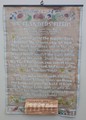
A copy of the poem is placed to the left of our front door foyer. Has been for many, many years.
There is not a day that goes by where I don’t think about John McCrae and his poem. One hundred years later, I am morally indebted to a man I never met.
Let art forever teach compassion for compassion is the beginning of our humanity.
___________
In Flanders fields the poppies blow
Between the crosses, row on row,
That mark our place; and in the sky
The larks, still bravely singing, fly
Scarce heard amid the guns below.
We are the Dead. Short days ago
We lived, felt dawn, saw sunset glow,
Loved and were loved, and now we lie
In Flanders fields.
Take up our quarrel with the foe:
To you from failing hands we throw
The torch; be yours to hold it high.
If ye break faith with us who die
We shall not sleep, though poppies grow
In Flanders fields.
Dan's Related Posts:LeisureFlat Army Book Launch Party … A Sea of HumanityTerry Fox, My HeroPlease Don’t Let There Be Anonymity After DeathWhat I Learned About The Stigma Of My Stigma
Dan Pontefract
.
Blog
.
<span class='date ' tip=''><i class='icon-time'></i> Jul 14, 2015 10:12am</span>
|
|
In this LeaderLens webinar, Ashley Welch interviews Elana Yonah, co-founder of RISE, who shared her perspective on "Virtual Collaboration: Best Practices for Global Teams."
Patty McManus
.
Blog
.
<span class='date ' tip=''><i class='icon-time'></i> Jul 14, 2015 10:11am</span>
|
|
When Tony Hsieh won the prestigious ACM Programming Contest in 1993, you just knew he was going to do something great with his life. Check out the problem set he and his two teammates had to solve, and you get an acute understanding of just how smart he is.
Three years later, he founded LinkExchange — an online advertising network incorporating the use of banner ads — and promptly sold it to Microsoft in 1998 for $265 million. Not too shabby.
After selling LinkExchange, Tony founded an incubator and investment firm with his friend Alfred Lin (called Venture Frogs), where one of the first investment bets made was on a little online shoe selling company you might have heard of.
It’s called Zappos.
A couple of months later, the uber smart 27-year old Hsieh joined the company as its CEO and, well, the rest is history.
Today, Zappos is a wholly owned subsidiary of Amazon (having been acquired for $1.2 billion in 2009) and its roughly 1,500 employees, headquartered in Las Vegas, produce in excess of $2 billion in revenues annually. The company diversified its portfolio and now sells not only shoes, but all sorts of clothing for men, women and children.
But how does this company, with less than 2,000 employees, continue to dominate the mainstream and social media headlines? After all, there are many other companies selling clothes and shoes online. Why does Zappos seem as though it has a stranglehold on press hits and mentions?
In a word, it’s all about "culture."
Zappos is famous for establishing the bar when it comes to putting its customers first, aided and abetted by an engaged and happy workforce. The company has seemingly defined the causal link between a happy workforce and an equally balanced "purpose with profit" bottom line. The company’s tagline and overarching ethos is to "Deliver Wow" and since 1999, it has done so in spades, serving millions of customers across the globe. Barry Glassman does a fantastic job on FORBES describing the client experience at Zappos.
I visited Zappos’ headquarters earlier this year, partaking in a walkabout at their new downtown Las Vegas facilities. As you enter the building you’re inundated with "hellos." Everywhere you look, people are smiling and when your eyes intersect theirs, it’s the friendliest smile you’ve ever received. In one corner, someone is playing a ukulele. In another, people mingle about in a conference room that is literally blinking with fun, coolness and family-like values.
Their collaborative mindset is infectious, one that encourages everyone to scale the culture. Positivity is ubiquitous. It’s not up to Tony or any singular team to "deliver wow"; it’s the responsibility of every Zappos taem member. For example, every employee is given the opportunity to issue a $50 "co-worker bonus award" each month to one of their deserving colleagues. It’s an act of recognition, but it’s the opportunity for all Zappos employees to scale the culture. Employees are limited to sending one award per month, but there is no limit on the number of monthly awards an employee can receive.
Culture can grow in other ways, too. The cafeteria is a great example. Instead of the "Z Cafe" being simply a place to order food and grab a cappuccino, the company placed its "Mainframe Zappos Tech Support" center in the middle of "Z Cafe," not banishing it to the basement where many other organizations house similar IT outfits.
Zappos also takes their role in the community very seriously. On Thanksgiving, 2014, the company opened its doors and fed over 1,000 Las Vegas families, also giving away shoes and socks to anyone that needed a new pair. It doesn’t have to, but the company’s financial and time contributions help foster a culture that is putting purpose alongside profit.
Operationally, approximately 600 of the employees are part of CLT - Customer Loyalty Team - where they answer between 5,000 and 10,000 calls, emails and webchat sessions every day. So that everyone knows what it likes to "deliver wow," every single employee will contribute 10 hours of time to the CLT each year. This culture building act helps to absorb increased contact time requirements during the busy holiday seasons but it also helps those in non-call-center roles to reengage with the customer and those in the CLT itself.
Overall, Zappos has an outstanding retention record, particularly given more than one-third of the employees are CLT agents solving customer problems and taking sales orders.
When I asked my Zappos tour guide about exit statistics at the company, only 13% leave Zappos on a voluntary basis annually, whereas 7% are let go on an involuntary basis for various reasons. That works out to about 300 new Zappos employees being hired on an annual basis, and amazingly, there are over 30,000 resumes submitted each year to Zappos recruitment for those 300 roles. Clearly the company’s culture is not only doing wonderful things for its long-standing employees, customers and the community, it has infiltrated the lexicon of everyday people such that 30,000 people a year put their hand up and say, "Can I please please please work at Zappos."
Wow!
But recently, the company has been creating headlines that run somewhat counter to its first decade and half of existence. The "wow" has begun to feel a bit like "oh wow"-and not in a good way.
We can trace some of the troubling headlines and anecdotes to the company’s recent transition to an organizational design model known as Holacracy®.
Holacracy?
Yes, the registered trademark symbol is necessary. Crazy as it sounds, Holacracy — as an organizational design model — is trademarked (irony point one).
In a nutshell, Holacracy is an organizational structure — initially devised by self-described "recovering CEO" Brian Robertson of HolacracyOne — that purports to do the following:
Holacracy is a distributed authority system - a set of "rules of the game" that bake empowerment into the core of the organization. Unlike conventional top-down or progressive bottom-up approaches, it integrates the benefits of both without relying on parental heroic leaders. Everyone becomes a leader of their roles and a follower of others’, processing tensions with real authority and real responsibility, through dynamic governance and transparent operations.
Holacracy is depicted as a way to operate an organization without the classic "command and control" dogma found in many of today’s organizations. I think anyone would be a fan of eliminating "command and control," so there are merits to the model simply on that basis alone.
It even has a constitution you are urged to follow.
At the end of 2013, Zappos CEO Tony Hsieh (never one to remain stagnant with the organization - and always trying to ensure the Zappos culture is pushing the ways in which to "deliver wow") held a town hall meeting to inform the fine folks who work there that their current organizational structure was being tossed in favour of Holacracy by the end of 2014. The company ran a pilot in 2013 with 150 or so employees. It worked so well Tony decided to (eventually) scrap his CEO title and all Zappos employees would do the same with their own titles under Holacracy.
Even Twitter co-founder Evan Williams has implemented Holacracy at his new(ish) venture, Medium.
But for Zappos, things seem to have become a wee bit complicated in the full adoption of Holacracy. On the surface, it doesn’t look as though everyone is welcoming the new organizational operating model.
As the Holacracy pilot concluded at Zappos, the "new" organizational model was to be fully implemented to begin the 2015 year. Some three months into 2015, however, Tony issued a 4,552 word email to Zappos employees that contained three main messages:
We aren’t where we should be with the shift to Holacracy;
We aren’t giving up on Holacracy - in fact, we’re doubling-down on our efforts;
If you’re not on the Holacracy bus by April 30, get out.
What’s puzzling to me (irony point two) is that Tony had to issue the email at all.
Wasn’t this the culture of an organization that everyone wants to work at?
Wasn’t this the culture of an organization where customers consistently rave about their "wow" experiences?
Wasn’t this the culture of an organization that equally serves purpose with profit, relentlessly focusing on the customer experience?
Quite simply, wasn’t this the culture of an organization that had figured out the link between an engaged workforce and a "purpose with profit" bottom line?
By April 30 (deadline day for those to get on the Holacracy bus), 210 Zappos employees took up Tony’s new "offer" and accepted a severance package of at least three months in wages as well as benefits.
To put things into perspective, 14% of the Zappos workforce left on April 30, essentially matching their annual voluntary attrition rate in one day. I don’t know about you, but when 14% of my organization leaves in one day, there is something amiss if not awry. When I was on my tour at Zappos earlier in 2015, I brought up Holacracy on several occasions with various employees I came into contact with. "Change is good," was often cited but you could smell the awkwardness that Holacracy was causing. (And my experience at Zappos was several weeks before Tony’s long email.)
The organization seems nonplussed about the number of exits. John Bunch, the Zappos employee who is leading the company’s transition to Holacracy said, "Whatever the number of people who took the offer was the right number as they made the decision that was right for them and right for Zappos."
But shouldn’t the company be worried?
Embedded inside Tony’s late March email missive was a reference to a book by Belgian consultant Frederic Laloux, Reinventing Organizations: A Guide to Creating Organizations Inspired by the Next Stage of Human Consciousness. Coincidentally, I had begun reading the book in early March, so the timing of Tony’s email was impeccable.
Through the use of several case studies, Laloux works his way through a series of organizational structures which, in his view, are representations of different and historical organizational designs. Each type has been branded as a colour.
For example, a "Red" organization (what he also coins "impulsive") was formed some 10,000 years ago, one that is led by a "power chief" who is ruthless and uses fear as the motivating glue in all operations. Authority in this case is very commanding, citing historical examples like tribes and more recent examples like the Mafia and street gangs as "Red" organizations. He used the wolf pack as a guiding metaphor to depict these types of firms.
A "Green" organization (coined "pluralistic" by Laloux) focuses on empowerment and values-driven culture. The guiding metaphor for a green organization as described by Laloux is "family." He even cites Zappos as a perfect example of a Green-pluralistic organization in the book (page 175).
But the crux of Laloux’s thesis is that organizations should reinvent themselves toward a "Teal" colour — the evolutionary model, as he describes. Evolutionary-Teal organizations reveal three breakthroughs:
Self-management: operate effectively with a system based on peer relationships, without the need for either hierarchy or consensus.
Wholeness: develop a consistent set of practices that invite us to reclaim our inner wholeness and bring all of who we are to work.
Evolutionary purpose: seen as having a life and sense of direction on their own — members are invited to listen in and understand what the organization wants to become, what purpose it wants to serve.
Personally, I found the book to be reverse engineered. Dave Snowden went further, and referred to it as, "the most trivial management book I had read in a long time."
The case studies used did seem to define Laloux’s so-called "Evolutionary-Teal" organization rather well, but self-management, wholeness and evolutionary purpose as a basis for business reeks of cultist cuteness, not an organizational design model that delivers both profit and purpose. Any organization looking to shift to "Teal" might want to first start with their existing operating culture.
What types of attributes are embedded into existing leadership practices and models? Should they be redefined? How do teams operate with one another? How do leaders treat their employees? Their customers? What systems and processes are in place to expedite ideation? What frameworks and technologies are used for employees to collaborate with one another?
It’s no secret millions of employees remain disengaged, if not disenfranchised at their places of work. But for an organization to shift from "command and control" to "evolutionary-teal" misses the chance to create a more engaging, connected and collaborative organization with existing structures.
Moving from a very hierarchical and "command and control" environment to the Teal colour is not for the faint of heart. In terms of Laloux’s book, I found it very difficult to envision companies in today’s ultra-competitive and stock-market centered world to shift to such an operating model. Noble? Yes. Practical? Not at all.
This brings me back to Zappos.
Tony Hsieh mentioned in his long email to employees that he had discussed the book with the Reinventing Organizations author himself over a Skype call. He encapsulates his discussion with Laloux into two main points, as a basis for introducing Holacracy and self-based management. The first centers around pressure:
We need to figure out what the antibodies are for when a small number employee take advantage of the freedom gained from being in a no-manager organization, or else it will demoralize the other employees. He [Laloux] said that in general, research has shown that peer-pressure based systems work the best. For certain types of job functions where there are easy metrics to measure performance, a public leaderboard ranking will naturally create peer pressure by showing which teams are performing and which aren’t.
If I’m reading between the lines, in order to successfully implement Holacracy, the organization has to simultaneously introduce a public shaming system (akin to wearing a Scarlet Letter) so employees feel the pressure to perform.
That seems rather odd to me. I don’t see it in any way, shape or form as ‘culture building’. In fact, I think it’s the exact opposite.
The second point Tony addresses in his conversation with Laloux centers around conflict resolution:
Conflict resolution starts with the expectation that employees are responsible for taking the first step and having a 1:1 conversation with whomever they are having a conflict with (instead of going to their manager for example). He [Laloux] said the most important thing is the need to have a strong conflict resolution process clearly communicated and clearly understood by everyone so employees know what to do.
That seems sensible to me, but what happens when it involves some form of harassment? Or what if an employee isn’t pulling his weight in the call center (e.g. Jim never volunteers for the call-center shifts on Thanksgiving or Christmas Eve) and claims it’s his right to work whenever he feels like it?
But what I don’t fully understand revolves around the point of motive. What was the motive of Zappos (or Tony) to shift toward Holacracy and a completely self-managed operating structure in the first place? Were there operating processes that were inhibiting Zappos’ quest to "deliver wow"? Were there struggles in their distribution channels, marketing plans, Customer Loyalty Team efforts or elsewhere that aren’t documented?
Did the company feel as though the culture was suffering, and thus a reinvention was necessary?
Perhaps there is a clue in the closing words of Tony’s email:
Like all the bold steps we’ve done in the past, it feels a little scary, but it also feels like exactly the type of thing that only a company such as Zappos would dare to attempt at this scale.
If an organization decides to become self-organizing — where peer-to-peer coaching is the organizational model, meetings are ad hoc, voluntary task forces comprise the operating mechanism and decisions are fully decentralized — does it make sense to issue a 4,552 word edict, forcing those employees who have helped to build up the "deliver wow" culture over time to leave the very place they’ve called their professional home?
In essence, is it "change for the sake of change" or is there some underlying business reason for the shift?
In defense, Zappos did release a statement on April 8, 2015 indicating "Holacracy is one of the many tools we plan on using to reach our destination," and "our true journey is to becoming a fully self-managing organization that culminates in making our work more productive, fulfilling and meaningful."
There isn’t a single employee on the planet who doesn’t yearn for a more "productive, fulfilling and meaningful" place of work, but I wonder aloud whether the hierarchical decision to enforce Holacracy isn’t (irony point three) potentially ruining the great culture that was carefully constructed over its relatively short tenure.
Will the company continue to ‘wow’ us all?
I know I’m going to watch eagerly in anticipation that Tony Hsieh — winner of the ACM Programming Contest in 1993 — will prove us all wrong, once again.
I hope his "bet everything on Holacracy" decision works out for him, Zappos and the customers it serves.
Now that will be a "wow" moment, indeed.
Originally published to FORBES.
__________
Dan Pontefract is the author of FLAT ARMY: Creating a Connected and Engaged Organization and is Chief Envisioner at TELUS Transformation Office. His next book, DUAL PURPOSE: Redefining the Meaning of Work, will publish November 10, 2015.
Dan's Related Posts:Holacracy Is Not The Answer To Your Employee Disengagement IssuesCalling Frederic Laloux Of Reinventing OrganizationsWaxing Lyrical On Leadership, Engagement, Purpose & InnovationIf Your Enterprise Social Network Is A Ghost Town It’s Probably Due To Your…There Is Nothing Wrong With The Term ‘Company Culture’
Dan Pontefract
.
Blog
.
<span class='date ' tip=''><i class='icon-time'></i> Jul 14, 2015 10:10am</span>
|
|
A LeaderLens webinar hosted by Demetra Anagnostopoulo. She was joined by Mike Woodard to discuss the topic, "Insights to Action: Leaders Thinking Strategically."
Patty McManus
.
Blog
.
<span class='date ' tip=''><i class='icon-time'></i> Jul 14, 2015 10:10am</span>
|
|
Ashley Welch interviewed Ken Pucker on the topic of "Leadership, Investors, and the Triple Bottom Line." What does it mean to lead in an organization committed to doing well financially, socially, and environmentally? What are the trade-offs and complexities?
Patty McManus
.
Blog
.
<span class='date ' tip=''><i class='icon-time'></i> Jul 14, 2015 10:09am</span>
|
|
Dropping various objects off of buildings as high as the sky is tall just might be the very definition of stupid.
But it’s so much fun, too.
Ever witnessed a melon explode into a million pieces, dropped onto the concrete sidewalk from a balcony several stories above ground? The sound is spectacular. Unique even. Like Johnny Cash’s singing. Or Prince Charles’ ears. But the mushroom cloud of red and green watermelon bits — interspersed by speckled black seeds — that creates a radial symmetry of organic beauty is something only Van Gogh or Picasso could dream up. It’s perhaps the first real example of sidewalk art.
David Letterman taught me that.
I know, most of you might think it’s an immature, disrespectful and utterly foolish act to drop items off of a roof or balcony, solely for entertainment purposes.
And you’re probably right. In hindsight, it is rather dumb.
And that’s how many of you will remember David Letterman. He was Late Night’s buffoon.
He was "that guy" who used to drop buckets of paint, oversized rocks or televisions off various New York building roofs to see what might happen. He adorned a velcro suit, hurled himself onto a wall to see if he might stick. He terrorized patrons at fast food restaurant drive-thrus just to make fun of their orders. You thought he was obnoxious. "What an idiot," you may have muttered when hearing of his antics. You vouched never to watch him again.
He was "that guy" who might otherwise have been coined a curmudgeon. Cantankerous, perhaps. You had heard of the way he interacted and interviewed some of his guests. "Why is he so mad," you asked a friend. Dave had an edge, for certain. In fact, it was his sharp, intense and at times pointed questioning and conversations that also sent you fleeing for the remote control. Just ask Paris Hilton. "I like the other guy," you exclaimed to your spouse. "You know, the friendlier one with the big chin."
He was "that guy" who rather famously — or should it be infamously — started off the 1995 Oscars telecast with the Oprah-Uma joke. I found it hilarious, but they didn’t.
But "that guy" — in his final week as a late night television host — deserves more than your scorn and scrapheap castoff. I’m here to say "Thank You, David Letterman." I’m here to illustrate that there are leadership lessons to learn from television’s last remaining true broadcaster.
More importantly perhaps, I want you (David Letterman) to know how much I’ve personally learned from you over the many years of watching your late night zaniness.
1. Self-Deprecation
Over the course of 6,028 shows and interviews with some 19,932 guests, you never once made it about "David Letterman." In fact, the most enduring and endearing characteristic was an unending swarm of self-deprecation. Whether for the show itself, or your own self-described foibles and idiosyncrasies, the predominant portion of guests were put at ease by your goof-ball, aw shucks, I’m an idiot demeanor. This sort of behaviour puts people at ease. I’ve learned to use a self-deprecating style in many of my interactions, most notably as a leader of people.
2. Honesty
There’s a certain element to being a late night television talk show host where honesty is expected. It’s not as though you could have lied about attending the Department of Radio and Television at Ball State University. But when you opened up to a live audience (and millions of viewers on television) about extortion attempts and acts of infidelity, well…that’s about as honest as things can get. In the same vein, you never faked your way through an interview or comedy bit. If the guest wasn’t the sharpest knife in the drawer — hello Justin Bieber — you wouldn’t mince words, nor play down to their lack of intelligence. You were honest, you remained you, and that’s how I learned to remain comfortable in my own skin.
3. Public Love
Although I’m 25 years younger than you, we had our first child at the same time. You’re a late night television talk show host. I’m not. But that didn’t stop you from demonstrating how proud you were — how much love you had developed — when your son, Harry, was born. Subsequently, Harry’s name, pictures and even appearances on the show surfaced over the years. It was PDAs (public displays of affection) non-stop. The best? Publicly quizzing your guests on parenthood tips, so you could become a better parent. (At least that’s how you masked the questions.) The public affection you showed for your precious mother was also infectious. As a result, I’ve learned not to be afraid to say in public, "I love my kids and wife and family."
4. Involving Others
I feel as though you might have been a part of the "math club" or some other high school team that often (and inappropriately) gets made fun of during the teenage years. Your penchant for involving others — particularly the regular people of society — was first-class. Stagehands like Biff, Pat, Kenny, Tony and Harold always had a role to play on your shows. In the neighbouring community, you’d involve "normal" citizens like Rupert, Mujibur or Sirajul as part of the show. I learned that community is important, and much like in sports it’s the crest on the front not the name on the back that we all play for.
5. Sincerity
You ran a comedy show. That didn’t stop you from being sincere. You presented flowers for Julie Roberts and other guests. You showed deep concern for peace when discussing political and worldly issues with former or current presidents and elected officials. After 9/11 — arguably your sincerest shows ever — you were the capstone of emotional unity. When you returned from quintuple bypass heart surgery, you invited the doctors and nurses that both saved your life, and took care of your recovery. You taught me to never forget those that assist you in life.
I’m 43 years old, and am blessed to have "married up," now co-parenting a 12, 10 and 8 year old. I met you — David Letterman — well before I ever met my infinitely better half. I’ve known you for more than half of my life, and through this one-sided relationship, I’ve learned to laugh, love, loathe, lead and live.
We’ll never meet. But I wanted you to know that although I was only one of the millions of people who learned from your zaniness and your love of life, it has meant a great deal to many of us.
Thank you, David Letterman.
Your only leadership mistake? You really should have dropped Howard Stern off of those buildings instead of the melons. In fact, you picked the wrong melon.
NOTE: Cross-posted to Forbes and The Huffington Post.
__________
Dan Pontefract is the author of FLAT ARMY: Creating a Connected and Engaged Organization and is Chief Envisioner at TELUS Transformation Office. His next book, DUAL PURPOSE: Redefining the Meaning of Work, will publish November 10, 2015.
Dan's Related Posts:What I Learned From My Daughter About Decision MakingGoodbye Team of Five YearsDear Mister Dylan Benson, you are the Definition of ClassLessons Learned From a First Time Author5 Ways to Become Less Collaborative at Work
Dan Pontefract
.
Blog
.
<span class='date ' tip=''><i class='icon-time'></i> Jul 14, 2015 10:09am</span>
|
|
In this LeaderLens webinar, Ashley spoke with Karlin Sloan -- author, speaker, and CEO.
Patty McManus
.
Blog
.
<span class='date ' tip=''><i class='icon-time'></i> Jul 14, 2015 10:09am</span>
|
|
I was speaking at a conference recently, and a question was posed to me from someone in the audience near the tail end of the session.
We deployed our enterprise social network last year, but it’s a ghost town. No one is using it.
I knew what was about to come next, but I politely waited for the question to be asked anyhow.
Why won’t anyone post to it? I mean we spent gobs of money, and invested oodles of time … why aren’t our employees willing to post, or share, or contribute anything?
The convention center room I was stationed at looked like any other convention center room I’ve spoken at over the past decade. They’re windowless and the carpets look as though designers around the world have colluded with one another to see who can come up with the most bizarre patterns possible. I withdrew my gaze that was stuck on the purple, yellow and reddish-turquoise diamond patterned carpet to the audience, and return volleyed a few queries of my own.
Fantastic question. One I know thousands of other companies and organizations are struggling with at this very moment. Tell me, would you describe your culture as one that is open or closed? Do you and your employees operate in a culture of fear or is it a relatively harmonious and engaged environment? Is innovation and ideation a shared experience or left to a few?
You could tell by the body language of the audience member where those answers were going to lead.
We’re a financial services company. Nobody shares anything, and everyone is afraid to speak their mind.
It was a refreshing and honest answer. The fact of the matter is this story is far too repetitive. It’s happening across many organizations. In part, it’s why enterprise social networks haven’t fully become a crucial component to an organization’s operating practice. Quite frankly, that saddens me because although technology isn’t the answer, enterprise social networks can do so much good for an organization’s culture and engagement.
Consultant Jane McConnell of NetStrategyJMC, has been researching enterprise social networks (ESN) for the past decade. Her latest report — based on surveys from employees in 26 countries representing 280 organizations — also suggests both leadership and culture are affecting the adoption of ESN. Of the nine dimensions to her Digital Workplace Framework research, culture and leadership (two of the nine) have not materially increased.
In the leadership dimension, for example, in the "majority" of organizations more than 80 percent of its leaders only provided vocal support and/or resources versus sustained commitment, conviction AND participation.
In the culture dimension, 75 percent of survey takers in the majority category didn’t feel as though they had the freedom to experiment or take initiative.
Charlene Li has also spent the better part of the last decade researching and writing about aspects of ESN and open leadership in general. Founder and CEO of Altimeter Group and the author of five books, in a recent column on Harvard Business Review, Charlene surfaced data that suggests less than half of the ESN deployed have ‘many’ employees using them regularly. Like me, Charlene is a crusader for a more open and collaborative culture. In her piece, she makes a point that I wholeheartedly endorse:
Our research shows that leadership participation is crucial for collaboration. Leaders know they should engage with employees, especially via digital and social channels. But they don’t, and they offer a string of common excuses such as "I don’t have enough time" or "Nobody cares what I had for lunch." More than anything else, they fear that engaging will close the power distance between them and their employees, thereby lessening their ability to command and control.
Why use the enterprise social network if it’s going to eradicate my ability to lead … or so the theory goes of many a leader.
But that’s not what grows an organization, nor is it a way in which we should be operating our organizations in the first place.
McConnell writes in her research paper, "Digital workplace maturity is significantly higher in organizations with a culture of trust: there is a strong sense of purpose, decision-making is distributed and people are free to experiment and take initiatives."
Indeed, part of McConnell’s research corroborates Li’s investigative analysis. McConnell writes, "The digital workplace tipping point comes when well over half of senior management understand the value of the digital workplace, participate and demonstrate sustained commitment." As is far too common in many organizations, however, senior leaders might provide vocal support but demonstrating active participation and open behaviours (like writing a blog post or posting a video of themselves) just doesn’t regularly happen. We might call it, "lipstick on a pig."
Sadly, because senior leaders have not yet instituted the correct open and collaborative behaviours inside the organization, they too do not understand the potential good an enterprise social network can create when it comes to improved business processes, ideation, innovation or customer service.
Over at TELUS — a Canadian telecommunications company, and my place of work — a member of our C-Suite regularly publishes short, self-made videos from a webcam on his laptop to highlight successes in the month, recognize individual employees, or simply to share his thoughts. There is a Senior Vice-President who publishes a bi-weekly video friendly ‘rant’, to solicit feedback on his thoughts or ideas from his team. Another Vice-President uses an internal blog to solicit feedback on an important business unit initiative related to customer service.
These are examples of senior leaders using the TELUS enterprise social networks, but the company didn’t simply dump a bunch of technologies on its 43,000 employees and hope everyone would start collaborating.
Over a number of years, a series of organizational-wide behaviour and culture change programs (and models) were introduced including leadership, engagement, recognition, community, learning, career, performance and collaboration. These were used in unison as a way in which to address our number one priority … putting Customers First.
Both Jane and Charlene - and their wonderful research - prove an organization needs senior level support for enterprise social networks to be successful.
But the real secret is hidden in an organization’s operating culture.
If the organization remains closed - if it’s a culture of fear - it doesn’t matter what fancy new features are found in the latest update from your ESN cloud provider.
What matters is if the enterprise social network might aid and abet your overarching culture change, one that is progressively more collaborative and cooperative.
I once asked Tony Bingham — CEO of the Association for Talent Development (ATD) — if he had come across any examples or stories where culture and technology seemed to blend nicely. He recalled a story about Booz Allen Hamilton, an American consulting firm with over 26,000 employees and $5.5 billion in revenues:
Walt McFarland, when at Booz Allen Hamilton, once told me that technology doesn’t make a difference if the culture doesn’t support collaboration. We had this discussion back when the idea of "social learning," some call it "collaborative learning," was really beginning to gain traction in the workplace learning profession. In an effort to better serve their clients, Booz Allen was using social technology tools to give their consultants the ability to reach across the organization and tap the knowledge of subject matter experts to solve complex problems. It’s important to note that at Booz Allen collaboration is a corporate value. Working together is built into the company’s DNA. In Walt’s terms the technology, or tools, ‘actualize the culture.’
I’ll keep answering those questions in the convention center rooms. I’m very happy to.
But one day, I hope the questions have more to do with ways in which to augment engaging and open cultures, versus asking why no one is using their enterprise social network.
Originally posted to Forbes.
__________
Dan Pontefract is the author of FLAT ARMY: Creating a Connected and Engaged Organization and is Chief Envisioner at TELUS Transformation Office. His next book, DUAL PURPOSE: Redefining the Meaning of Work, will publish November 10, 2015.
Dan's Related Posts:The Social C-SuiteRethinking the Work of LeadershipThere Is Nothing Wrong With The Term ‘Company Culture’Waxing Lyrical On Leadership, Engagement, Purpose & InnovationQ&A on the Future of Social, Mobile and eLearning
Dan Pontefract
.
Blog
.
<span class='date ' tip=''><i class='icon-time'></i> Jul 14, 2015 10:09am</span>
|
|
This LeaderLens webinar featured Brooke Deterline, Director of Corporate Programs for the Heroic Imagination Project. Brooke has spent most of her career working with executives to create "best practices" to positively affect corporate culture and reputation.
Patty McManus
.
Blog
.
<span class='date ' tip=''><i class='icon-time'></i> Jul 14, 2015 10:09am</span>
|