Blogs
|
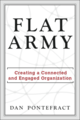
On occasion, I receive emails and requests to meet regarding the contents of FLAT ARMY. I try to answer those requests as best I can. Recently I received a series of provocative questions from a reader, and I thought it might be fruitful to release those answers in this space. I’ve removed the name and anything else that might infer the source:
Do you assume a homogeneous organization? I ask this from the point of view of how this affects a notion of engagement, trust and loyalty across different cultures within the same organization - i.e a global organization sensitive to many different leadership styles and nuances that don’t necessarily "match"?
I don’t assume a homogeneous organization, but I do presume there is a common wish by the cohort of senior leaders to speak one ‘leadership language’ (with and between employees) under the auspices of a common organizational vision and mission. Trust, loyalty and the right to have purpose in one’s role supersedes any concern for the ‘singularity’ or homogeneity in our organizations. Employees want to feel they are valued, and that their role is meaningful to the organizations common mission. It can materialize in different ways due to regional cultures or geographical differences, but the end-goal should be the same for leaders; "to engage others to influence and execute a coordinated and harmonious conclusion."
Your definition of employee engagement
"…reciprocal trust between employee and leadership to do what’s right…."
Do you think there is a distinction to be made between loyalty and trust at a local level and leadership at a corporate level? I know that your view is that leadership is "for all" and not "in an ivory tower" - "but should permeate throughout". Nevertheless the connection between an employee in a small office in SE Asia to the centre in New York (let us say) is a remote one?
As I write in the book, "Trust is not about rules. Trust is not about systems. To be trusting is to be mindful of the human condition." Is there really a difference for an employee based in SouthEast Asia to New York when it comes to trust, if defined as being mindful of the human condition? Leaders are clearly aware of what they are doing to employees if, for whatever reasons, the working conditions or the principles of work are bordering on malfeasance or corruption. To me, that is not trusting, nor will that create any iota of loyalty. If leadership does not trust the employee - if there is no loyalty for what he/she can do in the spirit of customer service, production, organisational goals, and so on - to do what’s right is as possible as inhabiting Mars next year. "To be trusting is to be able to act with authenticity and moral good." If there is no morality in leadership - wherever in the world that question is asked - there is no trust, no loyalty, and certainly no hope for employee engagement.
In my own experience (personal view only) when you work for an organization that represents businesses from different industry sectors/markets, loyalty is to their product/professional community/their teams - not to the organization as a whole. Does that mean they are less engaged or happy? "They work with a passion" but not necessarily for the company as a whole - but their particular product and market sector. That’s where they feel engaged and want to demonstrate success. Who they are owned by only affects them when the overall strategy and direction of the company decides they are to stay or not or benefits improve or decline.
First of all, I don’t believe in happiness at work. It’s a rather unfortunate misnomer. I believe an employee can feel fulfilled, can be thriving, flourishing and indeed engaged at work if a) there is an organizational culture that puts employee engagement first, b) the organization’s purpose is to deliver results that serve the interests of all stakeholders in society and c) the employee recognizes the difference between a job, career and purpose mindset. If a team is myopically focused on solely its product, segment, customers, etc. it has the potential to be creating a disloyal, disengaged and disenfranchised employee - either in that team, or on the other teams that are trying to work with them in the first place. This is how a fiefdom, silo, stovepipe culture manifests - a very easy catalyst to disengagement in the organization. This is a very key concept leaders often misunderstand. Just because one team is engaged (and the leader looks great for creating an ‘engaged team’) it could be the root of problematic disengagement on other teams, due to the fact it is closed, and disingenuous to the needs of other teams, and the organization itself. It is the dropping irony of engagement.
I’ve seen it first hand. A company I worked for (in a previous life) that was incredibly successful in its niche market and everyone who worked on it was very passionate about its success and its integrity to its loyal customers. There was the best feeling of comradeship and connectedness within the team than I’ve ever known. What they didn’t notice was that the company they belonged to was changing direction. At the same time a social platform was replacing our intranet - which I was particularly drawn to. I suddenly saw a much wider picture of what was happening and when I mentioned one day "have you seen what our CEO is saying" - the first response I got was "who’s he?" A couple of years down the road the company was sold. They were "dedicated" to doing the very best job, their sense of mission and passion was evident every day - but not to the organization. It was a restricted view. Does that make them less happy or engaged?
Whilst that team may have been engaged (perhaps by anyone’s definition) what about the other teams, and what about the final verdict? If a team is solely looking out for itself, without concern or care for the greater purpose of the organization (if it’s defined as I have suggested earlier) then there are going to be all sorts of other employees and teams that are disengaged (or not engaged) as a result of the selfish actions of this myopic thinking/acting team. Your situation is nothing new, sadly. Many organizations and its senior leaders award accolades and bonuses to leaders of teams with ‘high engagement’ when they are the very cause of disengagement in the organization itself. Another area to watch out for are those employees who are simply ‘managing up’, pretending to be engaged for fear of reprisal from their leader. If the first response from your example above was "Who is the CEO?", it’s a ‘head in the sand’ syndrome coupled by the potential that this team was ‘managing up’ to ensure it looked good in the eyes of the leader.
I work in an organization that is based on a "command and control " basis - recently reinforced by the arrival of a new CEO. I work at HQ so I feel the changes and see it at play all the more acutely as the new strategy is slowly played out. As I said in my email to you, I think very much along the lines of what I’ve read in your book and I run projects in a way that allows me to be transactional, collaborative, engaging , considerate, inclusive, humble, but insistent and executing . But if the organization I work for doesn’t reflect that - am I wasting my time? Can you "be FLAT ARMY" in an organization of command and control?
I hold out hope that a flat armada can indeed be successfully implemented anywhere, in any situation. When they take the throne as King and Queen of the Kingdom, I envision (or at least hope) Will and Kate will lead the way to a new way of operating royally. Perhaps they can become a beacon of hope, in the United Kingdom, for example. "I have stated repeatedly through FLAT ARMY that leadership is for all, and that to become both a connected and collaborative leader, a camp mentality must not form. It is not us against them. It’s not a game between those with direct reports and those without. Leadership is not found in a white ivory tower; it permeates throughout, meandering like a river, reaching all banks of the organization. If you’ve missed that message, you may have wasted your money investing in this book. It too is not about a continuous group hug. Inclusivity is important and employee engagement is key but getting things done is also critical. Equality between the two must form. It is the new organizational symbiosis."
Dan's Related Posts:The Simple Act of TrustingCorporate Culture in a Venn DiagramDon’t Be a FOOL: Fear of Open LeadershipGreat Work Interview - Flat Army & Michael Bungay Stanierthe FLAT ARMY cheat sheet
Dan Pontefract
.
Blog
.
<span class='date ' tip=''><i class='icon-time'></i> Jul 14, 2015 10:14am</span>
|
|
As the economic climate grows more challenging, business leaders worry about productivity and performance. In business, agreements are the links that connect strategy to execution, and ensure the urgent and necessary work gets done.
Patty McManus
.
Blog
.
<span class='date ' tip=''><i class='icon-time'></i> Jul 14, 2015 10:14am</span>
|
|
It was 35 years ago this week when Terry Fox started his Marathon of Hope.
Truth be told, my hero is Terry, a Canadian legend. His is a story of creating the result that cannot be matched. In 1977, Terry contracted cancer in his right leg. It was amputated, but this courageous and tenacious basketball player didn’t let that stop him. In 1980, he set out to raise $24 million for cancer research — $1 for every Canadian citizen — by running across Canada under the banner called ‘Marathon of Hope’. That’s right, Terry intended to run marathon a day in hopes he could attain his goal. His quest commenced in the spring of 1980 in St. John’s, Newfoundland which would take him across Canada where he would dip his leg in the Pacific Ocean in Victoria, British Columbia at some point in the Fall of 1980.
Cancer is inhumane and it came back to stop Terry in his tracks in Thunder Bay, Ontario after 143 days and 5,373 kilometres of running. Do the math, it’s just shy of a marathon a day for 143 days on one human leg and one prosthetic leg. I was 10 years old. Stunned, shocked and disappointed was how I was feeling back then. Nine months later, Terry succumbed to cancer where I and my nation mourned uncontrollably from the loss. Unjust doesn’t begin to describe the irony. Some 30 years later, Terry’s goal of $24 million has easily been reached with the annual Terry Fox Run — the world’s largest one-day fund-raising event for cancer research — bringing in well over $500 million to date.
During the ‘Marathon of Hope’ itself, Terry was joined by his brother Darrell and good friend Doug Alward. It was here where Terry demonstrated the act of creating the result. Terry’s pugnacious drive and hardened vision would not allow failure to be an option. He was resilient and always on top of Doug and Darrell to achieve the daily goal in hopes of reaching the overall objective. He was relentless. He was focused. He praised his team when needed, and pushed if necessary. Terry was accountable to the team, himself and the mission. His stamina — physically and mentally — was unassailable. Were it not for the unkind fortune of a disease that doesn’t seem to quit, Terry would have accomplished his feat with dignity, engagement and a results positive outcome. He inspired a generation (and now a second generation) to be bold, driven and at all times to create the result. I know he has done that for me and lately with our children. Can Terry be your inspiration to create the result too?
Dan's Related Posts:In Honour of Ada LovelaceTwo Very Incredible & Courageous WomenLessons Learned From a First Time AuthorAmidst Uncertainty the Inuksuk Surfaces"Oh, you’re one of those. You want to work anywhere, anytime."
Dan Pontefract
.
Blog
.
<span class='date ' tip=''><i class='icon-time'></i> Jul 14, 2015 10:14am</span>
|
|
A work team's productivity and performance are affected by the team's structural interdependence, and its team members' use of collaborative skills.
Patty McManus
.
Blog
.
<span class='date ' tip=''><i class='icon-time'></i> Jul 14, 2015 10:14am</span>
|
|
When I was 16 years old, I experienced the tragic and untimely death of a friend. Paul was a beautiful boy, full of charm, zeal and confidence. His alluring, Italian good looks had the girls swooning over his every move, no different perhaps than those today that fantasize about the lads from One Direction. He was that attractive and debonair. I was infinitely jealous.
Between the ages of 12 and 15 in our mutual hometown, we were actually foes on differing competitive soccer teams and eventually high schools. Paul went to the rather large Catholic school, whereas I went to one of the much smaller public high schools. We competed on the soccer pitch several times a year. Because we were both midfielders, we saw a lot of one another. Whether it was when we battled one another through our high schools or through our spring and summer competitive teams — Sparta and Saltfleet — we were rather good enemies. Paul was a skilled dribbler. He also possessed a clinical finish. I was the controlling midfielder, trying to prevent him from doing ‘his thing’. We were an oxymoron.
During the year we both turned 16, the unimaginable happened. Paul was asked by my coach at Sparta to join our club that season. The enemy was now amidst the camp. How could this be? It felt traitorous. It was as though George Harrison had just announced he was leaving The Beatles to join The Rolling Stones. But the Stones already had Keith Richards. That couldn’t be right. Something was amiss.
During the initial moments of our first-ever practice together, the coach brought the two of us to the middle of the pitch. "Do you know why Paul is with our club now, Dan?" he asked with a bemusing twinkle in his eye that seemed to ironically become highlighted by his thick Scottish accent. Without waiting for either of us to answer — he was great at answering his own rhetorical questions — the coach suggested that, "Because together, you are going to make one another so much better."
"Great," I thought to my pugnacious teenage self. "I suppose it’s time to start looking at other clubs for next year."
But then I quickly had a second thought.
"Maybe the crazy ‘If it’s not Scottish it’s crap’ sage elder is right," I cheekily thought to myself next. "Maybe he has a point."
And he did. And it wasn’t degenerate.
Over the course of the next two months, Sparta was a much better club. I became a much better player as well, working in tandem with Paul. He was more of an attacking midfielder whereas I was more of a punishing, "no one gets by me" defending midfielder, able to intercept oncoming balls (and players) to subsequently pick out teammates with counterattack passes. This new dynamic duo was working magnificently. Paul and I seamlessly cooperated and collaborated together to fortify a team that was already an excellent squad. In a word, it was ‘magic’.
During one of those dog days of summer that signifies Southern Ontario in July, I received a telephone call from a mutual friend of ours — Kendall — asking if I was home. Given I answered the phone (and there were no mobile phones back then) Kendall asked me to stay at home and not venture anywhere. He wanted to come by the house. There was important news to deliver. Confused as I was, I agreed to sit tight.
"Paul’s dead," Kendall shrieked as he came bursting through the side door of the house.
"It was a boating accident, he’s gone," he continued.
Incredulous as the news sounded, I burst into tears. How could this be? My enemy who had just become my soccer friend — my partner in a new form of teamwork — was no longer among us. What of his family? What of those swooning girls? What of our budding on-field friendship?
Kendall was a much better friend to Paul than I ever was. Their history together started when they were both in the single digits of age. Kendall and I went to the funeral later that week together. It was awful. So much grief. So much crying. I think that’s the day I became a man. At least I started to knock on the door. The sadness was pervasive if not suffocating. It was one of the hardest and most emotional days of my life.
It’s been almost thirty years since I’ve thought about Paul. You might say I forgot about him. How sad. Why is that? Why did I forget about Paul? Even as a prepubescent and subsequently pubescent lad, there was (and is) much to recall, much to remember, much to learn about Paul.
For many of us however, sadly, there is anonymity after death.
If perhaps you have contributed great ideas, inventions, literature, hope, music or discoveries during your lifetime, your relevance remains arguably perpetual to the world. William Shakespeare, Niels Bohr, Ernest Rutherford, Mother Theresa, John Lennon, Oprah Winfrey, Epicurus, Thomas Edison, Friedrich Nietzsche or Pablo Picasso need not worry about their anonymity in the afterlife. Heck, let’s even add Marilyn Monroe to the mix. Generations of people will be able to read about their contributions, for they are firmly ingrained in the consciousness of history ever after.
What of the rest of us? What is our legacy? How might we be remembered?
We’re still considered ‘old school’ in our home because the daily national newspaper is delivered to our front door. It may seem morbid but on Saturdays I tend to scan the obituaries. Typically there are no Rutherfords or Lennons or Winfreys. No, they’re always on a page separate from the obits.
But there are oodles of Pauls.
And all of those Pauls are people to learn from if we indeed take the time to remember how they touched us.
Like snowflakes, humans descend in various shapes and sizes. We’re all unique. Some of those snowflakes are used to build snowmen. Others lie within the serenity of an open field, undisturbed until the warmth of spring peeks through. It’s not possible to remember every snowflake — thus, every human we come into contact with — but we ought to take the time to recall those that helped us to create some magic in our own lives.
You need not read the obituaries, but you might attempt to begin recalling what you’ve learned from those that have passed on, who you’ve come into contact with. There is gold in those memories. Your family members, relatives and best friends are a given. How could you forget them?
But what of that neighbour down the street who once helped you build a fence?
What of the office mate that annoyed you, but always managed to find a way to compliment your PowerPoint presentations?
How about the lady you used to buy your coffee from every day in the café kiosk?
Who are the Pauls in your life?
We are all snowflakes. We all eventually melt. It’s a physical inevitability. Rather obviously, we are all human, too. Paul was human. But I forgot about him. I let him mentally melt away. I shouldn’t have. He was a charming, glowing and unique snowflake.
Upon a quiet moment of reflection this week, I realized I still have much to learn from him. His life may have been somewhat ephemeral, but that doesn’t mean he should melt into obscurity or obsolescence. Thank you Paul, I’ll be sure to pass on what I’ve learned from you to others. In the end, you did make me "so much better."
Don’t let those who might not be considered within your inner circle or family melt away. Don’t simply rely on the famous either. There is so much to learn from every one of those snowflakes that come into your life.
Don’t let there be anonymity after death.
NOTE: Originally posted to The Huffington Post.
Dan's Related Posts:Can Humanism Replace Capitalism?The Leadership Collapse of Manchester UnitedMy Employee Engagement Advice to a StrangerWhat I Learned About The Stigma Of My StigmaLeadership Lessons From Late Night King David Letterman
Dan Pontefract
.
Blog
.
<span class='date ' tip=''><i class='icon-time'></i> Jul 14, 2015 10:14am</span>
|
|
Patty McManus' white paper, "Beyond Feedback: Breaking the Vicious Cycle," explores a particular type of interpersonal workplace conflict that involves a complex dynamic. The tricky thing about some conflicts is that they can't be "fixed" by giving feedback.
Patty McManus
.
Blog
.
<span class='date ' tip=''><i class='icon-time'></i> Jul 14, 2015 10:14am</span>
|
|
I’ve witnessed it before. I’m certain I’ll witness it again.
Someone is promoted to a senior leadership role. Deserved or not, everyone knew it was coming.
She surrounds herself with familiar, friendly faces. Some call it nepotism.
Words. They can be so funny, so revealing.
Nepotism comes from the French word népotisme and from the Italian word nepotismo. The etymology informs us that nepotism is formed through a relationship, thus, there is a ‘relationship’ with the word nepotism to the English word ‘nephew’.
Why?
History tells us that there were so-called "nephews" of various Popes — who fathered illegitimate sons — for whom the Popes provided the boys with specific privileges and powers. Hence, nepotism.
Surround yourself with like-minded ‘nephews’ and then assign plum positions via nepotism and something else comes into play.
Groupthink.
As Wikipedia informs us, groupthink is:
A psychological phenomenon that occurs within a group of people, in which the desire for harmony or conformity in the group results in an irrational or dysfunctional decision-making outcome. Group members try to minimize conflict and reach a consensus decision without critical evaluation of alternative viewpoints, by actively suppressing dissenting viewpoints, and by isolating themselves from outside influences.
When you combine nepotism with groupthink, the leader has entered into a new form of power.
I like to refer to it as ‘(un)common sense’.
In her 1979 piece, Power Failure in Management Circuits, Rosabeth Moss Kanter beautifully summarizes what becomes of leaders in an organization when their power is enhanced by new titles and positions:
"What grows with organizational position in hierarchical levels is not necessarily the power to accomplish — productive power — but the power to punish, to prevent, to sell off, to reduce, to fire, all without appropriate concern for consequences. It is that kind of power — oppressive power — that we often say corrupts."
We might suggest the leader has lost all common sense, as a result of this newfound power, aided and abetted by these acts of nepotism and groupthink.
My friend, this is not a good thing.
In the pursuit of power, many leaders believe it’s a good idea to adorn themselves with ‘horse blinkers’. (Also known as horse blinders.)
These blinkers seem to come with instructions in which to invoke nepotism and groupthink. Despite every management article known to humankind suggesting leaders in new positions of power should be doing the exact opposite, there continues to be example after example of leaders who succumb to the blinkers.
It’s bonkers.
When power overthrows common sense, the organization splits into a dizzying array of cliques, camps and confusion.
When power overthrows common sense, the hallways, water coolers, emails and conference calls become emblazoned by chit-chat that runs contrary to the organization’s true purpose.
When power overthrows common sense, therein commences the demise of an engaged organization.
I’m certain employees don’t want to be a part of it.
That sentiment also includes me.
__________
Dan Pontefract is the author of FLAT ARMY: Creating a Connected and Engaged Organization. He’s finished writing his next book — DUAL PURPOSE: Redefining the Meaning of Work — which will publish November 10, 2015.
Dan's Related Posts:What Should The Title Of My Next Book Be?That Decision Is Above My Pay-GradeConation: The Word of 2015Book Review of WORK RULES: Insights From Inside GoogleThe Collateral Damage of Selfish Leadership
Dan Pontefract
.
Blog
.
<span class='date ' tip=''><i class='icon-time'></i> Jul 14, 2015 10:14am</span>
|
|
Having gone through the process of publishing a book once before, I can honestly say one of the most rewarding experiences is when the book cover is finalized.
It’s that time, again.
Releasing November 10, 2015 … DUAL PURPOSE: Redefining the Meaning of Work.
I hope you like it. (I also hope you might read it, too.)
Dan's Related Posts:My Next Book Has A Title And A Publish DateAnnouncing the Full Book Cover Jacket of Flat ArmyCalling Frederic Laloux Of Reinventing OrganizationsAnnouncing the Front Cover of Flat ArmyWhen Power Overthrows Common Sense
Dan Pontefract
.
Blog
.
<span class='date ' tip=''><i class='icon-time'></i> Jul 14, 2015 10:14am</span>
|
|
Collaboration is a critical driver in business today, particularly if your business is global and your teams are far-flung. New technologies are promising, but the simple truth is technology doesn't collaborate, people do. What special methods do your people have to collaborate successfully?
Patty McManus
.
Blog
.
<span class='date ' tip=''><i class='icon-time'></i> Jul 14, 2015 10:14am</span>
|
|
I nearly choked to death this morning, while chomping away on my cereal.
The headline from Harvard Business Review read, Why "Company Culture" Is a Misleading Term. While wiping off the milk from my iPad, I began to read on.
"Organizational culture is assumed to be important to making sure that employees are happy and productivity is good. At the same time, the concept, meaning, and function of culture rarely garners much thought."
WHAT? At this point, I stopped eating the cereal for fear of a Heimlich Maneuver in my immediate future, most likely performed by a scrawny but increasingly concerned 9 year-old.
The author of the piece — Dr. John Traphagan, professor in the Department of Religious Studies at the University of Texas at Austin — seems to have crossed his wires throughout the piece. I’m here to defend the term, "Company Culture".
But first, a bit of a background to the author. John’s LinkedIn profile suggests he is "a cultural anthropologist with over 15 years of experience in research and teaching" where he has been "consulting with government agencies and industry and working with the media on issues related to Japanese culture and society."
Is there no "company culture" present in Japan?
His biography page at The University of Texas at Austin poses further questions for me. Aside from the grammatical/spelling error, John states the following:
Dr. Traphagan’s research interests center on the relatinoship between culture and science. His past work has focused largely on medical concepts and religion in Japan. Currently, his primary research focuses on the application of anthropological ideas within the field of astrobiology.
Aside from me wondering what his recent research focus on astrobiology has to do with "company culture", I’d like to argue that there is indeed a relationship between culture and science, much like there is one between culture and the company.
When Dr. Traphagan suggests "the concept, meaning, and function of culture rarely garners much thought" and that "most of us give very little thought to what that term means and how its use influences behavior and thought within organizations" he is flat wrong.
Three years ago, Greg Smith — a high-ranking employee at Goldman Sachs at the time — penned a rather influential (if not controversial, for some) editorial to The New York Times. In it, he opined:
"Culture was always a vital part of Goldman Sachs’s success. It revolved around teamwork, integrity, a spirit of humility, and always doing right by our clients. The culture was the secret sauce that made this place great and allowed us to earn our clients’ trust for 143 years."
He’s right. Greg eloquently depicted what true "company culture" ought to be about. Concepts such as teamwork, integrity, humility and finding the processes, behaviours and mechanisms inside the company to put your ‘customers first’ is indeed what true "company culture" is all about.
I surface the editorial from Greg because he went on later to describe how the culture had evaporated at Goldman Sachs, leading to his resignation. "I am sad to say that I look around today and see virtually no trace of the culture that made me love working for this firm for many years. I no longer have the pride, or the belief," he continued. "Get the culture right again, so people want to work here for the right reasons. People who care only about making money will not sustain this firm — or the trust of its clients — for very much longer."
It was a bit of a personal vendetta against his employer, but it was a bit of a wake-up call for senior leaders at Goldman Sachs, too. Whether or not executives had forgotten about their "company culture" at Goldman Sachs, ever since Greg’s whistle-blower letter of sorts, the company has regained (and augmented) their internal operating composure and are (again) thinking and acting on their company culture. It’s but one example, but Dr. Traphagan’s assertion that organizations aren’t giving much thought to "company culture" is balderdash.
Alan Mulally, former President and CEO of Ford, provides us with another example. Saddled by an economic crisis in 2009 just short of the 1929 depression, he worked extremely hard to turn around the company and avert complete financial ruin. One of several strategies he introduced was something called ONE FORD. Mulally knew not only were the stakes high for his company’s survival, he had an entire workforce (and industry) worried sick. This was not the time to invoke any sort of "superhero syndrome" … it was an opportunity to fix the "company culture" at Ford in order to ensure the company actually survived.
ONE FORD was the plan-on-a-page quest introduced to employees — and external stakeholders thereafter — that invoked teamwork, collaboration and cooperation. Introduced as a graphic to the entire organization, the left side contained three defining statements (ONE TEAM, ONE PLAN, ONE GOAL) that outlined "people working together" and an "exciting viable Ford for all". The emphasis Mulally introduced in a time of crisis centred on the redefinition of "company culture".
On the right side of the graphic, Mulally used the word Ford as an acronym further detailing how they would recover from the economic meltdown they were facing. The details included:
Foster Functional and Technical Excellence
Own Working Together
Role Model Ford Values
Deliver Results
This is the epitome of "company culture" and it helped turn the tables of bankruptcy at Ford, while improving morale and so on.
Perhaps the example at Ford and with Alan Mulally in particular demonstrates causality with research conducted by Stanford University’s Charles A. O’Reilly III and his peers. They surfaced evidence that "company culture" will often reflect the personality of its CEO. In turn, the CEO creates a significant impact on the performance of the company itself.
Do you think, therefore, that a CEO isn’t thinking about culture if his or her behaviour might affect the bottom line?
Dr. Traphagan further asserts that, "We need to stop using the term "culture" to talk about what’s going on in our organizations," in part because, "Corporations and other organizations do not have cultures; they have philosophies and ideologies that form a process in which there is a constant discourse about the nature and expression of values, beliefs, practices, ideas, and goals."
Is that so?
Deloitte suggests "employee engagement and culture issues exploded onto the scene, rising to become the no. 1 challenge companies face around the world" in research it released earlier in 2015. If that is the case, how is it that senior leaders are looking the other way when it comes to "company culture", as Dr. Traphagan is blindly suggesting. How is it that corporations and other organizations "do not have cultures" if it has become the number one issue that needs to be addressed, according to CEO’s and senior leaders?
In 2007, levels of employee engagement at TELUS (Canada’s fastest-growing national telecommunications company, with $12 billion of annual revenue and 13.7 million customer connections) sat at 53%. I know what "company culture" is, and I know how important it is because I joined TELUS from SAP the following year, in 2008. That year began a quest by the company to make the shift from "good to great" by focusing on all facets of its "company culture" in order to indeed put its valued "customers first".
Through the introduction of "company culture" pillars such as Bravo (a recognition program), We Give Where We Live (a community investment and philanthropy mission), TELUS Leadership Philosophy (an open behavioural leadership model for all 43,000+ employees in eight countries), Connected Learning (a formal, informal, social learning model), Habitat Social (a collaboration technology platform), and of course Customers First (a seismic shift in the way TELUS interacts, listens and conducts business with its customers) employee engagement rose to 85% and a multitude of business and customer metrics rose in concert.
Whether the organization is Goldman Sachs, Ford or TELUS, you can rest assured Dr. Traphagan that "company culture" is as important an issue as anything in the organization these days. Some firms are succeeding better than others. (as is evidence from the woeful state of employee engagement across the world)
But the term "company culture" should not be retired. You state that we, "need to develop a way of talking that captures the discursive nature of group behavior and to think in terms of all groups as processes that shape and are shaped by individuals."
An organization need not forego "company culture"; it simply ought to work with its employees to craft common operating principles (behaviours, tools, processes, and so on) that connects the entire organization as one. Sub-cultures in varying geographies or countries is rather obvious. In fact, it should be encouraged.
But for organizations to succeed in the 21st century there needs to be a "company culture" such that the employees and its leaders are working together under a common language — a unified DNA — to do as Peter Drucker stated when on the topic of defining the purpose of business, which is, "To create a customer."
Dropping the term "culture" from the lexicon of organizational and corporate consulting and research would be a horrible step to take.
It’s perhaps as short-sighted as me eating cereal again over my iPad while reading about such a concept.
Originally posted to Forbes.
__________
Dan Pontefract is the author of FLAT ARMY: Creating a Connected and Engaged Organization and is Chief Envisioner at TELUS Transformation Office. His next book, DUAL PURPOSE: Redefining the Meaning of Work, will publish November 10, 2015.
Dan's Related Posts:If Your Enterprise Social Network Is A Ghost Town It’s Probably Due To Your…Rethinking the Work of LeadershipIn Answer To Your Questions About FLAT ARMYApparently, Organizational Culture is CrapCan Humanism Replace Capitalism?
Dan Pontefract
.
Blog
.
<span class='date ' tip=''><i class='icon-time'></i> Jul 14, 2015 10:13am</span>
|