Blogs
|
Forbes.com ran a guest post by IA CEO Linda Stewart on the value of brainstorming for achieving important results, when matched to the appropriate challenge.
Patty McManus
.
Blog
.
<span class='date ' tip=''><i class='icon-time'></i> Jul 14, 2015 10:15am</span>
|
|
Do you take the time to say ‘bless you’ to a stranger on a plane who has just sneezed?
Do you take the time to hold the door for someone many steps behind you?
Do you take the time to read to your children?
Do you take the time to walk your neighbourhood at sunrise?
Do you take the time to answer that email or voicemail?
Do you take the time to give the panhandler a couple of bucks?
Do you take the time to marinate in the moment?
Do you take the time to re-evaluate blurred lines?
Do you take the time to thank those who knowingly assist?
Do you take the time to push boundaries?
Do you take the time to address problems, large or small?
Do you take the time to process failures?
Do you take the time to sing with the birds?
Do you take the time to release the fear, to embrace the unknown?
Do you take the time to recognize everything’s gonna be alright?
Do you take the time to take the time?
Dan's Related Posts:My Employee Engagement Advice to a StrangerThe ABC’s of CollaborationI’m Not Scared of Email; I Developed a System called DADDIOA Review of "How To Be Interesting" While Sitting Beside a Drunk on an…IF
Dan Pontefract
.
Blog
.
<span class='date ' tip=''><i class='icon-time'></i> Jul 14, 2015 10:15am</span>
|
|
Forbes.com published a guest post by Interaction Associates CEO Linda Stewart, with strategies to lead virtual teams.
Patty McManus
.
Blog
.
<span class='date ' tip=''><i class='icon-time'></i> Jul 14, 2015 10:15am</span>
|
|
The fine folks at Learnnovators conducted an interview with me recently, where I spouted off on aspects of leadership, engagement, purpose and innovation. The results can be found below:
1. Learnnovators: It is so inspiring to hear you speak of leveraging the metaphor of Canada Geese, which rotate leadership, thus ensuring that each member of the team contributes to the end result. You say "We are not allowing our employees to be engaged… we are not enabling ‘workplace actualization." What would be your position on the transformation required in workplace learning in today’s organizations? What are the challenges ahead? What are your recommendations to prepare organizations for the 21st century?
Dan: Although I’m not an ornithologist, I like to think of myself as a ‘bird scientist’ on occasion. Canada Geese - indeed any flock of birds - are an interesting and inspiring metaphor to consider, as it pertains to the organization and its health. Canada Geese in their flocks still exhibit some form of hierarchy, but as they travel from point A to point B, they do in fact rotate leadership of the V-formation (the skein) that propels them to their destination. The journey is non-hierarchical, but there remains an order inside the flock itself. In today’s organizations, we often use the hierarchy of the organization (e.g. C-Suite, to VP’s, to Directors, to Managers, to employees) to maintain order, and to drive the organization to its destination. While this has worked in the past through command and control behaviours, today’s organization needs to be more like the Canada Geese and involve employees in the journey itself. I don’t believe in Holacracy or other foolish organizational models that want to rid the organization of hierarchical structure, but the behavior of leadership itself must change. There can still exist a hierarchy in the organization, but it must act in more open, collaborative and trusting manners with the employees of the organization it serves. For organizations to fuel their own growth and innovation (and survival), leadership must be willing to offer a new model of interaction - a new leadership model of collaboration - if they want to exist in the future.
2. Learnnovators: You’ve always challenged conventional wisdom around how we look at workplace engagement. You are, in fact, concerned about ‘workplace disengagement’, and have been on the lookout for solutions to rid organizations of this malady. What are your thoughts on leveraging the power of new or emerging technologies such as gamification to boost employee engagement levels and thereby improve performance? What are your experiences?
Dan: I’ve always stated that for an organization to mature and adopt a more open and collaborative ethos, it must put behavior before tool, and form before function. There is a popular movie - Field of Dreams - starring Kevin Costner, who is called by the ghosts of yesteryear to build a baseball diamond, with the popular quote being, "If you build it, they will come." Well, this is a horrible strategy for an organization. One can’t simply implement a series of collaboration or social technologies in the organization and hope that employees will start magically collaborating. This is fool’s gold. But, I am a huge fan of collaborative technologies and platforms. Gamification is very powerful. Wikis, blogs, microblogging, video-sharing are all very important aspects of an organization’s culture. But, if you were to simply dump these types of tools and technologies on the organization - and the leadership hadn’t done anything about the culture, disengagement or lack of collaborative behaviours - those tools will remain empty ghost-towns, as no one would use them due to the fear factor of either being fired for something they might say, or having no understanding why it’s important in the first place.
3. Learnnovators: One of the main things you work to change in organizations is their tendency to treat employees like mere numbers (or as you say, ’gladiators’ in a Roman army). However, it is exciting to note that leadership style has started to change as you had envisioned, from ‘command and control’ to ‘cultivate and coordinate’. On a similar note, organizations treat their employees as mere ‘learners’ who need constant support to learn (as if they do not know how to learn) and perform. However, we know that continuous learning is the key to maintaining an ongoing competitive advantage, both for individuals and organizations. How would you like to change this scenario in today’s connected world of self-organized workers? What would be your message to L&D leaders to empower employees to take charge of their own learning (and thereby their professional development)?
Dan: Every building that is erected first starts with a team of architects. Once the architects have their drawings and plans approved, it’s up to the builders to actually mix the concrete, and surface the building to the skies. From there, the interior designers get involved to ensure the accoutrements in the building are fun, funky and usable. Finally, people (or employees) inhabit the building. This is somewhat akin to what should be happening in the ‘learning world.’ The learning leaders and professionals are the architects. They have the responsibility to draw up the building of what I call ‘Pervasive Learning’ for their organization. They possess the requirement to define what it means to have a formal, informal and social learning model. They are the architects of learning. From there, leaders and employees alike can build their learning paths, learning needs, and learning opportunities. They become the builders, designers and users. Sure, learning leaders can assist the creation of those learning opportunities - no different than an architect being onsite to help the builders or the designers - but it’s the model that they’ve created that assists others with their learning outputs.
4. Learnnovators: We know you are busy writing your next book - the Flat Army sequel, scheduled for release in late 2015 / early 2016. We understand that it is an investigation as it relates to mindsets in the organization, and discusses how the employee, leader and the organization itself are responsible for the differences between job, career and purpose. Could you allow us a brief preview of this work for our readers please?
Dan: The book is called "DUAL PURPOSE: Redefining the Meaning of Work" and it breaks down the true purpose of ‘purpose’ in the workplace. It suggests that there are two parts to purposeful organizational impact. The central arc of the book: every leader has a responsibility to redefine the purpose of an organization and they have a responsibility to assist employees to reach a sense of purpose in their roles. Thus, DUAL PURPOSE is aimed to redefine purpose for the organization and employees. The mission for this book is to act as a fundamental implementation tool to help leaders put purpose into action. As a sequel to FLAT ARMY, it’s complimentary to engagement, connectedness and collaboration - important aspects of an organization’s culture. For DUAL PURPOSE, it extends the argument but focused on the important aspect of purpose, something I hope all organizations and employees achieve.
5. Learnnovators: Future forward organizations are allowing their employees to be ‘Entre-ployees’ (employees who are also entrepreneurs) thereby offering them the freedom to work on their own ideas during work hours using their own business resources. What would be your reflections on this? There are many who feel that entrepreneurship is one of the best settings for children to learn. Do you advocate making entrepreneurship part of the school curriculum?
Dan: I have always advocated that the term ‘recess’ at school should be replaced with ‘play’. I find we do not allow students or employees, by extension, to play enough with one another. When students or employees are permitted to play, wonderful aspects of innovation and creativity manifest, arguably defining the culture (and people) as entrepreneurial.
6. Learnnovators: To quote Clark Quinn, "Survival requires continual innovation, and at the core is learning faster than everyone else". You always have been passionate about trying out new things and preparing yourself for the innovations that are yet to come. How significant, according to you, is innovation for businesses to succeed? What role does innovation play in L&D? How can a leader (HR or L&D) drive everyday innovation? How significant is continual experimentation to innovations in learning?
Dan: To innovate is to learn. To learn is to collaborate. To collaborate is to engage. To engage is to include. To include is to participate. To participate is to share. To share is to grow. To grow is to innovate. (repeat)
Dan's Related Posts:My Definition of Work and an Update on Book TwoIf Your Enterprise Social Network Is A Ghost Town It’s Probably Due To Your…Corporate Culture in a Venn DiagramThe Collateral Damage of Selfish LeadershipHolacracy Is Not The Answer To Your Employee Disengagement Issues
Dan Pontefract
.
Blog
.
<span class='date ' tip=''><i class='icon-time'></i> Jul 14, 2015 10:15am</span>
|
|
The "soft stuff" is the hard stuff, as many CEOs know too well. Never doubt that there are ways to make real inroads by putting programs in place to change behaviors that move the needle on key employee metrics - and ultimately the company’s financial performance.
Patty McManus
.
Blog
.
<span class='date ' tip=''><i class='icon-time'></i> Jul 14, 2015 10:15am</span>
|
|
There is a diagram floating around LinkedIn and Twitter that attempts to illustrate an individual’s true ‘purpose’. It’s amusing to me, because it’s short-sighted. It may even be delivering a disservice to some.
Whenever I come across the graphic, I immediately wonder if it’s doing a disservice to employees everywhere.
There are four circles in the Venn Diagram, where the overlapping circles read as follows:
Passion/Profession - That which you are good at
Passion/Mission - That which you love
Mission/Vocation - That which the world needs
Profession/Vocation - That which you can be paid for
In the middle of all four circles is a blue star, which denotes ‘purpose’.
Cute, but it’s rather myopic.
The diagram suggests your purpose (arguably something that is aided and abetted by whether or not an employee is engaged at work) isn’t affected by other factors such as your direct manager, your team, or the organization where you work.
Naturally, this got me thinking.
I think everyone deserves to reach their purpose in life, at work, and so on. I believe, however, that it is extremely difficult to achieve one’s purpose without the support of other factors in the place (or places) where he or she works.
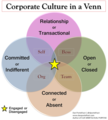
Therefore, I whipped up the "Corporate Culture in a Venn" diagram to depict something that does take into account four key factors:
Self/Boss - Relationship or Transactional
Does an employee and his/her boss actually have a productive, communicative relationship — where the leader is helping the employee develop, learn, grow, etc. — or is the duo more of a transaction, where the boss uses the employee as an asset, treating him/her like headcount, and not caring whatsoever about his/her future. Does the employee use the boss solely for a paycheque?
Boss/Team - Open or Closed
The employee is normally part of a team of some varying size. If the the team and the direct leader is open, reciprocal and accessible, it does wonders for purpose and engagement. If, however, both the boss and the team exhibit closed behaviours — unwilling to adapt, be proactive or ideate — it’s a definitive nail in the coffin of goodness.
Self/Org - Committed or Indifferent
When the organization and its senior leadership are committed to the employee (fair wages, community involvement, learning and development opportunities, etc.) it is far easier for the employee to commit him or herself to the organization’s mission, satisfying its goals, customer commitments, and so on. If the organization is indifferent — not caring about the employees who make up their "most valuable asset" quips on annual reports, you can be certain the employees will become indifferent to the organization as well.
Org/Team - Connected or Absent
For a team to be a successful cog in the wheel of the entire organization, it must feel connected to other teams, thus other parts of the organization. For an organization to act as one, it itself must be connected to all teams, not simply the Sales Team or Marketing, for example. When all teams are connected, the organization becomes symbiotic. If, however, a team becomes absent — making no effort to connect with other teams, or the organization — it is the very definition of silos, fiefdoms and stovepipes. In other words, a culture killer.
If all four components mentioned above are achieved — Relationship, Open, Committed and Connected — I believe (through my experience and research) that the organization will become engaged, and thus the employee has a greater chance of achieving their purpose.
Dan's Related Posts:In Answer To Your Questions About FLAT ARMYthe FLAT ARMY cheat sheetPerhaps the Purpose of an Organization?Maybe We Should Be More Like a Fridge at WorkFuture Of Work: A Flat Army Of Open Leadership via A.G. Lafley
Dan Pontefract
.
Blog
.
<span class='date ' tip=''><i class='icon-time'></i> Jul 14, 2015 10:14am</span>
|
|
At Interaction Associates, we work with clients to achieve greater and more sustainable levels of business return on investment, by delivering a different ROI — Return on Involvement™.
Patty McManus
.
Blog
.
<span class='date ' tip=''><i class='icon-time'></i> Jul 14, 2015 10:14am</span>
|
|
Business leaders are embracing collaborative leadership to drive strong business results. What is collaborative leadership -- and what's involved in making it work in your organization? How can you know if you have what it takes to be an effective collaborative leader?
Patty McManus
.
Blog
.
<span class='date ' tip=''><i class='icon-time'></i> Jul 14, 2015 10:14am</span>
|
|
I had the good fortune of spending some time in the great city of Montreal this week, on what many call a "business trip". Despite the unrelenting Arctic chill that continues to engulf its inhabitants — since late last year, a perpetual blanket of roughly a million degrees below zero — it dawned on me that there are three individuals in particular who continue to warm the omnipresent frigidness of the city. (And I was lucky enough to spend some time with each of them.)
Karl Moore is Professor of Strategy and Organization at McGill University’s Desautels Faculty of Management, having done so since 2000. His specialties center around the business world, specifically globalization, leadership, CEO leadership, and strategy. He has previously taught at leading universities such as Oxford, London Business School, Cambridge, Darden, Cornell, INSEAD, Duke, the Drucker School, the Rotterdam School of Management, IIM Bangalore and Queen’s.
Not too shabby, dare I say.
We met for an hour over an espresso and ‘pain au chocolate’ at his favourite haunt, Cafe Castel, beside the McGill campus. He owns the place, saying hello to every other passerby on the street, and two-thirds of the people in the joint itself. But that’s Karl. He is a wonderful connector, a networking aficionado, and a very deep thinker about all nuances with respect to the organization. He hosts a very popular radio show where he interviews CEO’s and other leaders. His writing and quotations at The Globe and Mail is vast and extensive, with over 800 references. (800!)
Our talk, as usual, covered an array of topics. He was very helpful regarding a couple of strategies for my next book, as well as providing some insight into the content itself. He’s genuinely interested in the plight of the organization, which is probably why I think he’s so cool. He even asked when I might be returning to higher education / academia. That answer, naturally, remains private between the two of us. I’m looking forward to reading his next book, and generally anything that he puts out there on various mediums. I’m a much richer person knowing Karl, and reading or listening in on his various contributions.
Karl is the first of my Montreal wise men, and if you weren’t aware of his writing or intellectual thoughts, be sure to click any of the links above to remedy it. You won’t be disappointed, I assure you.
Jon Husband was the next wise man I met up with this week in Montreal. We enjoyed a lovely dinner at a restaurant that anyone would fall in love with at first bite. (I urge you to visit Restaurant Laloux the next time you’re in Montreal - you won’t be disappointed.)
Almost five years ago, I introduced Jon in this very space with a story entitled, "My Network Is My Net Worth". Indeed, my net worth continues to increase as a result of having Jon in my life. Ever since meeting him in 2009, Jon and I have had far-ranging and multiple conversations about the ‘future of work’ … even when it seemed there was no future. Our dinner this week was no different. His self-described ‘deep generalist’ DNA continues to improve my competence and understanding of the world in which we live.
Jon is a walking encyclopedia, able to rhyme off book after book and their importance, not only on him, but on other authors and organizations that took the intellectual property to enact change or new bodies of knowledge. If you aren’t aware of Jon’s writing, you must at a minimum ‘lunch and learn’ with yourself and review his thoughts on his rather brilliant and self-defined principle known as Wirearchy.
To get you started, Jon defines Wirearchy as:
An emergent organizing principle that informs the ways that purposeful human activities and the structures in which they are contained is evolving from top-down direction and supervision (hierarchy’s command-and-control) to champion-and-channel … championing ideas and innovation, and channeling time, energy, authority and resources to testing those ideas and the possibilities for innovation carried in those ideas.
I even cited it in FLAT ARMY, specifically in Chapter 8, The Collaborative Leader Action Model.
What I appreciated this week when we met up for dinner was his belief in me. He thoughtfully provided a coaching ear during our meal, in a manner that was part provocative, part reminder, and part sanity check. I’m grateful for Jon, and that is why he’s the second of my Montreal wise men.
The third and final wise man who I spent time with in Montreal this week was none other than Henry Mintzberg.
You know, the brilliant mind and author of 15 books including classics such as The Rise and Fall of Strategic Planning and Managers Not MBAs. He’s also a colleague of Karl Moore, holding the Cleghorn Professor of Management Studies role at McGill University’s Desautels Faculty of Management.
Henry really needs no introduction. He possesses one of the — if not the top — management minds of the past 50 years. (I’m trying very hard to catch up.)
I’ve spoken with and interviewed Henry on the phone before, but had never been fortunate enough to spend any time with him face-to-face, in any sort of intimate atmosphere. That all changed on Tuesday of this week. How lucky was I. Walking through the streets of the neighbourly district in Montreal known as NDG — Notre-Dame-de-Grâce — we finally stumbled upon what seemed like a makeshift restaurant below ground that served African food. It was delectable. The plantain was out-of-this-world, but so too was our conversation.
Henry had just released his most recent book, "Rebalancing Society: Radical Renewal Beyond Left, Right, and Center". At 75 years of age, it is arguably one of Henry’s best. (Go buy it.) There is no stopping this man, and I hope he continues writing books like this for another 30 years. The latest centers around the hard-line positions society takes (those on the left, and those on the right) arguing that society actually requires a balance between private, public and plural organizations. He likens it to a 3-legged stool (something I often use in my talks) claiming the stool will fall over if one of the legs are removed, or become out of balance. This was a great discussion to have with him over lunch. I consider myself a lucky man.
Over our walk and during the incredible food we devoured at lunch, I learned Henry is an ardent cyclist, regaling me with stories of biking trips across Europe, Japan and Canada. Given I’ve got a penchant for cycling as well, I didn’t think it was possible to like the man any more than I originally did, but he proved me wrong yet again. I hope we can fit in a cycling excursion this summer, together.
The weather might have been freezing to this follicular-challenged man of West Coast climate living, but the time I spent with Karl, Jon and Henry was scintillating if not blistering as it relates to my learning. These three wise men donated their time, and I was the benefactor. I reckon the combined management and intellectual experience of the three is over 120 years.
I consider myself a blessed man, and consider this post a small form of gratitude in return for their sharing, time and camaraderie.
I won’t ever forget the week. I won’t ever forget Montreal’s Three Wise Men. They have taught me so much. Thank you Karl, Jon and Henry.
Dan's Related Posts:LeisureInterlocutors of 2012 (the goats are better for it)Announcing the Full Book Cover Jacket of Flat ArmyI Missed My 25th High School Reunion That Never WasLessons Learned From a First Time Author
Dan Pontefract
.
Blog
.
<span class='date ' tip=''><i class='icon-time'></i> Jul 14, 2015 10:14am</span>
|
|
Effective collaborative organizational change is possible when the team is strategic and self-aware — and has a strong capacity for collaboration.
Patty McManus
.
Blog
.
<span class='date ' tip=''><i class='icon-time'></i> Jul 14, 2015 10:14am</span>
|