Blogs
|
Here’s something you may not have seen in print: Leading collaboration is so demanding that many leaders will not only never collaborate effectively — they’ll never even really understand what it means. But there’s good news.
Patty McManus
.
Blog
.
<span class='date ' tip=''><i class='icon-time'></i> Jul 14, 2015 10:25am</span>
|
|
Elana Varon of the SAP Center for Business Insight recently interviewed me with the topic and questions focusing on different approaches to corporate learning.
The full report, entitled Why Companies Should Invest in Revamping Corporate Learning — with additional insights from Marcus Schwarz and Karie Willyerd of SAP — is available at this link. I encourage you to download it. (it’s free) My specific responses are below.
Elana: Do employers have an obligation to train and develop their employees?
Pontefract: We consider it a responsibility of TELUS team members to participate in learning. There are a lot of tools we make available. But we’re really trying to take care of our people. It’s not the case that they have to go figure everything out for themselves. The model is for leaders to assist.
Elana: Companies still seem to be very invested in classroom-style learning (both online and offline) rather than in facilitating collaboration. How do they need to change?
Pontefract: Companies need to blend that learning model into the corporate culture. Often, marketing or IT is in charge of deciding what collaboration tools employees will use and showing people how to use them. Meanwhile, the learning function within HR is playing catch-up. But the learning function should be leading, or at least working in parallel with other functions.
Elana: What do you think about expanding the role of corporate learning to include the whole ecosystem of business partners, freelancers, and contractors?
Pontefract: You have to make a judgment call as to what type of relationship you have with a particular contractor when you decide who should have access to your training programs and whatever informal or social learning opportunities people have internally. But in general, hiring fewer full-time employees and relying more on contractors or freelancers - which many companies are doing today - means that fewer people inside your company are learning the skills they need to accomplish the work.
Dan's Related Posts:It’s Time to Revolutionize Corporate LearningHow TELUS Engages Employees Through Pervasive LearningRethinking the Work of LeadershipTry Implementing Flexible Work Options to Increase Employee EngagementGreat Work Interview - Flat Army & Michael Bungay Stanier
Dan Pontefract
.
Blog
.
<span class='date ' tip=''><i class='icon-time'></i> Jul 14, 2015 10:24am</span>
|
|
A recent survey of 900+ professionals across Canada, conducted by ESI International, yielded some interesting conclusions about collaboration in business.
Patty McManus
.
Blog
.
<span class='date ' tip=''><i class='icon-time'></i> Jul 14, 2015 10:24am</span>
|
|
Decision making: for many leaders, this is a critical test of their collaborative acumen. As a leader, I loved having the ultimate say about things I cared about; sometimes I could have lived without the tricky dilemmas I faced when having to make a tough call.
Patty McManus
.
Blog
.
<span class='date ' tip=''><i class='icon-time'></i> Jul 14, 2015 10:24am</span>
|
|
I absolutely love reading (and throw in writing, for that matter) non-fiction leadership books. Unless there are multiple editions, a book unfortunately runs the risk of potentially missing out on new developments or changes in the landscape since its original publication.
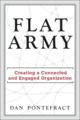
Take for example my first book, FLAT ARMY: Creating a Connected and Engaged Organization, written in 2012 and published in 2013 by Wiley.
Whilst I remain proud of the book — and my thanks to those who have bought it, and provided positive feedback to me directly — in hindsight there are certain elements I would subtract and add now that I can look back on it, two years since I finished the writing. It’s still a good book, in my eyes at least, but there are many elements I’d now change.
Take for example Benefit Corporations (more commonly known as B Corps) and how this sort of structure and ethos could aid many of the ills found within for-profit corporations today, specifically with respect to employee engagement. FLAT ARMY aims to help organizations build a more connected and engaged organization, and the example of B Corps, sadly, is missing from the book. I define employee engagement as;
"The state at which there is reciprocal trust between the employee and leadership to do what’s right however, whenever and with whomever."
This seems to run through the heart of a B Corp.
What is a B Corp?
At its core, a B Corp is an incorporated company that intends to make a profit. That’s not really a surprise. It’s no different to what you’re used to in today’s for-profit organizations. There is a great divergence, however, from today’s profit hungry organizations and that of a B Corp. Benefit Corporations seek to take into account the welfares (and bottom line interests) of stakeholders that include the communities in which they serve, employees, environment, customers, products/services and its shareholders. A registered B Corp (adjudicated by the Certified B Corporation organization) must be "certified by the nonprofit B Lab to meet rigorous standards of social and environmental performance, accountability, and transparency" in order to achieve their accreditation and good standing.
As you might denote, B Corps are structured much differently than a traditional for-profit corporation. There is still a hierarchy — an executive team runs the company in addition to (if applicable) an elected board of directors to oversee governance and so on — but the measurement of success is vastly different. Whereas a traditional for-profit company is (usually) judged solely on its financial performance — with shareholder return being the de rigour metric of the past 30 years — a B Corp judges both financial and qualitative metrics as a basis for its success.
It DOES NOT solely measure success by financial targets.
Take for example Vermont-based King Arthur Flour. They state the following on their website: "Being a good steward of our community and our environment, treating our employees and our business partners with respect, and remaining steadfast in our commitment to quality has been King Arthur Flour’s recipe for success for more than 220 years." They back this statement up in many ways, not the least of which is their publicly available annual report. Aside from their community and environmental targets that were achieved, the company reports the following on their compensation practices:
King Arthur Flour believes in paying at or better than a livable wage. We currently pay all regular employees at least 14% above livable wage.
Profit sharing is paid when the company achieves certain financial targets. All eligible employees draw from a pool amount according to a formula set by the Board of Directors each fiscal year.
An Employee Stock Ownership Plan (ESOP) is an important part of total compensation for King Arthur Flour employees. The ESOP helps tie us together as one company, making it clear that we succeed by succeeding together. The amount in each employee’s account increases based on company contributions, our stock price growth and person’s tenure at King Arthur Flour.
Could it be this good? Could B Corps have established an operating model that might curb employee disengagement while continuing to meet financial goals … all the while doing good in the community and for the environment, while not losing sight of the customer?
I reviewed the websites of many registered B Corps (there are over 1000 at the time of this writing) including the likes of Schoolzilla, Ben & Jerry’s, Etsy, and Canada’s own Bullfrog Power and by the time I got through them all, I was grinning ear to ear.
What’s the Problem?
The good news is a B Corp refuses to focus its sole identity and operating mantra on the shareholder. Thus, the "world’s dumbest idea" — maximizing shareholder return — gets equal billing to the employee, community, customer and environment in the running of a B Corp.
But how did we get to a place where those for-profit organizations became myopically fixated on maximizing shareholder return, and seemingly scoffed at the other stakeholders such as community, employees, customers and the environment? Roger Martin, Academic Director of the Martin Prosperity Institute at the Rotman School of Management, informed us in Harvard Business Review that, "After Michael C. Jensen and William H. Meckling published "Theory of the Firm: Managerial Behavior, Agency Costs and Ownership Structure" in the Journal of Financial Economics in 1976, "maximizing shareholder value" became the new corporate mantra." Arguably, Jensen and Meckling were building off of Milton Friedman’s 1970 essay in The New York Times Magazine entitled "The Social Responsibility of Business is to Increase its Profits", where he stated, "there is one and only one social responsibility of business-to use it resources and engage in activities designed to increase its profits so long as it stays within the rules of the game, which is to say, engages in open and free competition without deception or fraud."
B Corps weren’t defined prior to 1976, but it’s fair to suggest many organizations were unknowingly being run as a B Corp, before the advent of "maximizing shareholder value." Once CEO’s and Management Boards clued in to this magnetic vortex of financial gains (both personally and organizationally), it became the way a company was managed.
There have been many opponents to the adage, "maximizing shareholder value" backing up Roger Martin’s thesis in his classic book, "Fixing the Game". Rick Wartzman, executive director of the Drucker Institute at Claremont Graduate University, for example, wisely stated at Time, "Building a company to be sustainable, and assessing its progress toward that end, is complicated; "maximizing shareholder value" is, by contrast, seductive in its simplicity." The B Corp concept is not easy — after all, there are five different stakeholders to manage — but the draw of financial gains is indeed seductive if that’s what everyone else is doing. It’s a new albeit uglier form of "keeping up with the Joneses".
Steve Denning, author of The Leader’s Guide to Radical Management: Reinventing the Workplace writes at Forbes, "CEOs and their top managers have massive incentives to focus most of their attentions on the expectations market, rather than the real job of running the company producing real products and services." Steve has long been an opponent of "maximizing shareholder value" and his recent example highlighting IBM cuts sublimely to the core of the matter:
"As revenues fall, IBM’s higher earnings targets are met through relentless cost cutting, tax reduction gadgets and share buybacks funded by borrowing. While IBM’s share price soars, as the top managers and big investors extract cash from it in a weird kind of reverse-Ponzi-scheme, IBM steadily becomes an increasingly unproductive shell, a mere shadow of its once truly-innovative self. As a triumph of financial engineering, IBM "makes money from money," while its future is being systematically destroyed. How many more of such disasters will we have to witness before the shareholder primacy idea finally dies?"
Over the course of an interview with the Financial Times in 2009, former General Electric CEO, Jack Welch even said, "On the face of it, shareholder value is the dumbest idea in the world. Shareholder value is a result, not a strategy … your main constituencies are your employees, your customers and your products. The idea that shareholder value is a strategy is insane. It is the product of your combined efforts - from the management to the employees". Unbeknownst to Jack, he may have been setting us up for the introduction of B Corps, although at least in this interview, he neglected the tenets of community and the environment.
What Have Been Consequences on the Worker?
The top 100 compensated CEO’s in America pulled in a hair short of $3 billion in 2012. Larry Ellison Jr., CEO of Oracle Corporation, topped the list with $96,160,696 in earnings. Number 100 was Alexander Smith, CEO of Pier 1 Imports Incorporated who took home $18,755,923 in total compensation. For comparison sake, according to the United States Social Security Administration, the median wage in the U.S. in 2012 was $27,519.10, which is up ever so slightly from 2011′s median wage of $26,965.43. When adjusted for inflation, however, the median wage remains virtually unchanged since 1998 where it stood at $27,519.55 when adjusted for inflation. Americans actually earned less in 2012 than in 1998.
Do you think the top 100 CEO’s in America were compensated $3 billion by way of a bi-weekly paycheque, or perhaps you would agree the bulk of that wealth came in the form of stock options and restricted stock units, by way of increasing shareholder value over time? If you’re an employee of the organization, without the financial means or performance output to partake in said shareholder wealth, how might you be feeling if your senior leaders are becoming über rich, and your total personal compensation is actually trending downward? And we wonder why — in part at least — employee engagement levels remain woefully anemic, according to Gallup, AON Hewitt or BlessingWhite.
In Canada, and according to the Canadian Centre for Policy Alternatives (CCPA), it’s no different from the data points I outlined above regarding America. Based on 2012 compensation levels, Canadian CEO’s earn on average close to $8 million per year totalling roughly 171 times the average take-home pay of Canadians. Since 1998 that figure is up 105 times the average wage. Canadian workers average $46,634 in compensation, only $7.95 million shy of the CEO average in Canada. Notice any correlation to maximizing shareholder value?
According to the non-partisan Economic Policy Institute, between the years 1978 and 2011, CEO pay in America increased by more than 725 percent. Paradoxically, the Federal Reserve Bank of St. Louis reported that worker productivity actually increased by 93 percent over the same time period. But this is where things seriously go askew. What has a regular worker’s pay gone up by over that same time period? Would you be surprised to know that the wages of common workers have increased by … wait for it … only 5.7 percent. There seems to be quite a gap between pay and productivity. Add to this the irrefutable fact global levels of employee engagement have not significantly increased since firms started measuring the metric in the late 1990’s, and you have yourself a recipe for disengaged organizations.
B Corps to the Rescue
If America had some form of B Corp knighthood, I’d be the first to recommend Arthur T. Demoulas to be knighted. Market Basket is a supermarket chain of 71 stores in Massachusetts and New Hampshire, with new ones about to launch soon in Maine. The company employs over 25,000 workers. I might add Market Basket is run like a B Corp, where employees receive better pay (than its competitors), customers enjoy lower prices (than its competitors), a focus on community and the environment is a fixture … and it’s all accomplished by paying shareholders smaller dividends (than its competitors).
Imagine that.
When Arthur T. (the company’s fearless leader) decided in 2013 to offer his customers an additional 4 percent discount — suggesting his customers could probably use the money more than the company’s shareholders — a coup d’état was put in motion, and Arthur T. was ousted as its top leader. Even after volumes of sales increased, and its low employee turnover became even lower, Arthur T. was sent to the grocery sidelines. Interestingly, factions of his own family ousted him. (That ought to be a difficult Christmas this coming December)
But then a Hollywood script broke out. The workers — you know, the ones who were being treated so well under Arthur T’s leadership — exerted their ‘purpose before profit’ company ethos, and walked out. Over a six-week period, the Market Basket employees stuck up for their fearless leader, and over negotiations, lawyers and I imagine a few bottles of Scotch, Arthur T. Demoulas announced he had reached a settlement with his shareholder value fixated family members, and bought back the company for $1.6-billion, assuming operations and leadership of the chain again. Once news reached the employees, I imagine backflips and cartwheels were performed in parking lots across the two states where they currently have stores.
It’s but one example, however Market Basket serves us with a few lessons.
Most importantly, employees want to feel that they’re a part of something. Fair compensation is one thing, but for an employee to truly be engaged, they want the company that they work for to be a true corporate citizen that pays equal attention to the five tenets of a B Corp. As Market Basket informs us, sometimes those investments in customers, employees, environment and community come as a result of lowering shareholder value, not maximizing it. Take that Jensen, Meckling and Friedman.
It’s also a concept I’m extremely familiar with at the very place I work, TELUS, a telecommunications company. Since 2000, for example, TELUS and its 44,000+ team members have donated over $350 million to the communities it serves and we have volunteered more than 5.4 million hours of our own time. The environment is a key tenet as well. By way of our revolutionary Work Styles program, in 2013 we reduced our carbon (CO2) footprint by 4,365,000 kilograms. Our team members are flourishing, making Martin Seligman proud I’m certain. Between 2007 and 2013, our employee engagement levels rose from 53% to 83%, with AON Hewitt informing us that, "The TELUS engagement score is #1 globally amongst organizations of its size and composition." Add in our commitment to the Customers First program while — still, one might argue — becoming the global leader amongst all telecom service providers since 2000 with a total shareholder return of 286 per cent, outpacing the number two incumbent by 110 percentage points. Technically, TELUS isn’t a certified B Corp, but one might argue it really is a B Corp, one that happens to also post $11.4 billion in annual revenues.
Imagine that.
In summary, if Wiley ever asks me to write a second edition of FLAT ARMY, you can be assured B Corps become an entire section, if not a new chapter to the book. Maximizing shareholder return is not sustainable, nor is it the way in which a corporation should be run. B Corps, however, just might provide a little levity if not innovation to curbing this financial only fallacy of shareholder return myopia once and for all.
PS. If you’re a visual and audible learner, Jay Coen Gilbert delivers a superb TEDx Talk entitled "On Better Business" that details the nuances of B Corps.
Note: cross-posted to Huffington Post.
Dan's Related Posts:My Hopes for the Drucker Forum #gpdf14The Collateral Damage of Selfish LeadershipCan Humanism Replace Capitalism?The Great Transformation of the Organization Still Needs the HowTry Implementing Flexible Work Options to Increase Employee Engagement
Dan Pontefract
.
Blog
.
<span class='date ' tip=''><i class='icon-time'></i> Jul 14, 2015 10:24am</span>
|
|
Feedback is the oil in the engine of teamwork: keep it flowing and the engine can operate at a high level with no damage, let it dry up and your engine could seize up or fail completely, potentially beyond repair.
Patty McManus
.
Blog
.
<span class='date ' tip=''><i class='icon-time'></i> Jul 14, 2015 10:24am</span>
|
|
Here’s a 20-minute talk of mine, delivered at the SAP Sapphire Now conference in Orlando, Florida in June, 2014 where I discuss the Flat Army model, interspersed with metaphors and stories.
Dan's Related Posts:Flat Army CSTD Keynote as ArtFlat Army Book Trailer (one minute)Great Work Interview - Flat Army & Michael Bungay StanierThe Simple Act of TrustingIF
Dan Pontefract
.
Blog
.
<span class='date ' tip=''><i class='icon-time'></i> Jul 14, 2015 10:24am</span>
|
|
"I have not failed. I have merely found ten thousand ways that won’t work." ~ Thomas Edison
Patty McManus
.
Blog
.
<span class='date ' tip=''><i class='icon-time'></i> Jul 14, 2015 10:24am</span>
|
|
At Apple’s most recent product launch in Cupertino — where Apple Watch, Apple Pay and iPhone 6 (oh, and iPhone 6 Gigantic) were flaunted about like the Halloween parade I took part in at my elementary school every October as a child — a wonderful culture moment took place on stage.
No it wasn’t what the Internet is referring to as Apple Scarf Guy. (Although according to Zara, male scarves are now sold out, literally, across the planet.)
And no, it wasn’t those three Irish lads from Dublin (and an Englishman) showing up on that same stage (clad in leather looking like a biker gang from Holland) singing something about Joey Ramone. They even managed to give away their new album free via iTunes to over 17 billion people. (I may have rounded up.)
That did give me an idea to give away my next book — for free — via Amazon. After checking in with Amazon though, they informed me I’d have to wear leather pants and a scarf for a year, so that’s out, for now.
The culture moment I’m referring to involves Tim Cook, Apple CEO.
For fashionistas out there, I’m sorry to disappoint, but it has nothing to do with Tim’s decision to un-tuck his shirt either. I must admit, I wondered to myself if ex- Burberry CEO Angel Ahrendts — now Apple’s lead on all things retail and online stores — might have whispered into his ear just before show time,
"Tim, un-tuck that shirt or I’m jumping ship to
JC Penney or Target or Sears or any other retailer that is imploding."
No, Tim’s culture moment was simple yet profound.
He recognized his team in a public forum.
You probably will stop reading now. After all, what does employee recognition have to do with culture let alone knowing when the next full moonrise is about to occur? (Oh the pending charm of Apple Watch)
Once the three product launches concluded on stage, Tim paused ever so slightly, and what seemed unscripted (at least I hope it was unscripted) he asked all Apple employees present in the auditorium to rise up from their seats.
With a round of applause initiated by Tim, he thanked everyone for their hard work, their creativity and their commitment to the launch and everything leading up to the day.
This is one of the most important traits a leader — let alone the CEO of the world’s most famous fruit company — can demonstrate and act upon. Failing to recognize your employees is akin to eating sushi without soy sauce and chopsticks. When Tim took a brief moment to say thanks in front of that auditorium — and in front of the 23.4 billion people tuned into the live stream — he said to me, "My leadership style is inclusive, timely and one that supports recognition of the employee. The culture at Apple is becoming one that is open."
After a dizzying display of jumps and high kicks by U2 front-man Bono concluded (wait, wrong decade - it’s not 1985) and the somewhat awkward announcement of a free U2 album, Tim stood alone in my mind. I’ve been publicly critical of Steve Jobs in the past, regarding his alleged and documented bouts of bullying and various "leader of people" malpractices at Apple.
When Mr. Cook decided to publicly recognize the Apple team and their performance — when he demonstrated his moment of open culture — he became more than a CEO.
He became a Chief Engagement Officer too.
(And for what it’s worth, I really like the song ‘Every Breaking Heart’ from the free U2 album. Don’t judge.)
Note: originally aired at Huffington Post
Dan's Related Posts:Here’s to the Crazy OnesIn Honour of Ada LovelaceLessons in Leadership From Jim Balsillie and Mike LazaridisAir Canada Isn’t Collaborating With Its EmployeesThat Decision Is Above My Pay-Grade
Dan Pontefract
.
Blog
.
<span class='date ' tip=''><i class='icon-time'></i> Jul 14, 2015 10:24am</span>
|
|
If you're interested in developing your capacity to listen, here's an exercise you can try. Find a news or call-in program on the radio or on television with commentators who hold completely different opinions than you do, and draw upon a belief system that you disagree with.
Patty McManus
.
Blog
.
<span class='date ' tip=''><i class='icon-time'></i> Jul 14, 2015 10:24am</span>
|