Blogs
|
Depending on the scope and topic of a keynote address I deliver, there is a point in the talk where I might tell the story about our three young goats, and why Denise and I are coaching them to publicly blog.
I even wrote a post about it entitled, "Our Three Young Children Blog … Here’s Why".
An article by Kathryn L. Mills entitled "Effects of Internet use on the adolescent brain: despite popular claims, experimental evidence remains scarce" to be published in the forthcoming edition of Science and Society suggests the fear is pure blatherskite. (malarkey, if you prefer)
Mills states:
Current evidence suggests that typical Internet activities do not impair social development during adolescence.
That sums it up nicely in fact.
The article cites fifteen different studies — from changes to the brain, cognition, sedentary concerns and relationship to musical-training — but more importantly she researched and analyzed 134 published studies on adolescent brains and moderate or typical Internet use. Her findings effectively debunks what is mostly prevalent in society today.
That is, parents, educators, and adults alike believe the internet is one big distraction and is affecting brain development.
This thing called the world wide web is negatively affecting the brains of our up and coming generation. (well, that’s what we adults think)
Indeed, in their How Teens Do Research in the Digital World report, where 2,462 middle and high school teachers currently teaching in the U.S., Puerto Rico and the U.S. Virgin Islands provided insights and opinions, Pew Research stated:
87% of teachers indicated the internet was creating an "easily distracted generation with short attention spans"
64% say today’s digital technologies "do more to distract students than to help them academically"
Whether these teachers are followers of Oxford University neuroscientist Susan Greenfield remains unknown. Baroness Greenfield is one of the leading opponents to increased screen time for adolescents. She has coined the term, "Mind Change" — paying homage to a different calamity, climate change, perhaps — indicating the internet isn’t exactly bringing the best out in us, adolescents included.
As Professor of Synaptic Pharmacology at Oxford University, Susan leads a team investigating the physical basis of the mind and its implications for our understanding of human behaviour, work and society. I’m sure she knows a thing or two, but Mills’ exhaustive research and provocative debunking is at the very least important to understand.
Mills — a PhD student at the Institute of Cognitive Neuroscience, University College London — concludes her piece with the following:
In the 25 years since the World Wide Web was invented, our way of interacting with each other and our collective history has changed. There is currently no evidence to suggest that Internet use has or has not had a profound effect on brain development.
People have openly questioned me after a keynote, asking why we’d ever let a kindergarten child write a blog and interact online.
As educators (and as parents) we believe the internet is as important an asset as the physical dictionary, encyclopedia and reference books were when we were growing up. Those were our examples of screen time when we were adolescents in the 70’s and 80’s.
We mandate proper screen time allotment, which often is overlooked by the naysayers. Our children play, create art, build with Keva Planks, participate in sport and music, and perform in plays and operas.
Our job as educators (and parents) is to teach digital citizenship. Screen time may in fact change their brain, but we’d rather be in front of that opportunity, coaching and mentoring along the way such that they understand responsible use and proper etiquette.
After all, it’s not as though the internet is going away anytime soon.
Dan's Related Posts:Our Three Young Children Blog … Here’s WhyLet’s N-Screen the ClassroomIn Honour of Ada LovelaceCan Leaders Lead From the Side?The TED of all Learning Conferences #LWF12
Dan Pontefract
.
Blog
.
<span class='date ' tip=''><i class='icon-time'></i> Jul 14, 2015 10:28am</span>
|
|
Facilitative Leaders excel at collaborating with others to reach sound decisions. But online meetings present a unique challenge: how to tell when agreement is reached? With in-person meetings, you probably instinctively look around the room and note body language.
Patty McManus
.
Blog
.
<span class='date ' tip=''><i class='icon-time'></i> Jul 14, 2015 10:28am</span>
|
|
I’ve always been an admirer of cetaceans. They are, quite possibly, my favourite parts of nature.
The problem I have, however, rests not with the cetaceans but with the humans who capture them for entertainment purposes.
I had another revelation. Perhaps there is a metaphorical link between the captured and caged cetaceans and employees in an organization who aren’t listened to, or asked for their opinion … on anything. It’s a metaphor linked to culture.
I proceeded to have a Twitter conversation with myself. Here’s what I tweeted:
Cetaceans confined to an aquarium is akin to the millions of employees unable to contribute their ideas for an organization’s well-being.
— Dan Pontefract (@dpontefract) May 27, 2014
Cetaceans confined to an aquarium is akin to the millions of employees unable to contribute their ideas for an organization’s well-being.
— Dan Pontefract (@dpontefract) May 27, 2014
Free the whales. Listen to your people.
— Dan Pontefract (@dpontefract) May 27, 2014
Culture can’t be manufactured within glass walls. You can’t buy it at a gift shop. The pod swims the ocean together creating harmony as one.
— Dan Pontefract (@dpontefract) May 27, 2014
SeaWorld? How about SeeWorld. Reality bites.
— Dan Pontefract (@dpontefract) May 27, 2014
No one ever asked Ms. Nootka. No one ever said, "Hey Tilikum, what do you think?" Caged cetaceans … a metaphor to consider.
— Dan Pontefract (@dpontefract) May 27, 2014
I’ll come back to this metaphor. So far, it’s shifting toward a new form of laminar flow.
Dan's Related Posts:My PurposeFlat Army Graphics on SlideshareFlat Army CSTD Keynote as ArtRethinking Approaches to Corporate LearningThe ABC’s of Collaboration
Dan Pontefract
.
Blog
.
<span class='date ' tip=''><i class='icon-time'></i> Jul 14, 2015 10:28am</span>
|
|
Two conversations this week with leaders from large companies reminded me again about the value of context in meeting business challenges, and how social entrepreneurs address challenges with context front and center.
Patty McManus
.
Blog
.
<span class='date ' tip=''><i class='icon-time'></i> Jul 14, 2015 10:28am</span>
|
|
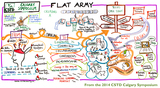
I had the chance to deliver the CSTD Symposium keynote in Calgary, Alberta on June 5, 2014. Hopefully audience members came away with a nugget or two of inspiration or ideas for change.
I can safely report no tomatoes were launched on stage.
The inimitable Corrie Melanson of seemeaning.ca captured the talk as a graphic.
Correction: it really is art.
Thanks Corrie for a fab piece of work. Thanks Team CSTD for the chance to speak, and for hiring Corrie to capture my talk.
Dan's Related Posts:When Euan and Dan Keynote Together at #HRtecheuropeA 20-minute Talk About Collaborative LeadershipInternet Activities Do NOT Affect Adolescence DevelopmentReflecting on Potential Workplace TrendsGive Piece a Chance
Dan Pontefract
.
Blog
.
<span class='date ' tip=''><i class='icon-time'></i> Jul 14, 2015 10:28am</span>
|
|
"Can you develop and lead a global expedition for our high potential leaders to study water scarcity and develop leadership capacity?" the head of corporate social responsibility of a large hotel asked me this week. And then she added, "We want to invite hotel guests, too."
Patty McManus
.
Blog
.
<span class='date ' tip=''><i class='icon-time'></i> Jul 14, 2015 10:28am</span>
|
|
To understand something fundamental about innovation, you could start by helping me get my teenage daughter to clean her room. Her room is a serious mess, and I’m out of ideas. Her mother and I avoid eye contact with her doorway when we walk the hallway towards our bedroom.
Patty McManus
.
Blog
.
<span class='date ' tip=''><i class='icon-time'></i> Jul 14, 2015 10:27am</span>
|
|
Americans can rest a little easier today, reassured that people with genuine differences of opinion can find it in their hearts to compromise rather than allow their constituents to suffer from a dangerous game of brinksmanship. I’m referring, of course, to the resolution of the NFL lock-out.
Patty McManus
.
Blog
.
<span class='date ' tip=''><i class='icon-time'></i> Jul 14, 2015 10:27am</span>
|
|
This time of year, a lot of my conversations with friends, colleagues, and clients began with the question: "How was your vacation?" Typically, I hear a wistful recounting of highlights, followed by comments about the shock of re-entry into the daily routine.
Patty McManus
.
Blog
.
<span class='date ' tip=''><i class='icon-time'></i> Jul 14, 2015 10:27am</span>
|
|
It’s only a 30-second commercial, but it rubs me entirely the wrong way.
I suspect the advertising agency for Volkswagen wasn’t thinking about the backwards way in which they depicted the workplace (or life) throughout the commercial, but the evidence is as clear as day to me.
I have a few observations:
Dad is stuck at work, whereas Mom is gleefully sitting in at the auditorium, watching her son’s violin recital.
Does this suggest Mom doesn’t work? Or does she simply have a more lenient employer? Did she have to take a day off to watch?
There is an empty seat to the left of Mom.
Does this imply Dad was supposed to attend but couldn’t? If he couldn’t, what were the reasons? "Emergency" meeting? Did he forget about the recital? Did his boss say "no" when he asked that morning?
Dad excused himself from the meeting to listen to the recital via the Passat mobile phone sound system, but he didn’t attend in person.
Will there ever be another moment like the one where he missed his son’s recital? What type of employer is he working for that doesn’t permit him to excuse himself for a short period of time? How will it affect the son, over time?
Yes, there are rebuttals to each of my questions.
Mom is a teacher at the school. Dad is away on business, in another city. There are other men in the auditorium. He did ‘hear’ the performance, Dan.
That being stated, the commercial rubs me entirely the wrong way.
It’s Dad who’s at work.
It’s Mom who is watching the performance.
It’s Dad who can’t get away from the office.
It’s Mom who is holding up a phone so Dad can partake.
It’s Dad who works for an organization that clearly doesn’t demonstrate life-work flexibility.
It sends a message, a signal, a doctrine that is tiresome, over-played and rooted in history.
Our workplaces can do better.
Our lives can be lived better.
That father should have been at the recital.
Our workplaces need to become more humane.
Dan's Related Posts:Employee Access to Social Media in the Workplace DecreasesHere’s to the Crazy OnesYa, I Cry at Work. Do You?Five Essential Tips to Effectively Work from HomeAlarming Trends in CIPD Employee Outlook Survey
Dan Pontefract
.
Blog
.
<span class='date ' tip=''><i class='icon-time'></i> Jul 14, 2015 10:27am</span>
|