Blogs
|
I thought I’d make use of the Jetpack statistics function that comes with my WordPress installation of this site to determine what terms people entered into a search engine over the past year that brought them directly to danpontefract.com
First of all, I suppose I should thank Mark Zuckerberg for coming up with the term ‘facebook‘.
Wow.
Second of all, I suppose I should have written a book about ‘facebook‘ and called it "Flat Facebook: How To Get More Hits To Your Website".
Seriously.
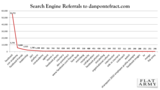
The graphic below illustrates the top 30 terms used in various search engines like Duck Duck Go, Yahoo! (do they still use the exclamation mark?), Bing … oh, and something called Google.
Click to enlarge.
The total number of search engine referrals is 136,003. If I look at the entire list (you can too by viewing this PDF file) I reckon 40% of the searches have some version of the term ‘facebook‘ as an entry point into this site.
40%!!!
So, be forewarned … for the rest of 2013, every post will now have the term "facebook" in it and not "Flat Army".
Note this isn’t the total number of visits to the site, simply the entry point from a search engine search term. I’ve got a brother and a sister that must visit this site roughly 500 times/day each to find out what the heck I’m doing in my life and to help pad the overall visitor stats.
2,576 total views, 53 views today
Dan's Related Posts:Should Companies Allow Facebook at Work?Is Facebook a Narcissistic Walled Garden?The 10 Winners of Flat Army Copies Are …Pervasive Learning Graphic from Flat ArmyI Unfriended You On Facebook. Are We Still Friends?
Dan Pontefract
.
Blog
.
<span class='date ' tip=''><i class='icon-time'></i> Jul 14, 2015 10:59am</span>
|
|
Sometimes you don’t want to turn the page. It’s typical in eLearning projects to assemble the module as a series of slides, and many times you can get all of the information that you want in a single slide, but sometimes, you want to provide optional information or include an opportunity for a simple, custom […]
Pooja Jaisingh
.
Blog
.
<span class='date ' tip=''><i class='icon-time'></i> Jul 14, 2015 10:59am</span>
|
|
If you’ve read Flat Army, you know there are five key models that make up a Flat Army leader and a Flat Army organization. If you haven’t read it … well, how can I sway you to remedy that?
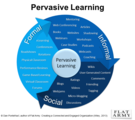
One of those models is something I call "Pervasive Learning".
You can watch a short video (2 1/2 minutes) about me describing what is in the chapter that utilizes the term Pervasive Learning (the chapter is called Learning at the Speed of Need) … and, now, you can download the Pervasive Learning graphic if you so desire.
3,296 total views, 29 views today
Dan's Related Posts:Flat Army: Chapter 9 OverviewConnected Leader Attributes Graphic from Flat Armythe FLAT ARMY cheat sheetDownload Chapter 1 for Free - Flat Army: Creating a Connected and Engaged…Flat Army: Chapter 6 Overview
Dan Pontefract
.
Blog
.
<span class='date ' tip=''><i class='icon-time'></i> Jul 14, 2015 10:58am</span>
|
|
Adding closed captions to your eLearning courses is a basic requirement to meet accessibility standards like Section 508 and Web Content Accessibility Guidelines 2.0. You can easily do so for your audio-based courses by adding narration to your screen, adding slide notes, and then converting those slide notes to closed captions. But a little known […]
Pooja Jaisingh
.
Blog
.
<span class='date ' tip=''><i class='icon-time'></i> Jul 14, 2015 10:58am</span>
|
|
"Who can think without horror of what another widespread war would mean, waged as it would be with all the new weapons of mass destruction."
Archbishop of Canterbury Cosmo Gordon Lang, December, 1937 London Times newspaper
The aforementioned line is recognized as the first known use of the term ‘weapons of mass destruction’. But today, in 2013, I want to discuss a new weapon — a weapon of class destruction — and that weapon is social.
Let’s first define what I mean by ‘class’.
I’d like the term class in my social as a weapon of class destruction thesis to denote two things for purposes of this piece:
societal & organizational status
the physical place we go to learn
In society (and in our organizations) there remains both a visible and at times invisible ranking system of class. In society in general, we judge those with more money and with less money. We analyze people’s socioeconomic status including where they live, what type of work they perform, and even their title at work itself. Sociologists define the theory ‘social stratification’ as Peter Saunders does in his 1990 book, "Social Class and Stratification".
Harold Jarche recently wrote "The Social Imperative" where he states:
"Better social relationships (non-hierarchical and not based on dominance of others) can make for healthier populations. In addition, they are the only way our collective intelligence can adapt to increasing complexity. Becoming more social is not just a new business driver but also a societal imperative."
Social as a weapon of class destruction can help us not only demystify the social stratification that manifests in society, it can assist and perhaps mitigate a culture of fear that rests in many organizations today. This culture of fear is often as a result of hierarchical systems (a hierarchy for the sake of hierarchy) and managers who breed fear as opposed to disrupting the system and encouraging openness, collaboration and, well … being social.
By being social (both the in-person face-to-face kind and through the use of collaboration tools) we will find not only healthier populations but healthier organizations.
At SAS, they have "The Hub" and at TELUS (where I’m currently employed) we recently improved our existing social collaboration experience by launching "TeamHub". (I’ll write about this later) After four weeks, over 6,000 people are already on TeamHub (and specifically cloud-based Jam) utilizing the platform for connecting, collaborating, learning and sharing. In each case, using social as a weapon of class destruction actually unites the organization, whilst equally breaking down silos and ‘hierarchy for the sake of hierarchy.’
With this new weapon, we can break down the hierarchical status symbol in our organizations and introduce what Ronald Burt refers to as ‘near peers‘ "through whom opinion and behavior spreads through connections turn out to be network brokers". Social can break down the class structure into a network of knowledge and innovation brokers.
And if our new weapon is breaking down the hierarchy it might as well break down the belief that all learning must occur (or does occur) in a class(room).
It doesn’t.
Charles Jennings wants us to consider ‘experience rich continuous learning‘ where he says, "by supporting and encouraging learning within the workflow, and through and with others, a culture of continuous learning will evolve."
It can.
The use of social as a weapon to annihilate any class(room) based learning is missing the point and therefore misguided. That stated, when social is used as a weapon of class destruction we’re referring to those that believe learning only occurs in a class(room). We must compliment any class based learning opportunity with social, be it pre and/or post class learning with the use of social behaviours and of course social collaboration tools. For extra credit you will utilize social tools during the class event itself.
In summary, you may take umbrage with my use of the term social as a weapon. There probably isn’t a more friendlier term on the planet than social, so why am I turning it into a weapon?
I’ll tell you why.
Our organizations are still stuck with the ideology that those with fancier titles know more, can do more, and therefore get paid more to tell us what to do more. That’s why life happiness scores are flat and that’s why employee engagement levels remain unchanged (and at alarmingly low levels) for the past 15 years. It’s why Global Silicon Valley (GSV) Advisors predict global corporate classroom based learning expenditure will increase from $356b in 2012 to $524b in 2017; we’re stuck thinking class(room) based learning is the only (and perhaps best) way in which to learn.
That’s why we need social as a weapon of class destruction.
3,112 total views, 27 views today
Dan's Related Posts:Learning 2.0 is Dumb: Use ‘Connected Learning’ InsteadLearning by OsmosisThe Hierarchy of EducationMy Employee Engagement Advice to a StrangerApparently, Organizational Culture is Crap
Dan Pontefract
.
Blog
.
<span class='date ' tip=''><i class='icon-time'></i> Jul 14, 2015 10:58am</span>
|
|
There is this board game I played as a child called Stratego that taught me a thing or two about planning, competitive forces and winning.
The premise of Stratego, as Wikipedia tells us is "to find and capture the opponent’s Flag, or to capture so many enemy pieces that the opponent cannot make any further moves. Players cannot see the ranks of one another’s pieces, so disinformation and discovery are important facets to gameplay."
Each player gets 40 pieces to place and control on a 10×10 board. One of those pieces is the flag, while the others range in order and numbers. A number seven can take a number nine, a Spy can take a number one, and so on.
Oh, and there are bombs too. Those bombs go boom if you hit one.
At first blush we might argue that Jim Balsillie and Mike Lazaridis — former co-CEO’s of RIM / BlackBerry — were excellent Stratego players. They hid their flag well, and knew when to advance into enemy territory and strike either through new innovation or large enterprise contracts. The BlackBerry Enterprise Server system, for example, is second to none when it comes to security and systems management.
Then, over a period of time they got cocky. They left their flag in the open.
"Cameraphones will be rejected by corporate users." - Lazaridis, 2003.
It’s not as though they intentionally left their flag nakedly blowing in the wind to be captured at first, but they certainly weren’t playing Stratego like they used to.
On the threat from the iPhone:
"[Apple and the iPhone is] kind of one more entrant into an already very busy space with lots of choice for consumers … But in terms of a sort of a sea-change for BlackBerry, I would think that’s overstating it." - Balsillie, February 2007.
Over time — and as I have written about in Flat Army — they exposed their flag, retreated to their bunker, and served us a lesson in leadership.
From Flat Army:
What was the situation at RIM? It was an organization whose leadership and leadership behaviours were closed and unrepentant. There was no evidence of collaboration (or change in strategy) once the Apple iPhone arrived on the scene. Communication channels seemed to be non-existent between staff and senior management. The situation at RIM was one of ego, bravado and ruthless ignorance. The situation was a giant example of groupthink. To many, RIM seemed to morph from an innovative and flexible organization to one that was rigid, blind, egocentric and hierarchical. The situation at RIM was a lack of perception and many of its leaders were culpable. The situation has become a vortex with close minded behaviour at the root.
Yes, their Stratego game was now in retreat, left only with miners (#8), a single bomb (perhaps the break-up of the company) and the now penetrable and certainly disfigured flag.
"No other technology company other than Apple has successfully transitioned their platform. It’s almost never done, and it’s way harder than you realize. This transition is where tech companies go to die." Balsillie, April 2011.
You’ve got it right Jim (and Mike) on this one. No longer will RIM (sorry, BlackBerry - almost forgot about the shareholder approved name change) need to worry about playing Stratego with Apple or Google/Samsung. In fact, I’d say given BlackBerry’s recent decision to decide whether to break itself up or sell outright after a relaunch gone sideways, this has become a classic case study on actual leadership gone sideways.
If only Jim and Mike had rethought their Stratego moves, perhaps this could have been avoided.
Are You Happy Now Jim Balsillie and Mike Lazaridis?
I know the folks at Harvard Business School and Richard Ivey School of Business — who salivate at potential case studies like BlackBerry — are no doubt happy about the chance to depict the rise and fall not of another technology company but of leadership ignorantia.
Perhaps not all is lost. After all, if you have a spare $5.3 billion lying around, you too can buy and have access to the 5000+ patents in BlackBerry’s possession, plus their $2.8 billion in cash … and to boot, you get a mobile phone company that seems as relevant as adding glue to a Tinker Toys set. There is always Jeff Bezos though. After all, he did just buy a newspaper.
Boom!
<ironically, this was written on a BlackBerry Z10>
2,311 total views, 19 views today
Dan's Related Posts:My Employee Engagement Advice to a StrangerVirtual Worlds in an Organization are not a Time Waster (and other beefs)The Harmonic Leader: Stage 5 of 5 in the Leadership Tonic ScaleFor every fall there is a spring in our stepWHY I Wrote Flat Army: The Flat Army Golden Circle
Dan Pontefract
.
Blog
.
<span class='date ' tip=''><i class='icon-time'></i> Jul 14, 2015 10:58am</span>
|
|
A few days back, I started exploring a cool new tool named Expresso to create short videos to share my thoughts and ideas with my friends and colleagues. It’s a pretty simple tool to create videos to explain concepts and ideas with the help of out-of-the-box video assets and adding text/drawings on the fly. The […]
Pooja Jaisingh
.
Blog
.
<span class='date ' tip=''><i class='icon-time'></i> Jul 14, 2015 10:58am</span>
|
|
As I always say, form before function and behaviour before tool.
The Connected Leader Attributes model found within the book Flat Army describes fifteen key behaviours that are necessary for leaders (and the organization) to operate as a Flat Army.
Chapters 4, 5 and 6 in the book outline in full detail what the fifteen attributes are all about in addition to outlining the methods in which you can employ in your day-to-day work life. (Click to view a short video on Chapters 4, 5 or 6)
The tree is a metaphor; the roots are your foundation (when you are becoming a Connected Leader) whereas the trunk is when things get done (when you are being a Connected Leader) and you are a fully functioning Connected Leader when there is beautiful foliage beaming from the branches (when you are going beyond a Connected Leader).
You may click on the graphic below for a full-size version and download if you wish.
3,974 total views, 2 views today
Dan's Related Posts:Flat Army: Chapter 6 OverviewFlat Army: Chapter 5 Overviewthe FLAT ARMY cheat sheetFlat Army: Chapter 4 OverviewThe Fifteen Habits of a Connected Leader
Dan Pontefract
.
Blog
.
<span class='date ' tip=''><i class='icon-time'></i> Jul 14, 2015 10:58am</span>
|
|
This week I hosted Adobe Captivate Developer Anita Horsley in an eSeminar and was thrilled to learn a cool new tip. (Yup, even I didn’t realize that you could do this nifty little trick with your eLearning modules.) Permit me to set the stage. You are building your latest learning module in Adobe Captivate. You […]
Pooja Jaisingh
.
Blog
.
<span class='date ' tip=''><i class='icon-time'></i> Jul 14, 2015 10:58am</span>
|
|
From time to time — and now with an increasing frequency, like that of my biscuit cravings — people reach out to me for some advice over the ole email.
If I can, I’m happy to help.
It would be even better if they could find a way to hide the biscuits in my house.
One such plea for assistance arrived in the ole email this past week. Given the situation isn’t unique, I thought I’d share the problem as well as my answer (seems sensible, no?) in terms of a potential resolution. Of course, I’ve removed the names and other bits in order to ensure anonymity of my new friend.
Scenario
My question for you is, since I work for a <insert industry/organization type> which is very much rooted in old-school structure and organization, what is your advice for implementing some sort of formal innovation management structure? I know the terms seem contradictory, innovation and structure, but we currently have a "talk2ceo" email which is a direct line for suggestions to our CEO, but I think sometimes people are shy to speak up BECAUSE it is the CEO.
Also, when our CEO recently had a pre-budgeting meeting with all of our managers and asked for 3 out of the box ideas from each person, we didn’t get any mind-blowing suggestions. My thought is that either they couldn’t think of anything so they came up with small ideas to round out their expected "three ideas," OR these small ideas come up because people aren’t sure of the avenue for their ideas, or they fear that the idea is silly or will get lost in the shuffle. In addition, I think that the big ideas don’t come out because our employees are AFRAID that it will be too out-of-the-box.
dp’s Potential Solution
It sounds like you need one of two things:
1) An "idea jam" that is itemized by 3 levels: incremental change, evolutionary change and crazy out there change. If it’s framed appropriately employees will see the difference and provide feedback accordingly.
2) A private "idea jam" might also be useful. One that is open only by level or title, and then a handpicked crew sort through the suggestions and pare them down to implement. This allows employees anonymity with the entire org.
If your culture doesn’t yet support an open idea exchange, the two suggestions above can work well.
3,397 total views, 14 views today
Dan's Related Posts:Virtual Worlds in an Organization are not a Time Waster (and other beefs)The Harmonic Leader: Stage 5 of 5 in the Leadership Tonic ScaleAn Example of the Flat Army CLAM in Action: BC Ideas2ActionFuture Of Work: A Flat Army Of Open Leadership via A.G. LafleyLessons in Leadership From Jim Balsillie and Mike Lazaridis
Dan Pontefract
.
Blog
.
<span class='date ' tip=''><i class='icon-time'></i> Jul 14, 2015 10:58am</span>
|