Blogs
|
It’s true what they say … "when the cat’s away the mice will play."
When ‘Mom’ went out for dinner one night and the 10, 7 and 6 year-old’s suggested they wanted to interview ‘Dad’ on life as an author … it became a collaborative, open and fun project for all four of us.
Kinda how I envision any and all organizations and teams.
Enjoy.
2,154 total views, 6 views today
Dan's Related Posts:Would You Send Your 6-Year Old to an MBA Program?Flat Army Graphics on SlideshareIn 5 Minutes Louis C.K. Nailed Behavioural Malfunctions in a Connected WorldFlat Army: Chapter 2 OverviewFlat Army: Chapter 1 Overview
Dan Pontefract
.
Blog
.
<span class='date ' tip=''><i class='icon-time'></i> Jul 14, 2015 11:02am</span>
|
|
Topic: Go Mobile with Adobe Captivate 7.0.1 Description: The new update for Adobe Captivate 7 is loaded with enhancements to help you create stunning mobile learning courses using the HTML5 publish option. Join Suresh Jayaraman, Captivate Engineering Manager and Dr. Pooja Jaisingh, Adobe eLearning Evangelist, as they show you how to use the new mobile […]
Pooja Jaisingh
.
Blog
.
<span class='date ' tip=''><i class='icon-time'></i> Jul 14, 2015 11:02am</span>
|
|
Whether you are working to impress the boss or to share your favorite game tips with friends, virtually everyone is looking to YouTube videos to catch and create the latest trends. In the past, creating great videos has been a difficult proposition, it’s difficult to imagine how you can go from average video surfer to […]
Pooja Jaisingh
.
Blog
.
<span class='date ' tip=''><i class='icon-time'></i> Jul 14, 2015 11:00am</span>
|
|
I liken learning in an organization to osmosis.
At least I think it should be like osmosis.
The Oxford definition of osmosis can help us:
Biology & Chemistry a process by which molecules of a solvent tends to pass through a semipermeable membrane from a less concentrated solution into a more concentrated one.
The process of gradual or unconscious assimilation of ideas, knowledge, etc. (eg. by some strange political osmosis, private reputations became public)
Learning therefore is part art and science. It can be a scientific process methodically laid out (i.e. a formal event of some sort) and it can be a manifestation of colour, creativity and vibrancy (i.e. serendipitous discovery). Learning by osmosis permits employees the opportunity to allow new ideas and concepts to fill our gaps through any type of passage or membrane. It is as much conscious as it is unconscious. And most importantly, learning should be thought of as pervasive.
In my book, Flat Army: Creating a Connected and Engaged Organization (Wiley, 2013) I define ‘Pervasive Learning’ as:
learning at the speed of need through formal, informal and social learning modalities.
Confucius once said, "I hear and I forget. I see and I remember. I do and I understand." This sums up what Charles Jennings has established as part of his 70-20-10 Forum mission and it aligns ever so nicely to my definition of Pervasive Learning as well.
We — as workers in the organization — learn by doing not by rote memorization. Learning fills us up (like osmosis) as we perform our roles, our actions and our objectives. We complement our intelligence and acumen through daily interactions but we also do so through ‘self-directed’ and ‘undirected’ methods utilizing formal, informal and social means.
Deft leadership skill is not trapped or boxed in by the leader. Knowledge is not found solely on a Trivial Pursuit card. Similarly, learning isn’t held hostage by the formal classroom event or eLearning module. We must open our minds — think through the pervasive learning reality of both the art and the science — and once and for all recognize that learning happens directly and indirectly, formally and non-formally, experientially and sequentially whether with people or without.
Pervasive Learning should not be treated as a commodity rather as a way of being. You don’t go to training, you learn wherever, whenever and however in an organization. We all should employ this model in an attempt to build engaging teams and companies who want to learn and to drive business results.
"Sally, did you get your two weeks of training this year," asks Betty over lunch.
Sally responds, "No, I didn’t. I’m pretty sure my boss doesn’t care about my development or my career."
As citizens of the organization, we must see past the fool’s gold of a classroom-only training mindset. It does no one any good.
We should all believe (and demonstrate the ability to) learn at the speed of need. Pervasive Learning is the switch from a ‘training is an event’ fixed mindset to ‘learning is a collaborative, continuous, connected and community-based’ growth mindset. It is for everyone in the organization.
I liken it to moving from ‘sage on the stage’ to ‘guides & strides from all sides’. If osmosis can be thought of as both a science and an art, we must unlearn what we’ve learned and redefine the way in which we learn in our organizations. We must instil pervasive learning as our new mindset.
The 70-20-10 Forum sets out to help individuals, teams and organizations make the shift to such a learning paradigm. The Forum helps shift the learning mindset to become pervasive, an art and a science, and ultimately … like osmosis.
I’m all for it. Are you?
Originally published to the 70-20-10 Forum. I received no compensation for such an endorsement. It’s simply my true belief.
4,900 total views, 12 views today
Dan's Related Posts:Pervasive Learning Graphic from Flat ArmyLearning 2.0 is Dumb: Use ‘Connected Learning’ InsteadWhy You Must Define the So-What of Learningthe FLAT ARMY cheat sheetMy Employee Engagement Advice to a Stranger
Dan Pontefract
.
Blog
.
<span class='date ' tip=''><i class='icon-time'></i> Jul 14, 2015 11:00am</span>
|
|
Topic: The Coolest Adobe Captivate Tips on the Planet Description: Too many Adobe Captivate features are hidden and not well known. In this session, Joe Ganci, President at eLearning Joe, will show you many of the Captivate features you need to make the most of this powerful tool. Why is it important to know about […]
Pooja Jaisingh
.
Blog
.
<span class='date ' tip=''><i class='icon-time'></i> Jul 14, 2015 10:59am</span>
|
|
The one thing we can be assured of until humans safely land and colonize Mars is "organizational culture" will continue to be a topic of conversation. It’s about on par with the Leadership vs. Management debate — as John Kotter rehashed earlier in 2013 — but I’ll save my thoughts on that meme for another day.
Google returns over 22 million hits when you search the term "organizational culture". You can even read what Google has to say about its own culture. You may find it interesting to know, for example, that they "strive to maintain the open culture often associated with startups." Almost 10 years has passed since Google filed their S-1 IPO papers where they stated, "Don’t be evil. We believe strongly that in the long term, we will be better served — as shareholders and in all other ways — by a company that does good things for the world even if we forgo some short term gains." That sounds like a pretty good starting point of organizational culture to me.
But what really is organizational culture?
Cheryl Morris, a Director of Marketing at Nanigans introduced me to something on the HBR Blog site I had never heard of before: culture decks. In her piece entitled, "Why Executive Teams Shouldn’t Write Culture Decks" Cheryl tries to explain a culture deck — a series of slides that depicts your organization’s culture to the outside world — should not be created by an executive because "genuine culture is organic, not imposed" and "culture is not our mission statement or how our teams are structured."
It’s a tad naïve and somewhat myopic to start-up only mentality, but in essence what Cheryl is trying to state (I think) is executives might be out of touch with the ‘real’ culture of the organization and thus it should come from the actual people of the organization not outfitted with a fancy title or position. Although culture decks are cute, the real issue is why we believe the divide between employees and senior leadership is akin to "No Man’s Land" in the battlefields of World War I.
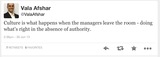
I then stumbled upon a tweet by Twitter quote machine Vala Afshar, Chief Customer Officer and CMO at Enterasys, which quite frankly surprised me:
It’s not that I disagree, per se, given levels of employee disengagement and disillusionment in our organizations of today. It’s that the tweet was written in the first place. Is this what organizational culture has come to? Have we taken liberties from Hugh MacLennan’s literary masterpiece and written "Two Solitudes for the Organization"?
I’m one of those practicing pundits / futurists that thinks (and practices) a fair bit about organizational culture.
I also wrote a book that delves a fair bit into this topic. In the Flat Army central thesis, organizational culture is defined by one criterion, and one only:
"An organization’s culture is defined by the manner in which employees are treated by their direct leader."
I go on further and write, "treat your people and your team members like a tool, a number or a subordinate, and you can merrily look forward to an organizational culture replete with apathy, disengagement and insubordination."
Put another way, if an organization’s culture is left to be defined (and actualized) by the employees when their leader isn’t in the room, you don’t have an organizational culture that is healthy, engaging or productive. In fact, you end up with factions and thus organizational culture camps. You end up with two solitudes. This is just as bad as a top-down enforced and/or rigid culture.
Cheryl and Vala aren’t wrong in their aforementioned assertions … but simply letting it continue as it has been for decades isn’t cool either.
Michael Watkins conducted a LinkedIn discussion earlier in 2013 entitled "What is organizational culture? How can we help newly-hired leaders learn about cultures and integrate more efficiently and effectively?" There were some fascinating and enlightening responses, not the least of which was Michael’s own observation that culture is "the organization’s immune system."
If there is an unhealthy and closed or extremely hierarchical culture, the immune system maintains its unhealthiness. The white blood cells are helpless. The employee (perhaps our white blood cells metaphor) might try to battle the bugs in the bloodstream but they will be unsuccessful in rooting out the existing malady. Put another way? The organization on the whole will remain disengaged or disenfranchised no matter what pharmaceutical medicine is applied. Thus, the organizational culture will remain laughable under the banner ads of "Two Solitudes".
Organizational cultures in need of shifting, improving and changing toward a more open and collaborative one doesn’t have to start at the top of the hierarchy. The change might very well commence from the employee base. But if an organization’s culture is defined (as is my thesis) by the manner in which employees are treated by their direct leader, it (the engaged and connected culture) must be upheld and continuously demonstrated by senior leadership across the organization so that:
all employees, regardless of rank, fully appreciate how important culture is to its success;
everyone can trust one another to do what’s right, backed by both the culture and leaders;
the entire organization can drive business results in a more open, inclusive and engaging manner. (yes, through its culture)
Organizational culture is not top down. Organizational culture isn’t bottom up either.
Organizational culture isn’t solely for employees and it certainly isn’t solely for leaders or managers.
If done effectively, organizational culture is one solitude not two. It happens together, harmoniously, built and honed by all and in hopes of participating in one singular working framework.
Anyone should be able to write the ‘culture deck’. And culture should happen both when the ‘manager’ is in the room and when she isn’t. Perhaps that’s where I inadvertently take umbrage with Vala and Cheryl.
We must break the divide between employees and senior leadership once and for all. We must deconstruct two solitudes into one. We must — as a singular organism and organization — become both the white and red blood cells as we harmoniously develop an improved immune system.
It’s not us against them.
It’s not employees versus management.
It’s not hierarchy washed away by anarchy or heterarchy.
It’s people working with people.
Period.
"If the washroom isn’t good enough for the people in charge, then it’s not good enough for the people in the store."
Lord Marcus Sieff (1913-2001), British president of Marks & Spencer
From A Passion for Excellence (Tom Peters and Mary Austin, 1985)
10,220 total views, 15 views today
Dan's Related Posts:The Connected CultureBill Sullivan, CEO of Agilent Technologies is a Chief Engagement OfficerWHY I Wrote Flat Army: The Flat Army Golden CircleSocial as a Weapon of Class DestructionGive Piece a Chance
Dan Pontefract
.
Blog
.
<span class='date ' tip=''><i class='icon-time'></i> Jul 14, 2015 10:59am</span>
|
|
Case Study: Transforming the classrooms with Adobe Presenter Description: Join Dr. Pooja Jaisingh, Adobe eLearning Evangelist, as she shares her experience on how the Government School teachers from Bangalore were able to transform their traditional classrooms to collaborative classrooms with the help of Adobe Presenter. She will also show you how the school teachers were […]
Pooja Jaisingh
.
Blog
.
<span class='date ' tip=''><i class='icon-time'></i> Jul 14, 2015 10:59am</span>
|
|
I’ve recently returned from 3 1/2 weeks away with the three ‘goats’ and Denise where we enjoyed the fine Puget Sound sea air of Gig Harbor. Ever since I can remember, Denise and I take 3 weeks of holiday in the summer usually coinciding with the last week of July and first two weeks of August. We might venture to Europe or parts of Canada … but this was our first time in the USA for three weeks straight and with the three goats.
We nearly FedEx’d the goats to Siberia half way through the trip, but that’s another story for another day.
I also have something to confess. I lied.
Not about anything from above, but with my ‘out of office‘ message.
If you received one from me, I mentioned in it that I was on my annual ‘acoustic and unplugged‘ summer tour.
I wasn’t unplugged at all. In retrospect, it was a lie. A bit like Google’s 20% time.
But there is a difference I’d like to share with you. Whilst I lied and was totally plugged in with my iPad and Blackberry Z10 (yes, I really like it - give them a break for crying out loud) fluidly connected to the interwebs … I was fully and completely detached from work, from email and from any of my current deliverables.
I may not have unplugged but I detached.
And the team at TELUS — where I currently work — were just fine while I detached.
While I was plugged in overlooking the beautiful waters of Puget Sound, I was doing a lot (I mean a lot) of reading for book #2. I was doing some writing as well, and as you know, I like to write in Evernote so being plugged in was somewhat handy at times. I even played a few online games.
And yes, we had fun with the goats as well. Do you know how many crabs there are to catch in those waters?
But whenever they find me or I seek them out, the statistics of people working during a holiday sends me to the infirmary. For example:
A Pertino Survey found 47% of Americans say relaxing on vacation means knowing they’re never more than a few clicks away from the office
Harris Interactive found 61% of employees planned to work while on holiday in 2013 up from 52% in 2012 and 46% in 2011
Robert Half Management found 64% of Canadian CFO’s they polled check in with work while vacationing
And this Vacation / Work-Life Balance (not) infographic depicting Americans and their vacation plans will surely send you to the nearest watering hole
While Baratunde Thurston may have "Left The Internet For 25 Days" — providing some compelling reasons why to unplug in his Fast Company piece — I’m advocating a different philosophy. In fact, research proves email ‘vacations’ — or detachment as I refer to it — can decrease stress and increase concentration.
You should detach while on holiday … not unplug.
You simply need the discipline to not do ‘work’ work while being plugged in. You need to detach yourself from work.
Think you can do it? Think you can detach and remain plugged in?
2,183 total views, 14 views today
Dan's Related Posts:A Summer of Anonymity is OverI’m Not Scared of Email; I Developed a System called DADDIOInterlocutors of 2012 (the goats are better for it)Our Three Young Children Blog … Here’s WhyAn Infographic Depicting Learning & Collaboration in Action
Dan Pontefract
.
Blog
.
<span class='date ' tip=''><i class='icon-time'></i> Jul 14, 2015 10:59am</span>
|
|
Topic: Designing Captivate-ing Games using JavaScript, Advanced Actions, and Variables Description: Did you know that you can create interactive games by using Adobe Captivate? Join Sreekanth Chakravarthy, Lead Learning Designer at IBM India, for an interesting session on how to create the classic Snakes and Ladders game by using JavaScript, custom effects and advanced actions […]
Pooja Jaisingh
.
Blog
.
<span class='date ' tip=''><i class='icon-time'></i> Jul 14, 2015 10:59am</span>
|
|
Back in the day, and by day I’m referring to PI (pre-Internet), the social employee was someone who knew how to network, to dialogue and to get things done without the aid of online systems or tools.
Remember Sally?
She knew everyone and anyone who she met in the elevator. In the cafeteria there wasn’t a day that went by where there wasn’t a throng of peers hovering around her, deep in conversation about company-related dialogue. She truly was a people person.
How about Darryl?
If you needed some form of company intelligence, insight into current practices or simply a name to get something you needed done, Darryl seemed to know everyone at the company. He was the connector, or as I like to say, the interlocutor. The more Darryls there were at the company, the more successful your company was.
These days, with the advent of collaboration platforms, remote work styles and the quest to define an external digital DNA at sites like LinkedIn, BranchOut or Quora, the social employee has taken on a diversified definition. And if he or she hasn’t, well, the word anachronistic comes to mind.
The default action of "social employees" can no longer simply be to network in a physical way. Sure, this will remain important; however, no matter who you are in the corporate hierarchy, everyone needs to augment the physical with the virtual. The social employees of today and tomorrow must take into consideration their abilities to actually be "social" when physical means may be dwindling.
Let’s look at a couple of examples.
Janice is a vice president of R&D at a company that has grown from 10,000 to 20,000 employees during the past three years. The company’s headquarters, where she works, has seen a population increase of 10 percent whereas the other eight employee sites are up anywhere from 20 percent to 135 percent. Even though she is the VP of R&D and is at company headquarters, it behooves Janice to increase her social employee credibility with those who may be working outside of headquarters. What knowledge, insight, experience or ideas might these virtual employees bring to her portfolio that she might not tap into if she defaulted to her normal face-to-face way in which to network? Janice cannot rest on the laurels of her jovial personality that people at headquarters might see on a daily basis to further her performance. She must consciously sort out how she is going to augment her social employee intelligence to not only help her own cause, but to demonstrate to the organization that as a VP, leadership styles can in fact change and that her "social employee" status is going to include all forms of digital relationship building.
Fu-Xing is a project leader. He gets rotated from project to project at the pharmaceutical company he works for. Typically, his projects have been made up of employees working at three of the local offices, but the next two projects he is slated for in Q3 and Q4 involve a much larger scope, team and geographical array of employees. In fact, one of the projects consists of two teams and a total of 30 employees whom he has never met face-to-face and who work in other time zones. Fu-Xing has always conducted his project meetings face-to-face and any follow-up has normally consisted of physical jaunts to the desk of team members. Fu-Xing, as a social employee, now has to incorporate into his project leader role other attributes such as discussion forums, online polls, Web conferencing, micro-blogging, team wikis and even blogging to help facilitate the goals of the team. He no longer can rest on the laurels of his previous project management and collaboration style.
The new social organization has an itch and that itch ought to be scratched as soon as possible. The employees of today and tomorrow (inclusive of leaders) must be aware of both their face-to-face and digital social employee intelligence.
The social employee is rising. Beware of the tide.
<originally posted to Chief Learning Officer>
3,569 total views, 8 views today
Dan's Related Posts:Flexible Working Works5 Use Cases for a Corporate YouTube in OrganizationsHas the Economic Meltdown & 9/11 Impacted our Definition of Teams?Five Uses for Virtual Worlds in the WorkplaceThe Social C-Suite
Dan Pontefract
.
Blog
.
<span class='date ' tip=''><i class='icon-time'></i> Jul 14, 2015 10:59am</span>
|