Blogs
|
In my career I’ve done a fair amount of traveling. Airplanes have become a place of solace for me, ironic as that may seem. Despite opportunities to be connected to the interwebs when 38,000 kilometers from terra nova, I prefer to use this oxygen deprived fuselage to both catch up and to (re)think. The introduction of the tablet has made it even easier. The number of times I’ve received glaring eyes from my seat companion for opening up a laptop are innumerable.
And bless you @pachikov for inventing Evernote. It’s my lifeline to rambling thoughts, pieces of information, things to remember, writing, photos and even a book. (more on the latter another day)
My reflections on air travel, however, lead me down a path of meandering musing.
Why don’t we tip flight attendants?
In roughly half the latté and tea shops I visit on this planet, there is either a tip jar or a tip line built into the credit card slip. When it’s the holiday season or end-of-school-year period, custom dictates a gift to be given to the teacher — a different type of tip — for teaching service provided. Restaurants — aside from several countries in Europe who build in a tip — pretty much mandate tips. It’s an expectation not a debate. And of course when was the last time you took a taxi in North America without tipping the driver?
So, why don’t we tip flight attendants?
Are they providing a service like the cashier, server, teacher or driver? What’s different? They seem to serve me drinks, food and other niceties on request. So do the others, right?
Is it the cost of the ticket? Perhaps. One has a potentially higher level of ‘free’ service expectation when forking over a wad of hard earned money to travel on an airline.
Is it history? Sure. If it’s never happened in the past, who really wants to start such a movement? (at least I don’t know of any airline tipping)
Is it role image? Does a flight attendant come across as more regal than the cashier, server, teacher or driver and as a consequence we paying customers hold them to a higher remuneration standard? "Flight attendants make oodles of money," we might say. "They don’t need any tips. Look at where they get to travel to. They’re so lucky."
Although those theories sound good to me, I think there is something else to consider.
Customer Experience
Airlines are notorious for two key facts: they’re bad at customer service and they have a tarnished and possibly unbreakable ‘culture of fiefdoms’ organizational structure to overcome.
Aside from low cost carrier anomalies like JetBlue, Southwest and WestJet, overall customer service of the network carriers in the airline industry is, well … pathetic. According to a J.D. Power and Associates North American Airlines Satisfaction Study, average customer service satisfaction ratings of the the network carriers is 647 on a 1000 point scale. Comparatively, the number one American telecom firm — yes, a telecom firm — was Verizon Wireless who gained a score of 762. That is a very wide gap although still not best in class. As an airline customer, with this rich tradition of bad customer service prevalent across most airline companies, it’s no wonder you’re not thinking about tipping your flight attendant. Why would you?
If the airline customer experience and satisfaction scores were to increase to the 900′s, I wonder if we the customer might actually begin thinking about tipping the flight attendants when they deliver us a meal. We might be having such a remarkable time through the entire experience — on the ground and in the air — we might feel compelled to tip.
But the second part to this customer experience issue is the aforementioned notion of a ‘culture of fiefdoms’. This is where the flight attendants get caught up in the vortex of corporate myopia and disenfranchised employees. You may already be incensed with the airlines because your previous experience of getting tickets, switching tickets, losing luggage, missing connections, being late, getting bumped off of flights, not being provided anywhere to stay due to cancelled flights — the list really can go on forever — ensures you don’t think highly of flight attendants in the first place because of the way the airline system is set up. It is a culture of fiefdoms where the parts do not operate uniformly together; they are separate pieces working independently and at times (seemingly) in competition with one another. Why would you feel compelled to tip a flight attendant if your non-flight attendant experience with the airline has been so disastrous? You probably wouldn’t.
But, if the airline industry were to fix their entire customer experience process and shift their scores into the 900′s, I wonder if we might think twice about tipping the flight attendant.
Related Posts:Can Employee Engagement Improve Customer Satisfaction?Case Study: Tim Hockey, a Collaborative & Transparent…Is Your Company Culture Linked to Social Learning Success?Steer Clear of Organizational Leadership Turbulence6 Use Cases for Enterprise Micro-Blogging
Dan Pontefract
.
Blog
.
<span class='date ' tip=''><i class='icon-time'></i> Jul 14, 2015 11:48am</span>
|
|
New Horizons was powered to Pluto with physics, chemistry, and a little bit of superstition. The post The New Horizons Team Has Some Weird Good Luck Charms appeared first on WIRED.
Wired Magazine
.
Blog
.
<span class='date ' tip=''><i class='icon-time'></i> Jul 14, 2015 11:48am</span>
|
|
Take that Microsoft Word.
Sorry Scrivener and Pages.
When I started the quest of writing my first book — aside from the instant classic I wrote as a 9 year-old that detailed with intricate depth the entire universe of Star Wars droids — I debated how to actually write it. I’m a digital packrat; I collect academic studies, documents, quotes, words, sites, books, articles and emails. Over the years, my file folder and email storage system of personal digital artifacts has shifted to Evernote and Dropbox with a splash of other cloud based services.
If it were 2007, I might have written the book entirely in Microsoft Word. I would have sketched out the book in Word and flipped between chapters with an incessant number of CTRL F actions, PG DN and PG UP keyboard strokes alongside a black-belt level of styles and embedded links and shortcut view changes. I would have become a book writing Word ninja. In hindsight, I may not have actually finished the book. Being an early adopter of Evernote (since late 2008) I found it quite easy (and preferable) to write the book entirely in Evernote. That’s 90,000 words all nested nicely in this cloud-based service.
Why?
How?
The ‘why’ is easy. I used Evernote because of these key features: access, snippets, notebooks & layout and search.
The ‘how’ requires an explanation of the ‘why’.
From a search perspective, I must have searched roughly one million times within Evernote phrases, words, documents and tags to see if I had written something previously or where a phrase, paragraph or snippet might be in the book itself. I searched the works of others that I store in Evernote as well. There was no needle in a haystack; search is simple and afterword, you can easily navigate back to where you were writing in the first place.
The layout of Evernote is both art and science. We might use a metaphor to help explain how cool it is. Notebooks are large filing cabinets that can contain folders of text, photos, etc. The ‘folders’ are where I would store pieces of each chapter, research, quotes, interviews and so on. I had one Notebook for each chapter, and others for larger containers worthy of a notebook but not a chapter outright. Words/Grammar was one of the non-Chapter notebooks, for example. As the chapters came together, I would/could easily shift pieces here and there in a single view. No major scrolling or switching documents at any time was necessary.
When using a web browser, you have the ability to grab snippets of text, photos, etc. from web pages. I did this a lot. After ‘snipping’ you are presented the option of storing the content in a particular notebook. This is truly handy when doing research and saves an immense amount of time as opposed to the ‘copy and paste’ approach that would have to be applied in other editors. (Although I do think the words snip and Bobbitt will forever be linked)
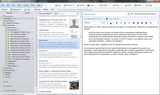
Finally there is access. For the record, I wrote the entire Flat Army book on five different devices in myriad locations. There were two laptops (Mac and PC), a Blackberry Torch, iPod Touch and an iPad. (iPad screen shot to the right … PC screen shot above)
I wrote in taxis, planes, helicopters, float planes, trains, ferries, cars, trucks, bus stops (and busses), kayak (I’m serious), restaurants, the Wolf and Hound Pub in Vancouver (a lot), houses, lounges of all sorts, poolside, curbside, bed, couch, stools, cycling (once - it’s not safe nor recommended), spinner (this is much safer) as well as while playing street hockey.
I like to think of myself as an ideas guy. My mind is constantly racing. It drives my better half completely nuts. But when you decide to write a book, these ideas need a home and the best way to write them down — in part or in full — is Evernote. It became a continuous brain dump of my thoughts and concepts … and wherever I was between May and October 2012, I was writing. It might be a short thought or it might be 1500 words. I always had a device with me of some sort, so it was easy to be perpetually writing.
Some people have asked me, "was it hard to write the book" and "how did you find the time?"
I don’t want to sound arrogant or come off as some dimwit wannabe author, but with Evernote, I found it to be — relatively speaking - easy to write the book.
And no, Evernote did not pay me to write this. And yes, I use the paid Evernote Premium service. You should too. (I’ll call it a business expense)
PS. I wrote this post entirely in Microsoft Word.
PPS. Just kidding. Evernote 100%.
Related Posts:In Defense of Alexandra Samuelflat army bookMy Thoughts: iBooks 2, iTunes U App & iBooks AuthorFlat Army: Chapter 5 OverviewFlat Army: Chapter 6 Overview
Dan Pontefract
.
Blog
.
<span class='date ' tip=''><i class='icon-time'></i> Jul 14, 2015 11:48am</span>
|
|
Ryan Murphy has managed to secure himself an entire hour at Comic Con, thanks to a panel that combined the AHS and Fox's new fall show Scream Queens. The post Everything From Today’s American Horror Story/Scream Queens Combo Panel appeared first on WIRED.
Wired Magazine
.
Blog
.
<span class='date ' tip=''><i class='icon-time'></i> Jul 14, 2015 11:48am</span>
|
|
The second installment of the video series that describes Flat Army: Creating a Connected and Engaged Organization is found below.
This 2-minute snippet sees me (Dan Pontefract) describe the overall thesis of the book including a brief introduction of the five key frameworks that make up a connected and engaged organization.
Related Posts:Flat Army: Chapter 1 OverviewFlat Army: Chapter 4 OverviewFlat Army: Chapter 2 OverviewFlat Army: Chapter 3 OverviewFlat Army Book Trailer (one minute)
Dan Pontefract
.
Blog
.
<span class='date ' tip=''><i class='icon-time'></i> Jul 14, 2015 11:47am</span>
|
|
The 'Heroes' reboot made a pretty good showing today at Comic-Con. Watch the new trailer for the show here. The post Heroes Reborn Actually Looks Pretty Exciting appeared first on WIRED.
Wired Magazine
.
Blog
.
<span class='date ' tip=''><i class='icon-time'></i> Jul 14, 2015 11:47am</span>
|
|
Do you recall what an interlocutor is?
I wrote about it at the beginning of 2012 and here we are, the last post of mine for the year, and I’m back yapping about it again.
Were you an interlocutor in 2012?
I hope so or I’m going to come crashing through whatever technology device you’re using to read this and tattoo the word interlocutor to your forehead. It’s not a one-time thing. (that’s my non-abusive point)
I know of several interlocutors I’d like to pay homage to for their over-the-top demonstration of this important attribute … specifically as it relates to the goats. (that’s code for our kids, Claire, Cole and Cate)
By the end of 2012, each of the goats had established an online presence through blogging sites. I suppose the apple didn’t fall far from the tree on that one.
How cool is it for a 9, 7 and 5 year-old to receive a steady stream of comments, ideas, wisdom and thoughts from these interlocutors based on their blog musings? It’s damn cool! These people take time out of their own schedule to read and chime in. They share the blog posts with others as well. They are engaging with the goats and in return the goats are extending their own knowledge.
Perhaps more importantly, the goats are gaining confidence in their writing and ability to influence.
You have my gratitude and sincere thanks for your continued demonstration of being a model interlocutor with the goats.
I wonder if others have demonstrated this sort of behaviour in their places of work. If not, they’d be wise to take lessons from these fine folk who regularly acted as interlocutors with the goats over the year 2012:
Nancy Miller
Denise Daoust
Brian Reid
Roman Picherack
Mike Desjardins
Kim Morgan
Becky Anderson
Mary Hewitt
Nicole Till
Denise Lamarche
Laura Jamieson
John McNaughton
Alan Wise
Danielle Tomlinson
These people are interlocutor rock stars.
This is the last post of the year. Enjoy the break, if you’re lucky enough to have one.
Thanks for dropping by in 2012. I appreciate your visits and comments. See you in 2013 … and for my word of the year in early January.
Hint: it starts with an "A".
Related Posts:Autotelic: The Word of 2013Whose Your Brian Reid?An 8 Year-Old Does Social LearningInterlocutor: The Word of 2012Dan’s Personal 2012 Goals
Dan Pontefract
.
Blog
.
<span class='date ' tip=''><i class='icon-time'></i> Jul 14, 2015 11:47am</span>
|
|
New images from New Horizons reveal that Charon has a checkered geological past, just like its neighbor Pluto. The post Pluto’s Biggest Moon Has a Personality of Its Own appeared first on WIRED.
Wired Magazine
.
Blog
.
<span class='date ' tip=''><i class='icon-time'></i> Jul 14, 2015 11:47am</span>
|
|
Those that frequent this space will know I started a tradition in 2011 by instituting a "word of the year".
In 2011, I urged people, teams and organizations to demonstrate reciprocity. I go into further detail about the act of reciprocity in my upcoming book, Flat Army, but in simple terms it’s the behaviour of both giving and taking equally. This is one of the more important traits to employ if you want a Flat Army like organization or team.
In 2012, I believed we all could be better interlocutors; capable of acting as a perpetual liaison between groups, ideas, knowledge and people. If you missed it, I thanked a number of interlocutors in my life who have consistently demonstrated this attribute through the blog postings of the goats, Claire, Cole and Cate. I am grateful for their connection to the goats, but for also providing opportunities for them to learn from the comments they left or the sage experience or links they shared. They are truly interlocutors.
I believe, however, that in order to achieve the holy grail of high organizational engagement, people in said organization need to be absorbed in meaningful work. We all need to have a meaningful purpose at work in and not apart from itself. That is, if we — the worker bees in an organization — truly want to be happy at work and tell great things to our friends, family and network about where we work, we had better be actually doing things in our jobs that make us feel this way.
To be absorbed in meaningful work is the quest for 2013. It’s your job — and the equal responsibility of leaders — to become autotelic.
That’s right … autotelic is the word of 2013.
So how can we become autotelic?
That’s a tricky question and I don’t think there is a common answer for us all. The first step may be, however, to look in the mirror and ask yourself an honest question:
Am I in a job or am I following my passion?
If you’re simply in a job — and have mentally conditioned yourself to accept that you’re merely collecting a paycheque to pay the monthly bills — it may be time to rethink whether you’re in need of a career change. Are you dreading work? Do you dislike your organization, your responsibilities, your teammates, your boss or your customers? If such is the case, you may be in a job and not in a passion. You may not be, therefore, absorbed in meaningful work.
I’m reminded of a gal I used to work with. We’ll call her Mary.
Mary was an instructor, then a courseware developer, then an instructional designer, then … I don’t know, I forget. She was bouncing around from one job to another in our organization. Now Mary was an absolutely wonderful gal. She was vivacious, bubbly, people-oriented and grounded in the rights and wrongs of society. She was beyond ethical. She had charisma. She was deeply troubled by the less fortunate in our world and sought to leave her job to follow her passion. That passion being the not-for-profit sector and aiding those in need.
Funny thing is Mary continued to go from job to job to job, even though she felt she was following her passion. She got the passion right, but her bosses in each new organization didn’t see Mary for what she brought to the table. Mary struggled, but continued to sort out the rights and wrongs and was determined to become absorbed in meaningful work … not just a job. She was determined to be autotelic.
Fast forward to 2013. Mary is happy, smiling and a full-blown autotelic. Her current situation is now a passion and she is fully engaged. It may have taken a while, but her perseverance and dedication to finding that ‘sweet spot’ paid off.
It’s the story of Mary that brings me hope for a world full of employees who are being (or becoming) autotelic.
There is meaning out there. The grass may not be greener in another organization however. To find meaning in your current position of employment — to become absorbed — may require some inner soul searching. Maybe you have to talk with your direct manager to discuss your options. Maybe you’re being underutilized. Maybe you need a job rotation. Perhaps you have an idea that might help improve work processes or a more efficient way of how the team operates. The bottom line is you may have to get creative — or at least flexible — in order to achieve an autotelic state.
Whatever the scenario, I hope you have the opportunity to become autotelic in 2013.
I’d also love to hear of any autotelic stories out there … if you’re willing to share, publicly or privately.
Related Posts:Interlocutors of 2012 (the goats are better for it)My Network is my Net Worth - Part IIIn Defense of Alexandra SamuelAn Infographic Depicting Learning & Collaboration in…Bosses Should Shift From Scroll to Swipe
Dan Pontefract
.
Blog
.
<span class='date ' tip=''><i class='icon-time'></i> Jul 14, 2015 11:46am</span>
|
|
Nintendo's president has passed away, the company has announced. The post Nintendo President Satoru Iwata Dies at 55 appeared first on WIRED.
Wired Magazine
.
Blog
.
<span class='date ' tip=''><i class='icon-time'></i> Jul 14, 2015 11:46am</span>
|