Blogs
|
Over at HBR, resident blogger Alexandra Samuel — she with the fab wardrobe — kicked up a "shitstorm" (as she calls it) on January 16, 2013 with a post entitled "Dear Colleague, Put the Notebook Down".
The central plot in this missive was for people of today’s organizations to drop their reliance on pen and paper and to adopt an entirely digital transcribing practice. Whether through a tablet or laptop, Alexandra argues "you’d make better use of your time if you took your notes in digital form, ideally in an access-anywhere digital notebook like Evernote that makes retrieval a snap."
Who am I to argue with that?
I haven’t worn a watch since 1982 when I was eleven and the last time I took a pen and paper to a meeting was, well … never.
That’s right, I’m 41 years-old and I have never carried a pen and paper to a meeting.
I also wrote a 90,000 word book entirely in Evernote … and blogged about it too.
Shoot me, HBR commentators.
When I started out my career as a high school teacher in 1994, the meetings I attended during those three years were ‘spray and pray’. I sat, I listened, I remembered, and I left. No need to write anything down there.
As I ventured over to higher education in 1998, I recall a story involving my Associate Dean. At the first meeting with her and the team when I joined the organization, it took about 5 minutes for her to stop mid-sentence and ask, "Dan, where’s your notebook?"
Of course, I didn’t have one. What the hell was a notebook?
"I remember everything," I said with a naive grin on my face.
Either perplexed, ticked off or nervous that she had hired the wrong guy, she replied, "Oh really? We’ll see about that."
At the next meeting, that’s when my all digital note-taking commenced. I arrived with a rather large IBM laptop (no Lenovo sell-off back in 1998) and began my life in the digital world of transcribing. I’ve been clicking — and now tapping — ever since. So, this year is my 15-year anniversary of such a practice. It’s become a habit, a personal discipline, but I honestly don’t think about it anymore. It’s a bit like breathing.
Which brings me back to Alexandra and her post.
With well over 200 comments and 95% of those vitriolic, negative or condescending, it made me and a few others think twice. Although I may have implemented my practice a decade and a half ago, it seems Alex and I are outliers. I too believe it saves time and it would be so helpful for many to at least try the option for a while and see if it suits their work style. Alex is right, and she had the guts to blog about it — at HBR no less — knowing full well what a "shitstorm" it would cause.
I’m in defense of Alexandra Samuel not because she employs the same practice I’ve used for years, nor am I defending her because she had the courage to challenge the reader. I’m defending her because I don’t want to see her reputation suffer. The comments found on the site give me great concern for her reputation, and I’m here to defend it.
Does she deserve the vitriol? Absolutely not. Even the Maple Leafs deserve to win the Cup one day again.
Could she have delivered her message and sage advice in a more helpful or nurturing manner? In my opinion, yes, she could have … and I’ve said as much to her already. (Disclosure: we’re friends)
Where have we landed, however, as an internet society if we stoop to anonymous comments that attack the author, regardless of message or intent? Are we that partisan? Are we that divided? Are we that forgetful of citizenship? What has happened to us when we use terms like ‘ignorant snit’, ‘hack’, ‘obnoxious’, ‘egocentric’, ‘offensive’, ‘unprofessional’, ‘one of the worst pieces of advise (sic) I’ve read on HBR’ and ‘you seem to be an expert in arrogance’.
Alexandra cares. Alexandra shares. Alexandra lives her life in the open so others might learn from her advice, experience as well as from her mistakes. Et tu brute?
Have we become a society where the difference of opinion — even at a reputable place of collaboration like HBR — is attacked by what I might define as verbal violence?
She had the gumption to weigh in on the comments too … well over twenty times.
Alexandra Samuel is a digital pioneer; a champion of change in this new found social world order. She might learn about tone and intent from this experience; however, we all can and will always be able to learn from her. She is open, honest and collaborative. She cares. She shares.
I am in defense of Alexandra Samuel.
You should be too.
Related Posts:Let’s Rename Micro-blogging to ChattingI Wrote a 90,000 Word Book Entirely in EvernoteVancouver is Home to Several ‘Social’ Rock StarsAutotelic: The Word of 2013My Network is my Net Worth - Part II
Dan Pontefract
.
Blog
.
<span class='date ' tip=''><i class='icon-time'></i> Jul 14, 2015 11:41am</span>
|
|
Too many people still think technology and the elderly go together like peas and guacamole. The post White House: We Need More Tech to Handle an Aging America appeared first on WIRED.
Wired Magazine
.
Blog
.
<span class='date ' tip=''><i class='icon-time'></i> Jul 14, 2015 11:40am</span>
|
|
The title of Chapter 3 is "The Connected Leader"
This 77 second video snippet sees me (Dan Pontefract) describe the background to Chapter 3 of the book Flat Army: Creating a Connected and Engaged Organization.
What does the Arc de Triomphe and General Sherman have to do with being a Connected Leader? Hmmm.
Related Posts:Flat Army: Chapter 4 OverviewFlat Army: Chapter 2 OverviewFlat Army: Chapter 6 OverviewFlat Army: Chapter 5 OverviewFlat Army: Chapter 11 Overview
Dan Pontefract
.
Blog
.
<span class='date ' tip=''><i class='icon-time'></i> Jul 14, 2015 11:40am</span>
|
|
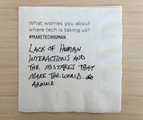
We continued the #maketechhuman conversation on cocktail napkins at the WIRED Business Conference in May. A couple of themes that keep surfacing in the #maketechhuman debate are concerns about (loss of) human connection, as well as technological advances inevitably outpacing regulation, not to mention meaningful global debate around the philosophical and ethical implications. To the […] The post Cocktail Party Conversation: What are you excited/worried about? appeared first on WIRED.
Wired Magazine
.
Blog
.
<span class='date ' tip=''><i class='icon-time'></i> Jul 14, 2015 11:39am</span>
|
|
One of my favourite people on the planet is Luis Suarez. Not just an IBMer, a collaborator, an interlocutor or an inhabitant of Gran Canaria Island in Spain — how cool is that — he is one of the foremost outliers pushing our organizations towards a world without email.
And who would blame him?
No matter what statistic you read or research paper you (hopefully) digest - like this one - email traffic is growing and it doesn’t seem to be stopping. Luis argues "if there is something out there that it’s killing our very own productivity, it’s not email itself, but our abuse of it that’s killing such productivity."
I believe him. My problem is not with Luis, his approach or his quest … it’s with the rest of the world. Judging from the current and forecasted state of email, I see no way for email to be completely eviscerated from our collaboration practices. In fact, I don’t think it’s going to go away at all.
We must adapt our attitude to email. We must change our habits.
So, with email firmly gripping our attention and actions, I thought I might share with you how I handle it on a daily basis.
Let’s first start with the definition of email. No, not the one from Wikipedia or PC Magazine, rather my own definition. I think email is any form of direct contact made to you that is done through web or internet enabled services. There are the classic examples such as Gmail, Hotmail, Yahoo! and your corporate email or ISP email as well. You may use Outlook or Lotus or whatever messaging system or application is provided to you to send and answer these types of emails. For example, I have three classic email addresses; a corporate account, a Gmail account and an account through this site.
But that’s not where electronic mail ends for me. I’m on Twitter, Skype, Google+ and Facebook. Each of these services offers ‘direct mail’ opportunities. This is still a 1-1 (or one to many) electronic mail instance you have to handle. LinkedIn is also on the list. These have to be considered as email types too.
Where I work, we also use micro-blogging and IM (instant messaging) applications. Isn’t this another form of email when people can contact me directly through 1-1 means? Of course it is.
And what about texts and voicemails? Sure, why not. When someone leaves me a voicemail, I have it transcribed into text and it’s sent to me via email. When it’s a text, it’s merely another form of electronic messaging.
And that’s really my point. Email has morphed into electronic messaging; we have to take into consideration all forms of messages that we are responsible to read and even answer. To look simply at the classic definition is naive … and that’s why I don’t think it’s going away.
Now, about my system of managing all types of electronic messages; I call it DADDIO. I know what you’re thinking; why have I devised a pneumonic that paints me out to be some sort of caricature in a B-rated film? Fair enough. At least it’s something I can remember.
Before I detail each of the DADDIO categories, one thing I do that helps is I’m plugged in most of the time. Whereas 76% of people check their email accounts six times a day, I’m somewhat of an outlier. Whether through my mobile device, tablet or laptop(s), I equip myself to be scanning these electronic messages most of the day. Sure, I exercise without a device (although sometimes I’ll be plugged in when on a spinner) and I hang with the kids, Denise, friends without being rude. But if there are moments during a day - work or play - when I might address the messages in the queue, I do so. I have set times when at work to handle this as well, most notably from 7:30-8:00am and 4:30-5:00pm. The bottom line? I try to achieve inbox zero (in whatever inbox those messages gather) all the time.
And with that insight in mind, I employ DADDIO:
Delete
I am ruthless. After the quick scan, my gut reaction is to delete and for many of the electronic messages - particularly unsolicited ones - they end up in the bin.
Action
If it can be dealt with immediately, I’ll do it. Perhaps some of my responses are curt, but I’d rather be curt than let it sit there and collect digital dust. If it needs a more thorough response, see the next point. (Twitter only permits 140 characters, right?)
Delay
After the scan, if I can’t delete it and I can’t act on it immediately - and it needs my direct attention - I delay it to another point in time. It’s ideally the same day, but no promises.
Delegate
Maybe I can steer the request in another direction. Whether Google+, Twitter, traditional email, etc. if someone asks for me something and I don’t have the answer (or I don’t have the time) I will delegate down, across or up.
Interrupt
Twice a year, I interrupt my rules for a ‘life without electronic messages’. In particular, I check out from ‘work email’ and relax everything else to a trickle. I firmly believe that for 4-6 weeks a year my brain needs a break from this rigid regime.
Optimize
Wherever I can, rules are implemented and ways to consolidate messages are optimized. Keywords send certain messages to certain folders, local or on the cloud. (I then proactively delay action)
Electronic messages aren’t going away. If you have suggestions to improve my own DADDIO philosophy, I’d be keen to hear them in this space.
Related Posts:Hey Microsoft! Why Not Merge Outlook with SharePoint?Email, A Love StoryYear Zero: The Future of Communication Skills in…Why I Love Newsle5 Ways to Become Less Collaborative at Work
Dan Pontefract
.
Blog
.
<span class='date ' tip=''><i class='icon-time'></i> Jul 14, 2015 11:39am</span>
|
|
The title of Chapter 4 is "Becoming the Connected Leader"
This 84 second video snippet sees me (Dan Pontefract) describe the background to Chapter 4 of the book Flat Army: Creating a Connected and Engaged Organization.
There are 5 key attributes leaders should employ in order to demonstrate ‘Becoming a Connected Leader’. What are they? You’ll have to watch the video to find out.
Related Posts:Flat Army: Chapter 3 OverviewFlat Army: Chapter 2 OverviewFlat Army: Chapter 6 OverviewFlat Army: Chapter 5 OverviewFlat Army: Chapter 11 Overview
Dan Pontefract
.
Blog
.
<span class='date ' tip=''><i class='icon-time'></i> Jul 14, 2015 11:39am</span>
|
|
These glass luxury pods are the new glamping. The post Cliff-Hanging Sleep Pods Take Glamping to New Heights appeared first on WIRED.
Wired Magazine
.
Blog
.
<span class='date ' tip=''><i class='icon-time'></i> Jul 14, 2015 11:39am</span>
|
|
In December of 2012, Twitter announced it had surpassed 200 million users. As TechCrunch noted, it was a 42% increase in their user base in under a year. Wow.
Of course it was CEO Dick Costolo who let us know in the summer of 2012 that 400 million tweets were being sent each day. With the increase in users since that time, one can easily surmise we’re well past this number in early 2013.
These data points got me thinking.
How am I ever going to read 400 million tweets a day?
No, not really. I’ll save that for a trip to the Library of Congress where they have already collected 170 billion tweets and are still going strong.
What I’m referring to is our (or perhaps my) approach to Twitter.
Upon reflection, I think I’m missing out. When I’m on Twitter, I’m scanning streams, hashtags and searches that I make. That part is ok and I’m learning a lot as a result of my usage habit. But what I’m not doing enough of is spending time reviewing the streams of individuals. I’m not putting time in my personal time management system to review what individuals have ‘tweeted’ over a period of time.
Because I may check Twitter infrequently, I may be missing out on potentially golden tweets of individuals. Because I may be searching or scanning hashtags for certain topics, I may be missing out on sage advice, links or thoughts because I don’t pick it up during my normal Twitter habits. Those tweets are buried on the profile of a Twitter user.
That’s going to change. I’m going to start checking out past tweets of individuals, in case I’ve missed something.
I’m not simply going to follow on Twitter anymore, I’m going to spend time reviewing.
Related Posts:Learning is Lurking (Part 2 of 2)deets on tweetsTweet Kings & Pretty Things (aka Micro-Blogging Habits)I’m Not Scared of Email; I Developed a System called…I Unfriended You On Facebook. Are We Still Friends?
Dan Pontefract
.
Blog
.
<span class='date ' tip=''><i class='icon-time'></i> Jul 14, 2015 11:39am</span>
|
|
Here is a numerical model to explore baseball range and density. The post Does the Density of Air Matter in the Home Run Derby? appeared first on WIRED.
Wired Magazine
.
Blog
.
<span class='date ' tip=''><i class='icon-time'></i> Jul 14, 2015 11:39am</span>
|
|
The title of Chapter 5 is "Being a Connected Leader"
This 75 second video snippet sees me (Dan Pontefract) describe the background to Chapter 5 of the book Flat Army: Creating a Connected and Engaged Organization.
Building off of Chapter 4 (Becoming a Connected Leader), Chapter 5 suggests five additional attributes that help you to become a connected leader. It’s also a chapter that’s about getting things done. What are the 5 attributes? Watch the video to find out.
Related Posts:Flat Army: Chapter 6 OverviewFlat Army: Chapter 4 OverviewFlat Army: Chapter 3 OverviewFlat Army: Chapter 11 OverviewFlat Army: Chapter 10 Overview
Dan Pontefract
.
Blog
.
<span class='date ' tip=''><i class='icon-time'></i> Jul 14, 2015 11:39am</span>
|