Blogs
|
Week 11 of the WIRED 'Star Wars' Challenge is already here. Behold your assignments! The post Here Are Your WIRED Star Wars Challenges for Week 11 appeared first on WIRED.
Wired Magazine
.
Blog
.
<span class='date ' tip=''><i class='icon-time'></i> Jul 14, 2015 11:54am</span>
|
|
If you haven’t noticed, I’m a big fan of trying to create simplicity from chaos.
That stated, I am more comfortable when a part of (or the instigator of) chaos itself. As Churchill once said, "to improve is to change; to be perfect is to change often."
Perhaps my own personal leadership style is one that evokes equal parts chaos and order.
Give your brain a dose of ‘mental Olympics’ and read former VISA CEO Dee Hock’s "Birth of the Chaordic Age".
The tweet version of Chaordic Theory, in essence, is a new organizational form Hock calls "simultaneously chaotic and orderly."
Chaordic is any self-organizing, adaptive, non-linear, complex system, whether physical, biological, or social, the behaviour of which exhibits characteristics of both order and chaos or, loosely translated to business terminology, cooperation and competition.
Hock may be 83 years old, but this is an open invitation for him to pen a few words to the back cover of my pending book.
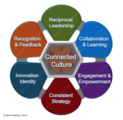
A ‘connected culture’ is one that simultaneously drives organizational clarity with precarious innovation. It is one that believes equally in leaders who demonstrate reciprocity as it is an executive board who insists upon a consistent strategy.
It is order amongst chaos; and chaos amongst order.
A ‘connected culture’, in its simplest, orderly and most chaotic form, refers to the point at which all employees act as one corporate organism. As an individual, he or she thinks not about himself or herself, rather, they act with the greater good of its people and the organization itself in mind. As an organization, in totality, business units, teams and projects are united such that duplication is negated and a selfless amount of contribution is the norm.
The ‘connected culture’ of an organization is the point at which chaos meets order coupled by an infinite and unobstructed flow of corporate commonality.
It is professional panacea.
The following diagram aims to depict what I refer to as a ‘connected culture’ in an organization.
What does it mean?
Further details in the book, but in short:
Reciprocal Leadership
The shift from hierarchy to wirearchy with situational hierarchy. Leadership is reciprocal, and it should not be held accountable to the fabrication of presumed leadership via the org chart found in Microsoft Outlook or otherwise.
Collaboration & Learning
The Collaboration Cycle and the Connected Learning frameworks are good starts. Bottom line? The culture of an organization is going to become more connected if these principles are applied throughout your company.
Engagement and Empowerment
It’s amazing to me why more companies (and leaders) don’t understand the relationship between an empowered organization and one that is engaged. To become a ‘connected culture’, attention must be paid to both of these important ‘E’’s
Consistent Strategy
It is somewhat dumbfounding the number of organization that alters their strategy when pressure mounts. Heeding to the whims of Wall Street, Bay Street or The City, executives often flee what was arguably an originally sound strategy. Imagine their employees? Think they feel connected to their culture if it’s changing every second Tuesday?
Innovation Identity
A ‘connected culture’ will manifest if employees are encouraged to adapt an identity encouraging innovation. A risk averse culture, one that relies on a select few to dream up new ideas will suffer the fate of actually becoming (or being) a disconnected culture.
Recognition & Feedback
What do employees want? The ‘connected culture’ of an organization can surface if employees are recognized for their efforts while also being provided consistent and authentic feedback. Conversely, if an employee isn’t recognized nor is feedback ever provided, the ‘connected culture’ of an organization will never be reached.
I’m going into summer hibernation.
Thanks for dropping by. See you in early September.
In the meantime, I thought you might enjoy this paper entitled, "Who Killed the Inner Circle? The End of the Era of the Corporate Interlock Network". Perhaps things are in fact changing for the good.
Related Posts:Is Your Company Culture Linked to Social Learning Success?The Link Between Leadership, Learning & Organizational…What’s Needed First? Culture Change or Enterprise 2.0…Steer Clear of Organizational Leadership TurbulenceFuture of Work: Add Open Leadership, Enterprise 2.0,…
Dan Pontefract
.
Blog
.
<span class='date ' tip=''><i class='icon-time'></i> Jul 14, 2015 11:54am</span>
|
|
Interestingly, I recently learned that the term ‘stakeholder‘ was coined at Stanford Research Institute in 1963 to describe ‘those groups without whose support the organization would cease to exist‘.
I then started thinking about the term ‘table stakes‘, which lead me to Wikipedia. Table stakes:
… refers to the minimum entry requirement for a market or business arrangement. It can refer to pricing, cost models, technology, or other capability that represents a minimum requirement to have a credible competitive starting position in a market or other business arrangement.
HR is both table stakes and a stakeholder for an organization.
It gets an unbelievably bad rap in some circles, but these days, I don’t believe it’s about HR needing a seat at the table. In fact, I believe they are the table.
Of course, if HR begins to play offence, takes the bull by the horns, and enacts a human capital strategy that provides a more cohesive way in which employees can more efficiently do their job, then yes … it makes sense. If HR remains passive, plays defence and simply takes marching orders from elsewhere, then no … it cannot and will never be both.
To be the ‘table’ of the organization, HR needs to provide a solid foundation that connects people to people and people to projects, ideas and information. It needs to make it easier for employees to do their job. When you sit at a table with other people, you naturally feel connected. It’s a table and you’re sharing. It could be that you’re simply sharing the space, but nonetheless, you’re sharing.
A table connects people. It can permit ideas to surface. It bridges distance. It acts as a solidifying force. It shares a meal.
It’s easy.
HR should be the table of the organization.
Recent acquisitions and a seismic shift in the HR technology space only underlines what is in motion. The big guns like IBM, Oracle, SAP and Salesforce realized HR’s opportunity to become a true stakeholder when they began gobbling up companies such as Kenexa, Taleo, SuccessFactors and Rypple. They saw it as table stakes.
For it to be a stakeholder in the organization — to truly become the force that connects its employees and makes work-life more efficient and productive — it needs to stop thinking a seat at the table is the ultimate win.
It’s now time for HR to actually be the table. It’s table stakes for the organization of tomorrow.
Related Posts:The Hare, the Tortoise and the Jackass of Social HRWaiting For SuperExecutive: Why Executives Should Get on the16 Months of Social Learning Platform Insanity: A RecapVirtual Worlds in an Organization are not a Time Waster (andAutotelic: The Word of 2013
Dan Pontefract
.
Blog
.
<span class='date ' tip=''><i class='icon-time'></i> Jul 14, 2015 11:54am</span>
|
|
With such little space and such defined functionality, not everything makes sense on the Apple Watch. These apps do. The post The Only Apple Watch Apps You Actually Need appeared first on WIRED.
Wired Magazine
.
Blog
.
<span class='date ' tip=''><i class='icon-time'></i> Jul 14, 2015 11:54am</span>
|
|
I tweeted a joke hashtag last week.
@dpontefract: I’m proposing a new hashtag … #e20socbizhrtechedtechentswfutureofworktchat … that just about covers it
In retrospect, perhaps I wasn’t joking.
What’s going on out there in vendor land is rather interesting. What’s going on in our organizations is equally intriguing.
On one hand, we have vendors from the larger technology companies and spaces (Oracle, SAP, Microsoft, IBM, Salesforce et al) snapping up HR technology companies whilst other smaller cloud-based companies continue to sell themselves as the "social business" or "human capital cloud" saviour.
I am fond of SuccessFactors at the moment. (an SAP company) Under the tutelage of Vishal Sikka and Sameer Patel (amongst others) it seems they are listening to the needs of its customer base and the HR space in general by actually evolving social software such that it’s not a shiny object rather it’s becoming what Sameer calls, "social glue". This is an important distinction from simply dropping social media or collaboration tools on an organization and suggesting it’s now more collaborative by virtue of wikis or blogs. Who cares, that’s not enough.
And that’s where we begin our metaphor for the day.
To those social business, collaboration, HR technology and Enterprise 2.0 software vendors — on-premise and/or cloud — that continue to flog features versus behaviour change, your hare-like attitude is becoming annoying if not alarming.
There are far too many organizations listening to the hare preach about the virtues of collaboration features only. "Get these collaboration tools into your organization as quickly as possible because your employees need to start blogging and creating wiki’s," says several hundred vendors today. I wouldn’t be listening to the hare for it’s the tortoise that is my torch-bearer. The hare wants to sell you licenses. The hare is quick to depict features and functions. The hare is burning out.
The tortoise, on the other hand, might be viewed as ‘slow’ right now, but she is eloquently amassing a vision that weds organizational culture, engagement and behaviour to the technology to improved business processes, results and outcomes.
I don’t care if conversations in a micro-blogging platform are threaded, per se, I care what micro-blogging can do to help culture, engagement and behaviour. Start there first Mr. Hare and you will act more like the Tortoise. This, in my opinion, is a good thing for you to begin doing.
My bet is on the Tortoise. Whatever ‘Social HR Technology‘ company, outfit or division that is methodically building out the behaviour change needed by so many organizations today will win the race. We are simply at the end of the beginning; the hare is out of touch with the reality of today’s organizations. And sadly, too many organizations are listening to the hare versus thinking through their behaviour change first.
And what about the Jackass you ask?
Sadly, it’s those within the organization itself who are both blind and deaf to the wave that is cresting their culture. They ignore the behaviour change needed whilst doubling down at the jackass table remaining ambivalent to the equally pervasive tsunami of social collaboration technology possibilities in their midst. They’re out there; a sea of jackass drones causing harm to their employees.
These are the type of leaders within organizations who simply wouldn’t understand a joke like #e20socbizhrtechedtechentswfutureofworktchat
Do you?
Related Posts:To Really Drive Enterprise 2.0 Forward We Need A Behaviour…16 Months of Social Learning Platform Insanity: A RecapMicro-blogging can help build your organisational cultureThe ‘Occupy IT’ Movement of OrganizationsHR Doesn’t Need a Seat at the Table, it is the Table
Dan Pontefract
.
Blog
.
<span class='date ' tip=''><i class='icon-time'></i> Jul 14, 2015 11:53am</span>
|
|
At super-low temperatures, a crystal called samarium hexaboride behaves in an unexplained way. The post Paradoxical Crystal Baffles Physicists appeared first on WIRED.
Wired Magazine
.
Blog
.
<span class='date ' tip=''><i class='icon-time'></i> Jul 14, 2015 11:53am</span>
|
|
I’m not a particularly religious man, however Time Magazine, Life, Fortune and Sports Illustrated founder Henry Luce once said,
"We didn’t invent the idea of delivering news through stories about people. The Bible invented it."
And frankly, he has a point.
Peter Bregman, author of 18 Minutes: Find Your Focus, Master Distraction, and Get the Right Things Done states that an easy way in which to begin changing an organization’s culture is by telling stories. I further posit that if we truly want to improve employee engagement, company productivity, future innovation, and customer satisfaction, organizations should ensure the culture of an organization surfaces and circulates both positive and not-so-positive stories into the conversation ecosystem.
Steve Dale also opines that storytelling is invaluable when it comes to knowledge sharing. To me, knowledge sharing is as synonymous with collaboration technologies as it is with storytelling in your organization.
Therefore, an easy math calculation suggests that storytelling + collaboration technologies = an engaged, productive, knowledgeable, learned and customer satisfied organization.
Is it that simple?
By flooding (or at least encouraging) the internal ecosystem of an organization with positive and not-so-positive stories, you will undoubtedly create a groundswell of cultural change. As the adage goes, "stories beget stories".
A great example of storytelling affecting change in an external and positive light is via GlobalGiving, a charity organization that gives social entrepreneurs and non-profits from anywhere in the world a chance to raise the money that they need to improve their communities. Since 2002, GlobalGiving has raised $67,930,184 from 271,216 donors who have supported 5,829 projects.
But what this extraordinary organization has learned is that it can do even more good in this world if it developed what they call ‘better feedback loops’. Through the web, and open to anyone and everyone, GlobalGiving launched a Storytelling project to collect community feedback that assists in the decision making process, the learning process, and the information process as cycles of investment are positioned and made.
Since 2010 and specific to Kenya and Uganda initiatives, scribes have collected 40,600 stories from over 5,000 community members by asking a simple question: "tell us about a time when a person or an organization tried to change something in your community."
Using the brilliance of Dave Snowden’s SenseMaker technology and the Cynefin framework, the stories get mined to assist in the process of providing funding and tangible solutions to their communities’ most pressing needs.
If stories are working to dramatically assist the very unfortunate in Kenya and Uganda, surely an organization can find ways to invoke the same opportunities inside their physical and virtual walls to help drive employee engagement, productivity, knowledge and customer satisfaction.
Right?
Related Posts:What’s Needed First? Culture Change or Enterprise 2.0…The Collaboration CurveCase Study: Tim Hockey, a Collaborative & Transparent…To Really Drive Enterprise 2.0 Forward We Need A Behaviour…Tabula Rasa, Enterprise 2.0 & Induction
Dan Pontefract
.
Blog
.
<span class='date ' tip=''><i class='icon-time'></i> Jul 14, 2015 11:52am</span>
|
|
Pico Park takes 10 players and forces them to work closely together to succeed. The post A Raucous, Teamwork-Teaching Game for 10 Players appeared first on WIRED.
Wired Magazine
.
Blog
.
<span class='date ' tip=''><i class='icon-time'></i> Jul 14, 2015 11:52am</span>
|
|
"When I was 5 years old, my mother always told me that happiness was the key to life. When I went to school, they asked me what I wanted to be when I grew up. I wrote down ‘happy’. They told me I didn’t understand the assignment, and I told them they didn’t understand life." John Lennon
According to Michelle McQuaid - a leader in psychology interventions in the workplace — Americans are unhappy at their place of work and they simultaneously loathe their direct manager.
Key points McQuaid surfaced in a study she conducted with Americans include:
36% of Americans are happy at their job / 64% are unhappy
65% indicate a better boss would be them happier at work / 35% said a pay increase would
If those polled actually got along better with their boss 55% stated they would be happier at work while 60% suggested their performance would increase
Only 38% believe their bosses are ‘great’
More ammunition lies ahead.
A study conducted at Indiana University that researched tweets over a three year period also proved we’re getting a lot unhappier. In China, despite a financial boon that has enveloped many citizens in the country, the level of happiness dropped from 28% (itself, not very impressive) to an astonishing 12%. Chris M. Herbst at Arizona State University proved both men and women have seen their sense of life satisfaction decrease over a twenty year period.
The World Happiness Report does us no favours either. In their seminal research, they state:
One striking finding of happiness research is that the time of day when people are least happy is when they are in the presence of their line manager. This suggests that too many managers fail to inspire their workers and rely too much on mechanical incentives and command.
Of course we’ve known for years thanks to the Easterlin Paradox that money doesn’t buy happiness either. For example, in the U.S. gross national product per capita has grown by a factor of 3X since 1960 yet average happiness in America has remained the same since that time. That is, Americans have more money, on average, yet their level of happiness has flat-lined.
Where am I going with this doom and gloom?
I was staring at my iPad the other day thinking to myself, ‘I certainly do a lot more swiping than scrolling with this device compared to my laptop.’
And then it hit me.
What if bosses were more like an iPad versus a laptop?
What if they acted more horizontally than vertically?
What if — by swiping versus scrolling — bosses were able to flatten their style such that their team members felt they were part of the solution?
Would we be happier at work?
Related Posts:Virtual Worlds in an Organization are not a Time Waster (andAutotelic: The Word of 2013The State of Culture, Collaboration & Enterprise 2.0There is Nothing More to Say in 2011 … but ThanksGive Piece a Chance
Dan Pontefract
.
Blog
.
<span class='date ' tip=''><i class='icon-time'></i> Jul 14, 2015 11:51am</span>
|
|
KYOTO, JAPAN — In Brave Yamada-kun, the titular lead is a full-time video game company employee who codes his own games on the side in nothing but his underwear. It’s an RPG about a guy who makes RPGs in his spare time, who then leaps into his own creation to become the hero. I ask […] The post Art Imitates Life in this Indie RPG About Making RPGs appeared first on WIRED.
Wired Magazine
.
Blog
.
<span class='date ' tip=''><i class='icon-time'></i> Jul 14, 2015 11:50am</span>
|