Blogs
|
From the very earliest days of Versal, many of our conversations revolved around one core idea: how do we make our platform as open and welcoming as possible?
That’s why when we launched last July, Versal’s interactive course creator was (and will remain) open to everyone - from schoolteachers and professors, to tutors and corporate trainers. No contracts for your organization or district to sign, and no hoops to jump through.
This philosophy is also why we chose to empower you to embed courses anywhere on the web. No walled gardens. And it’s why we will open up our gadget library to third-party developers early this year.
Today, we’re continuing with this theme and are very excited to announce that Versal is now open to collaborative authoring. Invite anyone to contribute to your course and work hand-in-hand to transform online learning. Please keep in mind that this is a new beta feature, so if you encounter a gremlin or two please shoot us a note (and thank you for your patience!). We’ll be continuing to test and enhance everything over the next few weeks.
All Versal courses are now collaborative by default - the new features are seamlessly integrated into the platform.
In our official press release this morning, our CEO Gregor Freund shared more on his vision behind open collaboration:
"Collaborative authoring paves the way for a new approach to creating online courses. Imagine dozens of physics professors and researchers from around the world working together to author the ultimate guide to the fundamental structure of the universe. Or an online community of gardening enthusiasts teaching people how to grow organic vegetables. Or a network of global non-profit advocates creating a water filtration course to help individuals in developing countries. The possibilities are unlimited."
Beyond enabling you to invite people to join your course, approved contributors may also comment on each other’s contributions and exchange ideas inside the course creator. We’re expecting lively debates!
There are no restrictions on the number of contributors you may add to your course. However we recommend that you initially limit it to people you trust - especially if the content you’ve created is sensitive. Soon we’ll release new permissions to allow you to choose who can only add and edit their own gadgets.
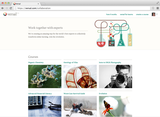
We’re also kicking off this new feature by opening up a catalog of pre-scaffolded courses designed for anyone to join in and contribute. Courses range from Organic Chemistry to The Clever Gardener Guide to DSLR Photography and more. Check it out! (We’ll be accepting requests to join these courses on a rolling basis at first, so if you don’t receive approval right away, you will soon.
Welcome to a new era in open collaboration. Give it a try and let us know what you think?
Christopher Poseley
.
Blog
.
<span class='date ' tip=''><i class='icon-time'></i> Jul 14, 2015 12:48pm</span>
|
|
Workplace Learning Today pointed me to a post Ten Common Phrases That Could Soon Be History. I use similar kinds of examples in my presentations (and posts such as Work Skills Keeping Up?). I thought it might be fun for me to catalog some of the ones that I’ve used in my presentations and other places as well as have this ready for future presentations. So here is a list of technologies that: Boomers - used Gen X - know what it is (probably) Millenial - never used / likely don’t know what it is If you are a Boomer or an older Gen X, this list is sure to make you feel a bit old. Pay Phones - Collect Calls Where’s the nearest pay phone? Call me collect? Typewriter / Ribbon / Correcting Ribbon "You need to mute your sound" Records / Phonographs Sounds like a broken record Skipping Needle Cassette Drive Floppy Disk / Floppy Drive Dual floppy drive Word Star Word Perfect Punch Card Card Catalog Microfiche Reader Rabbit Ears Overhead Projector Rolodex Inbox / Outbox What we did before email … "Pen Pals" "Walkman" "Carbon Copy" or even "BCC" What did I miss? eLearning Technology
Subscribe to the Best of eLearning Learning for updates from this blog and other eLearning blogs.
Tony Karrer
.
Blog
.
<span class='date ' tip=''><i class='icon-time'></i> Jul 14, 2015 12:48pm</span>
|
|
Wolfram|Alpha. Mathematica.
Stephen Wolfram spotlights a Versal gadget at SXSW
These are incredibly powerful and essential tools in the classroom (and beyond). Now, Stephen Wolfram & team are beginning to roll out their next big projects…the Wolfram Cloud and Wolfram Language.
And together, they’re going to transform the way you and your students create and access Wolfram-powered
resources.
In a nutshell, the Wolfram Cloud will enable educators to access the power of Wolfram’s dynamic content from any
web device. It’s all about sharing and collaboration. Wolfram Language is all about knowledge-based programming.
How can Versal help you take advantage of the Wolfram Cloud and Wolfram Language?
By building the first way to embed Wolfram Cloud content into an external web experience - via a Versal gadget.
The new gadget is a window into all of the dynamic Wolfram Language content that will soon be available via the Wolfram Cloud. Thanks to their new web-based platform, Wolfram content is more portable than ever before.
And we’re excited and honored that just a few minutes ago, Stephen Wolfram shared a demo
of a Versal course on stage at SXSW Interactive during his speech titled "Injecting Computation Everywhere."
When we heard about the still-stealthy Wolfram Cloud and Wolfram Language initiatives, we
knew that Versal’s gadget-based course creator would be the ideal platform to showcase the
new Wolfram capabilities. And even more importantly, it will help you integrate the Wolfram Cloud into your lessons.
By adding the gadget to your Versal courses, you’ll be able to embed interactive Wolfram content directly within the context of all of your videos, text, and interactive diagrams and other Versal simulations. It’s coming to your gadget tray very soon…stay tuned!
If you’re at SXSW Interactive, please say hello, we’d love to meet up (shoot me a note to connect). Gregor, James, Dylan and I will be here until Tuesday and happy to answer any questions.
Christopher Poseley
.
Blog
.
<span class='date ' tip=''><i class='icon-time'></i> Jul 14, 2015 12:48pm</span>
|
|
Saturday Night Live certainly doesn't think much of online degrees a subject that I was thinking was going away since I posted about it back in 2006 - Lower Value of Online Degree Programs? eLearning Technology
Subscribe to the Best of eLearning Learning for updates from this blog and other eLearning blogs.
Tony Karrer
.
Blog
.
<span class='date ' tip=''><i class='icon-time'></i> Jul 14, 2015 12:48pm</span>
|
|
Are you interested in learning more about how interactivity can bring your online training to life, better engage your learners and ensure your material is understood and retained?
This past Wednesday, Versal’s VP of Business Development Chris Poseley hosted a live webinar in conjunction with ASTD.org (just rebranded as ATD). Over 500 people joined in for a lively presentation and Q&A, and now the recorded webcast just went live. It’s free and available to anyone. Check it out here.
Below are many of the awesome questions asked by participants. While we tried our best to keep up in real time, we’ve taken a little extra time to provide more detailed answers.
If you have any other questions, please add them to the comments below. And don’t forget, ATD members receive a free 60-day trial (no credit card required) at versal.com/astd.
Thank you…we can’t wait to see what you create.
Sample questions from the Versal/ATD webinar:
Is Versal cloud based?
Yes, Versal is SaaS (software-as-a-service). We host the course creator and courses in the cloud and you do not have to install any software on your computer, or save your work locally.
Can I sign-up for a trial period?
Yes, we offer a free 60-day trial at versal.com/astd. No credit card is required.
If you want to use as a non-organization, is there "personal" use pricing?
Yes! The basic version of Versal is always free.
Can you use Versal on mobile devices, such as iOS and Android?
(Updated) We’re currently testing the Versal learning experience for compatibility with mobile devices. People taking your course from tablets and smartphones may experience glitches and some gadgets may not work properly. We’re working on improving our mobile support and will keep you updated. The authoring experience is only supported from desktop/laptop browsers.
Is it SCORM compliant? Section 508 conformant? Tin Can API compliant?
All of these standards are very important. SCORM compliance is expected in the coming weeks. Your course will be able to be packaged as a SCORM archive and be runnable in any SCORM player.
TinCan API is expected in the second half of this year, and we’re formulating our plans for Section 508 conformance plus ADA compliance.
Christopher Poseley
.
Blog
.
<span class='date ' tip=''><i class='icon-time'></i> Jul 14, 2015 12:48pm</span>
|
|
Happy new year. I took some time off from blogging over the holidays. I’m just now getting back into the swing of things. To help me get moving, I just posted Storyboard Templates and iPhones - Best of December 2009 over on eLearning Learning. Some great content posted back in December that I need to go back and review. I’m hoping that folks might be able to help someone who just sent me a question. This is a company that sells mostly compliance training to the healthcare market (Hospitals, healthcare practices, individual physicians etc…). They have a licensed LMS, but want to move away from it and build a custom LMS that meets their specific needs. Their questions: 1. What are some features that they might not be thinking about that people will be asking for in the near future? In their words, "what is the need of the hour"? 2. Is it a good idea to start with an open source LMS? Their team strength is principally .NET, ASP 2.0. Are there any open source LMS on those technologies? And my question: 3. Does it make that much sense to build a custom LMS anymore? I’ve seen it numerous times, but I feel like some of the low cost LMS or rapid LMS solutions would make more sense? Appreciate any thoughts you have on this. eLearning Technology
Subscribe to the Best of eLearning Learning for updates from this blog and other eLearning blogs.
Tony Karrer
.
Blog
.
<span class='date ' tip=''><i class='icon-time'></i> Jul 14, 2015 12:48pm</span>
|
|
There have already been some great contributions to this month’s big question - Predictions and Plans for 2010. I was reading Jay Cross’ response and one of his predictions: Faster, faster, faster, real time. Time-to-performance becomes the new metric. It’s funny to see that term again. I thought that Time-to-performance was going to be the key metric back in 2002. When I was working with various high tech, insurance and financial services companies - a key ingredient was how quickly people could effectively roll-out new products, policies, respond to competitive threats, etc. It really was about how quickly you can become proficient on all the new stuff. It was about Time to Performance. Granted there are still core skills that will need to be developed in other ways (see Does Deliberative Practice Lead to Quick Proficiency for a bit of discussion around that). Still a lot of what we talk about with informal learning, performance support, etc. is how we can make people perform quickly. Or at least have the appearance of expertise (see Expert Level Answers via Social Networks as one way to appear to be expert). Still since the last time this term and related metrics never really took off, I’m curious what people think. Is Time to Performance really going to get traction in 2010? eLearning Technology
Subscribe to the Best of eLearning Learning for updates from this blog and other eLearning blogs.
Tony Karrer
.
Blog
.
<span class='date ' tip=''><i class='icon-time'></i> Jul 14, 2015 12:48pm</span>
|
|
Harold Jarche posted Business models looking back and forward where he looks at various trends and implications on business opportunities. One of the main points he makes is: In early 2010 it is pretty obvious that nobody needs an other Web portal. I both agree and disagree. He’s right. No one really wants another web portal. We’ve got plenty of information sources already. At the same time, we need lots of help filtering the flood of information. Harold is a master of that and effectively uses twitter, RSS reader and lots of other sources to bring across and filter information. My strong belief is that there is more and more of a need for effective information filtering. Basically, easy ways to get the information that you want or need. Heck, a lot of what learning professionals do is filter information. Harold is comfortable with small pieces, loosely joined as a means of filtering. My belief is that there’s a fairly large population that will get value from what are essentially portals that take advantage of social signals (a powerful information filtering mechanism). That’s somewhat the whole point behind eLearning Learning. Professionals who don’t have time to try to find, subscribe, read all of the various blogs and other sources can look to a portal like eLearning Learning (and particularly it’s Best Of emails) as a means of getting a filtered set of all of this. Of course, there’s so much more to defining what someone particularly needs. This filtering is horribly crude and will get much better over the years. But since a lot of what a portal can bring is information filtering - I’m not quite so ready to sign up with Harold’s assertion. eLearning Technology
Subscribe to the Best of eLearning Learning for updates from this blog and other eLearning blogs.
Tony Karrer
.
Blog
.
<span class='date ' tip=''><i class='icon-time'></i> Jul 14, 2015 12:47pm</span>
|
|
I’m still working on my yearly post that is my eLearning Predictions. That will be coming out shortly. In the meantime, I’ve been invited to do a virtual presentation for ASTD DC on this topic. The organizer will give preference to his local members, but will let other folks attend who contact him. Here’s the information: Ten eLearning Predictions for 2010 To kick off the new year, Dr. Tony Karrer is sharing some thoughts on what's going to be happening in the world of eLearning in 2010. Back in 2006, Tony was talking about eLearning 2.0 and it's long term impact on workplace learning. What will be similar kinds of key issues that we need to be aware of in 2010? Tony promises to deliver a fast-paced, interactive discussion that will look at trends around social and informal learning, mobile, authoring, learning management systems, and others. Come participate in what promises to be a fun session. This event will be held via the web on Thursday January 21 from 2:45 - 4:00 Eastern. It is being hosted by the local DC Chapter of ASTD’s Technology Learning Group. If you are interested in attending, please contact Todd Slater at toddslater1@gmail.com for webinar information. About the Presenter: Dr. Tony Karrer is an expert on innovative uses of technology that improves human performance. He is a sought after presenter on Web 2.0’s impact on knowledge work and workplace learning. He is author of the award-winning eLearning Technology blog, creator of eLearning Learning, and founder of Work Literacy. Dr. Karrer’s experience is diverse including initial CTO of eHarmony, associate professor of Computer Science, and consultant to Credit Suisse, Citibank, Lexus, Microsoft, Nissan, Universal, IBM, Hewlett-Packard, Sun, Symbol Technologies and many others. He was valedictorian and attended USC as a Tau Beta Pi fellow, one of the top 30 engineers in the U.S. where he received a M.S. and Ph.D. in Computer Science. eLearning Technology
Subscribe to the Best of eLearning Learning for updates from this blog and other eLearning blogs.
Tony Karrer
.
Blog
.
<span class='date ' tip=''><i class='icon-time'></i> Jul 14, 2015 12:47pm</span>
|
|
Ken Williams has been teaching the Vedic system of math for more than thirty years. What is Vedic mathematics? It’s a unified approach to solving math equations that is more creative and flexible than traditional methods, which have a tendency to scare off students. In Ken’s experience, once people learn to recognize Vedic patterns, anybody can enjoy math.
Though Vedic mathematics is an ancient discipline, dating from 1200 BCE in India, Ken’s approach to teaching is decidedly modern. To create his Vedic Mathematics course on Versal, Ken simply imported his existing instructional videos, organized them into lessons, and added quizzes to help students achieve mastery.
Over 2,000 students have taken Ken’s Vedic Math course on Versal. "Nothing else out there quite like what you’ve done," he says. More recently, Ken recommended Versal to several colleagues. Ken also created a follow-on course on polynomial equations on Versal.
Want to multiply large numbers in your head without breaking a sweat? Check out Ken Williams’ Vedic Mathematics course in the Versal’s catalog. You can also learn more about Vedic math by visiting Ken’s website, vedicmaths.org. And look out for more courses by Ken in the new year!
Christopher Poseley
.
Blog
.
<span class='date ' tip=''><i class='icon-time'></i> Jul 14, 2015 12:47pm</span>
|