Blogs
|
Massive open online courses (MOOCs) have their detractors and their sceptics; while those offering MOOCs are wondering how to ‘monetise’ them - that is, how to make money from the intellectual property that comprises these courses. Nonetheless, MOOCs have shown that they have the potential to disrupt the corporate learning world — in terms of price, technology and even pedagogy.
On November 19 at 10am EST; 3pm GMT, or 4pm CET, join us for a live panel discussion involving four key industry thought leaders on the subject of ‘MOOCs: from Academia to Corporate’.
00
days
00
hours
00
minutes
00
seconds
Register now!
The panel will discuss: what MOOCs are; different types of MOOC implementation; MOOCs within a corporate setting; MOOCs versus curricular education; MOOCs versus e-learning courses; identifying the hype about MOOCs; exploring the future of learning - and discussing MOOCs’ part in it.
The members of this thought leaders’ panel are:
John Leh, the CEO and Lead Analyst at Talented Learning. He has some 18 years’ experience of the online learning sector.
Dr Mike Orey, has been an Associate Professor at the University of Georgia since 1989. He’s a teacher, researcher, designer, developer and a visionary focused on meeting the needs of today’s learners.
Aaron Silvers, a designer, technologist and strategist responsible for helping to bring into being learning technologies - notably SCORM and Experience API (otherwise known as ‘Tin Can’).
Erica LeBlanc, the Operations Development Manager for the IP & Science Business at Thomson Reuters, where she manages a team of instructional designers focusing on the creation and delivery of customised sales training courses.
This webinar will last no longer than 60 minutes and all those who register will be able to access a copy of the recording after the event!
Register now!
The post Webinar: MOOCs - from Academia to Corporate appeared first on Docebo.
Docebo e-Learning Blog
.
Blog
.
<span class='date ' tip=''><i class='icon-time'></i> Jul 15, 2015 05:56am</span>
|
|
We’re happy to announce the release of Docebo Mobile - a mobile app which enables its users to learn anywhere, anytime, on-demand. This mobile app allows the integration of mobile learning - which is important to any learning strategy.
Learning on the go
This app allows a client’s workforce to access learning materials on a just-in-time time basis via their mobile devices. The Docebo Mobile app allows you to attend your Docebo-based e-learning courses via a Smartphone and any mobile device.
With Docebo Mobile, users can access courses optimised for Smartphone delivery on the go, and administrators can view learners’ progress and management reports.
Create your own elearning apps for Mobile!
If you are a Mobile app developer you can create training apps with the Docebo software development kit (SDK). This is because of open (or public) APIs - the Docebo Mobile App is open source and has been released under the Open Source BSD license.
To start using the Docebo Mobile app visit the Google Play Store or the iTunes Store!
The post The Docebo Mobile app is out! appeared first on Docebo.
Docebo e-Learning Blog
.
Blog
.
<span class='date ' tip=''><i class='icon-time'></i> Jul 15, 2015 05:56am</span>
|
|
Last month we released a new app that makes the course enrollment process even faster than before.
This new App allows the LMS Administrator to create random access codes to distribute to platform end users. By inserting one of these access codes in the course registration page, users will be able to enroll themselves in a course.
To activate this app you will simply need to go to the Additional Feature section of the Apps and Features Menu. Once the App is activated you will be able to create Subscription codes according to your needs.
Within the app you will be able to decide how many codes to create, the validity period and associate the code with specific courses. From the app’s dashboard you will also be able to check which users used the code and when.
If you want to know more about this app you can check out the manual or you can simply get started with it by activating a free 14-day trial of the Docebo LMS.
The post The Subscription Code App appeared first on Docebo.
Docebo e-Learning Blog
.
Blog
.
<span class='date ' tip=''><i class='icon-time'></i> Jul 15, 2015 05:56am</span>
|
|
Got time for a coffee break? Want to check out a Cloud e-learning solution for your company? Only have enough time to combine the two? Well, ‘Take 20’ is for you.
Part of the #DoceboLive demo webcast series, Take 20 takes place weekly at 10am PT | 1pm ET.
The ‘Take 20’ series gives users a high level overview of Docebo in only 20 minutes (ideal for your coffee or lunch break if you’re time strapped!). This series provides 20 minute snippets of knowledge around the Docebo LMS functionality and features.
This webinar is designed for new users testing the Docebo trial, or existing customers that want to learn more about Docebo’s robust feature offering.
Each week the Docebo North America Team will tackle different topics and highlight how various aspects of the Docebo platform can aid in achieving your business goals.
Register now!
Some of the topics covered in the coming weeks will include :
User management: quickly create users, groups, and organizational branches that save your business time and increase productivity
Course creation: easily create a variety of courses with Docebo’s intuitive blended learning capabilities
Branding: save time and money by creating a unique look and feel for your LMS without having to outsource your web design
Reporting and analytics: anything worth doing is worth measuring - track every move your students and groups make within Docebo’s robust report center
Transcripts and dashboards: because the LMS is not just a learning tool but the center of your employee’s training history!
Integration: integrate your legacy web apps into one single learning ecosystem
Ecommerce : drive revenue with Docebo’s off the shelf e-commerce app
Webinars: create one location for all e-learning activity by utilizing Docebo’s integration with your preferred webinar vendor
Social and Gamification : create a unique learning environment using built-in Social and Gamification apps
Register now!
The post Take 20’ during a break for a Docebo LMS demo! appeared first on Docebo.
Docebo e-Learning Blog
.
Blog
.
<span class='date ' tip=''><i class='icon-time'></i> Jul 15, 2015 05:55am</span>
|
|
Yesterday we hosted a webcast on ‘MOOCs from Academia to Corporate’ to a record turnout of over 1100 people. We’d like to personally, and publicly, thank our guests - the thought leaders in the industry - that helped make this event happen: John Leh, the CEO and Lead Analyst at Talented Learning; Dr Mike Orey, an Associate Professor at the University of Georgia; Aaron Silvers, a designer, technologist and strategist responsible for helping to bring into being learning technologies - notably SCORM and Experience API, and Erica LeBlanc, the Operations Development Manager for the IP & Science Business at Thomson Reuters.
If you missed the webcast you can contact us to access this webinar on-demand.
This massive turnout tells us two things, firstly that a lot of people in the industry are looking for ways to apply MOOCs to the corporate sphere, and secondly, that there is not a lot of clarity as to how. Questions flew in - for example: ‘how can we use online learning / MOOCs to generate revenue and/or leads i.e., how can we make money with these tools?’ to ‘what are the pieces of a MOOC that might work implemented within a company?" and more!
Check out the ensuing chat on Twitter:
[View the story "#MOOCsChat Qs&As" on Storify]
Unfortunately we were unable to address all of the fascinating questions that our audience sent in, so we promise a follow up #MOOCSchat webinar in the first quarter of next year to answer all 300 questions on building corporate #MOOCs !
If you’d like to be notified about our follow up MOOCs webinar, please sign up for our weekly newsletter, or check out updates on our website or @Docebo on Twitter!
Yours in elearning,
@rgogos
The post Did you miss MOOCSchat on social media? appeared first on Docebo.
Docebo e-Learning Blog
.
Blog
.
<span class='date ' tip=''><i class='icon-time'></i> Jul 15, 2015 05:54am</span>
|
|
We’re happy to announce the release of our latest case study with the Italian National Basketball Federation.
Recognizing that competitiveness in all sports has increased markedly, the Italian National Basketball Federation (FIP) concluded that increasing emphasis needs to be placed on the training of coaches and players. Consequently it is implementing innovative training strategies via the Docebo LMS.
FIP believes that this will increase competitiveness throughout the sport in Italy and on the international scene. Moreover the FIP believes that ultimately this will contribute to the overall growth of Italian basketball.
According to the FIP, it chose the Docebo LMS because:
Docebo "is a synonym for e-learning excellence"
The Docebo LMS enables the FIP to manage a large number of training projects, all of which have been created in-line with FIP’s goals and are proving effective
Docebo’s tools allow the FIP’s basketball experts to share their knowledge online - especially with the association’s coaches
They also allow the FIP’s managers to constantly monitor all the learners’ training records, via the Docebo system’s in-built reporting tools
Read the Case Study!
The post Scoring points with Docebo: Docebo LMS helps National Basketball Federation appeared first on Docebo.
Docebo e-Learning Blog
.
Blog
.
<span class='date ' tip=''><i class='icon-time'></i> Jul 15, 2015 05:54am</span>
|
|
Last week, we hosted a live panel discussion on ‘MOOCs from Academia to Corporate’ - during that webinar we received an overwhelming number of requests to explain how to build MOOCs for corporations, and more specifically how to build MOOCs using the Docebo Learning Management System (LMS). Whilst the first question will be addressed in a follow up webinar on MOOCs early next year, we would like to address the more specific question of how to build MOOCs using the Docebo LMS in this blog post.
Incidentally, if you missed the ‘MOOCs from Academia to Corporate’ webinar and would like to see it, you can contact us to receive a link. Also check out the #MOOCSchat blog post.
Building MOOCs with Docebo
Academic institutions, cultural foundations, non-profit organizations and other businesses are now adopting MOOCs to help them achieve their goals. Thanks to the flexibility of cloud technology and an integrated ecosystem of add-on apps and cool features, the Docebo LMS is an effective solution to develop Massive Open Online Courses (MOOCs).
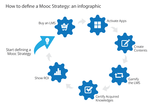
Start by defining your strategy
In the image below, you can see our six basic steps to building an effective strategy:
Get started
To try this out using Docebo, activate the Docebo free trial here, and then start customizing your system by activating these apps:
Courses catalog;
E-commerce;
Gamification;
Once completed, follow our suggestions on how to make your LMS an open system, and then start creating content by adding videos and allowing learners to leave comments.
Engage your users by creating a gamification system inside your platform: learners will be motivated to complete as much content as possible in order to rise in rankings.
Create a template for the certificates that users can earn once they complete the required content.
Remember, the goal is to monetize your business! In order to do that, you should create a Business Intelligence System to measure the ROI of your platform.
The following simple steps allow you to create a complete and effective MOOCs program
How to manage free self-registration
To activate self-registration, select the Admin icon from the sidebar and choose the Advanced settings option. You will be redirected to the Advanced settings page, where you will select Self-registration from the menu on the left. Select Free self-registration and set the following options:
Add a registrations and lost passwords email sender;
Choose if you want to send a confirmation email to the users or not;
Establish a limit for the expiration of the subscription request;
Decide if first and last names are required, if the privacy policy is accepted, and if you would like to use an advanced registration form;
Once you have completed these options, click Save.
Let’s see how a user can register and access the platform:
Once on the login page, they will see the register button, shown as in the picture below.
To register into Docebo, the user must fill in the form according to the settings you have selected.
Docebo also offers moderated self-registration if that is preferred!
How to create and add content
Docebo allows you to add new contents of any kind by structuring them into one (or more) root "courses" (i.e. baskets of raw contents).
The best strategy for a MOOC library is to create one course for each piece of raw content you wish to make available to your end users. Each user will be then allowed to structure his/her own learning path by selecting courses from the library according to his/her own specific training needs.
How to create a course
Docebo allows you to create, and categorize courses quickly and easily. By using a single interface, you can create the course, change the layout at any time, upload, manage contents, and much more!
Select the Admin icon from the main menu, and click Course from the E-Learning area.
To begin, click the New Course tab.
Add the course name, and choose an image.
In order to turn your Docebo platform into a MOOCs system, make sure you provide a very clear description of the course when you are creating it so that users can decide if they are interested in the course or not. Please note that the description will be visible in the public catalog.
Once you are finished, click Confirm.
The course you have created will appear in the courses list.
From here, you are now able to manage it.
You can also set advanced options in the Docebo Course Management area, where you have an Advanced Settings section. There you can:
Edit course details: change the language, associate a label to the course, and if necessary, assign a certain number of credits and a difficulty level.
Set catalog options: decide who can see this course, choose a max subscription quota, if overbooking is allowed, add demo material, establish a subscription’s availability, and set the enrollment policy.
Manage the E-commerce tool: decide if you would like to sell the course and establish its price. This tool is available only if you have activated the E-Commerce APP.
Set time options: decide if the course will be visible always, or if it will be valid just for a determined number of days.
Associate a certificate to the course
Once you have created your courses, you can start to add content; then create catalogs to maximize the ROI of your MOOCs. You can add certificates, gamification, and use sophisticated reporting to monitor the ROI of your MOOCs investment. By simply configuring the Reports option, a fully-fledged reporting section can be set up within minutes.
To read in further detail how to build MOOCs using the Docebo LMS, please consult the online manual.
Now you are ready to start your MOOC’s project using your Docebo LMS! If you’d like to test-drive Docebo for yourself, sign up for a free 14-day trial or contact one of our consultants directly!
The post Creating MOOCs with Docebo LMS appeared first on Docebo.
Docebo e-Learning Blog
.
Blog
.
<span class='date ' tip=''><i class='icon-time'></i> Jul 15, 2015 05:54am</span>
|
|
We will be showcasing Docebo 6.4 and our latest Mobile apps at the Training & Development Show ME 2014 at the Dubai World Trade Centre, in stand 245, on December 8 and 9.
Claudio Erba, Docebo’s CEO, will also be speaking on the subject of ‘E-learning in the Middle East: trends and user cases’ on December 8th, from 1-1.30pm in Theater 3.
Come check out our recently launched apps for mobile learning - Docebo Mobile for iOS and Android. To learn more about this release check out this blog post.
"If you’re coming to the show, please call in at the Docebo stand - number 245 - to see an example of what is, according to independent U.S.- and U.K.-based LMS analysts, one of the world’s top LMSs. Docebo staff will be delighted to discuss with you how your organization can improve its operational efficiency with help from a top-performing LMS."
Josh Squires, Docebo’s Chief Operating Officer, EMEA
If you would like to make an appointment with one of our consultants at the show and/or see a demo, please contact us.
The post Meet us @ Dubai’s Training & Development Show, Dec 8-9 appeared first on Docebo.
Docebo e-Learning Blog
.
Blog
.
<span class='date ' tip=''><i class='icon-time'></i> Jul 15, 2015 05:54am</span>
|
|
Massively Open Online Courses (MOOCs) without a doubt are one of the hottest topics within the eLearning world. Having recently wrapped up moderating an online panel discussion on MOOCs I felt it would be a great opportunity to jump in with a blog post that includes my personal opinions on where the MOOC concept stands and possibilities for the future.
To begin I would like to offer a heartfelt thanks to our Panelists: Aaron Silvers of MakingBetter™, Erica Leblanc with Thomson Reuters, John Leh of Talented Learning, and Michael Orey with the University of Georgia, for providing an articulate and very informative discussion about a wide range of MOOC topics.
There were a few topics that while covered in the webinar I feel still may cause some confusion and disagreement in the larger community. There is a lot of mixed branding in our industry about what constitutes a MOOC and about MOOC offerings within corporate America and I wanted to take some time to provide my opinion. Many industry pundits are using the term MOOC almost synonymously these days with any elearning course that they are offering. I feel that this should be reevaluated.
The functional definition of MOOCs are Massively Open (large enrollments and free) Online Courses (web based curricula) and I feel that everyone can easily accept this definition as it is exactly what MOOC stands for. My concern is that we see many groups trying to apply the "hot label" of MOOC to their traditional eLearning and while I understand the marketing value of doing this I feel that it may be done under false pretenses. The "working definition" of a MOOC is very narrow and very specific and in my honest opinion not a very great fit for most corporate practices as it is very difficult to monetize the free nature of MOOCs. Most of our panelists touched on this point as well.
If you’d like to view the panel discussion on MOOCs from Academia to Corporate click here
Now many of you will probably debate my definition of MOOCs saying that they have evolved beyond the original definition and now have taken on a life of their own naturally evolving according to market influence. I would also agree with this point of view maintaining that definitions are important as long as the wide body of users of the definition maintain a shared meaning. The only exception I will take is that many groups are using traditional eLearning courses and promoting them as MOOCs. To these I will say all MOOCs are eLearning but not all eLearning are a MOOC!
Definitional philosophy aside, if we widen the scope a bit on what a MOOC is, there really are some interesting points on how to utilize a MOOC framework within corporate America both from implementing existing MOOC curricula as a model of professional development or building one for internal and external stakeholders within your existing infrastructure.
We see many corporate groups offering Massively Online Courses (MOC) at a cost and doing it very successfully in a B2B/B2C (Business to Business/Business to Consumer) model that really works. The main difference between these and the traditional MOOC model is these are usually for targeted skills and typically aren’t constrained by a defined time model (and usually cost money). They also don’t have the level of discussion-based engagement that most of the traditional MOOCs offer (connectivest design model). While these don’t fit a traditional definition of a MOOC they none the less have a Massive reach, are offering Online Courses and are market influencers in their industry (think Skillsoft, Lynda.com, or Cegos). While they don’t fit the traditional definition of a MOOC as all are offering courseware for a fee to be used according to your needs, they come close (especially in the Massive department). Most importantly these courses are professionally designed with Instructional Designers, Developers, and Subject Matter Experts all contributing to the product, where many MOOC courses are just videos of a Professor pontificating on their subjects (though the above mentioned lack in the social components). You also have Udemy which bills itself more of a learning meetup platform allowing experts to build courses to offer either for free or a fee to students interested in their topics. The question then arises are these MOOCs or just examples of eLearning.
As business ideas go these are all very successful. Implementing a MOOC concept within your organization however will require some thought as the biggest question really should be: do I want to build a MOOC or just offer some really good eLearning to my team? There is a difference!
For those of you who want to get some practical tips and understand more of the functionalities of how to build MOOCs - or just really good eLearning - we are going to be holding another MOOC webinar in the first part of Quarter 1 2015. During this webcast we will have our experts discussing some practical applications of corporate MOOCs as well as some tips on how to build one and some best practices in building out really good eLearning. In addition we will have a Q&A session at the end in which we will engage directly with our audience on some best practices in building engaging eLearning to promote as a MOOC or leaving it alone and promoting it as engaging eLearning.
To be notified of this upcoming webinar, please sign up for our newsletter!
Author: Josh Squires
Josh Squires is currently serving as the Chief Operating Officer of Docebo EMEA. Josh has spent the past 15 years researching and implementing creative learning solutions within corporate and higher education environments. With clients ranging from Motorola to Disney, he has been on the designing and implementing stage of a wide range of learning scenarios with customers spanning the globe. Josh has also taught Instructional Technology theory and tools as a consultant and faculty member for over 8 years in both Corporate and Higher Education environments.
You can contact him directly at josh.squires@docebo.com or connect with him via LinkedIn
The post Is it a MOOC or just eLearning? appeared first on Docebo.
Docebo e-Learning Blog
.
Blog
.
<span class='date ' tip=''><i class='icon-time'></i> Jul 15, 2015 05:53am</span>
|
|
The Middle East is going through a very delicate yet complicated period. After 30 years of great wealth derived from oil exportation, the time has come to innovate in order to guarantee a stable future in, and for, the region.
As Claudio Erba, CEO of Docebo, explained during his speech at the "T&D Show Middle East 2014" in Dubai, it is now crystal clear that real market leaders distinguish themselves from others by offering outstanding training in their organizations. We offer more insight into the Middle East’s elearning and mobile learning market in this infographic.
[/vc_column_text] During yesterday’s speech Claudio presented many useful statistics on the elearning and mobile learning markets in the Middle East, quoting the two reports published by Docebo this year: "E-learning market trends and forecast 2014-2016" and "Learning on the Go: trends and tips in mobile learning".
If you would like to take a look at either report, you can download them for free here:
E-learning market trends and forecast 2014-2016
Learning on the Go: trends and tips in mobile learning[/vc_column][/vc_row]
The post Reflections on Dubai’s Training & Development Show appeared first on Docebo.
Docebo e-Learning Blog
.
Blog
.
<span class='date ' tip=''><i class='icon-time'></i> Jul 15, 2015 05:52am</span>
|