Blogs
|
A great evening was had by all at the 2014 E-learning Awards Gala Dinner in London on 6th November. Sponge UK took the E-learning Development Company of the year award on their 10th anniversary which was really great to see. For all the other winners see E-Learning Age magazine (the award organisers). Entries for the 2015 awards open from February 2015. Now what project could I enter I wonder?
All the winners here: E-Learning Age list of winners
The post E-Learning Award Winners 2014 appeared first on Designed For Learning.
John Curran
.
Blog
.
<span class='date ' tip=''><i class='icon-time'></i> Jul 15, 2015 06:06am</span>
|
|
If you're interested in learning games or gamification, you'll like this insightful interview with the author of Playful Design, John Ferrera.Post from: The eLearning CoachELC 018: Designing Awesome Game Experiences
Connie Malamed
.
Blog
.
<span class='date ' tip=''><i class='icon-time'></i> Jul 15, 2015 06:06am</span>
|
|
Articulate excel when it comes to product support. In the early days of Articulate Presenter the tool was fairly basic and there were a number of competitors with similar feature sets so the guys at Articulate realised early on that if they were to stand out in the marketplace then they needed to help customers use it effectively. This support extended way beyond simply using the tool (the button pressing) and really helped those new to e-learning explore how great e-learning gets made. Today Tom Kuhlmann, Jeanette Brooks and David Anderson are stars in their own right because they have helped elevate Articulate and Storyline 2, to be the authoring tool of choice. When it comes to learning as content marketing Articulate are practitioners par excellence.
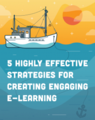
And now they have launched a great new e-book: ‘5 Highly Effective Strategies for Creating Engaging E-Learning‘ a great guide for those just getting started with developing e-learning or for those who already have some experience under their belt.
It’s broken down into five key sections (obviously) along the following lines:
How to Build a Compelling Visual ExperienceA great introduction to the basics of good graphic design.
How to add Meaningful InteractionsA really useful overview of what constitutes a proper learning interaction
How to let Learners Pull ContentA wonderful exposition of the ‘in at the deep’ end approach with a great defence of the ‘don’t lock navigation’ ideology.
How to Engage more Senses with VideoJust some really useful practical stuff on making and incorporating video and screencasts.
How to Add Fun Gaming ElementsA useful (but quite short) section on gamification.
Download the FREE e-book here: 5 Highly Effective Strategies for Creating Engaging E-Learning
The post Great E-Learning Design Book from Articulate appeared first on Designed For Learning.
John Curran
.
Blog
.
<span class='date ' tip=''><i class='icon-time'></i> Jul 15, 2015 06:06am</span>
|
|
One of the most frustrating aspects of designing an eLearning course is choosing the color palette. The color palette refers to the limited and predefined set of colors you use in a design. If we only had 100 color choices, choosing a palette might not be a problem. But many scientists agree that people can […]Post from: The eLearning Coach8 Ways To Choose A Color Palette For eLearning
Connie Malamed
.
Blog
.
<span class='date ' tip=''><i class='icon-time'></i> Jul 15, 2015 06:05am</span>
|
|
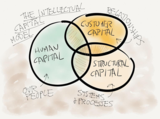
Organisations often say that ‘people are their most important asset’ but most don’t behave as if this really is the case. This manifesto explores why human capital really needs to be taken more seriously. It’s meant as a focus for discussion and debate - please comment, share and adapt as appropriate.
We believe that employees should no longer be considered as resources but as value contributor’s in their own right. Human Resources (HR) should accordingly be re-named Human Capital (HC) and like other forms of capital should be monitored and valued as part of the organisation’s total value.
"Human capital is the stock of competencies, knowledge, social and personality attributes, including creativity, embodied in the ability to perform labour so as to produce economic value." Wikipedia
Strategy
We believe HC should sit at the board table and help set strategy. HC believe that people are the key drivers of value in any organisation. Developing people and developing the organisation go hand in hand. You can’t do one without the other.
Commercial
We believe HC have to be commercial. This means understanding how the organisation makes money and spends its money. It means understanding the key metrics that the organisation uses to measure financial success. And it means being able to recognise how HC strategies and tactics impact on those financial metrics. HC is a key element of an organisation’s intangible assets and is therefore a key determinant of an organisation’s market value.
Customers
All organisations must ultimately be accountable to their customers. We believe that HC should understand the nature of the customer experience and work to improve it through the organisation’s people whether they work in a direct customer facing role or in a back office function. Customer experience is about customer centricity and this is key to every service or product that we deliver to our customers.
Systems Thinking
HC must be connected, joined up and integrated. It must work across silos and see the organisation as a living interconnected system. Working with other functions (e.g. operations, marketing etc.) to improve the overall system is the ultimate goal of HC.
"Systems thinking is the process of understanding how things influence one another within a whole. In organizations, systems consist of people, structures, and processes that work together to make an organization "healthy" or "unhealthy"." Wikipedia
Autonomy
The modern workplace has flatter structures resulting in more autonomous workers and these smart workers need smarter support from HC. People now want to take control of their own development. HC must switch from organising and delivering training courses to scaffolding a broad range of learning interventions that are open and accessible in the workflow. HC need to move from directing to orchestrating.
Learning
HC believe that the time has finally come for the learning organisation. We believe that learning in all its myriad forms (formal, informal and social) should be in the DNA of our organisations. Only by being a true learning organisation can we succeed in today’s global knowledge economy.
"Organizations where people continually expand their capacity to create the results they truly desire, where new and expansive patterns of thinking are nurtured, where collective aspiration is set free, and where people are continually learning to learn." Peter Senge
Social
We believe social media is a catalyst for change, changes to the ways we work and the ways we engage with our colleagues and customers. We believe that our organisations must have social in their DNA.
Authenticity
We believe that we should be true to our values and adopt an open and transparent approach to our interactions with colleagues, partners and customers.
Creativity
We believe that HC must look for creative and innovative solutions to business performance problems. HC must inspire and innovate and lead by example.
Technology
HC need to embrace technology and use it appropriately. We must be comfortable and adept at procuring and using technology to aid human performance improvements. We believe HC will have increasing ownership of technology and not defer all technology decisions to IT.
Analytics
We believe that evaluation and analytics are the best way to guide our development efforts. If it makes a difference we can measure it, evaluate it and review future strategy and tactics based on our measurements. What gets measured gets done.
FLAT: to be on a level surface, not in a hierarchy ARMY: a large group of people who share similar aims or beliefs FLAT ARMY: an unobstructed flow of corporate commonality.
Dan Pontefract’s Flat Army
Download a PDF version of The Human Capital Manifesto
The post The Human Capital Manifesto appeared first on Designed For Learning.
John Curran
.
Blog
.
<span class='date ' tip=''><i class='icon-time'></i> Jul 15, 2015 06:05am</span>
|
|
Before you send your eLearning on for a quality review, how well do you test it yourself? A self-check may seem like an obvious task, but some people pass on their eLearning courses for a quality check when the work is less than stellar. Within a few minutes, the reviewer or tester can tell it […]Post from: The eLearning CoachHow To Quality Check Your Own eLearning
Connie Malamed
.
Blog
.
<span class='date ' tip=''><i class='icon-time'></i> Jul 15, 2015 06:05am</span>
|
|
Good Practice have published a really useful report on the 70:20:10 framework. It covers both the pros and cons and also looks at some of the competing (but very similar) approaches such as Dan Pontefract’s 3:33 from his book Flat Army. Definitely worth a download and a read (you have to tell them about yourself before you get your hands on the report but it’s worth doing).
Next Friday 28th November we are running an E-learning Network event on ‘Social and Informal Learning‘ and will have a session on 70:20:10 from Charles Jennings and Charles Gould. Places still available at the ELN Web Site.
Get the report here: New Perspectives on 70:20:10
The post Formal or Informal Learning? A fresh look at 70:20:10 appeared first on Designed For Learning.
John Curran
.
Blog
.
<span class='date ' tip=''><i class='icon-time'></i> Jul 15, 2015 06:04am</span>
|
|
Find out how to design a learning environment to fulfill a specific need. These have the potential for providing a rich and broad learning experience.Post from: The eLearning CoachELC 019: Shifting To Learning Environments
Connie Malamed
.
Blog
.
<span class='date ' tip=''><i class='icon-time'></i> Jul 15, 2015 06:04am</span>
|
|
I missed Donald Taylor’s hangout with Elliott Masie from 5 December 2014 in London but it’s all been recorded and it’s definitely worth a watch. Covers MOOCS, mobile learning, wearables, personalisation and more.
The post Google Hangout on E-Learning with Elliott Masie appeared first on Designed For Learning.
John Curran
.
Blog
.
<span class='date ' tip=''><i class='icon-time'></i> Jul 15, 2015 06:04am</span>
|
|
How important is it to distinguish between hard and soft skills in the design of learning experiences? Many researchers think that it’s critical. The strategies needed to transfer hard skills, such as technical and procedural knowledge, can be quite different than the knowledge needed to develop soft skills, which involve interpersonal and intrapersonal (occurring within […]Post from: The eLearning CoacheLearning For Soft Skills: What works?
Connie Malamed
.
Blog
.
<span class='date ' tip=''><i class='icon-time'></i> Jul 15, 2015 06:04am</span>
|