Blogs
|
Recorded conversation with Julie Dirksen about how to improve our eLearning designs through user testing and better usability.Post from: The eLearning CoachELC 014: Are you getting any better?
Connie Malamed
.
Blog
.
<span class='date ' tip=''><i class='icon-time'></i> Jul 15, 2015 06:08am</span>
|
|
What do experienced instructional designers think is important when practicing instructional design? 25 heuristics listed.Post from: The eLearning Coach25 Rules Of Thumb Deemed Important In Instructional Design
Connie Malamed
.
Blog
.
<span class='date ' tip=''><i class='icon-time'></i> Jul 15, 2015 06:08am</span>
|
|
I contributed a video on ‘The e-Learning Revolution’ to Bitpod’s ‘In a Nutshell’ series. The script is shown below (it started out at 700 words but was trimmed to 300 to create just two minutes of video).
To be successful in today’s knowledge economy we need new ways to learn, ways that don’t rely on us turning up in a classroom with the teacher.
E-Learning has been around for a while but is often seen as the poor relation to learning delivered in the classroom. This view is rooted in the idea that ‘teacher knows best’ and without a teacher a class is incapable of learning. This position is misguided in two ways.
Firstly the quality of the classroom experience depends almost entirely on the effectiveness of the teacher. If you have a great teacher the learning is effective. If you don’t it isn’t.
Secondly it assumes that learners aren’t self motivated; that without a guide the learning won’t get done. In practice today’s learners are much more self-directed and they need a guide only occasionally.
E-Learning, if it is well designed, can be just as effective as classroom learning but it does have different strengths.
Undoubtedly the single biggest advantage of e-learning over the classroom is efficiency. If you need one thousand people in your organisation to learn something quickly, then e-learning is the only realistic solution. That’s why pretty much all basic compliance training is done online.
E-Learning is also tremendously flexible - its available 24/7 and accessible pretty much anywhere - in the office, at home, or on the train to work. This always-on capability has fuelled the growth of e-learning and the demand for what is called just-in-time learning - learning that’s available at the moment of need.
E-Learning is also cheap - an e-course is typically a quarter of the cost of a day in the classroom. That’s Buy One Get Three Free in the language of Tesco or Walmart.
That’s a powerful driver for the e-approach.
The post The e-Learning Revolution appeared first on Designed For Learning.
John Curran
.
Blog
.
<span class='date ' tip=''><i class='icon-time'></i> Jul 15, 2015 06:08am</span>
|
|
Reviews of some fascinating books to read this year.Post from: The eLearning CoachBooks For Learning Designers To Read In 2014
Connie Malamed
.
Blog
.
<span class='date ' tip=''><i class='icon-time'></i> Jul 15, 2015 06:08am</span>
|
|
Ellen Wagner, Ph.D., demystifies big data and explains how it can help the learning and development function make better, smarter decisions.Post from: The eLearning CoachELC 015: Don’t Fear The Data
Connie Malamed
.
Blog
.
<span class='date ' tip=''><i class='icon-time'></i> Jul 15, 2015 06:08am</span>
|
|
I’ve put my name forward for a position on the Board of the eLearning Network (ELN). I’ve always been an active member of the ELN and it has done a lot to promote e-learning in the UK especially in the corporate world. Not sure how much work is entailed if I get appointed/elected but hopefully it will be enjoyable!
Here’s my 100 word manifesto (100 words is not very much):
I’m passionate about e-learning because it combines two subjects I love - learning and technology. I’ve been in e-learning since the early days. Initially it was tough trying to get people to switch to new ways of learning - the classroom was seen as the only place where real learning took place. But things have changed. The web has revolutionised the way we do things and it’s now revolutionising the way we learn. This is a great time to be involved in e-learning and I’m keen to help spread the love as a board member of the ELN!
The post e-Learning Network Board Member appeared first on Designed For Learning.
John Curran
.
Blog
.
<span class='date ' tip=''><i class='icon-time'></i> Jul 15, 2015 06:07am</span>
|
|
As designers of learning experiences, we’re tasked with identifying the characteristics of the target audience. We discover their job responsibilities, prerequisite knowledge and interests. Our purpose is to understand them well enough to "connect" so that the learning experience we create is relevant and motivating. While recently coaching someone who was new to the field, […]Post from: The eLearning CoachBe The Learner
Connie Malamed
.
Blog
.
<span class='date ' tip=''><i class='icon-time'></i> Jul 15, 2015 06:07am</span>
|
|
Thanks to everyone who voted I am now the Vice Chair of the E-Learning Network. We had our first Board meeting last week and there is lots to do in 2014 - not least increase the membership and ensure that the ELN plays as valuable a role in the e-learning industry in the next 10 years as it has in the last 10 years!
The post Elected as Vice Chair of ELN appeared first on Designed For Learning.
John Curran
.
Blog
.
<span class='date ' tip=''><i class='icon-time'></i> Jul 15, 2015 06:07am</span>
|
|
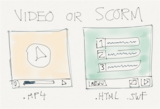
In case you may have missed it e-learning, or online learning as I prefer to call it these days, has gone mainstream. From YouTube to Lynda, from iTunesU to MOOCs everyone is learning online. But one surprising aspect of this frenzy of online learning activity is the simple fact that almost none of it uses SCORM. If you don’t know what SCORM is this probably won’t bother you, but if you’ve been involved in designing, building or buying conventional e-learning then you will know that SCORM is key to making e-learning work. If you build an e-learning module in a tool like Articulate Storyline and want it to work on your LMS it had better be published as a SCORM package. So if SCORM is so important how are LMSs like iTunesU or Udemy ignoring it completely?
To answer this we need to remind ourselves just what SCORM is. SCORM (Shareable Content Object Reference Model) was developed back in 2000 by the US Department of Defense as a way to standardise the way e-learning objects were built so that they could be shared on various platforms (LMS) and combined to create courses. Hence the shareable content object in the name. In practice, outside of very large organisations learning objects are rarely re-used. However the portability and interoperability was useful since there are many tools and ways to build e-learning and lots of LMS’ to put it on so what was particularly useful about SCORM was its role as a ‘connector’ technology. In practice this role is performed by the SCORM run time environment (RTE).
Link: SCORM Run Time Environment (RTE)
So why does the content need to connect or communicate with the LMS? Well there are two reasons. Firstly to track progress through the content and secondly to record a test score. The SCORM RTE uses JavaScript to handle this communication.
So back to our video. Is this able to communicate progress? No. is there a score recorded? No. Video has none of this functionality built in.
The other aspect of a typical SCORM e-learning module that is missing from video is learner interaction. Most e-learning is built using either Flash or HTML5 and is designed for interactivity. This isn’t a feature of SCORM but of Flash and HTML but it adds an extra dimension to content that isn’t available with video. Video is essentially a passive medium. As a learner you just watch it.
So why are iTunesU, Udemy and most MOOC platforms going with video and not supporting SCORM? There are two reasons. Firstly SCORM adds complexity. Secondly, and probably more significantly, SCORM is much less likely to run on mobile devices. Actually it’s not the SCORM that’s the issue but the interaction environment. Mobile devices don’t support Flash and they don’t always support HTML5 reliably either. Videos on the other hand will happily run on pretty much any device.
As a learning designer video’s lack of interactivity makes it a second rate choice compared to a SCORM module (what I call an iLesson these days). However if it’s combined with other learner activities such as assignments, discussions or quizzes then it can play a useful role within a course. And we are going to see a lot more innovation in video with interactivity already featuring on some platforms.
So does this mean that the days of SCORM are numbered? Yes it does, but it will probably take a while to die and it will be replaced by another very different middleware technology known as the Experience API (formerly TinCan) but that’s a subject for another article.
The post Video or SCORM? appeared first on Designed For Learning.
John Curran
.
Blog
.
<span class='date ' tip=''><i class='icon-time'></i> Jul 15, 2015 06:07am</span>
|
|
If you’re looking for strategies to make learning more engaging and effective, you’ll want to listen to this interview with Dorian Peters. She is the author of Interface Design for Learning: Design Strategies for Learning Experiences and Positive Computing. Dorian is an eLearning interface design evangelist. She currently directs online strategy for the University of […]Post from: The eLearning CoachELC 016: Strategies That Improve The Interface To Learning
Connie Malamed
.
Blog
.
<span class='date ' tip=''><i class='icon-time'></i> Jul 15, 2015 06:07am</span>
|