Blogs
|
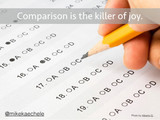
Comparison slide
This past week we went to WMCAT, a local arts center and students worked on final art pieces to related to gender equality and women’s rights. One of the options that students could do was fiber art and sewing. I was very impressed with one of the boys who broke the gender stereotype and was excellent at sewing. I checked in on a new fiber art group the next day and asked "who is the best sewer?"
Appropriately, the girl identified by her classmates as the best responded with the above quote, adapted from Theodore Roosevelt, "Comparison is the killer of joy."
It was a new quote for me and definitely got me thinking about how often we do this in schools…
Mike Kaechele
.
Blog
.
<span class='date ' tip=''><i class='icon-time'></i> Jul 16, 2015 11:32am</span>
|
|
Structures to "protect" us.
Schools are overwhelmed with structures. Almost all of them are limiting. Don’t go off script. You have to implement this curriculum or policy. All students must… Bell schedule, hallway passes, class periods, subjects, graduation requirements, AYP, school improvement plans, …
Most schools have layer upon layer of structures related to classroom management, behavior, standards, curriculum, assessment, and more. Almost everything structurally about school is designed to control either teacher, student or both.
My friend Kiffany Lychock uses the term "visionary vagueness." This is the idea that there needs to be space in institutions for great change to happen. Leadership at all levels needs to give people the freedom to experiment with ideas, new and old. So how to "structure" visionary vagueness?
PBL is one of the few structures that allows for creativity, teacher judgment, and freedom for both teacher and student. It respects teachers as professional designers of student centered learning and students as agents of their own learning. Some people think student centered learning is a "free for all" but that is not the case. At the other extreme some people may think that all structure is limiting. PBL destroys both of these misnomers. It provides structure and freedom at the same time.
PBL is a structure that gives freedom for people to be innovative and student centered. PBL lets people think structurally about innovation and changing schools.
If you are interested in learning more about the PBL process, please drop me a note on my contact page about my PBL workshops.
Mike Kaechele
.
Blog
.
<span class='date ' tip=''><i class='icon-time'></i> Jul 16, 2015 11:31am</span>
|
|
My students made a video to document how they took over the Water Project last year.
Mike Kaechele
.
Blog
.
<span class='date ' tip=''><i class='icon-time'></i> Jul 16, 2015 11:30am</span>
|
|
I like this short video 10 Expectations. It is what students should expect of schools and PBL meets these expectations very nicely.
Mike Kaechele
.
Blog
.
<span class='date ' tip=''><i class='icon-time'></i> Jul 16, 2015 11:29am</span>
|
|
This post is totally selfish and self promoting. Skip it if that offends you
I am excited to officially be a National Faculty member of BIE. BIE is a leader in professional development of Project Based Learning and I will be doing PBL 101 workshops for them in the summer. I am excited by this opportunity especially since it is part time and I will remain doing my true love-teaching in the classroom.
I also am available as a consultant for workshops on various topics ranging from PBL, Standards Based Grading, inquiry and student centered curriculum, and more. You can leave a comment or reach me on my contact page.
Mike Kaechele
.
Blog
.
<span class='date ' tip=''><i class='icon-time'></i> Jul 16, 2015 11:29am</span>
|
|
Creating a great culture in a school is no accident. The key is to build a community of trust, respect, and responsibility among teachers and students. Relationships matter. Without strong relationships, there can be no community.
There are also intentional activities that can be planned to help build school community at the beginning of the year. This is especially important if this will be your students first experience with PBL. I recommend not starting the year off with a PBL project or class content, but instead with activities to build community and expose students to the PBL process. Simple, mini projects that teach the structure of PBL help expose students to how PBL works. Then when you start your first project students won’t be confused by the process and the lingo and can focus on the content.
I created this document to share activities that have worked for my school at the beginning of the school year to create culture and introduce the PBL process.
Questions? PBL Consulting? I can be found at my blog michaelkaechele.com or @mikekaechele onTwitter.
Mike Kaechele
.
Blog
.
<span class='date ' tip=''><i class='icon-time'></i> Jul 16, 2015 11:29am</span>
|
|
I team teach American Studies, an integrated class of U.S. History and 10th grade ELA in a full time PBL environment. We have a daily, two hour block and students get two credits for it. This past year was our third year of this class. I often get asked about scope and sequence of the class. So I made a table overview of our class projects to give other teachers ideas of how to teach a thematic, PBL social studies class.
This is not meant to give out every detail of the projects, but rather to give ideas of themes, DQ’s, products, and audiences that others can adapt to their own local situation. I have also included some links to blogposts and other resources about certain projects. This is also my projects from last year only. My projects for next year will have some repetition and some new ones. I like to keep projects that go well and especially ones with good community partnerships. But I don’t like to keep everything the same as that gets boring for both me and students. Also the students change every year and there needs to be voice and choice each year.
Questions? PBL Consulting? I can be found at my blog michaelkaechele.com or@mikekaechele onTwitter.
Mike Kaechele
.
Blog
.
<span class='date ' tip=''><i class='icon-time'></i> Jul 16, 2015 11:29am</span>
|
|
In A Whack on the Side of the Head, Roger von Oech recommends being foolish to stimulate creativity:
Look at the problem before you and say, "It’s not what everyone thinks it is," and then give a different interpretation of what’s going on. Deny that the problem even exists, or maybe solve a different one. Doubt the things that others take for granted. Ridicule your basic assumptions. Expect the unexpected. Ask the stupid question that nobody else seems to be asking. Do whatever you can to shatter the established way of looking at things. You’ll find that it will stimulate your creative juices.
Where in school is there room for this kind of thinking? It won’t help kids on standardized tests. It might lower their grade on an assignment. Some teachers might feel disrespected or irritated.
It also might lead to new understandings of content and life. Students and teachers might come up with imaginative solutions to problems. As a side effect students might not be bored and might find school fun and relevant.
Mike Kaechele
.
Blog
.
<span class='date ' tip=''><i class='icon-time'></i> Jul 16, 2015 11:29am</span>
|
|
Susan Smith Nash
.
Blog
.
<span class='date ' tip=''><i class='icon-time'></i> Jul 16, 2015 11:29am</span>
|
|
In Memoriam: Amy WinehouseI'm feeling really devastated by the news of Amy Winehouse's death. The last three years have been a rollercoaster with more drops than rises. I loved her performances in the early years -- 2004 - 2007 (even 2008-ish). I could not bear to stand to watch the decline. It is tragic in many senses -- for Amy Winehouse personally, and in the way she is / was all of us, no
Susan Smith Nash
.
Blog
.
<span class='date ' tip=''><i class='icon-time'></i> Jul 16, 2015 11:29am</span>
|