Blogs
|
If the 21st Century had to be summarized in five words or less, most could agree on "The Age of Information." Between text messaging, social media, and the numerous chat programs floating around cyberspace, we have become a culture that rapidly interacts and shares new ideas on every platform available. That being said, blended training programs that incorporate these features often experience increased user engagement.
However, creating a blended learning program, and getting learners to embrace it, are two different beasts. We have listed a few quick tips below for building a community around your blended training, but feel free to contact us for additional ideas.
Setting Initial Expectations Early
It is not uncommon for employees to avoid speaking up and conversating within the training context. Hence why blended learning should use a community approach to create conversations among students early on. By creating group activities and encouraging deeper discussions, it sets early expectations for students to communicate.
Generate Attention-Capturing Lessons
Also, by utilizing content and mechanics that inspire communication you are likely to get learners more involved. Creating discussion both in the classroom and virtually is a great way to keep learners engaged. This is blended learning at its best, and these topics should be thought-provoking so users feel compelled to become a part of the conversation. By tying together both teaching styles, the US Department of Education shows that students/workers can greatly surpass the learning potential of traditional methods.
Likewise, the web training itself should be used as a catalyst to bring students together. Creating group assignments and activities is a great way to create new relationships, inspire collaboration, and is also a powerful learning tool. As long as these activities are engaging (and hopefully fun), students will see it as a positive growth opportunity and be more likely to interact.
Make Sure Training Evolves With Your Learners
By creating features like leaderboards, sharable badges and chat systems to keep users engaged, learners are far more likely to collaborate with others and remain engaged. The goal is to always have additional incentives in place before users meet every possible challenge, so there is additional room to grow and learn. Think of training as a living entity, it needs nurtured and attention to stay functional and beneficial.
For additional information on building a web training community or help with creating an E -Learning solution, feel free to call us at 866-316-9126 or contact us through our website.
Andrew Hughes
.
Blog
.
<span class='date ' tip=''><i class='icon-time'></i> Jul 16, 2015 04:43pm</span>
|
|
From boardrooms to warehouse floors, and call centers to dispatch vehicles, businesses large and small are discovering the capabilities gamification and E-Learning can bring. Whether a business seeks to motivate workers toward better customer service or create behavior change, gamification can aid in reaching those goals.
Check out what major media network, PBS, is saying about gamification.
From PBS’ Idea Lab - home of reporting on media innovations and start-ups - comes an interesting piece we discovered by writer Chris O’Brien on how to gamify the news for digital sources. Since many news sites are going towards a metered revenue system as a way of making money for their reporting it would be beneficial to keep users on their sites for an extended period of time.
As O’Brien explains it in his article entitled, How Can We ‘Gamify’ the News Experience?, "I’ve come to believe that over the next decade gamification will profoundly reshape the way we experience the web, to the same degree that social media and networks redefined the web last decade. To that end, I’ve been thinking in the broadest terms what that could and should mean for how we can reinvent digital news…Even if the term is new to you, the elements are probably not. Gamification suggests features like leaderboards, progress bars, rewards, badges, and virtual goods. Now that we live in a time where the majority of people play videogames of some kind, often many hours each week, it’s fair to say that these kind of features have become widely familiar...Think about how that could work at a news site that uses some kind of metered revenue model. Someone who is a free member gets to do 30 things: Read an article, post a comment, and contribute to a news task. When they run out of credits, they could ask their network for more credits. Or, they could buy some more."
The idea of using gamification for customer engagement is certainly a concept worth pursuing for businesses using a metered model of content consumption.
To learn more about gamification and how it can benefit your organization, contact us today!
Andrew Hughes
.
Blog
.
<span class='date ' tip=''><i class='icon-time'></i> Jul 16, 2015 04:42pm</span>
|
|
Designing Digitally, Inc., in partnership with two separate Universities, was presented Honorable Mention in the E-Learning and Blended Learning categories by the International E-Learning Association. The team at Designing Digitally, Inc. partnered with Rutgers University to develop an online learning experience like no other. Living Independently Virtual Environment (L.I.V.E.)," has been selected by IELA as Honorable Mention in the Blended Learning category of the 2014 International E-Learning Awards--Academic Division.
Also, in collaboration with Cuyahoga Community College, Designing Digitally, Inc. developed a 3D Simulation providing an immersive experience on how stress affects the body. The Tri-C 3D Stress Simulation was also selected as Honorable Mention in the E-Learning category of the 2014 International E-Learning Awards--Academic Division.
When notified of the honorable mentions, Andrew Hughes, President of Designing Digitally, Inc. stated, "We are honored to be acknowledged for our hard work and dedication to providing engaging learning experiences for our clients. We are thankful to have such great partners like Rutgers University and Cuyahoga Community College."
Both of these learning experiences are currently owned by the Universities and are being delivered to students via their learning managements systems.
About The International E-Learning Association (IELA)
International E-Learning Association (IELA) is dedicated to advancing the knowledge and practice of e-learning in schools and universities, and in the workplace. With members hailing from every continent —and from the realms of business, industry, government, and academia— the IELA is a vibrant and diverse community of e-learning professionals, researchers, and students.
About Designing Digitally, Inc.
Designing Digitally, Inc. is a full-service E-Learning development firm and serious game developer. Located in Franklin, Ohio, Designing Digitally, Inc. has developed a number of serious games and simulations, virtual worlds and E-Learning solutions for corporations, Universities, and government agencies across the globe.
Andrew Hughes
.
Blog
.
<span class='date ' tip=''><i class='icon-time'></i> Jul 16, 2015 04:41pm</span>
|
|
While it would be a great benefit to educators if there was a "one size fits all" type of learning style where all students thrive, that’s simply not the case. Hence why schools and businesses have used variations of blended learning for some time now; there is simply no way to predetermine which students will respond better to visual aids, direct interaction, lectures, independent study or dozens of other forms of teaching. By combining these styles of teaching into one highly flexible lesson plan, however, it is much more likely no student will be left behind.
Here are a few of the more important considerations to create an effective blended learning course-
Specific Institutional and Learner Requirements
One of the most important aspects of designing any blended learning course is to ensure it meets the organization’s ultimate needs, from both a technical and an educational perspective. This can only happen by performing an in-depth analysis of existing hardware/software technologies, plus gaining an understanding of how the learning courses will be distributed and ultimately used by potential students. These types of insights will directly affect what design elements are chosen and how they can be implemented the client’s with existing technologies.
Understanding the student’s specific learning needs is also an important aspect to consider, because this will also help determine which types of blended learning models will be the most successful. For example, if part of the student’s overall training objective is to become proficient with operating certain types of equipment or machinery, then it would make sense to include a simulation to offer practical experience.
Learning Management Systems & Compatibility
Once the various delivery methods are decided, then the next step is to select the proper learning management platform that will handle all of the organization’s needs. Since there are a number of viable learning management systems (LMS) available with varying levels of security, accessibility, management levels and other considerations, it is important to select an option that ensures 100% compatibility with the technology and the various learning courses that will interact with it.
Likewise, the actual management of a blended learning course is another consideration since there will be decisions to be made regarding scheduling, registration and notifications. How resources are shared and delivered will also play a factor, as will the instructor’s level of interaction with the various learning formats.
Long-Term Evaluation and Expansion Possibilities
Since a blended learning course is a continually evolving system that tracks and evaluates each learner, the monitoring tools it provides instructors is critical for the program’s success. This could mean implementing a number of evaluation methods for different types of instruction so that feedback and adjustments can be made as quickly as possible. The system should also be expansive enough to allow for quick implementations of new courses as a need arises.
Of course, the main objective of any organization considering a blended learning course is to deliver great course content that stimulates the student and accelerates the learning process, which is exactly why so many organizations turn to us at Designing Digitally, Inc. For more information on creating an effective blended learning course or to receive a custom needs evaluation, please contact our staff directly at (866) 316-9126.
Andrew Hughes
.
Blog
.
<span class='date ' tip=''><i class='icon-time'></i> Jul 16, 2015 04:40pm</span>
|
|
In order for an E-Learning course to be effective, it is essential for the material to quickly capture the student’s attention in an interesting and engaging manner. This guide will shed some light on the matter and explain the easiest way to create a learning experience where students are engaged.
Use Explanations Only When Necessary
One, "not so best practice" in learning courses is to open with a long dialogue about the expectations to be met throughout the course. The student already has a pretty good idea about what they will be learning, so overloading them with initial information is actually a counter-productive task. However, a brief introduction is a good thing; a lengthy, drawn out intro dialogue is not. In most situations, it is a lot more helpful to save the dialogues for when the student will actually need instruction; like when learning a new concept or completing a timed exercise.
Also, consider using optional tips and explanations that can be accessed by the student whenever he/she requires additional information to complete a certain task. That way, both fast and slow learners can work at a comfortable pace.
Meaningful Narration
Likewise, think a little bit about using a narrator in your eLearning course, especially if it will be to read instructions that are already on the screen. This may be helpful in some children’s learning courses or in situations where the tutorial gets a little tricky, but adults would much rather just read the information themselves and move on with the exercise. Since the average adult learner can read 3-5 times faster than a narrator’s voice, it just doesn’t make sense to use narration in all scenarios.
Then again, don’t be afraid to use narration when it will create a more immersive feel. For short stories, challenges and/or complex tasks, the narrator can become a very effective learning tool. Just reserve it for those types of situations and your students will appreciate the change of pace.
Make Objectives Fun and Engaging
Another common mistake in learning courses is to make the objectives dry and boring. While this is never intentional, it happens when a learning platform tries to over-prepare students for what they will be learning by giving far too much information. So instead of telling students what to expect or how to solve a problem, it makes a lot more sense to actually show them in an interactive way that holds their attention.
The true power within a serious game, E-Learning course or 3D simulation is the immersive feel that helps students feel connected and motivated to succeed. Objectives should be designed with these same goals in mind; they should offer a direct challenge that allows the student to quickly move from one goal to the next.
Challenge Students to Prove their Knowledge
While testing is always an important indicator of a student’s knowledge, it is also the least favorite activity of learners for obvious reasons. E-Learning presents the opportunity to change that, however, by creating hands-on scenarios where the "test feel" is virtually forgotten. In a well-designed course, users can show practical knowledge by being asked to demonstrate their comprehension as the lesson progresses, which makes the testing phases feel a lot more natural. It also allows more advanced students to quickly progress through basic tutorials by proving that they have enough knowledge to progress to harder stages.
One of our main goals at Designing Digitally, Inc. is to always find new and exciting ways to challenge students within our learning environments. For more information on capturing your employees’ attention, please feel free to contact us at 866-316-9126. Believe it or not, there are dozens of ways we can make learning fun within your corporation and we would love to share how.
Andrew Hughes
.
Blog
.
<span class='date ' tip=''><i class='icon-time'></i> Jul 16, 2015 04:39pm</span>
|
|
In today’s world, there are dozens of ways for companies to leverage emerging technology to train their staff members. It’s not always a clear-cut choice between them, however, because there are a lot of strong learning models out there that can perform well in a number of different corporate environments. This article will examine each of those online learning models to help better explain how their technologies can be utilized.
The Fundamentals of E-Learning
E-Learning is generally thought of as a text-driven type of user experience, such as an online classroom that many high schools and colleges now use. In recent years, however, e-Learning modules have incorporated many game-like elements to help the user become directly involved, plus it incorporates audio and video aspects to create an immersive feel. This type of learning can take place inside more of a traditional classroom setting or solely online (or a hybrid of both).
Large corporations usually prefer the E-Learning model when they are teaching large amounts of information to various departments, educational experience and skill levels. The learning segments can be broken into small, specialized modules as well so new topics can created and distributed quickly for important updates and requirements.
The Fundamentals of Serious Games
A serious game, on the other hand, creates an actual gaming environment to educate the user. These learning platforms are much more interactive as well, and many of the lesson plans are objective based to test the user’s ability to perform certain tasks. Serious games can also be implemented in a number of different play styles, which allows for almost endless customizations to meet a specific need or feel. In fact, some companies have serious games developed for advertising purposes to give customers a more enjoyable experience. The Domino’s Tracker is an excellent example.
Since serious gaming can be used for a number of different purposes in corporate training, it is an excellent choice for virtually any industry. For instance, using a game to teach sales techniques where users must assemble the proper response to a prospect objection. If you are looking for a way for your employees to have fun while learning, it would be hard to find a more perfect solution than serious gaming.
The Fundamentals of 3-D Simulations
When it comes to 3D simulations, users are fully immersed into an environment where the game mechanics mimic real world situations. While there may be some gamification involved, the main focus is having users complete tasks as they would on the job. 3D simulations are especially helpful when dangerous situations or expensive equipment is involved.
There are a number of businesses that benefit from the use of 3D simulations due to the immersive nature of the training. Since they allow employees to complete tasks without facing the real-life consequence of failure, it is a popular choice with the military, healthcare, construction and hundreds of other fields.
For more information about online corporate training methods, please free to contact one of our specialists that will gladly walk you through the design and implementation phases. You can also view our E-Learning Portfolio to get a better feel for each of our learning solutions and how they can be designed for your corporation.
Andrew Hughes
.
Blog
.
<span class='date ' tip=''><i class='icon-time'></i> Jul 16, 2015 04:39pm</span>
|
|
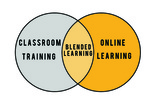
Blended learning is an excellent way to teach students since it overcomes so many of the traditional obstacles associated with the educational field. By offering instruction both online and in the classroom, learners are able to work through content on their own time, as well as receive person-to-person instruction. There are many benefits to a blended learning environment, we will discuss a few in this post. To learn more about blended learning for your organization, give us a call 866.316.9126
What is Blended Learning?
Blended Learning is a form of education where the student receives at least part of their formal instruction in a digital format. This could include learning through serious games and simulations, by completing eLearning courses over the Internet, or a combination of technologies. Students would also have access to an instructor that would teach them in a traditional classroom setting or through a virtual training system. Additionally, blended learning is often objective based coursework that can allow students to accelerate or slow down their studies as needed.
Below, we have listed a number of benefits blended learning provides-
Enhanced Planning and Flexibility
One of the largest benefits of blended learning is the freedom from regular school/work hours and travel requirements. Since some of the instruction is done online, students are free to choose when to study and how to access the learning material. Tools like online chat forums and video conferencing can add even more levels of freedom so that some classes can be taken from anywhere, and at any time it fits the student’s schedule.
In situations where learners attend traditional training for part of the day, blended learning also has a number of distinct advantages. With much more flexible class schedules and the ability to substitute online course-work with in-person tutorials, students can ultimately decide how to master the subjects they are studying.
Ability to Choose Learning Styles
While it has long been proven that some students learn better inside a traditional classroom while others are stronger with independent-study, blended learning ultimately lets the student decide which combination of learning styles works best. Since one-on-one interaction with the instructor is always available, students feel much more comfortable in completing coursework on their own or with a group of peers. Recent studies have shown that blended learning students also tend to become more independent, better critical thinkers and stronger with time-management as well.
Reinforced Lesson Plans
Another large benefit of blended learning is the instructor’s ability to reinforce complex lesson plans with an in-class discussion or assignment. Let’s say an instructor notices a large part of the class did poorly on an online assignment, for example. Instead of starting the next lesson plan, that instructor can easily reinforce the parts of the lesson that students are struggling with…without having to start all over from the beginning. On the other hand, when students demonstrate they have a solid grasp on certain concepts, the teacher is able to focus classroom exercises elsewhere to maximize learning potentials.
Better Feedback from Instructors
Believe it or not, a lot of instructors vastly prefer the blended learning model as well because it allows them to give much more detailed feedback to students. Since only a portion of the coursework takes place inside a classroom, teachers have the freedom to dedicate part of their day to chatting individually with students, holding group discussions and/or tutoring students who are struggling with the course material. That’s primarily the reason why blended learning reports better overall grades; the instructors actually have the time to make a difference in individual students without having to worry about neglecting the rest of the classroom.
For more information about blended learning or to discuss what eLearning options can be made available for your organization, contact Designing Digitally, Inc. at 866-316-9126 or contact us through our website.
Andrew Hughes
.
Blog
.
<span class='date ' tip=''><i class='icon-time'></i> Jul 16, 2015 04:38pm</span>
|
|
Try Avoiding These 5 Mistakes in E-Learning
Beginning a new E-Learning project is an exciting time. Project sponsors are anxious to see their ROI, management teams are ready to exceed expectations, and development teams are eager to bring their innovative ideas to life. However, rushing into the project without appropriate planning can cause catastrophic problems. Take the time to start projects on the right foot and avoid these five common mistakes:
Unrealistic Goals/Deadlines
An initial step in any E-Learning project is to outline goals and project deadlines. Unfortunately, this first step frequently leads to the first major mistake: setting unrealistic goals and deadlines. Development and management teams are destined to fail if they are frantically trying to hit an impractical target.
Establish a clear line of communication among the investors, management team, and development team. Often times, team members are happy to compromise once they understand everyone’s perspectives. The project manager must mediate until the teams agree upon a realistic set of objectives and milestones. A project can proceed only after the goals and deadlines align with the project budget, meet the investors’ needs, and are attainable by the development team.
Trying To Include Too Much Content
A second common mistake is overloading an E-Learning project with too much information. Dumping loads of irrelevant content onto a learner causes confusion and frustration. Carefully analyze the learning objectives. Can some be removed? Could the projected be divided into two parts? Should information be organized differently? The project manager should focus on streamlining the content in a clear and precise manner. Create an experience for the learner that is accessible and easy to follow.
Lack of/Poor Interactivity
A lack of interactivity is possibly the biggest mistake in the development of an E-Learning project. Most companies choose the quickest and easiest path of development, ignoring the need for a feature-rich project. They create projects comprised of on-screen text with a few basic graphics sprinkled here and there. Learners mindlessly click through the program absorbing little, if any, knowledge. The disengaging E-Learning project provides mediocre performance results at best.
Instead, commit to develop an interactive course that pulls the learner into the content. Incorporate effective features such as quizzes, videos, games, and scenarios to captivate the learner’s interest. Not only will employees retain the knowledge, they will begin to look at E-Learning as a beneficial activity instead of a dreaded requirement.
Not Meeting User Needs
No one would expect a guy in his thirties to be interested in a phone app designed for toddlers. Yet, many corporations create training to "appeal to the masses" without any regard to the target audience. Projects that do not resonate with the audience end up being ineffective wastes of time and resources.
An E-Learning project should be tailored to meet the user’s needs. In the early stages of a project, ask who the users and learners will be. Discover their demographics and comfort level with technology. You may conduct meetings with a few members of the target audience or distribute a short survey. Design an E-Learning project that is compatible with the devices the audience uses and appeals to their interests.
Lack of Internal Marketing
A company is thrilled with their flawless E-Learning project. It achieves the defined goals, contains the right amount of content, provides appropriate interactivity, and meets the user needs. But, there is still a problem. No one is using the training.
Companies must internally market their training programs. Spread excitement about new E-Learning courses! A campaign could include rewarding the employees who complete the training, sharing positive testimonials from learners, or making a cardboard cutout of a character from the E-Learning to stand in the hallway. Create awareness among employees in order to see successful results from the E-Learning project.
Our thorough Needs Analysis and Design/Development processes ensure none of these mistakes creep into your E-Learning projects. Contact Designing Digitally, Inc. to discuss your training needs!
Andrew Hughes
.
Blog
.
<span class='date ' tip=''><i class='icon-time'></i> Jul 16, 2015 04:38pm</span>
|
|
While the term "performance support" is certainly not a new phrase, it definitely has a new feel in the workplace thanks to the advances in smartphones. In fact, it wasn’t too long ago when companies faced massive logistical problems when it came time to update their staff members on new policies and practices, and the costs alone from productivity losses made these training sessions a real nightmare. Mobile performance support provides training when and where it is most convenient.
Here are just a few of the major benefits of mobile performance support-
True Knowledge on Demand
One of the most convenient aspects of the Digital Age is that almost everyone uses a smartphone and carries it with them everywhere. While they are not ultra-powerful in terms of processing power, smartphones are reliable miniature computers that can easily meet the demands of today’s business applications; including all aspects of performance support as well. With responsive design features, it can also be delivered and implemented across a wide network of employees at multiple locations.
Readily Accessible on Numerous Platforms
A great benefit of mobile performance support is it can work with any of today’s popular digital devices for easy consumption. That means your employees can learn from the iPhones, tablets, Android devices or whatever they happen to have with them at the time, which makes it much more likely they will access the information when it is needed. Of course, your performance support can also be made compatible with laptop and desktop computers as well, which means your employees will have plenty of options when it comes to accessing information on the fly.
Audio & Video Enabled
Mobile performance support also makes implementing audio and video files a viable option for busy professionals. Since the information can be accessed anywhere, it allows users to "brush up" on product information and other types of knowledge when it is needed. Mobile devices also make the most of this technology so it is a huge win/win for employers that prefer to share information across a number of mediums.
Offline Storage Capabilities
Finally, mobile performance support works because users can store frequently used information on their smartphones and access it whenever a need arises. Without the constant need for an internal network, this makes knowledge bases accessible at anytime, anywhere…even if your staff is pitching to a client in the middle of nowhere.
Utilizing mobile devices for performance support is a great way to keep vital information easily accessible at any time. Whether an employee needs to brush upon product specs on the way to a sales meeting, or look up a software tutorial a the office, mobile performance support is there when employees need it.
To learn more about mobile performance support, contact us!
Andrew Hughes
.
Blog
.
<span class='date ' tip=''><i class='icon-time'></i> Jul 16, 2015 04:37pm</span>
|
|
In the world of software design and E-Learning, getting to know your end-users is critically important for a variety of reasons. Take an average mid-level business, for example- there will be employees that encompass various age groups, professional backgrounds, reading levels, computer proficiency levels, and dozens of other demographics that will define how each user learns. While it is certainly a challenge to cater to all of these audiences at once, there is a number of ways to accomplish this task.
How Do Learners Really Learn?
To compound those problems even further, there is no definitive blueprint on how individuals learn. Some students may be highly visual people who have to see the concept to understand it. Others may learn better through repetition or with instruction that shows the same concept several different ways. Designing an E-Learning title all comes down to anticipating the various needs of the students involved, and then executing a plan to meet those needs as thoroughly as possible.
Since the goal is knowledge retention, a needs analysis is always the first step in getting to know your audience. In fact, absolutely nothing should be taken for granted during this initial process. Should the narrator speak like a college professor, for example, or should he sound a lot more informal like a co-worker would? How much industry jargon should be incorporated? Seemingly tiny decisions like these can have profound effects on the learning process.
Overcoming the "Curse of Knowledge"
Another problem in the educational segment is overcoming the "curse of knowledge" within certain genres. For instance, when an individual is so familiar with the industry/segment, they make assumptions based on their own experiences because they cannot "see the other side." Their expertise can actually become a curse because the information delivered is far too technical or advanced for a novice to understand.
So how do you ensure that you’ll avoid the curse of knowledge in your training efforts? There are several ways to avoid this pitfall, and each of them starts with taking a step back and identifying who the training is ultimately being designed for. If it is for new hire employees, for example, then industry jargon or company procedures would need to be explained and outlined in detail. Whereas, the same training for senior level employees may have an entirely different tone/feel since much more can be discussed without extra clarification.
Catering to Many Different Viewpoints
Besides seniority levels and industry experience, there are also a number of other differences to consider when training employees. A few of them are-
Educational backgrounds
Overall reading/writing levels
Computer proficiency
Age levels (and emotional maturity)
Preferred learning styles
One of the areas that we really pride ourselves on at Designing Digitally, Inc. is taking the time to get to know your students and all of their unique learning requirements. By working alongside each corporation as a partnership, we have a very long history of delivering the perfect training solution that exceeds our clients’ training needs. For more information, please contact us directly at 866-316-9126 or request a free quote.
Andrew Hughes
.
Blog
.
<span class='date ' tip=''><i class='icon-time'></i> Jul 16, 2015 04:35pm</span>
|