Blogs
|
Serious educational games have changed the way individuals learn, obtain information, and develop various skill sets. Serious games are more than just a form of entertainment; they are a strategic tool that educators and business owners alike are using. Games not only promote increased learning and give people realistic scenarios that work to improve their overall skill set and understanding of a specific subject, but they do so in a way that is entertaining and engaging. Integrating game-based learning practices into classrooms and businesses allows for information to be delivered in a way that is highly interactive and accessible to users 24/7.
Learning Through Engagement
Serious educational games are immersive and require a higher degree of engagement than traditional training and learning tactics. Games provide rewarding, safe, and relevant learning environments that allow users to put into practice what they have learned. Users are motivated and encouraged throughout the duration of the game, typically through a reward system that helps them advance while learning new skills.
The high level of interactivity that is a characteristic of game-based learning is both fun and effective. Serious educational games are often games of strategy that help develop excellent problem solving abilities and other skills that can be used in the workforce and everyday life. Because these games require engagement and use thought-provoking tactics, they work to deepen an individual's knowledge, skills, and competencies.
Personalized Learning Paths
Another bonus to game-based learning and a reason why serious games are, in essence the future of learning, is the ability to individualize each and every experience. Smart phones, tablets, and laptops allow for online learning that can be pursued at a different time and pace for each person. The Internet gives students and employees the option of playing whenever is convenient, as long as there is an Internet connection available. This is important because, as everybody learns differently, serious games give individuals a way to personalize their learning path. Additionally, game-based learning is effective because it promotes learner control, allowing people to go back and redo a complex task or portion of the game that they may have struggled with.
Promotes Necessary Knowledge Skills
Lastly, game-based learning is important because it uses and promotes technologies that are shaping the future. Because of the velocity in which technology has become such a huge part of virtually every aspect of our lives, it is no wonder that the skill sets and problem-solving abilities of employees and new graduates must change.
These changes mean that people must now work smarter, understanding the global implications of technology and learning new ways to communicate, make decisions, and address larger societal problems. Serious games promote these new skills by serving as an intelligent and practical way to train individuals on what is most current and relevant. As this is ever-changing, the role of serious games will continue to play an integral role in how knowledge is obtained.
A study performed by the University of Colorado Denver in 2010 showed that individuals who received classroom or workforce training through games not only were able to perform their jobs better, but they had a higher retention level of information. This shows the positive effects of serious games and that people respond better in scenarios that actually require them to put theory into practice. It is no secret that playing often translates to learning, which is why games have become such a significant learning tool. Games allow individuals to play smartly through connecting, engaging, strategizing, and problem-solving, all of which are necessary, important skills in everyday life.
Contact Us today for more information about serious educational games. Or, get a Free Quote.
Andrew Hughes
.
Blog
.
<span class='date ' tip=''><i class='icon-time'></i> Jul 16, 2015 04:58pm</span>
|
|
Designing Digitally, Inc., a full-service, interactive E-Learning, Serious Game, and Simulation development company, has been selected by elearningindustry.com as one of the Top 10 eLearning Content Development Companies of 2014.
The CEO of elearningindustry.com, Christopher Pappas, announces the list to inform the industry on top companies. Christopher stated on the website, "The 2014 Top 10 eLearning content development companies were selected based on the following 7 criteria: eLearning Content Development Quality. eLearning Expertise, eLearning Industry Innovation, eLearning Company’s Economical Growth Potential, Customer Retention, Employee Turnover and Company’s Social Responsibility to the industry."
Regarding the nomination, President, Andrew Hughes of Designing Digitally, Inc. said, "On behalf of the entire team at Designing Digitally, Inc. we are honored to be selected for the Top 10 eLearning Content Development Companies for a second time. We want to thank Christopher and the entire team at elearningindustry.com for recognizing the effort and dedication we have to our clients’ training iniatives."
You can view the entire Top 10 eLearning Content Development Companies list here.
About Designing Digitally, Inc.: Designing Digitally, Inc. is a full-service E-Learning development firm and Serious Game developer. Located in Franklin, Ohio, Designing Digitally, Inc. has developed a number of Serious Games and simulations, Virtual Worlds, and E-Learning solutions for large fortune 1000 companies, and government agencies around the world. Designing Digitally, Inc.’s overall goal is to add value to the clients they serve by creating engaging, educational, and entertaining learning solutions.
Andrew Hughes
.
Blog
.
<span class='date ' tip=''><i class='icon-time'></i> Jul 16, 2015 04:58pm</span>
|
|
Getting your employees to go along with a new program, initiative or behavior often depends on how your management team communicates the change. While it may seem like people are resisting change, it is more often the case that employees actually have a positive view of change, just not the way it is being imposed on them. The first step to implementing change and establishing a workplace environment that fosters creativity, positivity, and success is to help your employees feel a sense of ownership in the change process. It is no secret that people want to feel important and like they are involved in major decisions. Recognizing this and coming up with a plan for how you are going to present the change is integral to the outcome. So, what exactly does it take to create and maintain successful change? Here are some tips for changing behavior in the workplace.
Determine Readiness
Before you can create successful change in the workplace, you should determine your company’s organizational readiness. You will be able to do so by asking yourself some of the following questions:
Has this organization gone through any changes in the last several years?
How was this change received?
Does the organization have the necessary resources to take on more change?
How will your employees perceive this change?
By asking yourself these questions right off the bat, you will be giving yourself an advantage and a better idea as to whether or not your enterprise is truly ready for change. Whether you are looking for a change in behavior or altering the way employees receive training, the above listed questions apply. Once you have taken a deeper look at the history of your company and have an idea of what has worked (and what hasn’t) in the past, you will be better prepared to move forward.
Communication is Key
It is important to remember to communicate the change often, as well as why the change needs to occur and how it will affect your employees. Perhaps the main reason organizations are met with resistance when it comes to implementing change is a failure to communicate. Communicating the change often and frequently will help keep you from losing good employees, and it will give your employees a sense of inclusion. With this, it is also important that you use all the communication mediums available to you. From e-mail and voicemail to visual aids during a presentations and online resources, be sure you are mixing and matching mediums and methods so that people are being reached.
Plan Ahead
It is safe to say that no lasting positive change will ever come without advanced planning and thinking ahead. Organizations should plan for change as a way to minimize risk and encourage success. Do your research and look into what barriers or hurdles other companies have had to overcome with implementing change, as this will give you an idea of what you are up against. By eliminating possible obstacles right from the start and keeping communication lines open, you will have a better chance of success.
In order for companies to keep up with the fast-paced and ever-changing business world of today, they must embrace and implement various changes. Change should be embraced by all levels of your team and made a core part of your organization. Company leaders need to show employees how the new behaviors or the changes will help improve performance, and in turn, how this will help grow the company. For more information on how we can assist in helping create behavoir change at your organization contact us today!
Andrew Hughes
.
Blog
.
<span class='date ' tip=''><i class='icon-time'></i> Jul 16, 2015 04:57pm</span>
|
|
Are you thinking about converting to E-Learning as a new training strategy? If so, there are a few things to consider. Coporate E-Learning can come with a few nuances, but if you’re aware of them beforehand, you’ll stand a much better chance of working around them.
What Are The Benefits of Corporate E-Learning?
E-Learning is beneficial because it allows you to train a large number of employees within a relatively short amount of time. For instance, it wouldn’t be feasible to schedule a classroom training session for your entire sales force. Why? Because you would need to accommodate each one of their timelines and hectic schedules.
Corporate E-Learning provides both improved training costs, as well as decreased material costs. Few can argue that producing learning content, be it online or not, can be a time intensive process. However, the time spent upfront to develop the training modules, far outweighs the time and money spent on classroom style training. Also, E-Learning courses generally don’t require travel, as they are accessed online, which can ultimately save you time and money. In addition, E-Learning reduces training material costs. For instance, the cost to develop and print employee handbooks and training materials will be nullified by online learning. Also, training that would typically involve expensive equipment or dangerous situations can be done in an online simulation in the web based training.
Simple Solutions for Overcoming Pain Points
Overcoming these issues is not a daunting task when you take the time to work through them up front. For starters, utilize an internal marketing program to notify your audience of the new training and keep them involved. Also, providing incentives and rewards for their performance is a great way to keep engagement high. Utilizing gamification elements, such as badges and leaderboards, will additionally help keep learners engaged and excited about your training.
Another issue to think about is when the learner will be doing the training. If the learners are to complete the training at work, it may be a good idea to set aside time for them to do so. However, if employees are to do the training on their own time, from either home or office, it is important to provide incentives to keep them engaged and working through the training.
As a learner works through an E-Learning module, interacting with virtual scenarios and simulations, they may have questions or clarifications regarding the training material. To ensure your learners get the most of your web based training, a blended learning program may be a good method to help learners work through the course or answer any additional questions they may have. Also, in a blended learning environment, group discussion can occur following a simulation or experience in the E-Learning module.
Below are a couple more challenges that you might encounter when attempting to implement your E-Learning course:
Unfamiliarity: One challenge you might face is employees and managers being resistant to this new form of learning, seeing "nothing wrong" with the current classroom style training and/or being unfamiliar with E-Learning. Also, there may be unfamiliarity with technology. To mitigate this, ensure your E-Learning doesn’t require users to learn the software, only the course material. Furthermore, by using scenarios and modeling them after a real environment, you make the modules familiar with your learner, and thus, easier to comprehend.
Lack of Motivation: One advantage to running a classroom-style training course is that you can provide accountability and supervision. Therefore, a big challenge with E-Learning programs is learning how to keep employees focused while they are completing the course. Some simple solutions for this include offering incentives (like certifications or accreditations) and using gamification to engage and reward the users for their efforts. Also, utilizing internal marketing programs and project champions can get employees hyped about your E-Learning project.
Launching an E-Learning course comes with unique nuances that you should be aware of. If you follow the tips and advice presented above, it should make the transition into E-Learning much smoother for both you and your employees.
Contact us today for more information about our corporate E-Learning solutions or get a Free Quote.
Andrew Hughes
.
Blog
.
<span class='date ' tip=''><i class='icon-time'></i> Jul 16, 2015 04:57pm</span>
|
|
Designing Digitally, Inc. is proud to announce they have partnered with Auburn University Food Systems Institute to provide a 3D animated, HTML5, web-based E-Learning simulation that teaches learners how to perform standard practices for Polymerase Chain Reaction (PCR) and Gel Electrophoresis within a lab.
To help students better understand the PCR process and lab etiquette, Auburn University requested an E-Learning simulation that would walk users through each step of the procedure. Breaking the simulation into three separate rooms, each with a specific task and focus and representing important phases in the course, students are guided through the PCR and Gel Electrophoresis processes.
Students first start the simulation by entering the Antechamber, where they must ensure they are wearing the proper safety equipment before entering the Clean Room. Once in the Clean Room, students are guided through the process and proper lab techniques of gathering their samples and preparing them for PCR. Finally, they enter the PCR Room, where the actual procedures of PCR and Gel Electrophoresis take place. Students are required to go through each detailed step, including safety equipment, sanitation, and proper disposal of used equipment.
Detailed 3D animations and custom designed interactivity give students the ability to experience the lab and the technique of performing PCR before entering the actual lab. Repeated exercises help ensure students are familiar with each important aspect of work inside the lab, reducing likelihood of mistakes. Students are also able to see detailed animations of what happens during the PCR process itself, providing them with a better understand of what PCR is and how it works.
The simulation is provided to students by professors and is an integrated part of their lessons. Bookmarking and scoring allow professors to easily see when a student has completed the course and are ready for the next step in their education.
Team Leader Elizabeth Barger states, "We are very proud of this project and how well the use of animation and interactivity has allowed for an educational experience for learners. This type of learning experience is where the E-Learning industry is headed, and we're glad to be on the forefront of this movement. We strive to provide clients, like Auburn University, with a product they can use and are proud of."
Auburn University Food Systems Institute will be providing this 3D Simulation within their Canvas Learning Management System. You can read about the project in detail by reviewing the case study here.
Andrew Hughes
.
Blog
.
<span class='date ' tip=''><i class='icon-time'></i> Jul 16, 2015 04:57pm</span>
|
|
Game based learning has revolutionized the way CEOs and professors teach their employees and students. Below, we will discuss some of the reasons why game based learning is so effective. But first, what is game based learning? Game based learning (GBL) is using game style play while working toward a specific learning objective. Not to be confused with gamification, game based learning is using a game to teach, whereas, gamification is incorporating game elements (badges, points, achievements) in a non game setting.
Offers Greater Challenges
Studies have suggested incorporating challenges into the learning process can offer a great deal of motivational benefits. Hence, why people can play games for hours on end and not get bored - they’re forced to adapt, learn, and grow their skills in order to reach the next level (which in turn, builds up cognitive function). These challenges lead to greater satisfaction when the time comes that they are able to proceed to the next level. Same goes for challenges in education.
Game Based Learning Engages Emotionally
Have you ever wondered how, after participating in something that you really loved, time seemed to move so quickly? It’s because you were emotionally engaged. When people play video games, the same phenomenon is occurring. When you’re emotionally engaged, you’re more focused, which in turn, can help you learn more efficiently. Using game based learning for your corporate training can have the same benefits; engaging and entertaining the audience, while educating them as well.
Provides Freedom for Failure
In the real-world situations, experiencing too much pressure can dampen your performance, sap your confidence, and cause you to lose touch with your ability to think critically. After all, events in life can never be "reset" if you’ve failed. Fortunately, those who play video games don’t experience this problem in games - they can simply start a level over if they do not succeed.
This encourages them to take more risks and make more mistakes, which is essential to the learning process. Using game based features in your online training works in the same fashion, allowing learners freedom to fail, and thus, grow.
Game Based Learning Caters to the Learner
If two people were to play the same video game, each would have a different experience. Like video games, learning in a classroom requires personalization for each individual person. After all, not all students absorb information at the same rate, or even learn in the same way. Game based learning provides a way for users to experience the results of various actions and learn as they go.
Ways People Learn
When someone is motivated, they are able to focus and learn nearly anything. But the reward needs to be significant and relevant enough to that person to make it worthwhile. For someone to effectively learn, frequent and consistent practice is also required. Additionally, giving properly-timed feedback can reinforce their confidence when learning something new. Game based learning incorporates these factors into a learning process that is sure to reach your objectives. To discover more about how game based learning can improve your online training, contact us today.
Andrew Hughes
.
Blog
.
<span class='date ' tip=''><i class='icon-time'></i> Jul 16, 2015 04:56pm</span>
|
|
In 1956, an educational psychologist by the name of Dr. Benjamin Bloom, along with a committee of other professionals, developed a system of classification called "Blooms Taxonomy," which was designed to measure learning in the education industry.
What Are The Three Types of Learning?
Bloom and his team recognized three major areas of learning (called "Domains"), which are listed below. However, for this piece we will focus on Bloom’s most noted work, the Cognitive Domain.
Cognitive: Critical thinking and understanding (Knowledge)
Affective: Growing in emotional sectors (Attitude)
Psychomotor: Physical or manual skills (Skills)
Cognitive domain involves mental operations. These operations can be basic, like recalling a simple fact, or difficult, like using prior information to build something new. For example, employees who are asked, "what are the company’s three most important policies?" are being tested on the most basic recall level.
If an employee is asked to explain in their own words the importance of these three policies, then they are being asked to understand the material, not just repeat it. Bloom’s Taxonomy is a universally-accepted representation of how cognitive learning can vary. It also describes cognitive learning objectives from easiest to achieve, to more difficult as you move up the levels.
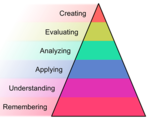
Bloom’s Taxonomy was later revised to create a more dynamic description. The levels were changed to the following: Remembering, Understanding, Applying, Analyzing, Evaluating, and Creating.
Looking More Closely at the Cognitive Domain
The cognitive domain includes information and the expansion of intellectual skills. This includes one’s ability to recall specific patterns, facts, or concepts that relate to the development of their intellectual skills or abilities. There are six levels of learning that originate from the cognitive domain. According to Bloom’s Taxonomy, they are:
Remembering: Recalling previously learned information in order to determine right or wrong answers. For example, the learner can recite a policy or quote prices using only their memory to a customer.
Understanding: Understanding the meaning of information. The learner would need to explain, in their own words, the steps involved with completing a specific task (such as an equation into a spreadsheet).
Applying: One’s ability to apply information (knowledge) that has been previously learned. For instance, quoting a price on a custom project based on previously learned factors.
Analyzing: Refers to the breaking down of material into smaller parts. It can also refer to the examining of information in a specific organizational structure. For example, a learner could troubleshoot specific equipment problems using logical deduction. They could also gather information from a department or select the tasks that are required for training.
Evaluating: When synthesizing information, the learner would be expected to design a plan, propose a set of operations, or place various parts or procedures together to create something new. For example, an employee could be required to develop a new company policy based on ones that already exist.
Creating: Compared to judging or deciding on something based on pre-specified criteria. There are no real wrong or right answers here. Here, the student would basically choose the most effective solution to a problem, which could mean hiring the most suitable candidate or justifying a budget change.
Bloom’s Taxonomy describes different levels of learning, breaking down the cognitive domain into sections. At Designing Digitally, Inc. we use this to determine where your learning objectives fall and how we will reach those goals through web based training. Lower levels of learning involved in your learning objectives means a less complex scope of work. As your objective moves to higher, more complex levels, the scope of work grows more complex as well. To learn more about Bloom’s Taxonomy and how it is involved in our process, contact us today.
Andrew Hughes
.
Blog
.
<span class='date ' tip=''><i class='icon-time'></i> Jul 16, 2015 04:55pm</span>
|
|
These days, game-based learning is being increasingly utilized in the corporate industry and educational sector. Both classroom and corporate training are not exceptionally engaging, and can be quite expensive. Given the millennial generation and older adults already have a lot of experience with technology and games, an E-Learning project would be a perfect way to engage them. In the following sections, we’ll discuss some key ideas to keep in mind when having an E-Learning project developed.
Defining an E-Learning Project’s Objective
Just because an E-Learning project is well-designed, doesn’t mean it’s going to succeed. The best way to create an E-Learning project that is going to be successful is to make sure the objective is clearly laid out. What are you trying to teach? What is it that you want your learners to walk away with upon completing the module? A clearly defined objective for your E-Learning project will ensure that you deliver the right learning experience that will reach your learning objectives.
How to Convey Information That Will Engage Learners
Once you’ve developed a clear objective for your project, you should start working on what will be the most efficient tactics for engaging learners. Whether it be providing more in-depth questions, or having a learner give a more insightful answer, questions that engage on a deeper level will most likely succeed at helping them learn. Through multiple choice, drag and drop, and other interactive knowledge checks you can engage your learners and increase knowledge retention.
Outline Your Target Audience
Similar to starting a business, you need to define your target audience for your E-Learning project. In order to provide the best web based training possible, you need to understand who your audience is. To be more specific, what are their job roles? Are they familiar with the technology you are using? How old are they and what level are they within your organization? One should consider this because a 55 year old Senior IT guy will learn a lot differently and have a different understanding of the technology than a part time, 24 year old college student.
Choosing the Best Platform for E-Learning Project
After defining your game’s objective, layout, and target audience comes another important step: choosing the best platform for your E-Learning project. For instance, will your target audience be able to access this game based learning program through the web? Will it be available on mobile platforms? This also relates back to your audience and project content. If your employees are doing the training at the office, then a mobile module would be unnecessary. However, if your project can also be used a resource for sales people, then a mobile solution would make sense.
The delivery method for your E-Learning project also has technical implications. For instance, the nuances of programing in Flash when trying to make an iPad deliverable module. These are critical issues because you need to figure out the best way to deliver the project to your target audience.
Each of the Above Tips Contribute To a Successful E-Learning Project
There are dozens of factors associated with the success of a game based learning program. But those mentioned above - defining a clear objective, determining your target audience, choosing the right platform, and knowing how to effectively convey information - are fundamentals to keep in mind.
These factors all contribute to a well-planned E-Learning project. When followed, you ensure your time and money were not invested in vain. To learn more about factors involved in E-Learning projects, contact us today.
Andrew Hughes
.
Blog
.
<span class='date ' tip=''><i class='icon-time'></i> Jul 16, 2015 04:55pm</span>
|
|
The E-Learning industry is continuing to evolve and adjust to new technologies and other societal changes. Whether used in educational settings or for training purposes in the corporate world, E-Learning technologies are revolutionizing many different sectors. Understanding the most current trends in E-Learning will help you make important decisions regarding how you use E-Learning tools in your own organization, and it will also give you an idea of what to expect in the future.
Mobile Learning
One of the hottest trends in E-Learning is the prevalence of mobile learning. The desire to access and share information 24/7 has been shaped by mobile devices and social networking platforms, and no one is left unaffected. Organizations are turning to mobile devices to give employees access to corporate networks, applications, and information. Moreover, using the mobile format for training purposes is becoming increasingly popular. The use of smartphones and tablets for training and E-Learning purposes is not only giving employees more access, but it is increasing employee engagement.
Gamification of Learning
Another hot trend in E-Learning is the use of gamification. Gamification refers to the use of game mechanics and gaming elements in traditionally non-game environments. The idea behind using gamification for corporate training purposes is that it will engage employees’ interest and provide a way to increase interest and motivation. When properly implemented, gamification can increase the retention of content and speaks to a new generation of employees. As millennials continue to enter the workforce, it is important for organizations to adjust to their technology and social-driven mindset.
Informality Is In
Similar to the rise in popularity of gamification, we are seeing a trend of informality in E-Learning. A good chunk of learning in today’s world is done naturally and in conjunction with other tasks. Mobile devices and tablets are also making it so learning is more self-initiated than ever. While it is nearly impossible to "create" informal learning, you can foster this type of environment by providing the proper tools and access points for your employees. Using social media platforms, networking communities, various technologies, and gaming elements for your training purposes will help establish an informal learning environment that your employees will be more inclined to become a part of.
Knowing what’s happening in the E-Learning industry can help your organization make the best decisions regarding your web-based training. Incorporating the use of mobile devices and tablets as well as modern training tools will help you keep up with the changing workforce, and will also work to engage and motivate your employees. To learn more about E-Learning, and how your organization can benefit from web-based training, contact us today.
Andrew Hughes
.
Blog
.
<span class='date ' tip=''><i class='icon-time'></i> Jul 16, 2015 04:53pm</span>
|
|
In the world of software design and E-Learning, getting to know your end-users is critically important for a variety of reasons. Take an average mid-level business, for example- there will be employees that encompass various age groups, professional backgrounds, reading levels, computer proficiency levels, and dozens of other demographics that will define how each user learns. While it is certainly a challenge to cater to all of these audiences at once, there is a number of ways to accomplish this task.
How Do Learners Really Learn?
To compound those problems even further, there is no definitive blueprint on how individuals learn. Some students may be highly visual people who have to see the concept to understand it. Others may learn better through repetition or with instruction that shows the same concept several different ways. Designing an E-Learning title all comes down to anticipating the various needs of the students involved, and then executing a plan to meet those needs as thoroughly as possible.
Since the goal is knowledge retention, a needs analysis is always the first step in getting to know your audience. In fact, absolutely nothing should be taken for granted during this initial process. Should the narrator speak like a college professor, for example, or should he sound a lot more informal like a co-worker would? How much industry jargon should be incorporated? Seemingly tiny decisions like these can have profound effects on the learning process.
Overcoming the "Curse of Knowledge"
Another problem in the educational segment is overcoming the "curse of knowledge" within certain genres. For instance, when an individual is so familiar with the industry/segment, they make assumptions based on their own experiences because they cannot "see the other side."
So how do you ensure that you’ll avoid the curse of knowledge in your training efforts? There are several ways to avoid this pitfall, and each of them starts with taking a step back and identifying who the software is ultimately being designed for. If it is for new hire employees, for example, then very little should be taken for granted when it comes to things like industry jargon or company procedures. The same training for senior level employees may have an entirely different tone/feel since much more can be discussed without extra clarification.
Catering to Many Different Viewpoints
Besides seniority levels and industry experience, there are also a number of other differences to consider when training employees. A few of them are-
Educational backgrounds
Overall reading/writing levels
Computer proficiency
Age levels (and emotional maturity)
Preferred learning styles
One of the areas that we really pride ourselves on at Designing Digitally, Inc. is taking the time to get to know your audience and all of their unique learning requirements. By working alongside each corporation’s designated instructor, we have a long history of delivering the perfect software solution that exceeds our clients’ training needs. For more information, please contact us directly at 866-316-9126 or request a free quote.
Andrew Hughes
.
Blog
.
<span class='date ' tip=''><i class='icon-time'></i> Jul 16, 2015 04:50pm</span>
|