Blogs
|
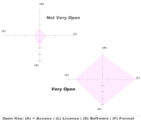
Last night was the first Tweet Chat for the #NWOER facilitation of the Intro to Openness course.The tweet chat focussed on 6 key questions throughout:Q1 What does openness and open education mean to you? Q2 Why does openness matter? Q3 What/How/Where do you share? Q4 How can we become more Open (in our practice or sharing our learning?) Q5 Do you use Open Source Software? Pls give details of what tools/platforms you use? Q6 What are the benefits of sharing?I shared the updated visuals using Martin Hawksey's TAGS Explorer, and Katherine Jensen created a Storify story.I thought it was an excellent Tweet chat, and there was lots of short discussions that got me thinking. We got onto the levels or shades of openness, and how the term 'open' means different things to different people, so I just wanted to pick up on some of my earlier work on visualising openness as well as Amber Thomas' great post on 50 shades of open.As Amber suggests, there is the purist view of 'open', which Schaffert & Geser (2008) suggest contains four principles: Open Access; Open Licensing; Open Software; Open Format. This kind of links in with the '4 R's of open' from David Wiley - Reuse, Rework, Remix, Redistribute (although he's recently added a 5th).Amber also picks up on other aspects such as the 'anonymity of user', which might also be incorporated into the purist perspective of 'open'. Now I don't want to delve into these specifics too much, but just wanted to reinforce the notion that 'open' doesn't have to meet the purist view. Things can more or less open, and I love this analogy:"Openness is not like a light switch that is either 'on' or 'off'. Rather, it is like a dimmer switch, with varying degrees of openness" (Hilton iii, Wiley, Stein & Johnson, 2010) So with this in mind, some time ago I attempted to visualise openness (right), or more-so visualise the openness of any particular object (RLO, OER, etc). I thought that by mapping an object against the different criteria for 'open', we could have a visual representation.So as in my previous post, I gave the example of an interactive Flash movie file (a little OER) that has been licensed with Creative Commons (CC-BY-NC) and placed within Jorum. The resulting visualisation might look like this;I suspect I should revisit this and revise the criteria for which an object might be more or less open. By way of the discussions last night, I'm thinking how we might visualise just how open a typical MOOC is (a big OER). I think we'd probably find it's not very open, and this is the part that some people get confused about. Because a MOOC is free, it doesn't mean it's open. Not in the purest sense at least. Returning to the Hilton et al. dimmer switch analogy, MOOCs are probably so dimly lit that we can't see all that much. A murky dark shade of grey, as Amber might suggest.Now I'm not against this per sé - I don't consider myself a purist. I think opening access to education is in any form is definitely a positive, but I do feel a sense of regret that MOOCs (in general) aren't more open. This is likely because MOOCs sort of stemmed from the Open movement, but aren't very open. I'm not just talking about making the content more open. I'm also thinking about things like workflows and curriculum development aspects, as well as platforms, etc. There are so many aspects where MOOCs could be more open. I'd like to think the FOOL (Flexible, Open, Online, Learning) we're currently facilitating is more open - access and licensing are certainly more open. But perhaps we should also share the processes of setting up and facilitating this type of 'course' - Paul Booth and Chrissi Nerantzi have been invaluable and without them this probably wouldn't have happened. But what can other people learn about our experiences? What works and what does not? What would our advice be to others?Right, that's a fairly big brain dump. I think there is a lot more to be discussed but I'd love to hear the thoughts of others....Peter@reedyreedlesThe Reed Diaries by Peter Reed is licensed under a Creative Commons Attribution-NonCommercial 3.0 Unported License
Peter Reed
.
Blog
.
<span class='date ' tip=''><i class='icon-time'></i> Jul 20, 2015 08:11am</span>
|
|
As teacher, I often tramp the journey. Most of the way, I learn more than I teach, which is fortunate as I’m bored easily.Even the well trodden-paths bear fruit. But I have to be more aware when pacing there; vigilant, else I miss what is to be learnt.As teacher, most of what I learn on the well-tramped lanes happens as I watch others less familiar with the paths. This learning is the most enlightening, yet so difficult to pass on to others.I’ve begun to understand why.As teacher, all learning is a journey. How can a learner explain the destinations to someone who has never been there and seen what they’re like? There is often no measure to compare, no gradation to gauge against, and no foundation to build upon.And so learning, once accumulated, is not necessarily always useful. At least, not as useful as we might think it should be. And so it is that the adage of teachers ‘filling jugs’ doesn’t really work, no more than their teaching does.Johnstone’s Information Processing Model, a simplified version which heads this post, suggests that there is a real need to tread the ways often. It implies that learners may not be wholly aware of what’s to be learnt on the way, nor of its significance even if they were.It also reinforces that perhaps filling jugs doesn’t work so smoothly, that much is spilt in the process - that many approaches may have to be tried before the jugs contain anything useful at all.
Ken Allan
.
Blog
.
<span class='date ' tip=''><i class='icon-time'></i> Jul 20, 2015 08:10am</span>
|
|
Making Sense of Video Analytics: Lessons Learned from Clickstream Interactions, Attitudes, and Learning Outcome in a Video-Assisted Course (Feb., 2015) Michail N. Giannakos, Konstantinos Chorianopoulos, and Nikos Chrisochoides Norwegian University of Science and Technology, Norway, Ionian University, Greece, Old Dominion University, USA Traditional lectures may no longer primarily serve the purpose of disseminating information, which... Read More ›
Classroom Aid
.
Blog
.
<span class='date ' tip=''><i class='icon-time'></i> Jul 20, 2015 08:10am</span>
|
|
Eliademy is used worldwide by numerous academic institutions, like Oaklands College, the Faculty of Dentistry of the University of Buenos Aires or the Faculty of Economics and Business of the University of Zaghreb. Within academic institutions, Eliademy is used as a … Continue reading →
Eliademy
.
Blog
.
<span class='date ' tip=''><i class='icon-time'></i> Jul 20, 2015 08:10am</span>
|
|
The Skill Mastery Hyperdome - SLENZ Project - Foundation Studies Build, KowhaiAuthentic learning is a solution to some of the problemsthat arise in schools, workplaces and in society today.Isn’t it funny that at a time when training is being heaved out of the workplace by a change of organisational thinking, it must find in-roads to secondary schools where, purportedly, it is desperately needed?Last week, I attended the Te Aho o Te Kura Pounamu All-School Forum 2010. This was an international occasion for Te Kura.Three Keynote speakers - Viv White from Australia, Elliot Washor from the United States and Stuart Middleton from New Zealand - gave their perspectives on ‘authentic learning’ in schools.Stuart could not attend the Forum. He gave a recorded presentation outlining how he saw the history of what has happened globally to education in the past 50 or so years, and how those changes are impacting on what is happening to the youth in society today.ROSLAClearly, the raising of the school leaving age, by several years, has brought about changes in how education is delivered. It has also altered how society looks on school-leavers who go about looking for jobs.A number of associated changes have accompanied all this.The origins and reasons for the changes are complex. But the situations for prospective employment of school-leavers are implicit. Over 40 years ago it was acceptable for kids to leave school without having any formal qualification. There were plenty of jobs for them. They were trained and educated on-the-job, and stories of their successes in life are numerous. Education through ‘the university of life’ was not an uncommon occurrence. As well, night classes became very popular. These provided a useful adjunct to the education of that group of learners.But the gradual societal changes, brought about through the raising of the school-leaving age and the programs introduced to schools to cope with these, meant that jobs for inexperienced and unqualified youths became less and less plentiful. What’s more, the general calibre of those jobs is now of a lowly nature and night classes are disappearing.Hands onToday there is a desperate need for kids who are likely to leave school early to be introduced to vocational possibilities during their remaining school years. It’s being recognised that preparation for the workplace in a hands-on manner and while kids are still attending school, is an effective way to accomplish this.It so happens that the standards-based qualifications system adopted in New Zealand early this century was adapted from the trades schemes. Argue as you may, there is more training taking place in schools today than was delivered there 40 years ago.It’s now recognised that the vocational access routes available for learners in schools are still not enough, a situation which is driving ‘authentic learning’ schemes into schools. I agree that more of this is now needed. I just wonder at what society is doing to education.Knowing what to doEducation is supposed to be preparation for life. It has been said by many educators that "education is knowing what to do when you don’t know what to do". When schools become geared to providing training for kids so that they can step into a job as soon as they leave school, isn’t there a possibility that ‘preparation for life’ will have to be diminished and/or postponed? When does that start if it has been displaced by the need for more immediate training in schools? Listen to Elliot Washor speak on Big Picture Learning with Kathryn Ryan.
Ken Allan
.
Blog
.
<span class='date ' tip=''><i class='icon-time'></i> Jul 20, 2015 08:09am</span>
|
|
Poll Everywhere for iPhoneI've just published a new post over at my Faculty TEL blog, guest written by an academic in our Vet School, who has looked at using Communicubes, Poll Everywhere and Turning Point with 4th year students. Interesting reflections that might be of interest....Head over to the full post for more info on Denis' little trial.Peter@reedyreedlesThe Reed Diaries by Peter Reed is licensed under a Creative Commons Attribution-NonCommercial 3.0 Unported License
Peter Reed
.
Blog
.
<span class='date ' tip=''><i class='icon-time'></i> Jul 20, 2015 08:09am</span>
|
|
Can Game Design Be Leveraged to Enhance Cognitive Adaptability? Patrick S. Gallagher, Ph.D., Shenan H. Prestwich Principal Researcher, Serco, performing on contract to Advanced Distributed Learning, Alexandria, Virginia USA Next Generation Learner, Researcher, Katmai, performing on contract to Advanced Distributed Learning, Alexandria, Virginia USA Abstract: Adaptability is a metacompetency critically important to the United States... Read More ›
Classroom Aid
.
Blog
.
<span class='date ' tip=''><i class='icon-time'></i> Jul 20, 2015 08:09am</span>
|
|
We are extremely happy to announce that Eliademy received Gold award in category "Living, Working and Learning" during gala event in New York this evening. Being recognized with an Edison Award is one of the highest accolades a company can … Continue reading →
Eliademy
.
Blog
.
<span class='date ' tip=''><i class='icon-time'></i> Jul 20, 2015 08:09am</span>
|
|
photo courtesy Jack AllanIn April 2009 I wrote a futuristic verse. It was a contribution to meetBud the Teacher’s deal to write a poem a day for the whole of that month. The verse looked only a little way into our possible future.In the last stanza I predicted that Stephen Hawking might never have had a chance to say what I assumed had been running through his mind."It’s been a long time since Cataclysm.They said in the beginning it might bequite a journey. And so we are all herein one form or another. No one knewit would be so simple to start it off.Even Fermi didn’t, though more than mosthe had the insight. ‘So where are they all?’was what he put to them, knowing full well!Fermi? He’s over by the supernova.Can’t get him away from it. Addictedthey say - he always was fanatical.Apparently he was among the firstto congratulate Hawking when he got here.Hawking knew all along of course. It wasonly a matter of time. And beforehe let it all out it was far too late."I may have been wrong about Stephen's timeliness. I hope I was.If so, I offer him my sincerest apology.Let’s hope that Stephen’s advice is timely, to assist us to survive so our successors can tell a different tale a few hundred years from now.
Ken Allan
.
Blog
.
<span class='date ' tip=''><i class='icon-time'></i> Jul 20, 2015 08:09am</span>
|
|
CC BY SA Flickr User PlanetaOur new Technology Enhanced Learning Strategy focusses on a number of key themes, one of which being a student skills development plan.I believe we should be developing student's digital literacies as a key component embedded within every programme we offer - it's important students can make the most of technology to support and enhance their studies. Not only that, it's important graduates are comfortable with digital practices more generally to prepare them for the world of work.Focussing on one aspect of the TEL strategy, the University has formed an internal Developing Digital Literacies Working Group, and we're looking at the Open University's Digital and Information Literacies Framework as a basis to build upon. It's broken down into five competence areas, with progression for each level of study:Understand and engage in digital practices;Find information;Critically evaluate information, online interactions and online tools;Manage and communicate information;Collaborate and share digital content.It looked like we would use the framework 'as is' at one point, but we collectively felt we should use it as a foundation instead. There are a couple of points that I personally would have liked to pick up on:The framework is quite heavy on information literacy, and quite light on digital practices and 'creating' the web. Almost to the point where this framework could be related to Web 1.0. Of course creating the web is only one subset of the wider digital and information literacy set, but I just think it should be a larger part and more fundamental to the framework.For me, the competencies of 'Find information' and 'Critically evaluate information' are one and the same. They can't possibly be separated because, for example, we are constantly critiquing and evaluating our searches in the process of finding information. And given the workflows of many people, the next logical step is to save the content (be it in the form of bookmarks and web clippings, etc) and sharing that content with friends (be it in course discussion forums, Facebook groups and on Twitter). These are not necessarily distinct categories, but rather activities on a broader process or continuum. I also think there are a lot of issues that run across the competences. Take for example, online/professional identity. This is a pretty core aspect within the 'Understand and engage in digital practices' theme, particularly for Medics, Dentists, etc, but it's also something that links in with 'managing information' and 'collaborating and sharing information'.The more I think about it, the more relevant I see Doug Belshaw's work on web literacies - his/their themes of Exploring, Building and Connecting seem applicable here - perhaps their specifics are too specific for us, but the themes are interesting and could provide a framework to build on...This is not an attempt to critique the OU framework, but I'm rather thinking critically on what a framework might look like for us at Liverpool. I'm wondering if we can visualise this in some way that makes sense; thinking how Doug's work might link in; and wondering if we should focus more on student's actual day-to-day working practices as a means to inform any such framework. Have any others engaged with the OU framework, or even gone a different way? Thoughts welcome...Peter@ReedyreedlesThe Reed Diaries by Peter Reed is licensed under a Creative Commons Attribution-NonCommercial 3.0 Unported License
Peter Reed
.
Blog
.
<span class='date ' tip=''><i class='icon-time'></i> Jul 20, 2015 08:09am</span>
|