Blogs
|
One of the many activities I keep enjoying quite a bit over the course of the years with regards to social networking is its innate ability to experiment and play with social technologies in order to figure out new use cases, proofs of concept, additional bursts of productivity, new business uses, etc. etc. You name it. All in all with the main premise behind all of that fun and play to figure out new methods to become more productive, effective and efficient at what I have been aiming all along: work smarter, not necessarily harder.
And to that extent I think it is now a good time to help introduce a new experiment I have been playing with in the last few months and which I think may be of benefit to others as well, specially, if you are into finding out about highlights from the hundreds of conference events out there, mainly, in the Social Business space that we get to attend or not. This new experiment has got to do with two different activities we all get to carry out eventually, but that I myself have grown to become rather fond of over time, since I may have just hit that perfect use case for me to continue making use of it eventually: live tweeting and curating highlights from conference events I get to attend and participate in.
Now, what do I mean with that exactly? Well, as you well know, there used to be a time where I had enough time in my hands to live blog conference events that I would be attending from all over the place. From there onwards, I moved on to putting together lengthy blog post to highlight some of the major key learnings I went through for each and everyone of those events. Things evolved further, availability of time got shorter and shorter and I moved into the next phase: live tweeting of events using the hash tag of the event itself in particular.
That method worked really well, till Twitter itself decided to play funny and not allow you to get back to those tweets after a certain period of time making them disappear into thin ether, which was rather annoying, since you new your live tweets are out there, yet, you can’t access them anymore! Not very helpful! And very frustrating over time, I can guarantee you that! Grrr
At the same time you get to notice how the vast majority of the live tweeting that goes on at conference events as of late is just a mere regurgitation of short phrases from the speakers trying to be compacted in less than 140 characters, so that other folks would be capable of retweeting the same thing over and over again. Yes, I know what you are thinking by now… That can certainly get very tiring over the course of time, as you get to bump into the same content live tweeted over and over! So what to do?
I am not sure what strategies have you folks adopted in order to keep providing value when "reporting" those live tweets (I would love to find out more about them in the comments, if you would want to share those tips across), but a little while ago I decided to try out one myself that I am starting to like quite a bit! And that is not so much to share those tweets reporting on what the speaker(s) may be sharing across, but more trying to build further upon it with my own insights on what I may have learned, may agree with or may disagree with by sharing a thought or two to help build up my highlights of the event.
Seeing how cumbersome it has become to then put together those various insights into meaningful blog posts I kept thinking what a pity that I would not be able to refer back to those tweets after a short period of time just because Twitter decided it was not helpful (to them!) keep those Twitter searches on hashtags going in the medium, long run. So I started to look out there, on the third party Twitter Apps ecosystem to see if there would be a good choice out there to help out address and solve this problem.
And it looks like I may have found something worth while exploring and playing with. Have you played with Snapbirg.org? No? Well, maybe you should! I am loving it at the moment! Snapbird is a lovely Twitter App Web site service that allows you to query Twitter to display a number of tweets, based on a particular Twitter ID and any hash tag of your liking and the free service would be able to display the last 1,000 tweets, which for one’s own tweets at a conference event is more than enough, I can imagine.
From there onwards the curation part of the experiment kicks in, because once you have captured all of your tweets, or those of the conference hash tag, depending on how many people live tweet eventually, you would be able to export them all as a very handy .PDF file (With Print as .PDF) and it is ready to share it across into much more sophisticated repositories. Not bad, eh? Indeed, not bad at all!
So that is what I have been experimenting with lately and with some pretty good results, at least, good enough for me to gt a grasp of what I keep learning at any event I may attend, specially, while on the road, because once I have got those .PDF files with the live tweets captured after the event itself, I just go ahead and I upload them into Slideshare, as if they were a presentation and right there I can share them with everyone else who may be interested in them. And voilá! Ready to go!
In order to show what it would look like I have put together already a couple of .PDF files from five different face to face events that I have participated in the recent past. To name: The Melcrum Digital Summit (In London), the brilliant Enterprise 2.0 Summit (In Paris), Congreso de Empresa 2.0 y Social Business (In Seville), the Social Business Strategy Summit (in London) and, of course, my favourite event so far this year: the Social Business Forum (In Milan). And since I have uploaded them to Slideshare already, here you have got the embedded codes for each and everyone of them, with an opportunity as well to download the along, as you may see fit:
Live Tweeting Highlights from #melcrumDCS Event, London, March 2012
Live Tweeting Highlights from #E20s Event, Paris, February 2012
Live Tweeting Highlights from #e20biz Event, Seville, May 2012
Live Tweeting Highlights from #sbss12 Event, London, May 2012
Live Tweeting Highlights from #sbf12 Event, Milan, June 2012
View more documents from Luis Suarez
Hopefully, from here onwards it would become a regular habit from yours truly; as a I keep getting to attend various other different events, I will continue to share them along over here for other folks out there, who may be interested in these topics, to benefit, as appropriate. And perhaps perfect timing, too!, since I am about to prepare for my next business trip, this time happening over the weekend, when I make my way to the always fascinating and insightful Enterprise 2.0 event in Boston and where I will be for the entire week, so if you fancy getting together for a drink or a meal, probably the best way to reach me would be through Twitter, at @elsua, or through my mobile number (If you have it…).
Hope you enjoy this experiment, and hope it does prove useful to you as well, just as much as it has been for myself in the last few months. I would also love to know what you think about it in the comments, please Is it worth while pursuing it further? Are you getting any additional benefits of that live tweeting I have been doing all long, now that I can finally curate it properly and share it across with all of you? Let me know what you think.
Really looking forward now to putting it into a massive test at the event of events on Enterprise 2.0 in just a few hours from now! Boston, here we come! Ready?
Luis Suarez
.
Blog
.
<span class='date ' tip=''><i class='icon-time'></i> Jul 20, 2015 10:27am</span>
|
|
It concerns me how a lot of the social learning conversation seems to veer around the tools in the space. Tools are arriving thick and fast and yeah, it's easy to get caught up with all the bling. And this is not to say that I'm never excited by tools - nothing could be far from the truth. This said, social learning is less about the technology and more about the human interaction. I often seem to get the sense that a large part of the learning community believes that the use of social media in learning is social learning. So sharing your courseware on a Facebook group then becomes social learning as does organising a lrchat-esque chat with pre-defined questions on a microblogging platform. To me this is perhaps Elearning 2.0 where you incorporate a higher degree of user interaction into your courseware, but it's still not social learning.
I want to explain my views in a little more detail on this blogpost and I hope you can humour me. And feel free to tell me I'm wrong.
We can't set a low bar for 'social'If the mere use of a social media platform makes a learning experience social then we've been social all along. I do a lot of classroom training as well. My classroom training is never about being a sage on stage. It's full of real world activities, interpersonal interaction and experience sharing. I do a lot of socratic facilitation in the classroom - I use my questions to draw out experiences, perspectives and lessons for the group. This said, I decide on what questions I want to ask, the agenda and the topic for discussion. If you think of lrnchat, it's quite the same thing. There are a set of pre-defined questions and a pre-defined topic for discussion. The only thing that's different from doing this with a facilitator in a classroom is that now we've distributed the discussion and there are several more participants than there could possibly be in the old world. So yeah, it's a far more scalable approach, I don't believe it's any more social. Now this isn't a criticism of lrnchat - I love being part of the discussion. All I'm saying that this is no different from formal interactions we've practiced earlier.
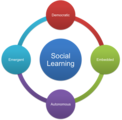
My bar for 'social' is quite high
Image credit: Jon Husband
I believe that true social learning has a few important characteristics. And this is where the 'new' social learning is different from the old. Here's what I think are non-negotiable criteria to dub any learning as social:
Democratic: To me the classic example of social interaction is gossip at a watercooler. Gossip emerges from the ground up. It doesn't need someone to lead, though a regular gossip fellow can facilitate the conversation and lubricate it. The key ingredient with social interactions at work or otherwise however, is that the crowd decides the agenda, the crowd decides the conversation. When a minority decides the agenda for a large group, then the interaction can still be social, but not enough to be any different from older models. Learning is truly social when individuals can decide what they want to learn and how they wish to collaborate on it.
Autonomous: The key factor with social interaction in real life is that it moves by itself and is not controlled by a facilitator. I look at my social network on Facebook and on Twitter and even my enterprise social network to behave this way. We aren't talking about a specific platform, it's about a pattern of interaction. Now a facilitator can help make the flow of the interaction smoother, but in no way does the facilitator become responsible for the direction of these interactions. We can term something as social learning when it gathers a pace of its own without intervention from a trainer, facilitator, manager or leader of any kind.
Embedded: One of the key aspects of social interaction in real life is that it's about life in general. It's not a separate exercise. I share stuff that I'm passionate about, I talk about things happening in my life. I blog about issues on my mind at a given point in time. Learning is truly social when it's embedded into the context of work. Think about this - I face a problem at work I know nothing about. I post a question about it to a company social network. Soon I receive a response from another colleague in a different team. That's the kind of interaction I'm speaking of - 'just in time' learning.
Emergent: Social interactions have no predefined structure. The structure emerges from the natural interactions of a participating group. A big problem with enterprise social learning is the desire to structure before you start. Predefined structure has its uses - I don't doubt that. The uses however are limited to finite amounts of information - such a sitemap for a website. The nature of social communication is that it's frequent and high volume. You can try second guessing the structure for this endless stream of communication and you can also guarantee failure for every such attempt. As I've mentioned earlier, everyone's structure is different. Andrew Mcafee has written quite eloquently about the concept of emergent structure. "These are all activities that help patterns and structure appear, and that let the cream of the content rise to the top for all platform members, no matter how they define what the cream is. Without these mechanisms, online content becomes less useful - less easy to navigate, consume, and analyze — as it accumulates. With these mechanisms in place, just the opposite happens; the platform exhibits increasing returns to scale, and becomes more valuable as it grows." You should read the complete article here.
This is my view and I'm happy for you to tell me I'm wrong - only when learning exhibits all of these characteristics can you call it truly social. This may or may not involve the use of social software, though I suspect it'll be quite tough to foster these characteristics without social media. What I'm saying though is that social media is a crucial tool for the success of a social learning initiative, but the use of social media doesn't necessarily mean that a learning experience is any more social than that in a classroom.
My aim is not to stir a hornet's nest with my statements in this post. In fact I've been wanting to write this post for a while but was wary that I'll upset some of my friends by terming what they do as 'not' social learning. Frankly if you don't agree with what I've said, feel free to post in the comments section and shout at me. I'm no theorist, but from experience I've built a bit of an opinion. If it resonates with you, I guess I'm thinking right. If it doesn't, I guess I'll learn from you. Look forward to hearing what you have to share. Until next week, bye!© Sumeet Moghe
Sumeet Moghe
.
Blog
.
<span class='date ' tip=''><i class='icon-time'></i> Jul 20, 2015 10:27am</span>
|
|
Last night something terrible happened. Toffee, my neighbourhood stray lost her puppy Sheena to some crazed driver who decide to knock the kid dead. Road kills happen all the time in India but for someone to be driving fast enough to kill a living being in a residential colony is brutal and inhuman. When I found Toffee this morning, she was mourning by the side of Sheena's corpse. She called me and almost implored me to check what was wrong. She kept squealing, crying and licking the limp body.
We think of animals being a lesser life than us. That is untrue. Toffee kept crying by Sheena's body until my wife and I came back to the scene and comforted her for a good length of time. We had to coax her into finding her other pup, Skittish. The way she called to Skittish and the kind of nervousness the surviving pup showed, was an example of how deep emotions run in the animal family. One careless driver has disrupted a happy family - we wouldn't do this to a human being. We wouldn't hit and run a human baby and leave it in a pool of blood. Why do it to an animal? This world belongs to them as much as it does to us. They feel pain too. I feel Toffee's pain - it's how I felt when Tequila died, perhaps a lot more.© Sumeet Moghe
Sumeet Moghe
.
Blog
.
<span class='date ' tip=''><i class='icon-time'></i> Jul 20, 2015 10:27am</span>
|
|
A very good friend of mine once told me that life is all about treasuring, cultivating, nurturing and enjoying the various moments of happiness we get exposed to over the course of our lifetimes. You know how it goes, they are very brief moments, rather fulfilling, sharp, intense, transient and hardly noticeable, unless you pay rather close, good attention to them by always staying alert!, since, before you realise about it, they are just gone. For good! Pretty much like when they came your way.
They keep saying that it is those moments of true happiness that make everything worth while, even going through the most painful of experiences; those ones we are supposedly learning the most from time and time again. The ones that shape us into becoming who we are eventually, the ones that help us provoke those moments of happiness themselves over the course of time, making us realise why they are so much worth while anticipating and waiting for all along and why that wait is always worth it. Even if it takes 92 years. Well, I think I may have just experienced one of those true moments of happiness for which it’s going to become rather tough to wake up from. Not that I would ever want to do that, but I know, at some point, I will have to. We will all have to.
As most folks out there would know by now, this blog post doesn’t have much to do with the usual topics I get to cover over here, but yesterday evening the Spanish national football (= soccer) team did it again! Once again, and it’s something that we are becoming too much used to, and perhaps we shouldn’t!, they won the title from a major competition, that one of the Euro Cup 2012 and entered the books of history, managing to win three major titles over the last 4 years (Euro Cup in 2008, World Cup in 2010 and Euro Cup in 2012, once more!), that no other national team has ever matched anywhere! How can’t you not enjoy such a moment of true happiness and pure bliss, right?!?! It’s exhilarating altogether on its own to no end! A once in a lifetime experience! Literally!!
Yes, I know and I do fully realise that Spain, my home country, is not going through one of its best moments as a nation, with the well known mantra "Made in Spain", and part of the European Union, due, perhaps, in part, to the rampant unemployment rate, a rather weakened economy by ruthless, unpunished financial speculators (Amongst others), plenty of natural catastrophes that have happened lately and to be governed, politically and economically, throughout the last few years, by corruption, fraud, greed and power struggles. Yes, the usual thing that a bunch of other European, and worldwide, countries are going through at the moment as well, but perhaps with a much more dramatic flavour added to it altogether.
The thing is though that we are still standing. 4 years have gone by and we are still standing. Perhaps that’s one of the last few things that will always be with us, that we can fall down, break a bone or two in the process, but stand up again. And again, and again. It’s what shapes nations over the course of centuries. It’s what makes them, and their people, tougher. You know how it goes, what doesn’t kill you, it will make you stronger. And that cannot be more real in today’s financial turmoil and econoclypse. But then again, just like Spain has done with its national football team, there has got to be a time when that has got to stop, when power, greed and money no longer rule, where we can ponder about what things were wrong, how we could address them and try to fix each and everyone of them. More than anything else, because the alternative continues to be just too ugly to face and, also, because deep inside our hearts, we know where the main issues are and how we could tackle them eventually.
I mean, taking further on the analogy from football, I remember the days, the decades, actually, when the national Spanish football team was rather mediocre, not having the right mentality, the right team spirit, the ability and eagerness to improve things, the sacrifice of one self for the others helping them become better at what they normally do, the innate talent willing to be shared across without asking much in return to achieve a common purpose, that little bit of luck you always need to achieve your goals, etc. etc., and eventually, with a touch of bad luck to add further up, we kept getting kicked out of major tournament after major tournament making it all almost far too embarrassing to notice.
Too painful to watch and experience. Even too frustrating to bear. But then again, we stood up. You could probably say that Spaniards, in general, are rather stubborn and resilient on their ways. But back in the day, by the late 80s, there was this brilliant, committed, modest, truly gifted generation of young players who gathered together thanks to the efforts from a superb initiative on working things out right from the base, starting when they were all young, and grow that over the course of time through lots of hard work, effort, energy, sacrifice, talent, education, team spirit, modesty, and a strong sense of achievement never seen before, along with a very well defined style, i.e. the tiqui taka, which has proved to be unbeatable over the last few years, and which confirms, once again, the power of groups & networks in helping achieve a common goal. The goal.
And there you have it, after a couple of decades gone by already, collecting the harvest of all of that hard work, good education and training, and true team spirit has paid off, once again. And it all started with small steps, right when that bunch of very talented players were really young. That’s perhaps the secret of the success for a national soccer team, but may be also for an entire country to start looking for ways of abandoning that catastrophic state of making ends meet barely through the econoclypse just because we have been looking at the wrong end of the equation from day one. It’s through that education, hard work, motivation and inspiration that young modest players have kept turning an entire country upside down over the last 4 years providing us all with that huge rush of delightful happy moments of pride of what one can achieve if it is given the right values on what really matters. The small things. As usual.
Yes, I do realise that this new achievement from our Spanish national football team is going to last probably too little, specially, looking back into today’s financial turmoil and appalling government policies (From past and present), but if there is anything that should help us all remember, and treasure, quite a bit!, is the fact that those moments of happiness we enjoyed last night, and probably today, are now ours. Forever. For good. They just can’t take them away from us. It’s part of our common psyche, as a nation, and if we have been able to raise over and over again over the course of decades from bad results after bad results, yesterday evening’s victory should remind us all, as we treasure and seize the moment, where the key of success really is: go out and seek desperately, work your b*tt off like you have never seen nor done before, provoke that moment of happiness and don’t let anyone take it away from you. Enjoy it!
They have continued to make us feel proud for what they keep achieving time and time again. They have shown us the way of what’s possible, of the potential we all have when we want to strike for those happy moments, so whenever someone reminds you of where you are today, as a nation, kindly educate them on what we know, and have been educated, best over the course of decades: stand up and fight for your happiness, because no-one else will. Now, it’s up to you, me, and everyone else, to up the game and show how well we are all playing this football match called "life".
So far, those young, talented boys, have shown us the way. They have shown us how the impossible does no longer exist. How if you would want to achieve it, because that’s what you would want to do, there is a great chance that you will, so you better be prepared to act accordingly. That’s what moments of happiness are all about and, again, remember, that no-one can take those away from you. They are all your own to be nurtured and treasured right from the beginning! For as long as you would want to!
My dear national Spanish football team, thanks ever so much for allowing us to experience one of the most unforgettable evenings *ever* that will surely occupy a dear place in each and everyone of our hearts for many years to come. Thank you sincerely for showing an entire nation, and probably the rest of the world, how, with a good dose of talent, hard work, effort, motivation, team spirit, and unselfish collaborative effort, the impossible is our new reality . What we live and strive for. Our motivation to move forward. Our way to show everyone that power and greed are never the way. They never have. That sustainable growth, as a group with a core mission, will probably pay off much better eventually. At least, the teams will be happy, content, with what they have delivered. I bet that’s how you are feeling right now, watching us from the short distance, and that’s exactly how we are sensing it from the other side. Admiration does not even come close to describe how we feel. So thanks much for that!
We will never forget!
Luis Suarez
.
Blog
.
<span class='date ' tip=''><i class='icon-time'></i> Jul 20, 2015 10:27am</span>
|
|
A lot of my friends in the learning community have been intrigued by the fact that we run Pecha Kucha nights every week at ThoughtWorks University. I often get asked how I run these and what value I see. In my experience Pecha Kucha nights are a great way to achieve a few things:
the speakers find a platform to share their thoughts around something they're passionate about;
the team gets an opportunity learn something new in a serendipitous fashion;
everyone gets to know a different side of their team members;
and even if the presentation has nothing to do with work, it often is a good laugh
In addition, Pecha Kucha is a great format to practice presentations. The constraint of 20 slides for 20 seconds each is a great way to force some positive presenter behaviours. Firstly the 20 second limit forces you to prepare well. If you don't prepare well, your slides are likely to overtake you. 20 seconds also forces you to be minimalist with your slide design. If you add too much clutter, you're likely to have no time to go through everything. The 20 slide limit forces you to prepare a crisp, yet impactful story. After all, when your time's over, you need to leave the stage. There's quite a bit more you learn - but I'll leave you to figure out the rest.
One of the main roles on a Pecha Kucha night is that of a Pecha Kucha host. The host runs the presentations that each speaker submits and also ensures that the talks keep moving on smoothly. Think of the host as an emcee for the night. I've been a Pecha Kucha host on several occasions and over the months there are a few things I've learned. In today's blog post I want to share a few tips for hosting these events. Take a quick look.
Before the eventRemember the presentation is not all about the slides. We don't want speakers to feel obliged to do a presentation. They should look at it as a platform to share their thoughts about something they really care about. Here are a few things I like to do a few days before the Pecha Kucha night:
Contact the speakers individually and ask them if about their topics - if they have selected a throw away topic, urge them to find something they have a passion for.
Ask the speakers if they need any help to create effective slides. Often you'll notice the very anti-patterns that we try to avoid and it's quite easy to fix these by giving them some Presentation Zen tips.
Remember, we want the speakers to look good during the presentation and potentially set them up for success. They shouldn't dread presenting by the end of the exercise. I like them to get addicted to the applause and mature as effective presenters.
On the day of the eventThe day of the event is crucial. It's not easy to produce a Pecha Kucha event, even if it is only for your little team. Make sure that you've invited more people than just your immediate team though - the larger the audience, the bigger the challenge and potentially the bigger the applause!
Try to get the presentations by 10AM on the morning of the event. This helps you ensure that all the slides play properly and that the speakers are happy with how they look on your computer.
Get the speakers together and give them a bit of pep talk. Try to soothe their nerves - a lot of them are presenting for the first time.
Call out some instructions and tips for the speakers:
Don't look back at the slides - show them the presenter view on your laptop and mention they can use this as a confidence monitor.
Ask them to make eye contact with the audience and to stand closer to the audience. Interacting with the group is likely to make their presentation effective.
Most importantly, let them know that they've done what they could have to prepare. From now on, they need to go out there and enjoy their experience.
Let the speakers know in advance the order they'll speak in. It helps to calm their nerves and doesn't surprise them when they're called on stage.
Remind the speakers to stay back on stage for questions and let them know that they should encourage questions - it's a sign that they engaged people in their talk.
Often neglected - order food if you can. Most people feel hungry if they have to be in the office until 7PM. We order pizzas, pastas, Indian food, burgers, salads and the like - there's no rule for this one.
During the eventThis is what everyone's been waiting for and you are the master of ceremonies. Remember, one of your key roles is to keep the event true to its spirit. If you notice anyone going over time - cut them off. You need to be consistent with this; otherwise, what's the point?
Make sure you have a whiteboard with a list of the speakers and the speaking order.
Don't forget to get a volunteer to record the talks - these are often great artifacts to share within the company. Who knows what people may learn?
Think of this as a mini-conference. How would you open the night? How would you welcome the audience? Where's your radio announcer voice?
Call out the rules of engagement. For example 6min 40s presentation, 2 mins for questions.
Remind the audience that several of the presenters may be speaking in public for the first time. As you call out each speaker, encourage the audience to applaud the speaker and ensure that they give a loud round of applause even when the speaker finishes.
Hold the speaker back for questions and encourage the audience to ask questions.
Close the event with a flourish. Food is a great ending, but don't forget to thank the speakers for putting in the effort. Be sure to announce when the next event is and perhaps tell the non-team members of the audience why they should return!
After the eventJust like the buzz behind a conference doesn't end the day it's over, the buzz behind your Pecha Kucha night should stay alive too. Here are a few things to try doing.
Get a hold of the videos and upload them on YouTube or a platform that you want to share them on. Tag them appropriately so you can easily find them later.
If you can, upload the slides to slideshare and tag them appropriately too.
Share these links with the speakers so they can look at their videos and look for areas of improvement and so they can also look back at presentations they liked for inspiration.
In general, think of the night as a show. There are performers who are in it for the first time. How can you still make this a grand success and a memorable evening? I hope you find this blogpost useful and I hope you can use this to host several awesome Pecha Kucha nights. Cheers!© Sumeet Moghe
Sumeet Moghe
.
Blog
.
<span class='date ' tip=''><i class='icon-time'></i> Jul 20, 2015 10:27am</span>
|
|
To get things going with the series of blog posts with highlights from the recent Enterprise 2.0 event held in Boston, MA, a couple of weeks back, late last week I had the privilege of posting the first of those articles over at CMSWire under the heading "Social Task Management - When Social Business Got Down to Work". You could go and have a look into it over there (Including the excellent commentary shared along already by a few folks), or, instead, you can check it out below reading further along into it, having taken the liberty myself of adding as well to the original piece the links to the presentations highlighted throughout the article itself, in order to make it easy to digest what I still think were the best speaker sessions I have attended at this year’s edition by far from everything else. There will be other entries that I will be putting together over the course of the next few days sharing along what else I learned throughout the event, but for now, let’s get things started with this one: Social Task Management - When Social Business Got Down to Work.
[Cross-post from CMSWire …] Social Business (at long last!) is getting down to some serious work, allowing knowledge workers to become more effective and productive at what they already do, that is, excel at their jobs.
This insight came after attending the the recent Enterprise 2.0 conference event that took place last week in Boston. A lot has been written in the last few days about some of the major highlights from the event (along with some phenomenal live blogging on the event itself courtesy of rather smart and talented folks like Mary Abraham and Bill Ives), that, if anything, confirmed this growing trend that most of us who have been involved with Social Business for a while now were happy to see finally becoming a reality.
Social Business is Maturing
From my own perspective, there are plenty of different highlights that I can point out to people out there who may be interested in learning more about what happened during those four days the conference event lasted.
For instance, the absolutely wonderful workshop on online community building that both the folks from The Community Roundtable and the Community BackChannel put together that were a culmination of another growing trend from the last couple of years with regards to social networking: communities still *are* one of the major drivers of social software adoption (whether internal or external) and as such, cultivating the art of building and sustaining online communities is becoming a key digital competency skill that knowledge workers can no longer ignore, nor neglect, but fully embrace.
Pair that with the absolutely stunning breakout speaker session done by Catherine Shinners on "Building an Online Community from Strategy, Planning and Launch to Effective Engagement and Adoption" and right there you have got an entire worthwhile adopting methodology on how to nurture your online communities with a business purpose. Worth a look on its own altogether.
Building an Online Community: Strategy, Launch, Engagement, Growth
View more presentations from CatherinePaloAlto
It’s Time for the Next Step
However, my absolute favorite key major highlight from this year’s Enterprise 2.0 conference event were the two different breakout speaker sessions that Alan Lepofsky, along with Yvette Cameron (both VP and Principal Analysts, from Constellation Research), did on leveling up the game for social software.
It’s time for social software to begin to discover the path of how it can embed itself into our day to day workflows with much more effectiveness and efficiency, by focusing on those common tasks and activities we keep repeating on a daily basis, but that, in some cases, generate a bunch of business pain points for which social networking tools could be that aspirin to get rid of the headache. Or perhaps that vitamin to help augment an already existing good user experience. Social networking with a clearer than ever business purpose: that is, empower employees to become smarter at what they already do at work, with perhaps a lot less effort involved altogether!
At the same time Alan gave another brilliant dissertation on how in the world of over-sharing with the Social Web out there becoming more and more relevant by the day, there is going to be a time where we may all reach the so-called Social Fatigue, if not already!
Apart from highlighting a-potentially-worth-while-looking-into growing pain, with how we make extensive use of these social technologies to make sense of their overall business purpose, Alan also shared a bunch of hints and tips on how to fight that social fatigue that will surely become rather helpful and insightful to those folks who may be thinking or sensing that they are reaching that point of social exhaustion. Truly fascinating and rather inspiring altogether!
The New Challenge for Social Business
But that’s not all of it, because if there is something that I would consider worthwhile highlighting from Alan’s presentation, and that was my major takeaway, is that realization that things are going to start getting a bit tougher for Social Business.
Now that we have proved the intrinsic business value of those various social technologies to help cultivate and nurture those personal business relationships, it’s time for the business world to be more demanding and request from Enterprise 2.0 to become a bit more resourceful on how it can help businesses grow more effective at what they already do: delight their customers with an even more enhanced exceptional experience.
In this particular scenario Alan coined a new concept under the suggestive heading Social Task Management which will bring us back to what some of us have been saying for a little while already: that Social Business will become a corporate reality as soon as it starts understanding, and fully embracing, how it needs to mix and mingle with our day to day workload, i.e. tasks and activities.
We need to start realizing how social networking for business has now, finally, managed to help converge three key aspects of how we get work done: People (self-organize more and more through networks and communities, versus just the traditional hierarchical structure(s)), Processes (helping them become much more open, public, transparent and agile) and Technology (where new, much improved!, experiences, including mobile, are helping knowledge workers get a better grasp of how social software is finally becoming more of an enabler than an obstacle).
Therefore this combination being pushed up on a massive scale, from the already existing structured business processes (Sales, Marketing, Engineering, Learning, Human Resources, Supply Chain, Customer Support / Service) and those other unstructured processes, like status updates, sharing, Q&A, exception handling (where email has been shining for perhaps far too long!), along with expertise location, provides us with a unique landscape of convergence difficult to ignore, if not embrace altogether.
This is where Social Task Management kicks in to help us achieve our business goals much easier, whether those social technologies are standalone, integrated or native.
In a memorable exercise where the conversation has, finally, shifted away from the rather rich Enterprise 2.0 vendor landscape, here we are at the crossroads for Social Business where the foundation of its core mission, i.e. helping knowledge workers work smarter, not necessarily harder, is taking a new level of engagement.
For the first time in a long while, employees, customers, business partners, along with their competitors and industry analysts, need to realize that while participating and engaging in social networking tools has been very helpful and valuable at helping businesses generate more revenue and profitable growth, we are only now reaching that tipping point where Social Business needs to really prove what it is made off.
Not just from the perspective of getting work done, but from realizing that, all along, it’s had the unique opportunity to help reshape the workplace of the future by resurfacing all of those tasks and activities, making them much more open and transparent, evaluating those business pain points we have been suffering for far too long and address and fix each and everyone of them. One step at a time, for sure, but eventually nailing down the work, which is what matters to both employees AND businesses alike in the long run.
Plenty of people have been asking for a couple of years for Social Business to find a purpose, its business purpose. I strongly feel that after attending the Enterprise 2.0 conference last week in Boston and being inspired by both Alan and Yvette, amongst plenty of other thought leaders in the space, we may have, at long last, discovered that purpose. Social Business is rolling up its sleeves and getting dirty, because, whether we like it or not, it is here to stay. For a good while altogether!
Social Task Management: A New Level of Engagement
So, what is out there left to say that we haven’t said already, right? Welcome to Social Task Management, I guess! Where the good fun starts!
That unique business purpose behind social networking we have been waiting for all this time and that we are glad it finally arrived. It’s been far too long and we just can’t wait to continue leveling up the game.
It’s time to demonstrate to businesses out there what Social Business is truly capable of: open up the conversations, become more transparent at what we do through observable work, work smarter, not necessarily harder, and all of that with a clear business goal in mind. That goal of delighting our customers with unique exceptional user experiences.
Easier said than done, I bet, but that’s essentially the fascinating and exciting journey we have been embarking on throughout the years. Time for us to come forward now, up the game for everyone and continue to execute accordingly! We have just got us all a new mission … Bringing Social Business to the masses!
Ready? Yes, I know, me, too! Let’s do it! Task Centric (Social) Computing, here we come!
Oh, one last thing… In order to make things easier, like I have mentioned at the beginning of this blogpost, I have decided as well to go ahead and share the embedded code over here from the presentations from Alan and Yvette, so that you folks can have a look right away and play them along. So here we go:
Taking the Training Wheels Off Social Software
View more presentations from Alan Lepofsky
Surviving Social Software Fatigue
View more presentations from Alan Lepofsky
Luis Suarez
.
Blog
.
<span class='date ' tip=''><i class='icon-time'></i> Jul 20, 2015 10:27am</span>
|
|
Image credit Christopher Schoenbohm
First things first, I'm sorry I couldn't post anything on the blog in the last few days. I've been in China and the great firewall is simply impregnable. I've somehow broken into Blogger and can now post. Thanks for your patience. So, let's come to what I want to write about today. Serendipity - it's a beautiful thing. Imagine walking down a street and seeing an interesting restaurant that you'd never heard of. You walk in, and order a great meal and have a great story to tell at the end of it all. I'm guessing I'm not the only person this has happened to. It's a wonderful way to learn about things around you and I argue that the human race would have learnt very little had it not been for the serendipity we've been privilege to, ever since our existence. Serendipity, or accidental discovery is also at the center of most social business strategy. Technology aside though, I believe this phenomenon has a big place in the physical design of workplaces. After all we didn't invent serendipity after social media. In today's blogpost, I want to share some thoughts about the design of workplaces and how they may affect the social fabric of your organisation.
Being Social begins in the Real WorldFor social media to make an impact to your workplace, the physical orientation of the workplace should ideally mirror all the behaviours you're trying to mirror online. Think of these of the top of your head, you'll perhaps come up with sharing, openness, visibility, connectedness, storytelling and the like. Why then, are workplaces designed for the exact opposite? Corner offices, cubicles, closed doors - all of these are counterintuitive to the idea of serendipity. Now, I'm not saying that we don't need closed doors conversations. Businesses are sensitive and certain conversations need a closed environment. That being said, designing your workplace around that as the default is perhaps a bad idea. This leads to the concept that I'm calling spatial serendipity. Here are a few questions to ask yourself.
How connected is your team?My team at work is starting to get bigger. Dinesh heads our knowledge strategy and enterprise 2.0 offering, Nikhil owns our social business platform, Sahana community manages, Kavita is our instructional designer, Siddharth handles industry research and Rajiv takes care of branding and events. Add to this the several people at ThoughtWorks University and we've got a fairly diverse team. It may seem like a good idea for each person to have their cubicle and work by themselves. In fact the commute in Bangalore is so bad that I sometimes feel like working in my silo at home. All this said, some of the most productive days for me are when I can work onsite with my entire team in one place. Merely listening in to my team-mates' work life creates a huge difference and each day I learn something new. If you notice from the picture above from our Xian office - teams in my company sit across one big table with no barriers. This is really cool because people can listen into conversations happening across the table and problems get instant solutions from the chatter around the team. Cubicles may be the way to go for predictable transactional work, but for knowledge work, a barrier free team environment is the way to go.
How visible is your work?Agile promotes the notion of big visible charts to depict your work. This is how you'll see creative companies like IDEO or Duarte work as well. There's something magical about making mental models explicit on a big, visible chart and to depict the state of work on a visible information radiator. Now my company also sells Mingle which is quite an awesome collaborative project tracking and collaboration platform. That being said, visualising your work only on a software system such as Mingle turns it into what my colleague Mark Needham calls an information refrigerator. There's a lot of value in having a representation of your work status that not just your team members but everyone in the office can see. Often, people walking by will notice something unusual and give you an interesting tip. Often people will learn from your representations. For example, I learnt an interesting way to represent a customer journey by looking at the above design wall for one of our teams in China.
How connected is your workplace?It's not just the team that needs connection and serendipity, but potentially your entire office. We talk of silo-busting in the virtual world, but what about the physical silos? Why do different teams need to have different rooms and work areas? Why can't we have large contiguous spaces where each team is visible to the other? Take a look at the design of our Xian office above. The entire office is one single space and the head of the office sits in the same place as the rest, as do people in HR, recruiting, admin, finance and the like. Everyone knows everyone - most people are aware of each other's work and that level of connectedness leads to solutions to common problems from the collective. It's not that tough, we just need to get over the default mindsets behind office design.In my view workplace design needs to be an integral part of any social business consulting that you seek out. Serendipity just happens, but the fact is that you can prepare yourself for serendipity by creating an environment that encourages it. Workplace design can't just be the realm of architects and interior designers - it's a social engineering activity. By now there's a lot of examples out there, including Google, ThoughtWorks itself, Stanford. Inspiration's out there - it's time for us to learn from it.© Sumeet Moghe
Sumeet Moghe
.
Blog
.
<span class='date ' tip=''><i class='icon-time'></i> Jul 20, 2015 10:27am</span>
|
|
If you have been following this blog for a long while now, you would know how, over the course of time, there has been one of those so-called pet peeves of yours truly that keeps re-surfacing every so often, time and time again, specially, when I am on the road, away from my home office. Indeed, I am talking about Internet connectivity, or, rather, the lack of.
Over the course of the last few months I have been doing a rather interesting mental exercise of taming myself, with plenty of education, patience and understanding, to confront all of that rage and irate opinions that keep coming up whenever I just can’t keep up with my knowledge Web work, just because the connectivity is very poor, if non existent altogether, while on the road. Thinking that it is ok to be disconnected every now and then. It’s good for the body, it’s good for the mind. It allows you to do plenty of good critical thinking on things around you. You know, there will always be a time, when you head back home, for you to catch up with everything in your social streams. Your ADSL home connection will do the trick and show you how you are still ok, despite that long period of disconnectedness when traveling around.
Well, what happens when back at home that, once trusted, reliable, scalable, relatively speedy, consistent, reasonably priced Internet connection ceases to exist? How does a remote knowledge Web worker keep up then? Not too well, apparently. In fact, struggling would probably be a much better word describing the growing pain mobile home workers are going to continue experiencing with their home connectivity over the course of time.
At least, that’s what has just happened to myself, upon my return from my recent business trip to Boston for the Enterprise 2.0 event, when I found out that my local ADSL Internet provider, my good old friend Movistar, downgraded my Internet speeds for download and upload without further notice, without even a confirmation of the deterioration of the Internet connection itself. It just happened and I have got to get used to it, whether I like it or not, because that’s what monopolies are all about. Or are they?
Plenty of people out there keep raving about how interconnected, and glued, to the Internet we have all become in recent times. The level of broadband penetration is at highest levels ever possible to the point where hardly anyone would claim they still don’t have a decent Internet connection. Even on mobile devices, whatever those may well be. It’s just not happening any more. But the reality is that things are different, much different, specially, if you live in a country where the entire network bandwidth is governed and managed by a single provider which consistently uses their monopolistic tactics to keep degrading end-users’ Internet experiences while raising the prices. That’s essentially what Movistar has been doing using as an excuse that they cannot longer keep up with the demand because their infrastructure is just not ready. Really? I mean, when fiber optic is providing speeds of 50 mbps to 100 mbps download? Really?
Here is a crude example of what I mean: I used to have a half decent 10 mbps download - 0.69 kbps upload with Movistar as my home ADSL connection. Not my 3G or USB modem, but my regular home Internet connection. About 2 weeks ago that changed drastically and deteriorated to a rather unbearable level: 5 mbps download and 0.58 kbps upload. While price is still pretty much the same. Around 70€ per month. Now, under normal circumstances, it would not have bothered me that much, that is, for personal, private use is probably good enough. Although expensive. However, as a remote knowledge Web worker, and I think there are two key important aspects to this, i.e. remoteness at the home office and Web work, it’s proved to be not very convenient, nor helpful. In fact, I’m starting to struggle with it all.
Not because of trying to keep up with the Social Web, whether internal or external, although it’s been a bit of a painful experience so far, but mostly because when trying to do a good number of different things, interactions I cannot longer feel that sense of being productive, nor effective. Specially, when handling rich media. In my role as a social computing evangelist focusing on enabling, facilitating, helping and coaching fellow colleagues on living social, I rely quite heavily on conducting remote workshops through emeetings, for instance, where both screen sharing and video conferencing are involved. And so far I have forced myself to rather reschedule the education sessions or cancel them altogether, because we haven’t been capable of making it work without the usual hiccups, temporary glitches coming from a rather poor connection. And here I am, musing on the irony of things and witnessing how Movistar takes a toll on my own productivity as a social knowledge Web worker not allowing me any longer to do my job properly. And getting away with it big time, since apparently there isn’t much more than I can do about it.
Yes, I know what you are all probably thinking at this stage, as I write this blog entry, the easiest solution would be for me to move, i.e. take my things and move to a new place, closer to the switches where my regular Internet connection could be reestablished and problem solved. Unfortunately, it’s not an option at the moment. In fact, I don’t think it would be fair for my private, personal environment to sacrifice what I have now just because of a monopolistic ISP can’t cope with the demand on what they offer, because of how poorly they have implemented their current infrastructure. Switching to another provider would not be very helpful either, since they all have to go through the same wired network, their own!, so even if I would change ISPs I would still have the same speeds as I have got now. Not good enough!
So it really hit me when I bumped into one very powerful tweet shared by my good friend Alan Lepofsky on the real impact of Social Business for that new kind of remote knowledge Web workforce that seems to become more of the norm, than an exception nowadays:
I’ve been quite bandwidth restricted this week and it’s reminded me how important offline/local access to data can be. Cloud can be cloudy.
— Alan Lepofsky (@alanlepo) June 30, 2012
Goodness! That’s just so spot on, from Alan! I mean, we surely keep taking the Social Web and our connectivity for granted, yet, as soon as that Internet connection gets interrupted, or deteriorated, there goes our Social Web experience suffering just as much as a result of it, with the end-goal of us, knowledge workers, no longer being capable of working effectively. Thus how much of a dependency would we have on our social technologies providing offline / local access, so that we could do our work, even if connectivity would be poor to then replicate or sync back to the server(s) with our data. It’s an old concept, I know, coming from groupware, (Lotus Notes anyone?) but do we feel that social networking tools would also need to be available offline for us to be productive? I am not sure what you would think, but I am starting to think that we would better prepare for it, because something tells me ISPs would try to cling to their power position and try to make business off that new remote workforce by providing poor service for big bucks till you eventually give in!
Being a remote knowledge Web worker as I am, and on the road on a regular basis, I have learned to tame myself and keep calm when connectivity is not there, thinking that when getting back home I can do proper catch-ups, and get up to speed relatively fast, so I can go ahead and do other things, but now the challenge that comes up is that if when coming back to my home office I can’t be productive enough because of the poor performance of the ADSL connection, it bears to question whether we, knowledge workers, should start pushing for offline access to our social networking tools for business. Or not. Somehow, and experiencing how tough it’s become to carry out certain social tasks with the downgrade I have experienced for a few days already, I am starting to ponder whether Social Business would be ready to face Internet traffic jams, because somehow it doesn’t look like it would be able to. And at what costs then for businesses out there?
How fragile is the business world at the moment, now that it is becoming more social and Web dependent than ever and how more and more third party agents are diminishing our ability to carry out business effectively? Is that something that the corporate world could afford? Seeing how their remote knowledge workers cannot keep up with the pace from their fellow colleagues while at an office location? Somehow, I am starting to find it rather worrying. And although we do have a good number of social networking platforms that embrace and support offline interactions there aren’t too many though. At least, not yet. In fact, most of the major social software vendors do not provide local access to social networking tools.
Thus what could we do about it? How can we keep justifying our lack of productivity while working remotely, if foreign circumstances keep getting on the way, like ISPs capping, or crippling, whatever your preferred term may well be, your network connectivity because they just can’t cope with it anymore? Yet the prices remain the same, if not higher. I am not sure what you would think, but I’m starting to sense that if we would want to address this issue with local governments, or, even better, in our case over here in Europe, with the European Union, we would need to have, at least, a proposal for a decent Internet connection that would allow us to do our knowledge work effectively by guaranteeing certain speeds that would allow us to remain productive. That, or social networking tools need to start supporting offline access. To be honest, I doubt the first scenario would be taking place any time soon, although I would think it would be the desired outcome from this growing pain to be dealt and done with, so I’m hoping that those Enterprise Social Software vendors start paying attention to the growing needs and demands from remote workers with poor connectivity to stay connected and start accommodating to those needs, or very very soon the corporate world as we know it will keep hitting huge losses of individual, network and group productivity that I doubt we would be capable of recovering from.
So, what do you think? Do you feel that Social Business is ready today to face Internet traffic jams? Do you feel that offline / local access, like Alan mentioned on that tweet, is something needed for us, remote workers, to keep getting work done effectively? Or would we eventually need to migrate to large, crowded cities to remain connected just because we just can’t fight ISPs monopolies strongly enough to shift their ill-behaviours of abuse, left and right, of our Internet rights. What would the European Union, because I guess local governments won’t be able to do much about it, nor that they would want to, need to do in order to change this growing, and rather worrying, trend where knowledge Web workers keep getting crippled right there where it hurts us all the most: our Social Web experience? Is there anything that we can do to get things back on track? I am surely hoping so, but right now I run out of ideas, alternatives, or good enough solutions. And that is a very sad thing for a remote knowledge Web worker, don’t you think? A pity, even.
Luis Suarez
.
Blog
.
<span class='date ' tip=''><i class='icon-time'></i> Jul 20, 2015 10:26am</span>
|
|
One of my friends in the wildlife photography circle is very strict about the copyright notices on his images. A lot of his images have descriptions such as, "Copyrighted by ... and may not be used, downloaded in any form, or Print Media website without written permission of the Photographer." While I don't wish to make a judgement about his choice of restrictive copyright, I personally dislike this approach. I consider it against the very fabric of the sharing culture that makes us human. I take it as granted that writing, photography and music are art forms. No doubt about that. I also take it that artists need to make money. But sharing and making money don't have to be exclusive of each other. My biggest example is Trey Ratcliffe - he's one of the best known travel photographers in the world. Trey travels the world and makes his best photography freely available on the web. His work is acclaimed the world over - he's even on the wall of the Smithsonian. I'm pretty sure Trey makes a lot of money too, and that's because of the word of mouth his photography gets - 175,000 views a day! There's obviously a business model to making money through openness - The Power of Open is a great testimony to that model. In today's blogpost I want to share some notes about openness - photographers, elearning developers, artists, writers are all likely to have a view on this. Feel free to rouse a debate if you wish.
Most of us are not looking for moneyThe fact is that most content creators don't necessarily want to make money out of the stuff we put out. The internet has given us a medium to share our work which we never had before. When all we had was 35mm film and 36 shots on the film, we'd create the pictures and share the albums with our friends and family - but only those that we met face to face. Today, even our aquaintances and distant friends and relatives can see our work and share their reactions. So yeah, the internet gives us wings we never thought we had. The internet however, is prone to it's ills. People can plagiarise our work, mistakenly or deliberately not point to us as creators. It's a risk - I agree. I am of the belief though, that if someone's a jerk and doesn't understand the effort an artist puts into their work then I'm not going to change him. In fact, if someone does plagiarise my work then I really don't have the means to take that person to court. So I'm not going to lose any sleep over that. What I can do, is make my licensing approach transparent, simple and low barrier so the majority of the (nice) people out there can use my work if they want. So if they want to use it in an article they're writing, sure they can. They want to use it in a presentation - why not? They want to create a derivative work - I'm ok with that too. All I really need is attribution - the fact that my work can get used in several places means that I'm more likely to build a name with that, than I ever will via restrictive copyright. Now I'm not famous and I don't do much to build a followership with my work. I do know though that if I did want that fame - attribution would still be the only thing I'd need.
Openness helps people around usI love wildlife photography. Actually I like all forms of photography, but wildlife photography is the only thing I'm half good at. Now the beauty of this beast is that it can be a great educational tool for anyone who views my photographs. Since my photographs are under a non-restrictive license, you can add them to Wikipedia and help build a great body of knowledge about the flora and fauna around us. People can use them for their dissertations and studies. Those who want to make a great presentation but have no money to buy stock photography can use my pictures too. By keeping my work open, I believe I'm more likely to help people and leave a bigger dent in the universe. The fact with photography is that I've created neither the moments nor the objects. All I do is to capture them through my own representation. To restrict people from being able to use that representation is perhaps being a bit full of myself. Now this is my approach and I don't say everyone needs to do this - but the only thing I restrict against is the use of my work for commercial purposes. I don't do this because I want a share of the profits or anything - though that would be nice. I take a lot of photographs with people in them. Now I am concerned if a brand decided to use the photo of the tribal woman I shot without giving her some money. Or if they used a photograph of my pretty friend without her explicit permission. Oh yeah, and I also have one more retriction. If you create a derivative of my work and share it with others, you're welcome to do so as long as you share under the same license that I shared the original work with. I don't want my open work to become closed as people create derivatives.
How to add the right copyright noticesLicensing is a matter of choice; however I strongly recommend the Creative Commons licenses for anyone producing artwork. My personal favourite is the Attribution-Non Commercial-Share Alike license (CC-BY-NC-SA). It allows people to create derivative works and share with others as long as they preserve the license and allows only non-commercial use. There's other less or more restrictive licenses. There are several ways to apply the licenses to your work.
If you blog, add the license embed code to the sidebar of your blog (example here). You can use a similar strategy when distributing music.
If you take photographs and have a newer Canon DSLR, you can add license information to the EXIF data of your photographs.If you are sharing photographs online on Flickr, then the application allows you to select from a list of Creative Commons licenses.If you're writing an e-book, you can add the license icons and deed to the the document itself.If you're distributing an elearning course, then you can either add the license inside the course or provide a separate license document in the package.If you have documents that support XMP, then you can add license metadata to them.
The key is to make the licensing transparent so that people know what the limitations are and how low the barrier to sharing is. Most people don't mind giving you credit for your work. There are some outlying idiots who we can either lose sleep over or just ignore. I choose to do the latter. If you still don't want to open up your work, at a bare minimum don't watermark your work with ugly patterns just because you're afraid of the crazy bootleggers. Share with confidence - not in fear!
You may think I'm taking the moral high ground here because no one really cares about my work. You could be right if you think that way - I'm no famous artist. That being said, TED, Jonathan Worth, DJ Vadim, Trey Ratcliffe, Curt Smith, Kalyan Varma and others are famous, aren't they? Something works for them because they make their work open. While my advice is only a guideline, their work is an inspiration. I strongly urge all of you to make as much of your work as open as you possibly can. Let's remember that we would have learnt nothing as a human race if anyone who discovered or created anything decided to close down their work under restrictive licenses. I'm more than happy to be part of a debate on this one - I have strong views as you may have noticed. So yeah, if you have a view - let me know. © Sumeet Moghe
Sumeet Moghe
.
Blog
.
<span class='date ' tip=''><i class='icon-time'></i> Jul 20, 2015 10:26am</span>
|
|
One of my favourite activities within the Social Web realm has always been that ability to keep up that playful spirit of finding opportunities time and time again to fine tune my overall user experience using social networking tools, whether internal or external, in order to find new use cases, or productivity tips, that would help boost my performance in allowing me to get work done in a smarter way, not necessarily working harder. And since lately I keep traveling quite a bit and spend more time on the road than at my home office, I thought it would be a good time exploring how I can improve my overall knowledge Web worker experience using various social networking / productivity tools while on the road. And, after plenty of experimentation I think I may have hit a magic formula that I have grown to become rather fond of in the last few weeks and that I think I am now ready to share it across with all of you folks who may be interested in finding out what’s all the fuss I have been making about it all along: TweetBot + Pocket + Evernote = Mobile Productivity Heaven!
As you may have noticed, over the course of the last few months, I have been blogging a couple of times on how increasingly tough it’s getting for yours truly to keep up with a reliable Internet connection, while on the road, or at home, so I have learned to treasure AND maximise the time that I remain connected to the Social Web to grab all of the information that I need and eventually continue working offline trying to find new methods of improving that offline productivity. And, like I have just mentioned above, I think I may have found that brilliant combination that will certainly help me along quite nicely.
So, I thought, why not share it across over here in this blog, for other folks to perhaps learn a new trick or two, or maybe expose that method across and see if other folks have got other, improved, methods of maximising that online exposure to continue working offline. And here I am! Thus, let’s go for it! Let’s see where it takes us …
As you may well remember, at the beginning of the year I mentioned how I was planning to stop spreading thinner out there on the Social Web and focus on what I then called The Big Three, that is, the three major social networking tools that I would be focusing on to get my work done: IBM Connections (Mostly for work related stuff), Twitter and Google Plus.
Well, while I am eagerly awaiting for Google Plus to finally land with its own native iPad App, which I think is coming up pretty soon, perhaps even to mark its first anniversary, who knows!, and while I have been enjoying tremendously the latest version of the IBM Connections App on iOS devices (More on that one shortly, too!), I guess it was time for me to fine tune my Twitter experience, while on the move. And, boy, have I found a superb option right there?!?!
Earlier on in the year, I blogged about how Janetter is my all time favourite Twitter desktop client on the Mac (By the way, it works in Windows, too!) and how I kept looking for a counterpart for my iOS devices, specially, for when I was travelling not bringing along the MacBook Air with me. And I found it. And I bought it. And I enjoyed it. And I started loving Twitter again while on the move! That absolutely essential Twitter App for mobile devices is called Tweetbot and I can tell you that after having tried several dozens of Twitter mobile Apps it’s just as good as it gets. For real!
Perhaps at some point in time I will create another blog post along the same lines of the one on Janetter and share Top 10 reasons why I heart Tweetbot big time as my default mobile Twitter client. But for now, I’ll go ahead and share across the main reason why I love that App: having the opportunity of going through an extended catchup of my timeline. You know, when I am on the road I am usually stuck on queues waiting for things to happen. Waiting for public transport, at airports waiting to check-in, or while boarding, waiting for meetings, at conference events, workshops, seminars, summits, etc. etc. you name it.
So I keep finding myself with plenty of time to go back in time on my timeline and catch up with my favourite source of news, insights and information on what’s happening around me, work related or not. And I try to make extensive use of it to keep up to date with what’s happening. In most cases I won’t be the kind of person who would be tweeting a lot, unless I’m live tweeting at a conference event, of course, but just reading through the tweets, diving into the Social Flow(s), trying to maximise the time I remain connected to see what’s happening and what I may need to pay attention to. And Tweetbot allows me to do that beautifully. If you haven’t tried it out I can certainly recommend it.
Then, once I bump into those golden gems that I would want to dive into, but that I didn’t just have time to explore further there is a second feature that I truly love from Tweetbot which is just fantastic. Oh, by the way, Janetter also has it, in case you are wondering. And that is a super user friendly integration with another one of my favourite productivity tools that I have been using for a while now: Pocket (Formerly known as Read It Later). Pocket is pretty much like Instapaper, except that it is free. It’s a service that allows you to save links to Web sites to view at a later time while offline! And I must admit that I don’t know why but the overall user experience, and, specially, the flow is far more attractive than that one from Instapaper. So I stuck around with it and I am glad now that I have, because I am enjoying it big time!
Pocket has got a bookmarklet, too, that I can use from my favourite desktop browsers, so I can still continue making use of it while using the Mac, but it also has got a fantastic iOS App that provides a superb user experience of fully interacting with the app while reading all of that offline content. It allows you to both search for it, as well as tag interesting items, you can star (mark as favourites) articles, mark them as read and a whole bunch of other nifty capabilities. Like I said, highly recommended!
Essentially, the way I use it in combination with Tweetbot though, while on the road, is that I have the latter configured to save items to Pocket with just a single tap, tap, of my fingers and off it goes, so within a matter of minutes I end up with several dozens of articles to read offline for when I am no longer connected. And off I go! Just brilliant!
Then when I am offline, which seems to be happening far too often nowadays with all of that business travelling, I fire up my third favourite productivity tool at the moment, which has become, essentially an extension of my physical memory for everything that I do and that I would want to annotate further, should I want to refer to it at a later time. Got a new idea that I have just come up with and want to write it down, there it goes. Have I got an interesting news article, blog post, Web clipping, thought, insight I would want to bring forward on to an upcoming blog post of mine, there it goes again. Have I got a quick thought I would want to jot down through audio, not a problem, there it goes one more time. Like I said, I truly meant those words that this particular productivity tool has become an extension of my memory. Of course, I am talking about Evernote.
There are plenty of great use cases that I have developed for Evernote, as a personal productivity tool, over the course of time and I will perhaps detail some of the most compelling ones on another upcoming blog post, but one of my favourite ones, at the moment, when combined with Tweetbot and Pocket is that ability of creating a note where I just draft blog posts from stuff I have bumped into through Tweetbot or that I may have saved into Pocket. Then, when I am back on to a steady Internet connection, I just sync those updates into the Evernote servers, get to my MacBook Air, launch both Evernote itself and MarsEdit (My default offline blogging client that I have been using for years now!), copy and paste from one to the other, fine tune the post, proof read it, add links accordingly and voilá! Blog post will then be published! On to the next one! Yay!!
And there you have it! All set on to new productivity levels as a mobile social knowledge Web worker. It’s just too funny though, because, just the other day I was talking to one of my good friends at another event, who is also a heavy twitterer himself, and he was surprised how this year I keep taking extended breaks from Twitter and he kept wondering whether I was having enough of it all and decided to give up on it altogether or not. No, not at all. Far from that. What’s happening is that since I keep struggling with staying connected while on the move, I have made the decision to shift towards offline working, where I possibly can, and I sense I have now found that magic formula that would still allow me to remain productive, while catching up with things and then share across what I have learned, which is essentially what folks would be able to find out with these blog posts that I keep sharing across over here every so often.
And it is thanks to that magic formula of Tweetbot + Pocket + Evernote that I have finally been capable of taming that growing pain and frustration of struggling to get work done while I am on the road, but there is still something else out there that has allowed me to improve those offline productivity bursts even more and into levels I never thought possible. This time around though nothing to do much with software, but with hardware accessories. But that would be the time for another blog post coming up next!
Ready? It’s coming … But before we dive into it can you have a guess about what it may well be? Folks who may have seen me face to face in the last couple of weeks may have noticed already what I am referring to, since they, too, loved both of those accessories, but what do you think? Any ideas what they may well be?
Stay tuned! Coming up!
Luis Suarez
.
Blog
.
<span class='date ' tip=''><i class='icon-time'></i> Jul 20, 2015 10:26am</span>
|