Blogs
|
As I await my flight to London, a strange thought possesses me. How much of Agile is valid today? A lot of Agile practices are almost a decade old. Since then, the enterprise collaboration landscape has changed significantly, team dynamics have changed quite a bit and dare I say the market is a lot more mature, having been through two relatively bad periods. This has always made me feel that to be Agile, you almost need to be 'not really Agile'. After all, the dictionary meaning of 'agile' seems to be:agile |ˈajəl|adjectiveable to move quickly and easily : Ruth was as agile as a monkey | figurative his vague manner concealed an agile mind.Well if that's the case, I feel like it's almost outdated to believe that a lack of colocation has to eventually mean a lack of collaboration and communication. Well there's no doubt that a colocated team in a team room will most likely generate great discussion, that said we've got technology today that can simulate team room like environments even without having people colocated. I say that a truly Agile team is so passionate about communication that they'll end up being resourceful enough to generate more communication in a distributed mode!It's not that you can't communicateThe fact is that today, more so than ever, the world is really, really flat. The notions of distance are almost becoming irrelevant with the advent of what some people are calling webvolution. Yes, there's not much one can do about 12 hour time differences. That being said, there's been significant advances in technology to ensure that if there's a fair overlap in timezones, teams can collaborate almost seamlessly without having to bother about colocation. Dinesh and I recently submitted a proposal to Agile 2010 to demonstrate how we're seeing teams adapt their way of working to ensure that distribution doesn't mean disaster! Here's a table from the proposal that indicates the various tool types that you have at your disposal to create rich communication within teams, distributed or not! Using a combination of enterprise social software and tools on the public internet, teams can actually make distribution seem much easier than we've traditionally made it out to be. Of course, there are some common sense considerations to distribution -- take a look at Mark Rickmeier's recorded talk for more information.Tools - How?Potential Implication - What?Agile Practice - Where can this be used?BlogsPersonal knowledge management, Learning and reflection, provides opportunity to convert potential ties into actual tiesTeam knowledge bases. Organisation wide knowledge sharing. Iteration reports. Daily Handoffs. Project timelinesWikisProject/Product Documentation, Co-Authoring learningRetrospectives, Negotiating Requirements/Stories, "Handovers" across time zonesWorkstreams - MicrobloggingAmbient Awareness - Who knows what?Standups, Distributed Dev Huddles, "Handovers" across time zonesSocial BookmarkingKnowledge SharingParticularly in the area of cross-project knowledge sharing and organisational knowledge basesSocial NetworkingSerendipityFinding experts in the organisation, leveraging weak ties, building relationships with potential problem solversPrediction MarketsCrowdsource complex decisions/outcomes - Estimation, likely release dates,Estimation, Release Planning (this is one which we’re yet to see in practice)Idea Management PlatformsOngoing improvement to practicesBrainstorming, Design decisionsWeb Conferencing ToolsDistributed pairing/reviews/Distributed Pairing, showcases, training, workshops, really all sorts of meetingsVirtual WorldsVirtual Offices, Realistic distributed simulations, synchronous learning, shared workspacesAll sorts of meetings, team room, Retrospectives, (There’s a state farm case study for this)Video ConferencingMeetingsIPM’s, RetrospectivesCollaborative Software Development EnvironmentsContextual Collaboration (one-stop collaboration platform)All kinds of practices, but particularly improving on communication and visibility.You just need to communicate differentlyNow you may argue that while the tools have been there for a while your mileage has been different. I don't deny that possibility. I don't even deny the fact that your communication may not have been as rich as what you've seen when you communicated face to face. This though, is not a problem with the tool -- it's a paradigm shift that we need to adjust to. Just like we say today, "What did we do before Google?" we will say in 2020 "What did we do before the social web?". The change is destined to happen -- but before that we need to adjust ourselves to the context of the platform. I relate this to how we change our communication in various cultural contexts -- a conversation on the streets in England is significantly different to a conversation on the streets of India. Similarly, we adjust our style of travel based on the context; we change our style of eating based on the context too. So why not think of communication in a similar manner?Conversations are great, but think of the value a facilitative tool like Google Wave brings you. The collaborative nature of tools such as Wave ensures that people like me who have a loud voice and can be extremely overbearing don't get an opportunity to derail the conversation. As a corollary, people who generally take time to get their thoughts organised or those that are generally shy, have the opportunity to now make their point in peace. Now to make best use of the medium, you need to appreciate these advantages and commit yourself to the context. In a similar manner, I believe webinars are far more facilitative than a face to face classroom session. In classrooms, people have to hold on to their thoughts for the fear of disturbing the sage on stage. In webinars OTOH, people can air their thoughts freely and without reserve at any given time. Now you may not be able to talk face to face, but can you communicate better - hell yeah! Take a look at some of the webinars from the virtual, free LearnTrends conference last year, if you don't believe me. As I always say, "The social web is more facilitative than facilitation!". You can keep making the comparisions and I suspect that if you're fair, you'll reach the same conclusions.The future is so bright, I should wear shades!The coming years promise a lot in terms of enterprise collaboration. I was recently reading Karl Kapp and Tony Driscoll's Learning in 3D, and the way the world is progressing towards the immersive internet, it could mean great things for society in general. Better collaboration platforms will mean lesser travel and hence a smaller carbon footprint. The diminishing need for colocation will mean that working moms, people in underprivileged countries can work in the best firms without having to leave their homes -- a great diversity boon for the industry! The fact that people will be able to work from their homes means that companies can spend less money on facilities and channel saved funds towards better pay and new business -- good news for all of us! The future is very, very bright indeed! As a knowledge worker, the possibilities of the webvolution really excite me. I believe big things can happen if we can change our perspectives slightly. What do you think? Let me know by adding your comments to this post. Hope you enjoyed today's article!© Sumeet Moghe, 2009
Sumeet Moghe
.
Blog
.
<span class='date ' tip=''><i class='icon-time'></i> Jul 20, 2015 11:37am</span>
|
|
One of the interesting fields of innovation today is business model innovation. Although technological innovations raise most interest and have the highest impact, business model innovation is the lever to business success in most cases. Examples like Google, Easyjet and IKEA prove that innovative business models can generate sustainable business success. In the module on Innovation & Entrepreneurship that I conduct for TSM Business School I used the very practical Business Model Canvas approach propagated by Alexander Osterwalder. For a brief summary of the idea watch the following video of his 7 minute presentation at the Emerce Day in the Netherlands.
Daan Assen
.
Blog
.
<span class='date ' tip=''><i class='icon-time'></i> Jul 20, 2015 11:37am</span>
|
|
From Wikipedia: Nan-in, a Japanese master , received a university professor who came to inquire about Zen.Nan-in served tea. He poured his visitor's cup full, and then kept on pouring.The professor watched the overflow until he no longer could restrain himself. "It is overfull. No more will go in!""Like this cup," Nan-in said, "you are full of your own opinions and speculations. How can I show you Zen unless you first empty your cup?"I've been thinking about this for a few days -- does increasing experience in a company eventually stifle innovation? Why do younger, smaller companies seem to innovate more than large organisations with years of experience?I've often felt that when a company is young, there are a lot of people with less experience who usually jump at most new ideas. There are those with a vision for the company that support these new ideas. Yes, there are pragmatists, conservatives and skeptics who may not be as gung-ho about new ideas, but in the initial days of the company, they're outnumbered by the enthusiastic lot and eventually they convert. It seems as if ideas flow in a viral fashion in these organisations.Fast forward a decade and a half and a lot of the innovators are now grizzled professionals. The visionaries have learned from their mistakes and are more risk-aware. Yes, there are new innovators, but because of the shift of the original enthusiasts, the company now has a larger number of people with their own set ideas of success and with a strong criticism for every new idea. They've got experience to know why specific ideas will fail, they know that they'd rather not experiment and invite risk! As it turns out, new ideas get beaten down even as they're mentioned. People spend so much time trying to justify their ideas, that when it's time for implementation, they've lost all their steam. As a consequence, innovation suffers.I have seen this phenomenon myself, but I don't know what organisations do to get out of such situations. Any thoughts?(Photo credit: london_ally under the Creative Commons)© Sumeet Moghe, 2009
Sumeet Moghe
.
Blog
.
<span class='date ' tip=''><i class='icon-time'></i> Jul 20, 2015 11:37am</span>
|
|
I'm speaking at the 11th International Conference on Agile Software Development, XP2010Dates: 1-4 June 2010, Trondheim, NorwayEarly registration deadline: 24 March 2010XP is a leading international conference on agile methods in software and information systems development. XP 2010 will bring together software and information systems professionals, both researchers and practitioners, to discuss the latest trends, applications, and theory, share experiences, and reveal new research results in agile software development.XP2010 features a full four-day program of up to nine parallel tracks with Tutorials, Workshops, Experience Reports, Research Presentations, Invited Industry Talks, Lightning Talks, Open Space, Posters, and a Doctoral SymposiumThis year's keynote speakers are:Scott Page (University of Michigan Ann Arbor): Leveraging Diversity in Parallel: Perspective, Heuristics, and OraclesDavid Anderson (David J Anderson & Associates, Seattle, Washington): Catalyzing Lean: Building a Limited WIP Society in Your OrganizationBjørn Alterhaug (NTNU) & John Pål Inderberg (NTNU): Improvisation: Between Panic and Boredom Perspectives on teamwork, dialogue and presence in music and other contextsXP2010 will be held in Trondheim, which is Norway's third largest municipality. Trondheim is a Norwegian center of education, technical and medical research with the Norwegian University of Science and Technology (NTNU) and SINTEF located in the city. NTNU has about 25,000 students. The conference will be at the Rica Nidelven hotel. On the riverbed floor of the hotel you will find the conference section with airy meeting rooms, all with wireless internet access, natural daylight and a view of the Nidelven river. A thousand years ago the Viking King Olav Tryggvason sailed up this river before founding his seat of government in Trondheim. For the fourth year in a row the Rica Nidelven Hotel has been presented with the award for Norway's best breakfast. Over 400 hotels in Norway compete annually for this award, which is judged by a panel of top chefs from Norway and Twinings.For an overview of topics and presentations, please see the conference program at http://xp2010.org/.© Sumeet Moghe, 2009
Sumeet Moghe
.
Blog
.
<span class='date ' tip=''><i class='icon-time'></i> Jul 20, 2015 11:36am</span>
|
|
Whether it’s online reviews or the number of social media ‘likes’, ‘+1s’ or ‘followers’, should we basing our decision on whether to use a service or purchase a product on what they tell us?
According to a recent BBC report, Navigating the potentially murky world of online reviews, 89% of British consumers are likely to be affected by online reviews. Globally it is said that around 70% of consumers base their purchasing decisions on online reviews, and social media ‘likes’ and ‘followers’ are also having a significant impact on customers buying habits. Of course word of mouth has always been a very powerful decision maker for buyers, but now that word of mouth is not just confined to friends and family, but widened to the views of a global online voice. In an American Express article Lisa Gordon, founder and CEO of Pollen-8 said "today’s customers seek opinions from a wide variety of reviewers", and these customers are not confined to consumers, but businesses as well.
The BBC report highlighted the fraudulent nature of many companies’ online reviews and how positive reviews are being purchased in large numbers. This certainly makes you question how some online businesses, new as well as those who are very established, obtain such large numbers of positive reviews on their products and services.
Some very big and reputable brands have been enticed by click farms, a form of click fraud, where a large group of low-paid workers is hired to click on paid advertising links for the click fraudster. These click farms are also operating as online social endorsement farms to mislead customers. According to a Guardian article back in 2013, ‘click farms have become a growing challenge for companies which rely on social media measurements - meant to indicate approval by real users - to estimate the popularity of their products’. Many of these click farms are in Bangladesh and the reason they do it is that it is a profitable business. In February 2013, Microsoft and Symantec shut down an operation that used up to 1.8 million PCs that were being used to create an average of 3 million clicks per day, bringing in $1m per year since 2009*.
Whereas reputable businesses will proactively seek reviews from their customers, the less reputable are taking a short cut and faking them. In an Institute of Directors video Peter Muhlmann provided an amusing analogy "faking reviews is like peeing in your pants, it’s warm at first and then it gets very cold!" presumably meaning that fake reviews might be a quick solution, but in the longer term they are very likely to have a negative impact on your business due to damaged reputation. As in the case of the headline ‘Fake Reviews: Amazon’s Rotten Core‘ and ‘Fake Tripadvisor reviewers face legal action‘
In this revealing video CBC’s Erica Johnson shows us a growing industry that’s designed to deceive.
So what can customers do to identify fake reviews, well we came across a tool developed by Cornell University called the Review Skeptic, which lets you cut and paste a review to see if it’s likely to be real or fake. Admittedly it does say that it is best used for hotel and restaurant reviews, but we thought we’d give it a go. Our reviews are verified, which means that they can only be submitted by customers who have purchased from us; a genuine order/invoice number has to accompany the review. We copied and pasted a number of our customer’s reviews into the Review Skeptic tool and it told us that one was fake, so in our case it was pretty accurate, but not 100%.
Our top tips for consideration when identifying fake reviews
If you answer ‘yes’ to any of these then our advice is to ask the company if you can make contact with the review contributor or at least seek further reassurances on other websites:
1. Do reviews sound like a sales ad for the product or company?
2. Is there an unrealistic amount of 5 star reviews?
3. Are all the reviews positive? There should be some that include less favourable comments; no-one is perfect!
3. Are there lots of reviews within a short time period?
4. Do reviews talk about product features, rather than service or quality?
5. Do reviews compare that business’s products favourably against other suppliers’ products?
6. Do reviews use many of the same buzzwords or technical terms that the website uses in describing its products/services?
Author: Carolyn Lewis, Managing Director of Elearning Marketplace Ltd and learning technology consultant.
* How low-paid workers at ‘click farms’ create appearance of online popularity
eLearning Marketplace
.
Blog
.
<span class='date ' tip=''><i class='icon-time'></i> Jul 20, 2015 11:36am</span>
|
|
An interesting HBR Blog post ‘Learning from Toyota’s Stumble’ by Stephen Spear. It reflects on what we can learn from the recent issues Toyota is facing with pedal malfunctions. Toyota for a long time has been leader in quality and books were published on the Toyota Way in almost all management area’s. From this case we can learn that this competitive success is fluid.
According to Spear the way to sustain success is to continue learning and improving: "The capabilities to do this are poweful but fragile and need constant reinforcement … This includes developing people by investing time in mentoring and developing their capabilities for pushing the boundaries of quality, efficiency, safety, and responsiveness, and taught them how to build those capabilities in others. But as we are now sadly seeing, the capacity for developing people can be overstretched. It was not recognizing this and succumbing to the temptation to make growth its first priority that led to Toyota’s current problems". This stroll of events caused great damage to the carefully developed image of Toyota being the most reliable car manufacturer in the World with quality and innovation as it’s guiding principles.
Conclusion: It is already hard to become a true learning organization, but it is even harder to stay one …
Daan Assen
.
Blog
.
<span class='date ' tip=''><i class='icon-time'></i> Jul 20, 2015 11:35am</span>
|
|
Yet again, I'm writing a blog-post at the airport! Over the last couple of days I've been part of a very keen set of discussions in the HR space. One of the topics we touched upon was Diversity, particularly in the IT industry. We discussed means to increase the number of women in the company and to keep them supported, but while in those discussions, I felt that the lack of women in the industry is perhaps a systemic problem. The real reasons for a lack of enough women in IT feel like:not many women study or have an interest in computer science;women are subject to a number of socio-cultural pressures that men aren't a part of;in a male dominated industry, there are very few women role-models to look upto - resulting again in #1 above.Fixing these root causes seems like a huge program of change beyond just providing a few measures at work. Here are a few thoughts I have about actually increasing gender diversity in IT.Tackle the problem at the Grassroots -- target studentsAll across the world, computer science doesn't seem to be a hugely popular discipline with young girls. The key could be to introduce young girls to the magic of programming at an early age. One of the projects that really excites me is Alice. Alice is an innovative 3D programming environment that makes it easy to create an animation for telling a story, playing an interactive game, or a video to share on the web. Alice is a teaching tool for introductory computing. It uses 3D graphics and a drag-and-drop interface to facilitate a more engaging, less frustrating first programming experience. Alice allows children to learn through a head-fake -- they believe they're playing a game, but on the sidelines they're actually writing a program in a modern object oriented language such as Java. Prentice Hall has gone to the extent of creating instructional materials to actually teach students how to program, using Alice as the teaching tool! Could companies support the educational system by sending their experts to schools and universities using Alice as a a teaching platform. That way we can introduce computer science as a discipline that's just as interesting and creative as management or humanities.Join Forces in the IndustryWhile a single company may not have many women superstars, there's absolutely no dearth of thought leadership from women in IT. Often we make the mistake of trying to solve our gender diversity problems in isolation. It may not be a bad idea for like minded companies to join forces and seek out great female potential by using their role model women as hiring ambassadors. A women only career fair with superstar women representatives from various companies could actually help other ladies be attracted to computer science as a career. In general, these alliances need to be strategic -- short term alliances are likely to be frustrating, but longer term alliances may actually allow organisations to build on each other's successes.Recognise Socio-cultural Influences -- Experiment with Next-gen ToolsThe webvolution, and immersive internet presents us with some very interesting possibilities. There's no doubt that the technology is still immature, but companies need to still start experimenting with virtual worlds as a way to create real-time, synchronous workspaces. Women, particularly in India are under the influence of great socio-cultural pressures. The ability to work from home and still enjoy a high degree of collaboration could be invaluable in increasing diversity. Karl Kapp is a great proponent of such technology and I think that when we can actually make 3D technology an inseparable part of work a few years from now, companies will enjoy significant advantages in addition to being able to increase their diversity. Here are some obvious advantages that come to mind:lower investment on facilities -- possibly lower opex;lower cost of commute;lower pollution levels as a result of lower cost of transport;lower carbon footprint as a result of reduced travel;better salaries as a consequence of money saved on lease, office space, etc;faster growth of business as a consequence of virtual workspaces and the ability to invest elsewhere.What other ideas do you have to increase gender diversity in the IT sector? ThoughtWorks is keen to right the wrongs of this industry in it's own small way and I can try to channel some of your suggestions in the right direction. Let me know what you think by adding your thoughts in the comments section.Photo credit: chrisjfry under the Creative Commons and Dr. Karl Kapp for the Protoshpere screenshot.© Sumeet Moghe, 2009
Sumeet Moghe
.
Blog
.
<span class='date ' tip=''><i class='icon-time'></i> Jul 20, 2015 11:35am</span>
|
|
The German drugstore Schlecker will be leaving the Dutch market. The price fighter faces decreasing revenue and decided to close all stores. Recently we have seen quite some companies aiming at price competition close their doors. Although it always has been argued that this strategy is not sustainable, it is interesting that it becomes clear in these economic times. On the one hand you might expect that buyers are more price sensitive and turn to these discounters. One the other hand the business models depending on low margins and high turnover are high risk in these times.
From studying succesful companies it becomes clear that applying a hybrid strategy is the way forward. Generic strategies like the ones described by Porter are to limited to stay competitive in the current competitive landscape and economic climate. Succesful organizations adopt a combination of competitive aspects to build a Hybrid Strategy. Examples are: IKEA (differentiate in design + low cost), Toyota (quality - although under pressure + price) and Ahold (quality + price). Just competing on price isn’t good enough anymore. Therefore we enter an interesting new era of strategic management in organizations.
Daan Assen
.
Blog
.
<span class='date ' tip=''><i class='icon-time'></i> Jul 20, 2015 11:34am</span>
|
|
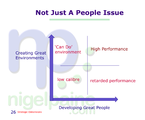
These are live blogged notes from Nigel Paine's webinar about Innovation on the Learning and Skills Group.From the LSG:Nigel Paine is a change-orientated leader with a worldwide reputation and a unique grasp of media, learning and development in the public, private and academic sectors. The former head of training and development at the BBC, he left the BBC in 2006 to start his own company focussed on leadership, creativity, innovation and learning, working with companies in Europe, Brazil, Australia and the USA. He teaches for several weeks each year at Wharton Business School in Philadelphia on a doctoral programme aimed at Learning Leaders.Difference between Innovation and CreativityCreativity - "The ability to transcend traditional ideas, rules, patterns, to create new meaningful new ideas"Innovation - "Something new or different introduced."If you're not introducing anything new and tangible, you're not innovating.Nigel conducted a poll asking people how innovative they think their organisation is:14% Very innovative28% Quite28% A bit10% Not really20% No AnswerWhy is Learning and Development ImportantInnovation is mainly about people -- if you don't have people who are capable of looking beyond the horizon, innovation will most likely not happen.Dan Pink's new book 'Drive' is about motivation - it's a human need not driven by carrots and sticks. e.g. (real story) University VC sends an email to all his professors saying they need to be innovative from Monday onwards.Questions for individuals and organisations to ask themselves:Did you do today better than yesterday?What do you want to be remembered for?What's your legacy as an organisation?Innovation requires people and that requires L&D to contribute to people's development. A culture of learning is a culture of thinking and that leads to innovation."If something works it's already obsolete."Definition of Innovation by DruckerDrucker says innovation is, "Change which creates a new dimension of performance". You can also call this the definition of L&D, says Nigel5 Kinds of Wealth by SharmaEconomicRelationshipHealthAdventure/ Challenge/ Fun Contribution and Impact If you take the last two Adventure/ Challenge/ Fun and Contribution and Impact you can create meaning for your organisation. Learning environments lead to an environment of innovation.5 ways you can make innovation thriveWhat stops innovation?Innovation that doesn't get supported from top is doomed - L&D can't drive it alone. We need executive endorsement.Management needs to set an example by being innovative. Too much process stifles innovation.Everything doesn't need a business plan - you should only need a business plan after you've gone through a few trials. Can't make people jump through hoops right at the beginning.There are more things that organisations do to stop innovation than they do to facilitate it!What helps innovation?1. The Taylor PhilosophyOpen: What might workCull: What will workFocus: energies on success2. It takes timeInstant returns rarely happen - you need to be in for the long haul.3. Lots of dangers en-routeYou have to be aware of what they are and deal with them as you go on. If you don't have the new dimension of performance -- you can't justify this effort though.4. Not Just a People IssueIt's also an environment issue. It's about how you work with people. A great environment is just as important as great people5. You need the right processese.g. Innovation forum at Intel, 20% time, Innovation and LearningNigel asked the group: Is L&D Involved in Innovation?Yes a lot - 10%Yes - 29%Hardly - 26%No - 6%No Answer - 28%L&D's agenda should be to drive innovation. There's a link between personal growth and organisational success. If people feel they are growing they'll contribute to the organisations success. Link learning to innovation - this is critical.© Sumeet Moghe, 2009
Sumeet Moghe
.
Blog
.
<span class='date ' tip=''><i class='icon-time'></i> Jul 20, 2015 11:33am</span>
|
|
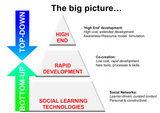
These are live blogged notes from the Learning and Skills Group Webinar today.Nick Shackleton Jones is the Informal Learning Manager at the BBC and the author of one of my favourite LnD blogs.Why Rapid DevelopmentIncrease OutputReduce Development CostsDevelop your trainersReduce Development TimelinesInvolve Client and SMEs in DevelopmentMaintain control and updatabilityWe do this now because we can!The Big Picture: Now you can co-create content with your SMEs with a low budget and you don't need to wait ages to gather the money to do something. Bottoms up is the future of LnD.Challenges - What's the worst that could happen?The worst that could happen could be:Clients as authorsand Trainers become developersNot sure this is a bad thing though, because purposing content is a skill too. As Nick mentioned, training becomes the quality control in this situation.The worst that could happen is that nothing really happens.So where are BBC today and how did they get there?BBC does some really cool courses using really rich media, videos, etc -- I saw one of them last year. Some of their clients are actually producing some high quality content as Nick demonstrated.Application training has become really easy to create, using tools such as Camtasia. Within the space of days or hours, there's an LMS compatible course available for your new system.They've now started to do some really immersive game-like environments and some very interesting courses, e.g. the ones they've done on Storytelling. What they learnt along the way. 'Mistakes are often the stepping stones to failure.'ProcessPair client with the learning consultantProject management skillsInstructional design skillsTechnical/graphical skillsRetain control of publishing to LMSOnline workflow helpsHave a strong implementationLead by example - show great stuff as examples!Have a rapid development 'bucket' budgetContentCreate a template - so courses look like they've come from the same sourceSeparate 'awareness' from 'resources'Use scenarios - put people in a situation and provide them feedback on what they doContextualise/ tell storiesPolish the graphicsConsider Accessibility - rapid tools can do this in a repeatable, standard fashionUse video/ voice-over if possibleKeep the length less than 20 minsFeature peers where you can - people like to see people they know© Sumeet Moghe, 2009
Sumeet Moghe
.
Blog
.
<span class='date ' tip=''><i class='icon-time'></i> Jul 20, 2015 11:32am</span>
|