Blogs
|
I've always had one pet peeve -- when designing onlines courses, we instructional designers often try to do everything within a Flash-based elearning course. Somehow I feel we need to think beyond the Flash shell and rather design learning 'experiences' than just courses. When we start appreciate the concept of learning experiences, it automatically helps us think beyond the context of the elearning shell. I do understand however, the need to minimise context switches for the learner. This is where it helps to integrate media from the web into the context of our courses. There are several benefits to this approach:
You can add high quality interactivity into your courses with minimal effortYou can reuse existing contentYou can update content easilyThere are perhaps several other benefits too, but I'll leave it to you to do that research (especially if this blogpost interests you). Let's take a look at a few examples of web content in elearning. I've used Articulate Studio 09 for the purpose of these demos.
Example 1 - Set up your Scenario
Click here to launch the demo
A few days back, I discovered this wonderful tool called xtranormal. All you need to do, is add a few lines of text and lo presto! Your video's ready! Given what Rich Mayer and Ruth Clark have discovered about the power of videos in scenario based learning, this can be an excellent way to create high quality scenarios, rapidly. Here's a simple elearning scenario that I created using xtranormal.
Example 2 - Show an Interactive TimelineLEBANON (History of) on Dipity.
When I did this demo, a friend of mine said, "The Articulate timeline is nice, but timelines that you can drag around are nicer." While I don't necessarily agree with that assessment, I do realise that timelines that you can navigate using scrollers are quite a common interaction. It could take you quite a bit of time and money to try and build something like that from scratch, using Flash. On the other hand if you could take xTimeline or Dipity and use that to create an embeddable timeline, you'll perhaps be done really quickly. And to add to that, the output is quite nice as well. While my output needs a lot of cleaning up, here's a quick demo I created this morning.
Example 3 - Display content differentlyGoogle Search Tricks on Prezi
Often, we look for different ways of presenting our content and the interactions within the rapid elearning tool may just not be enough. What do we do in such cases? I find the idea of getting web content from sources such as Vuvox or Prezi, quite interesting. Here's a quick demo where I've embedded a prezi into Articulate. Cool, huh?
Example 4 - Collect FeedbackEveryone wants feedback for their courses (I hope). However most rapid elearning survey tools are not designed for great data management. OTOH, other tools like SurveyMonkey or Google Docs are better suited for this purpose. So why not bring these tools into your course and have learners submit feedback directly into the more capable application? Here's a demo I've put up with Wallwisher and Google Docs.Of course, with all this, there's the challenge of visually integrating the web object with your course look and feel. That said, it is pretty cool that most of this web 2.0 media is embeddable and sharable. That gives you a whole lot of power and flexibility when designing your instructional experience. I think this is very cool and represents a huge advantage especially in the rapid elearning space. If you liked this post, you may like other people's articles on the same topic. As usual, I'd love to know what you think, so please comment liberally.
The source files for today's demos are here. Well, that's it for now folks -- enjoy! © Sumeet Moghe, 2009
Sumeet Moghe
.
Blog
.
<span class='date ' tip=''><i class='icon-time'></i> Jul 20, 2015 11:28am</span>
|
|
A few days back I was witness to a debate where we were discussing if the choice of tools really mattered when selecting a knowledge platform. A group of people felt that an organisation should make a far sighted decision about their knowledge platform and select one that offers features to scale, rate and manage information better. The other group believed that the tools didn't matter. As long as an organisation could take a popular tool and start getting more people to use it, the features didn't matter. After all, isn't post-modern knowledge sharing all about the culture of collaboration?
I find both arguments very compelling. Being as dim-witted as I am, here are my conclusions:
The tools don't matterThe tools do matterConfused? You must think I'm out of my mind! Let me explain what I mean.
The tools DON'T matter if you don't have the Right EnvironmentLast year, I'd written a post that talked about how little things can help your enterprise 2.0 efforts succeed. Let me be very clear about my opinions here. The most sophisticated tools will not help knowledge sharing thrive, if you don't have the following socio-cultural elements nailed down.
An Engaged CommunityPeople are naturally helpful -- they want to contribute. Unfortunately, most corporate intranets are so restrictive that they discourage the most enthusiastic contributors. When they're permissive, they just have all the wrong workflows. Add to that the participation inequality principle by Jakob Nielsen and you have a fairly huge challenge on hand. Andrew McAfee talks about the importance of making your knowledge ecosystem freeform, frictionless and emergent. That's a first step. To deal with participation inequality, communities need to find creative ways such as the ones described here.
Committed Community Management5 Tips For Increasing Community Engagement
The concept of self-organisation is pretty cool, but in my experience of working with a strongly self-organising company, I can say a couple of things:
To self-organise, the first thing people need is a shared objective. It's naive to imagine that people will self-organise without clear goals.Once there's a clear objective, every self-organising team needs a facilitator. In the case of communities, this person is the community lead or the community manager.As it turns out, many community managers are volunteers running a volunteer army. While that's how many organisations have to operate, it's fair to say that community managers can't be 'just' volunteers. The organisation needs to cut them some slack from their day to day responsibilities and the these leaders need to channel that time back into making their groups more successful. The above presentation from mindjumpers provides an excellent summary of how a community manager should operate.
Content StewardshipKnowledge is everywhere. Its on email, it's on IM, it's on discussion forums, conferences, unconferences, team wikis; it's in people's heads! It's in every possible place you can imagine. Most of this knowledge never finds it's way into an organisational knowledge base. Without establishing the right workflows to ensure that knowledge can move from these day to day channels to a universal platform, we run the risk of losing valuable information. As a consequence, we lose the opportunity to create the critical mass of information that attracts contributors. This is where traditional knowledge managers can still play a huge role and channel emerging knowledge from a silo to the rest of the organisation.
The Right Incentives"People usually have no more than 10 minutes each day to contribute content 'for the benefit of others'. When they have a choice between the broad, appreciative, internet and the puny, thankless intranet, the decision is quite simple."The last socio-cultural factor which I think we often overlook, is the question of incentives. Whether it's a soft toy, overall recognition or a rating on their performance reviews, people should have a clear idea of what's in it for them if they contribute. In the initial stages of an enterprise 2.0 rollout, this is crucial. I say this because there's very little reason why someone should spend time out of their regular work hours trying to contribute to a knowledge platform if they don't see a strong incentive. I'm not saying that there has to be a defined incentive here. The incentive could just be that it's 'the cool thing' or 'the fun thing' to do. In which case you need to invest heavily in the design of your knowledge system.
In the Right Environment, you DO need Capable ToolsIf you manage to take care of everything that I mentioned in my rather long discourse until now, then you will need a set of tools that plays well with your ecosystem. Simply layering 'search' over an archaic document management system will not do the trick. Knowledge sharing in this age is much more than just organising documents. You need a system that:
Can scale to hundreds of pages without adminstrative oversight.
Is easy to contribute to and integrates with the users' preferred channels (email?).
Accepts contributions in various formats and isn't tied to one method of content creation.Has support for metadata.
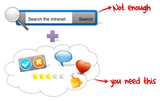
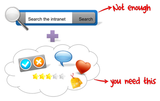
In a subsequent post, I want to touch upon the importance of metadata in a world of search, but let's just say for now, that metadata has four distinct uses:illustrate relationships between discrete pieces of information;illustrate the value of some information;illustrate appropriateness (self-policing);and to gather opinions about the information itselfThe above tag cloud is a representation of how I look at tool capability when it comes to selecting a knowledge platform. More on this in future blogposts.So what do you think? Do the tools truly matter? Or do they not? I'm I taking the right view of this debate? I'd love to hear from you - so please comment liberally and let me know what you think. If you liked my post today, you may also like my other posts on the topic of enterprise 2.0. I'm quite passionate about organisational knowledge sharing, so feel free to reach out to me directly if there's a topic you'd like me to contribute to!© Sumeet Moghe, 2009
Sumeet Moghe
.
Blog
.
<span class='date ' tip=''><i class='icon-time'></i> Jul 20, 2015 11:28am</span>
|
|
An interesting piece about Boeing’s Workplace Innovation Lab in Management Innovation Exchange. Boeing started a 90 day program that connected Gen Y employees to their managers for business innovation. The aim was to accelerate business priorities, leverage personal networks, facilitate conversations, and spread the use of new technologies. The idea of ‘reverse mentoring’ is something that strikes me as an interesting way of bridging not only a generation gap, but also a knowledge gap. This gap is mainly about the new technologies that businesses are facing.
The aim of the Workplace Innovation Labs were:
Performance improvement through more collaborative working
More effective ways to transfer expertise across the generations
More productive use of investment in collaboration tools
Helping leaders to be people-leaders as well as technical-leaders
Some of the lessons learned:
that communication tools should be varied according to the importance and urgency of the communication;
that a less seasoned employee can bring fresh perspective and valuable insight to a long standing business problem;
that having a manager open to innovative solutions and using young talent in innovative ways can be a powerful retention lever.
What I like about programs like this one is that they contribute to organizational learning and create social capital within the organization. That is why a program like this one should not be limited to a one-shot 90 days, but can work as a continuous tool for workplace innovation.
Daan Assen
.
Blog
.
<span class='date ' tip=''><i class='icon-time'></i> Jul 20, 2015 11:28am</span>
|
|
These are live-blogged notes from a very interesting webinar with Cathy Moore and Patrick Dunn, where they were talking about new approaches to Instructional Design. It was a pretty cool session where Cathy and Patrick talked about how old approaches towards design cease to be meaningful and how instructional designers need to make an effort to create experiences over architecting information.
Cathy's talkFor more than 25 years, Cathy's used technology to help people learn. These days, she helps people strengthen their instructional design skills, and designs and writes elearning for businesses.
We as instructional designers have jobs because organisations have problems. They have useful information and we have to get it into peoples heads. We decide to make this information interesting, so we chunk it or add interest by adding narrators. Sometimes we play games to make it fun. We tell stories with a character who need help.
We've got into the business of putting lipstick on a pig through these approaches. Information isn't bad -- getting information into people's heads doesn't change behaviour. Knowing that smoking is bad for you doesn't make you stop smoking?
So we need to start over.
Cathy is a great proponent of instructional design using action mapping. It's a simple process:
Start with a measurable goal.State job behaviours to help people reach the goal. These are real world behaviours. A useful question to ask, is "Why aren't people doing it?" Is it really a lack of skill?
Brainstorm realistic practice activities for each job behaviour.We then identify the bare minimum information people will need to complete these activities.The information is on the fringes -- it's not in the center. We need to limit the amount of information in our courses and place it in the spots where people will find it in their real jobs and teach people to find and use this information.
Design Lively Elearning with Action MappingView more presentations from Cathy Moore.
Our job is not to design information -- it is to design an experience.
As we do this, we start to solve performance problems and stop converting information into interactive presentations.
Patrick's TalkPatrick Dunn has been designing, producing and thinking about various forms of learning technology for more than twenty years.
According to Patrick, instructional systems design is perhaps an outdated, heavy process. On a pragmatic basis, what really happens in instructional design is the ADDIE process - analyse, design, develop, implement and evaluate.
In this world of gaming, social media, twitter, etc, is our old approach to instructional design still appropriate? Earlier, our options were few. Constraints were few and clear. Learning challenges were structured, well understood. As against that today, we have many options, many and unclear constraints and very chaotic learning challenges.
Patrick is looking a cheap, quick and effective design that combines:
RapidisationGamingSocial LearningThe question is -- does the old approach still make sense? Is it still fresh? For the current business climate it's neither fresh nor does it really make sense for the high impact solutions we're looking for.
So here are the ways to move to fresh approach.
Think experience, not contentThink about experiences in the real world that are changing people.Get emotional!What's the tone?Nobody learns from content, people learn from experience. You cannot know something until you do something with that knowledge. Research shows that using information supports long-term recall more than studying information. As I always say, it's not enough to just look at a lake and read about swimming -- you have to dive into the lake and actually swim!
Design bottom-up and top-downWe don't design from business objectives to performance objectives to strategies, etc. We should have Lean design, where we start with learning tactics and trust our hunches. If our strategy doesn't work, we should be flexible to change. Everything should be flexible to change.
Use multi-role teamsSubway subs are great because they get created by people in sharply defined roles. If people switch roles, then the subs can be awful. We don't want this in our teams. We need few people overlapping in roles and generalising deeply. Writers should be able to build, builders should be able to do graphic design, etc.
Use usersWe need more contact with learners.We need the right kind of contact with learnersThat's because people are now more into creating digital media than before. They can help us in a big way.
Prototype and IterateA working prototype gets more feedback than scripts, etc. A prototype forms a placeholder for discussion, so it's really important to get it wrong the first time and iterate from there. It's continuous improvement in design.
Play!Designers take themselves a bit too seriously. We need to play, laugh, sing, dance a little more and that'll allow us to experiment and do things in a truer designer like fashion.© Sumeet Moghe, 2009
Sumeet Moghe
.
Blog
.
<span class='date ' tip=''><i class='icon-time'></i> Jul 20, 2015 11:28am</span>
|
|
Ever since the introduction of the term Learning Organization back in the 1990s the concept has been the ‘holy grail’ for many organizations. In some business plans I reviewed recently, the organizations producing them had an explicit aim of becoming a learning organization. As it has turned out that the concept of the learning organization is rather abstract and difficult to implement, I was struck by this ambition and directly responded with some questions to articulate this ambition:
1. Why do these organizations want to become a learning organization?
2. How can these organizations become learning organizations?
3. What kind of learning do these organizations aim at?
Why?
Many management concepts are hyped by consultants and/or scientists, which in return, earn good money by implementing them. But, the learning organization is beyond that point. The importance of knowledge and learning is a given for almost all organizations. Therefore all organizations need to find opportunities to produce, distribute and commercialize knowledge. Learning is a critical process in contemporary organizations. As research has shown this process is multilevel when considered from the learning organization perspective (e.g. 4I model by Crossan et al.). Most critical learning takes place at individual and team level. Some of this learning is institutionalized at organizational level and is embedded into systems, procedures and practices. On individual and team level learning is also important for competency development, as it helps individuals and teams to grow and improve their performance. When looking at organizations, the answer to the why question depends largely on their strategy or the business drivers that are appealing to them. Strategy and business drivers are for instance aimed at security (compliance), improvement (exploitation), innovation (exploration) or HR policies (talent management).
How?
How does a learning organization learn? Of course 80% or more occurs in the informal or non-formal space. But, interventions are needed to secure that the learning is effectively captured and embedded in the organization. As many scholars suggest the right mix of formal and non-formal learning should be found in order to reach effectiveness of learning in organizations. Also the connections between individual, group and organizational level learning should be optimized. This ensures the proper institutionalization of learning in the organization. Developing the right mix of learning interventions, either formal or non-formal, is the aim for true learning organizations. This is quite a job and requires a learning climate that balances organizational characteristics in leadership, culture, structure and systems. Also it requires maturity in learning & development offerings that are aligned with the broader HR and talent management practices in an organization.
What?
What the learning organization wants to learn is a question that is overlooked in literature on the learning organization. In the why question some directions where given, but when you look at organization strategies some assumptions about the required learning for successful execution can be made. Typical strategic options are presented in the work on Value Disciplines of Treacy and Wiersema. They distinguish operational excellence, product leadership and customer intimacy as strategic options.
- When you want to play in the ‘operational excellence’ league, you probably want to have smaller learning cycles based upon process improvement. Learning will be focused on operations with a combination of plan-do-check-act learning cycles and a sharp eye for radical operational innovations. Learning will take place at production and supply chain level to a large extent.
- When you want to play the ‘product leadership’ card, learning should be aimed at technological and design innovations that can be embedded in products. This learning is focused on finding new combinations of technologies and design. Probably learning will take place with knowledge and business partners in this case.
- When your aim is ‘customer intimacy’ your learning should be aimed at the market and your clients. Market intelligence, questionnaires and direct learning from customer complaints and needs is a key differentiator.
With these questions in mind, the implementation of the learning organization concept is quite challenging. In my opinion it is a worthwhile ambition for organizations to become learning organizations. Not only for them to stay competitive, but also to provide their members with an inspiring work environment that allows growth and talent development.
Daan Assen
.
Blog
.
<span class='date ' tip=''><i class='icon-time'></i> Jul 20, 2015 11:27am</span>
|
|
OK, I admit that I use Google search a lot. I won't deny the importance of search in my life. These days, search is a convenient entry point into our complex intranets. However, I don't believe that layering search over document management systems is the answer to today's knowledge problem.Here's why I think so:Knowledge is linked. While search can identify physical connections between information, it cannot show qualitative relationships.Knowledge is contextual. Search cannot identify the contextual significance of information.Knowledge is valuable. Search by itself can't show value -- it needs 'intelligence' to decide value.This is where I see the importance of metadata on knowledge systems. Metadata, coupled with search makes enterprise knowledge systems as useful as the web for finding the right information.BTW, what is metadata?"Metadata is a concept that applies mainly to electronically archived data and is used to describe the definition;structure;administrationof data files..." - WikipediaIn today's post I want to outline the power of metadata for your enterprise knowledge platform. Hopefully, you can use this as a guide to choose your knowledge platform if you're at that stage of your journey.The Power to Relate InformationThe ability to show relationships between information, is key for knowledge platforms. A lot of systems do this through tags. On learninggeneralist.com, you'll notice that there's a 'label list' on the website that relates articles about similar topics. If you've used social bookmarking, you'll notice that we categorise information under tags. On enterprise systems, collective tagging helps relationships and structure emerge. It then becomes easy for people to look at a certain tag, to reveal all information possibly connected to it. For example, I've tagged my favourite enterprise 2.0 case studies here. This holds great potential for induction, onboarding and capability building.The Power to Show Value and AppropriatenessWhen everyone has the power to create useful information, everyone also has the power to create havoc through inappropriate contributions and misinformation. This is a risk that most execs are concerned about. Enterprise 2.0 systems mitigate this through 'more eyeballs looking'. We want users to have the power to say how valuable or suitable a contribution is. You must have seen several ways of doing this on the web.Favourites - if a lot of people 'favourite' an article, then it's perhaps valuable.Thumbs up or down - similar to favourites, except the thumb down can indicate if an article is unsuitable.Flagging - allows you to flag items as inappropriate.Rating scales - a quantitative way to suggest the value of specific content.The Power to Contextualise Information"Information in context, trumps information out of context." - Karl KappDr. Kapp's quote is a clear indication of why enterprise 2.0 systems are becoming the rage today. The ability to find useful, bite-sized information just when you need it is indeed the killer advantage. The ability to further contextualise this information makes it more relevant to the user's situation. On the web, we see this context emerge through comments. Take a look at blogs and associated comments for example. Free-form comments serve a number of purposes:They allow users to show their reactions to the content.They allow users to give feedback about the content. e.g. "I used this technique at work and ..." or "Here's another perspective..." or "I want to add that..."They allow other users to use the content effectively. User commentary gives different perspectives and much needed context for the information in question.This is just the tip of the iceberg when it comes to the benefits of metadata on enterprise knowledge systems. As you can see, the right kind of metadata can make your knowledge infrastructure come alive! I strongly believe that a knowledge platform based only on search is similar to putting lipstick on a pig! To make your knowledge come alive, you need users to contribute through low friction means. Comments, ratings, tagging create low barrier methods to make sure this happens. So do think about these elements when choosing your knowledge platform. Dinesh Tantri knows a lot more about these things than me, so do follow his blog here. Hope you enjoyed this post, please let me know what you think -- your comments are always valuable!© Sumeet Moghe, 2009
Sumeet Moghe
.
Blog
.
<span class='date ' tip=''><i class='icon-time'></i> Jul 20, 2015 11:27am</span>
|
|
Twitter, LinkedIn, Facebook, Youtube, Slideshare. There is a lot of buzz around social media application in every area of today’s organizations. Social media have deep impact on work and private live once embraced as a part of the live. But, still social media usage in corporations is not undisputed. Whilst in a recent study 81% of corporate training leaders belief that social media offer valuable learning opportunities for their workforce, there is also concern. Mainly about the impact of social media on employee productivity, security issues it might raise and the quality of information sources. Will the benefits triumph the risks? A brief analysis from three perspectives follows in three blogposts on this site: organizational perspective, employee perspective and manager perspective.
In this starting post some figures that show the impact of Internet and social media on today’s live, both working and private:
1.97 billion Internet users worldwide, with 825.1 million of them in Asia, 475.1 million in Europe and 266.2 million in North America.
An estimated 25 billion Twitter messages were sent in 2010, and the company added over 100 million users.
Facebook also saw record numbers, reaching 600 million users. It’s amazing to think that Facebook started 2010 with 350 million users.
Internet users sent 360 billion pieces of content across Facebook over the year, which included links, notes and photos.
Flickr, just one of a number of popular photo sites, saw 130 million photos uploaded to the site each month.
People watched 60 billion videos on YouTube each month — that’s 730 billion videos throughout the year. And the average Internet user watched 186 videos each month.
To be continued … Next post about the impact of Social Media on organizations.
Daan Assen
.
Blog
.
<span class='date ' tip=''><i class='icon-time'></i> Jul 20, 2015 11:27am</span>
|
|
This evening I was on UMBC's "ISD now!" webinar titled "Doing more with Less". These are live blogged notes from the event.UMBC’s ISD Now! Webinar Series is UMBC’s ISD Graduate Program’s newest online platform to share ideas and information on topics related to business, organizational productivity and workplace learning and performance.The panelist on this was Jay Cross - the progenitor of the term Informal Learning. Jay Cross is a champion of informal learning, web 2.0, and systems thinking. His calling is to help business people improve their performance on the job and satisfaction in life.As usual, Jay was on his favourite meme of Informal Learning and as always, it was fun listening to him.We started off with a poll that asked us about the importance of informal learning and not surprisingly most people said it was important or very important.Jay started off with a picture of the cloud. Well -- signs of what he's thinking, huh? Jay claims to learn a lot from his buddies at the Internet Time group and the web. Jay had a lot to say, but decided to do whatever he could do in the time he had at hand. F a while I was having a hard time keeping up -- 2230, and no visuals, what do you expect?Convergence of Work and LearningBut then we realise that Citrix was playing up, so back to a more visual webinar. Well, Jay started on his meme of 'work is learning now' and reminded us that we need to be moving learning platforms and workscapes. Well, this can't be easy. There are risks and not everyone's going to make it.10 Dirty WordsThis carries on from Jay's great article on 8 dirty words for us L&D professionals. So Jay doesn't like the words social, elearning, informal, learner, learning, etc. He likes to call this 'working smarter'. Jay talked about the examples of:how a twitter like information sharing saved a turbine company $3-$5m annually.how CGI saved 4000 systems engineers two hours a week by using in-house subscriptions to research findings.how intel's free wiki became the go-to source of information eliminating $20m a year in duplicate effort.how P&G has outsourced 50% of it's R&D to its customers, cut staff and increased innovationhow 7000 workers at a major insurance company are sharing information in near real-time via Twitterhow at Best Buy 2000 employees have providede more than 20000 answers to customer queries using Twitterhow at CAT 3000 communities of practice have generated more than $75m in savingsJay started to talk about Hans Monderman who radically changed street and road design. Read the Wikipedia article. So we need to be radical to be effective -- calling people learners isn't going to do that. They're workplace performers!Moving from Formal to Informal LearningJay finds the phrase 'Formalising informal Learning' to be absolutely incorrect. What we need to do instead, is 'institionalise' it. I agree -- that's what I like to say.So, informal learning is more pull than push. Formal bolsters knowledge, informal is wrapped up with doing things. Formal takes a while, informal is bite sized. Formal is away from work, informal in embedded in work. Formal design is by SMEs and instructional designers, informal design is by individuals. Formal takes months/weeks to develop, informal takes minutes. You go through formal learning in advance of the need, you pull informal learning only when you need it. Formal learning is top-down, informal learning is laissez-faire.Each of these have their space. If you're a novice, you need formal learning of some kind. Yes, some informality helps, but the recognition that a specific phase is over, becomes really important. But as you gain experience, you're looking for little wins, and small experiences which solve specific problems are really useful.Formal Learning is like being on a bus. You need to go through the entire journey. Informal Learning is like being on a bicycle. Stop where you want to and when you need to.We're all experienced with formality, but our focus on the informal is minimal. Most of our spending is for formal learning, but most of our learning is informal! Don't know how mathematically correct that is, but sounds right.Spectrum of ActivitiesThe above picture talks about the various activities that move from Formal to Informal learning and illustrates the bridges amongst them. The key is that you need to go through the entire spectrum. Try wrapping the formal learning experience within informal experiences. Example: team meets in advance of a workshop and discuss their goals for the workshop; go to the formal workshop and then ends with an alumni-support network followed by brief recall sessons.Businesses are part of a large ecosystem. What's the benefit of helping our customers and partners learn? Is it improved business results, better partnering, lesser friction? Hell, yeah!Q to Jay by a CxO: How do you know informal learning works?Jay's fabulous answer: Well how did you learn to standup, walk and learn? Did someone train you for hours before you spoke your first word?OTOH, do you believe everything you learnt at a religious school? Do smokers quit only because they know that smoking is bad for them?Skipping to the end - Cost/ Benefit of Informality.Jay skipped most other stuff and moved right to the end - bummer!Tips to make your informal learning project succeed:Your sponsor is god - well they're the folks backing you aren't they?Coordinate throughout.Agree measures up front.Only valid metrics are business metrics. If the business don't care, you shouldn't measure!If numbers are squishy, interview sample and extrapolate. Don't present unconvincing data -- find what you can.You must manage what you can't measure.Some more tips:Think of an elevator pitchKnow the ROI - you may not know the actual 'returns' but being able to articulate true value of the investment is quite useful in MY opinionTalk about helping people work smarterAsk for support from the executivesMost of Jay's talk is in a free white paper at his website. It's an awesome read, so please download it - great stuff. Jay's own website has a lot of free materials on the topic, so please look through that too! All in all, interesting, engaging webinar!© Sumeet Moghe, 2009
Sumeet Moghe
.
Blog
.
<span class='date ' tip=''><i class='icon-time'></i> Jul 20, 2015 11:27am</span>
|
|
Currently I am in Pakhuis De Zwijger, Amsterdam at the Startup Weekend. This is an intense 54 hour event which focuses on building a web, software or mobile application which could form the basis of a credible business over the course of a weekend. Entrepreneurship is a trade you learn in practice and this is where Startup Weekend provides an inspiring learning experience. Within the first 24 hours our team made great progress and developed our startup: Askbox. Askbox is an App for peer-to-peer knowledge sharing. Our aim is to connect questions from Askbox users around the world to a crowd of leading experts. They give users instant advice using rich media content (text, images, audio, video). So far it has been interesting to see how a team of back-end & front-end developers, designers and marketeers can work together to create something great. More updates to come of how the entrepreneurial Askbox team will progress. Follow us on twitter via @getaskbox.
Daan Assen
.
Blog
.
<span class='date ' tip=''><i class='icon-time'></i> Jul 20, 2015 11:26am</span>
|
|
Today I delivered a webinar for the 'Thought Leadership Webinars' series from ThoughtWorks Studios. I thought it could be useful to share stuff from the webinar on this blog, for the benefit of those who may be interested in this topic. My topic had nothing to do with the technical mumbo jumbo of creating software. While 'feedback' is a key XP value, it usually manifests itself on Agile projects as a way to improve software.
I like to look at feedback as a way to improve people as well, because people that improve continuously are more likely to produce better software in teams. Anyways, the slides for talk are on Slideshare and you can download them from there. I've tried to design my slides so they're self-explanatory to some extent. I'm happy to answer questions if you have any.
During the webinar, I also shared an elearning module on Feedback, which you can find here. Hopefully, this could be useful for any team to develop a healthy practice of sharing feedback. Let me know what you think.
This apart, chat transcripts and a webinar recording will soon be available at the ThoughtWorks Studios community, if they aren't there already.© Sumeet Moghe, 2009
Sumeet Moghe
.
Blog
.
<span class='date ' tip=''><i class='icon-time'></i> Jul 20, 2015 11:26am</span>
|