Blogs
|
Foi já divulgado o whitepaper do caso de estudo TechHub Leaderboarded (ver este post):
Whitepaper Case TechHub_Leaderboarded by GamFed
Comentários adicionais que foram enviados na contribuição submetida:
TechHub Noise Meter is an application of internal gamification or enterprise gamification. Is is used to improve collaborators' engagement that feel more motivated to participate since they receive feedback from their efforts through the leaderboard. Collaborators are not individually mentioned or rewarded but they have the sense of participation in a greater cause, the success of their company. From this standpoint, I consider its application as a "best pratice".
A leaderboard is a mechanic for short term engagement. It appeals to extrinsic motivation (winning a competition and achieving a better status) and this kind of motivation is for short term engagement. These type of rewards work as long as they exist. If they cease to exist, engagement could fall. They can also reduce intrinsic motivation.
I see Leaderboarded as a gamification tool that can be used with other tools to achieve a wider gamification experience. Alone, Leaderboarded is limited to its own specific purpose but combined with other tools it can contribute to a wider experience. I used Leaderboarded in an educational context combined with ClassDojo, a reward tool based on points, targeting students behaviors. Leaderboarded proved to be a very helpful and effective tool.
Education & eLearning Blog
.
Blog
.
<span class='date ' tip=''><i class='icon-time'></i> Jul 20, 2015 12:29pm</span>
|
|
January 30, 2010 is going to be an eventful day. Instructional Designers across cities in India are going to meet in groups in their own city. This is going to be the first meeting organized by the Instructional Designers Community of India this year.
More than 50 Instructional Designers have RSVPd for the meetup. This is a great number to start with.
If you are in India, make sure you show up in the location specified in each of the cities below:
Update: Chennai meetup is happening at 11 AM in : Element K India Pvt. Ltd. RR Tower II, 4th Floor (you will need to sign in on 4th floor), Thiru-Vi-Ka Industrial Estate Guindy, Chennai 600 032 INDIA
It is not too late yet. RSVP for the meetup here. If your city is in the list, please feel free to gang up with your fellow Instructional Designers in a coffee shop or park.
Do not forget to:
Take pics
Take the minutes of the meeting
Let us have a great time on 30th Jan
Rupa Rajagopalan
.
Blog
.
<span class='date ' tip=''><i class='icon-time'></i> Jul 20, 2015 12:29pm</span>
|
|
Realizou-se em São Francisco, nos dias 16 a 18 de abril a GSummit 2013, um evento que procura reunir os principais atores do universo da gamification.
No âmbito deste evento foi lançada uma iniciativa para premiar as melhores aplicações do conceito de gamification em diversos setores (GAwards), entre eles a educação. A lista dos nomeados na área da educação pode ser consultada aqui. Os resultados deveriam ter sido anunciados durante o evento mas aparentemente ainda não foram divulgados. De qualquer forma destacam-se o primeiro classificado nas votações - World of Classcraft - e o quarto classificado - 3 Key Lessons Learned in 5 semesters of College Course Gamification. Este último é um exemplo de aplicação de gamification no ensino superior e podem ser encontrados mais detalhes num post de Steven L. Johnson, o professor que promoveu a iniciativa.
Johnson tem ainda um vídeo onde apresenta a sua experiência (47m):
Esta experiência é também mencionada no Horizon Report - Higher Education Edition 2013: At the Fox School of Business at Temple University, a professor designed his social media innovation course as a quest in which students earn points for blogging and engaging in social media activities. They are awarded badges, and those that excel earn a place on the leader board.
No vídeo, Steven Johnson apresenta também a sua definição de gamification (aos 7m30s): "using game elements in some other stuff", uma versão mais ligeira do que a tradicional "using game elements in non-game contexts" (e mais uma definição a juntar à coleção).
Na sua aplicação de gamification, recorreu aos habituais points, badges, achievements, leaderboards e levels, usando um plug-in para o Wordpress no que diz respeito a achievements. A isto juntou o que designa por careful incentive design.
A apresentação inclui uma demonstração do portal do curso e uma análise comparativa de resultados (com e sem gamification). São apresentados igualmente os depoimentos dos estudantes envolvidos.
Uma análise de diversos plug-ins para o Wordpress que podem ser usadas em aplicações de gamification é também referida na apresentação.
Não fica muito claro de que forma é que os elementos de jogos foram efetivamente aplicados. Aparentemente terá tudo a ver com a participação em blogs (do curso e dos alunos). Os resultados apresentados e os comentários apontam para resultados positivos mas ficam por conhecer os pormenores.
O portal do curso alvo desta experiência - social media innovation - está disponível on-line.
Education & eLearning Blog
.
Blog
.
<span class='date ' tip=''><i class='icon-time'></i> Jul 20, 2015 12:29pm</span>
|
|
By ruparajgo | View this Toon at ToonDoo | Create your own Toon
Times are changing. Getting a job as a fresher is no longer so easy, I guess. At least that’s what the popular job portals in India tell me. I was checking some popular job portals and found that most employers require candidates with atleast 1 year of experience in Instructional Design. This does say a lot about the current job market.
This does not mean getting a job as a stark fresher is impossible. This means as a fresher with 0 experience in Instructional Design, YOU need to work hard to make it happen.
I have been training people in Instructional Design myself and I understand how important it is for them to get a job. This is when I thought of some ways in which freshers might be able to fight their way through this tough market.
So here are some tips for freshers looking for jobs in Instructional Design:
Decide what you want to do
The first step is to spend some time reading through job descriptions and decide what you want to do. Never go for brand names. Always go by job descriptions and your interests. For example, if you like working with technology, you can consider trying for a curriculum developer role in a software company. On the other hand if you like working on various subjects, you can join a company that is into custom e-learning. At the outset, be very clear about the kind of work you want to do. Remember Instructional Design is very vast!
Gain some basic Instructional Design skills
If you do not have time to take up a 3 month certification course in Instructional Design, try finding a mentor who can help you out or try a short duration course to gain some basic Instructional Design skills.
Understand Instructional Design and what Instructional Designers do
It is not important to remember instructional theories. It is more important for you to understand what instructional design is all about in simple terms and have a good understanding of the activities involved in creating training material (online and classroom). Most importantly, try to find out what freshers are expected to do when they join organizations.
Get your portfolio ready
As a fresher,having a portfolio might be not so easy. However remember times have changed. Employers want to hire people who can deliver and bring out results. Your portfolio can have sample storyboards. Carry some sample storyboards while you go for an interview.
If you know how to work with rapid e-learning tools, create a 2 minute learning video and add it to your portfolio. If you do not know how to work with a rapid e-learning tool, spend some time learning the tool on your own. Tools like Captivate are easy to use and easy to learn too.
Highlight your interest/knowledge/skills in your CV
When you write your CV, highlight your interest/knowledge/skills in Instructional Design. You might have been a lecturer in a college or a technical writer. While you write about your achievements, make sure you also communicate why someone must hire you.
Do not expect HR personnels to call you
Be proactive. Keep your eyes open for all kinds of opportunities. Submit your CV in all job portals. Contact some HR consultant and inform him/her that you are on the lookout.
Do not lose heart
If you fail in one or two job interview, remember that is not the end. Keep trying. Be patient. Things will work out if you work towards your goal persistently.
Do not stop learning
Let job interviews not distract you. Let failures not discourage you. During your free time, read about Instructional Design, practice writing and take up visualization exercises. Remember the more you practice, you will get better and better.
Learn from failures
Make a note of the questions asked in the interview. Reflect and think how you could have done better. If you attend 2 or 3 interviews, you will get an idea about the kind of questions people ask and what they expect. Prepare accordingly.
Network with Other Learning Professionals
Join a community for learning professionals such as Instructional Designers Community of India. Network with learning professionals and try finding opportunity through people.
Hope these tips help you.
If you want to add on to this, please do it in the Comments section.
Rupa Rajagopalan
.
Blog
.
<span class='date ' tip=''><i class='icon-time'></i> Jul 20, 2015 12:29pm</span>
|
|
Conferência Serious Game Time ! sobre aplicações de serious games e gamification no mundo empresarial.
Education & eLearning Blog
.
Blog
.
<span class='date ' tip=''><i class='icon-time'></i> Jul 20, 2015 12:29pm</span>
|
|
Hello All,
Today I complete 3 years of blogging and it really means a lot to me. This blog now has 222 posts, close to 600 comments and nearly 200 feed readers. I have got some really nice feedback on my posts and my blog. Thanks to all of you who helped me reach this far.
When I started blogging in 2007, I never thought I would learn so much through my blogging efforts. I got a chance to network with wonderful learning experts across the globe. I also made friends with my fellow learning professionals in India. This has been possible only because of this blog.
I realize the immense value of blogging very much this year especially now that I am an independent instructional designer. This blog has opened up great opportunities for me and that it why it is so close to my heart.
Today I would like to call out to every fresh Instructional Designer to start blogging. Take my word. It really helps!
I thank all my readers for motivating me to write more. I thank all my fellow instructional designers and learning experts across the globe for being a great inspiration for me to sustain my blogging efforts.
I hope to share all the knowledge that I gain through my learning process the coming year too.
Please wish Writers Gateway a very happy birthday!
And yes, please wish me good luck! I need lots of it
regards
Rupa
Rupa Rajagopalan
.
Blog
.
<span class='date ' tip=''><i class='icon-time'></i> Jul 20, 2015 12:29pm</span>
|
|
Call for papers - ICERI2013, 6th International Conference of Education, Research and Innovation.
After 5 years enjoying ICERI conferences in Madrid, this 6th edition will be held in Seville (Spain), on the 18th, 19th and 20th of November, 2013.ABSTRACT SUBMISSIONThere will be 3 presentation modalities: Oral, Poster or Virtual.The deadline for abstracts submission is July 11th, 2013.
OBJECTIVESThe objectives of the conference are to:- Present and disseminate projects about education and emerging technologies- Share best practices and promote international partnership and cooperation- Create an international forum to discuss and exchange ideas about the latest innovations in education and research, applied to all fields and disciplines
ICERI2013 Publications will be sent to be reviewed for their inclusion in the ISI Conference Proceedings Citation Index.
IMPORTANT DEADLINES- Abstract Submission Deadline: July 11th, 2013 (included)- Notification of Acceptance/Rejection: September 2nd, 2013- Final Paper Submission Deadline: October 3rd, 2013 (included)- Registration deadline for authors: October 3rd, 2013 (included)
facebook - http://www.facebook.com/iated
twitter - https://twitter.com/ICERI_Confhttps://twitter.com/ICERI_Conf
Education & eLearning Blog
.
Blog
.
<span class='date ' tip=''><i class='icon-time'></i> Jul 20, 2015 12:29pm</span>
|
|
How do you train someone to become a great manager? How easy or difficult is to train someone on leadership skills?
Are classroom training programs or online training programs on leadership skills enough?
A great leader never gets manufactured in a classroom. Why? Because leadership has lot got to do with behavioral and attitude change and this kind of change cannot be achieved through ordinary training programs. Great leadership skill need to come from within and that is very difficult to achieve.
As the saying goes" You can take the horse to water, but never make him drink it".You can give people tips on leadership skills but you cannot get the leader out of them.
What if you can persuade people to perform? How about persuading someone to do something that you want him to do? Be it a behavioural change or an attitude change, how about using technology to achieve this? Interesting?
Yes, it is interesting indeed.
Using technology you can persuade someone to do something that you want them to do. This is not new. This is something that you are used to. You are used to getting persuaded by technology.
Online advertisements are persuasive. You go to a website. There is a pop up with attractive visuals that says "Click here to win." The advertisement is persuading you to click on the banner.
Facebook is persuasive. The whole site is designed in a way that you feel like visiting the site again and again.
Mafia Wars is persuasive. You are feel like playing the game all the time.
The examples above illustrate how websites and games are designed to persuade people to play a game, visit a site or click on an advertisement.
Let us now look at one other interesting example of persuasive technology for learning/training. A company called Realityworks offers parenting programs for young people to create awareness about parenting and childcare. So what do they do? They develop robotic babies that behave and act like real babies.
If you enroll for this parenting program, you will be given this robotic baby to take care of and the baby must be fed, put to sleep diapered around the clock. The baby will keep track of how well you take care of it and will respond. Interesting? Strange? Whatever it may be. Technology here is being used in a innovative fashion to bring about a change in behavior which might be difficult to achieve through an awareness session or through a mentor.
Check out these interesting videos about Real Care Baby:
The parenting programs designed by RealityWorks is to control teen pregnancy. Read more on this here.
Persuasive technologies give you a real experience and can work wonders to bring about a behavioral and attitude change. The study of such persuasive technologies is called Captology. This term was coined by BJ Fogg.
I learnt about Captology and found the interesting example of Baby Care in this social network called: PINOT.
It is really interesting to note the way technology is being used to bring about a behavioral and attitude change.
Have you come across some such examples? Please feel free to share it.
Rupa Rajagopalan
.
Blog
.
<span class='date ' tip=''><i class='icon-time'></i> Jul 20, 2015 12:28pm</span>
|
|
I recently came across this website called Amplify that works just like Twitter and other social networking sites. However Amplify seems to be a much more effective tool for collaborative learning than any other freely available learning tools today. I say this taking into account some of the unique features in Amplify.
There are top 6 Features in Amplify that makes it an effective tool for collaborative learning. Here is the list:
Amplify Add-in : You can integrate Amplify into your web browser and it acts just like a Go button. Every time you come across an interesting article, you can share it with others within seconds without any manual entry.
Amplify URL/Amplify Selection options: These options are really interesting. In Amplify, you have the option of sharing portions of a web resource. For example, if you want to share an interesting finding about usage of e-learning from a report, you can highlight a specific portion in the report and share it with others.
Add you take option: This is the best option in Amplify. Every time you share information, you can add your 2 cents to it. So when you share resources with others, they get to read your perspectives/thoughts/opinions about the topic.
Recommend option: If you find an interesting resource posted by your friends, you can recommend it. You do not have to repost it.
Amplify Daily Brief: Every day you receive a list of resources posted or recommended by your friends. So even if you are not checking the site, you get to check the resources through your mailbox.
Integration with Popular Social Networking sites: You can sign into Amplify using your Twitter or Facebook accounts. This makes life easy
The features above do make Amplify an effective tool for collaborative learning. For example, if four students are working on a research paper, all of them can sign into Amplify and follow one another. During the process of researching, each of them can keep posting resources to Amplify. The resources could be full length articles, quotations from e-books, interesting findings from reports and so on. The resources can be qualified with personal comments/thoughts/ideas. Amplify will help the students to collate information, discuss and share ideas/thoughts as they work on their paper.
Amplify could also be used by organizations for employee training and learning. May be Amplify could be integrated into the corporate intranet or learning portal. Last but not the least, I must say I love the user interface design of Amplify and on a usability scale of 5, I would rate it as 4.5.
Now I would love to hear from you:
Have you used Amplify? What is your take on its use for collaborative learning?
Please share your thoughts.
Rupa Rajagopalan
.
Blog
.
<span class='date ' tip=''><i class='icon-time'></i> Jul 20, 2015 12:28pm</span>
|
|
Last weekend, we had an interesting online session for the members of Instructional Designers Community of India. During the session, Abhijit Patronobis of Monad Interactive demonstrated an e-learning module on music called Anandadhara. It was a very engaging session and it was interesting to see how music was taught to people using an asynchronous blended learning approach way back in 2003 when e-learning technology was not so well known in India.
About Anandadhara
Anandadhara was a training program on Rabindra Sangeet. This is Indian music, specifically bengali music. The objective of the training program was to teach songs of Rabindranath Tagore. Anandadhara was designed in such a way that people could learn Tagore’s songs at their own convinience with the assistance of experts.
As Abhijit says, "Most Bengali know about 50 to 200 rabindra sangeet (without even ‘learning’ them formally). Almost every Bengali in the age group of 30+ love singing Rabindra sangeet for the sheer pleasure of it, only a handful of them would learn though. There are various reasons, they either dont want to learn or they dont have the time to learn. Thats because we need to prioritize our needs. So someone who studies in a college or works full time, will not find a teacher available at that hour when he finishes his studies/work (although he may have an interest to learn and there may be plenty of teachers around).
Anandadhara gave people a chance to learn at their own flexible pace, under the guidance of the best teachers, any time, without having to go anywhere. and that too without having to buy instruments and learning to play them. They could perform any where without any live accompanist. These are some of the benefits that made us popular. The features like listening and looping through lines, the practice mode, the audio clips for pronunciations, the info for explaining the song — these are rich features that one does not get in a face to face class these days. Why? because the teacher does not have the time (and also the capabilities to explain)."
Anandadhara Training Approach
The training approach used was as follows:
The learner downloads the e-learning module onto their system.
The learner listens and practices the songs on their own.
The learner then records the song in his/own voice and sends the song in mp3 format via e-mail to the teacher.
The teacher gives feedback and suggestions in mp3 format and sends it to the learner via e-mail.
This way people across the globe could be a part of this training program on music.
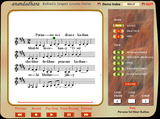
Here is a snapshot of the e-learning module on Rabindra Sangeet:
You can download the actual e-learning module here. You can also download the recording of the session on Anandadhara here.
My Thoughts
Today technology has advanced and there are a variety of ways in which you can design and deliver your training. So what options do you have today to deliver training on music:
Synchronous virtual classrooms: Using web conferencing tools like Webex, Skype and Adobe Connect, teachers can connect with the learner real time on the internet and conduct music classes.
Immersive Internet : In a 3D immersive online virtual environment as found in Second Life, you can form a live band and the experience of learning and playing music could be very similar to what you would find in real life.
What other technology options can you think of to teach music online? One other question that comes to my mind now is can online training can be applied to visual arts such as painting and drawing?
Please share your thoughts and views in the comments section.
Rupa Rajagopalan
.
Blog
.
<span class='date ' tip=''><i class='icon-time'></i> Jul 20, 2015 12:28pm</span>
|