Blogs
|
No seguimento deste post, Disco Flipper: A Case Study in GamFed, foi publicado, com data de 21 de fevereiro de 2013, o white paper deste caso.
Este documento destaca que as mecânicas presentes neste caso são "product recognition, retention, fun, brand awareness".
A principal conclusão sobre este caso de estudo foi "Gamifiers should look to leverage social reward mechanics, when permitted by the social platform, in gamified experiences".
O documento não menciona que o jogo pode não estar adaptado ao público-alvo da campanha assim como o facto de apelar à competição entre os utilizadores também não ser um elemento especialmente motivador para esse público-alvo.
O caso envolve ainda uma questão mais de fundo que é de quando considerar uma aplicação com estas características como um jogo sério ou como uma aplicação gamificada. A distinção nem sempre é fácil.
Aguardam-se por novos pedidos de participação em casos futuros propostos pela GamFed.
Education & eLearning Blog
.
Blog
.
<span class='date ' tip=''><i class='icon-time'></i> Jul 20, 2015 12:39pm</span>
|
|
Hello All,
I started the Game of the Week series in March 2009 and have managed to post quite a few games and my reviews every friday in this blog for the past 7 months.You can find all the games posted so far here.
Here are the top 10 games that you accessed and played through this blog:
Super Stacker 2
Edheads Design a Cell Phone
Pizza Hot
Bloxorz
Get The Glass
FarmVille
Post It Draw It
The Scruffs
Show Jumping
Pavlov’s Dog
I want to specially mention this game called Velma Vision that caught a lot of attention. Thank you all for playing the games that I post and also reading my game reviews.
To take this forward, I need your help. I would like to invite you to help me find some really good games that are freely available on the web.
If you find an interesting game and would like to feature that game in this blog, please send me the game url @ ruparajgo19@gmail.com. I will post the games in this blog with full credit given to you.
Please note that the Game of the Week series now changes to Game of the Month series. Starting October 2009, you should find a game on the last day, every month.
Hope you continue to enjoy the games that I post.
Cheers,
Rupa
Rupa Rajagopalan
.
Blog
.
<span class='date ' tip=''><i class='icon-time'></i> Jul 20, 2015 12:39pm</span>
|
|
Uma contribuição para o blogue de Gamifeye: Four Approaches to Collecting Data in Gamified Systems, publicada em 18 de fevereiro.
Tradução adaptada:
A análise de
grandes volumes de dados (big data
analytics) pode desempenhar um papel importante em sistemas gamificados. Assim, a
existência de algum mecanismo de análise é essencial nestes sistemas. Um sistema gamificado pode
ser visto como qualquer sistema de software que utilize elementos de design de jogo para envolver os utilizadores e mudar os seus comportamentos, a fim de melhor
atingir os objetivos do sistema (ver
este outro post). A forma como os utilizadores obtêm feedback
sobre as atividades que realizam é
crucial. Ao acompanhar algumas
variáveis relacionadas com as ações dos utilizadores,
um sistema gamificado pode encontrar
padrões, tendências e correlações
e ser capaz de fornecer um feedback
preciso e imediato.
O sistema
gamificado pode ser um simples site ou uma
aplicação web. Pode ser executado num servidor e ser acedido por um computador com um navegador web ou pode ser uma app em
execução num smartphone, armazenando dados na nuvem. Também pode ser uma combinação de ambos ou mesmo recorrer a dispositivos ou gadgets
específicos. Os utilizadores de sistemas gamificados, aos quais se pode chamar
'jogadores', podem ter um papel ativo
ou passivo na sua relação com os
elementos de jogos do sistema.
Para alimentar
o motor de análise, o sistema também deve incluir algum tipo de gestor de atividades, um componente capaz de
monitorar e ler os dados gerados
pelas atividades dos utilizadores. Um sistema gamificado, dependendo
do seu tipo, objetivos e arquitetura, pode usar uma ou mais
das seguintes quatro abordagens para monitorar e recolher os dados para
o gestor de atividades:
I - Automaticamente, pelo próprio sistema:
esta abordagem representa o que provavelmente a aplicação mais
habitual de gamification. As
ações dos jogadores num site ou
aplicação web são monitoradas e
recompensadas com pontos e badges.
Os jogadores podem partilhar suas
conquistas em redes sociais e comparar o seu desempenho com os outros
consultado tabelas de liderança. O
objetivo é aumentar o tráfego no
site o número de páginas vistas, a duração das visitas
e aumentar a fidelidade dos jogadores. É uma abordagem de marketing, onde as métricas usadas jogos sociais
como o número de utilizadores ativos por mês (MAU - Monthly Active Users) e o número de utilizadores ativos por dia (DAU
- Daily Active Users) assim como o nível de viralidade (referências feitas por amigos), são aplicadas para
medir o desempenho.
Os maiores players do mercado da gamification, empresas como Badgeville,
Bigdoor, Bunchball ou Gygia e outros empresas de menor dimensão como tierX,
PunchTab ou Uplaude fornecem as ferramentas para dotar sites, blogs e
aplicações web com estes elementos de jogos. Estas ferramentas podem ser
simples add-ons ou plug-ins para monitorar e recompensar as atividades dos
jogadores.
Os jogadores têm um papel passivo neste tipo de sistemas, uma vez que
não podem controlar o que é monitorado e apenas deixam que o sistema observe as
suas ações.
Os elementos de jogo aplicados são do tipo PBL (Points, Badges & Leaderboards), um tipo de elementos de jogos referido por Kevin Werbach no seu
livro, , For the Win: How Game Thinking Can Revolutionize Your Business.. As atividades dos
jogadores têm lugar num ambiente virtual e o contexto não lúdico onde a gamification
é aplicada é a própria aplicação web ou
site.
II - Usando
um
dispositivo externo:
neste tipo de sistemas gamificados, um smartphone ou outro dispositivo específico ou gadget é utilizado para acompanhar o que o jogador faz num dado contexto de atividade.
O dispositivo é sincronizado com um site
para fazer o upload dos dados recolhidos
e o jogador é recompensado com os habituais pontos ou badges, é
comparado com outros jogadores e as suas
conquistas podem ser partilhadas com amigos. O melhor
exemplo e mais citado deste tipo de
sistemas é o Nike +. Ao usar um
smartphone, um relógio específico, um iPod ou outro dispositivo da Nike, os jogadores podem controlar atividades
desportivas como a corrida. Exemplos
semelhantes, usando os seus próprios dispositivos,
são o Fitbit e o Zamzee,
este último dirigido a um público alvo mais
jovem. Outro exemplo interessante e divertido é o HAPPIfork, um garfo eletrónico que monitora hábitos
alimentares.
Os jogadores
têm um papel ativo no processo, uma vez que podem controlar se usam o sistema ou não,
o que é monitorado, o que é partilhado ou quais as conquistas a
realizar. Ao fazer isso, conseguem
uma sensação de autonomia.
O contexto não lúdico é um contexto no mundo real.
Feedback e um sentimento de diversão são
algumas das principais características
deste tipo de sistemas, assim como com a sensação de pertença a um
grupo e a competição saudável com
os outros jogadores. A maioria desses
sistemas tem como objetivo a
mudança de comportamento e promove
a adoção de um estilo de vida
saudável.
III - Contando com os próprios jogadores: neste terceiro tipo de sistemas
gamificados, os jogadores têm o controle total sobre os dados recolhidos. Os
dados são registados exclusivamente por iniciativa dos jogadores usando uma app
num smartphone ou um website. Os jogadores têm um papel ativo. O exemplo mais conhecido é o Foursquare.
Os jogadores são responsáveis por fgazer check-in numdeterminado local,
partilhando com outros jogadores. A motivação dos jogadores é a melhoria do seu
status social e a competição com os outros jogadores. Outros sistemas deste
tipo visam o auto-aperfeiçoamento dos jogadores como por exemplo as aplicações
para o iPhone, Lift.do, para acompanhar os objetivos pessoais, e Win Epic, para
monitorar tarefas e lembretes num cenário de RPG.
Para aumentar
nos jogadores a sensação de existência de um propósito para além da componente
lúdica e deixá-los sentir que estão a fazer uma diferença por algum motivo (e
também como forma de os manter a bordo), há sistemas como o Recycle Bank, com o
objetivo de melhorar os comportamentos dos jogadores como a reciclagem do lixo
doméstico ou usando a energia de forma mais eficiente. Outros exemplos são o
Pratically Green e Opower, este com o seu próprio motor de big data.
Para que estes
sistemas funcionem, os jogadores têm de ter um elevado nível de motivação inicial.
O sistema não vai funcionar se o jogador não é um jogador ativo. Este tipo de
sistemas é muito semelhante ao tipo anterior em que o dispositivo que monitora
as atividades é substituído pelo próprio jogador. Os jogadores fazem mais do
que simplesmente ligar e desligar o dispositivo já que têm o poder de escolher
o que registar e quando registrar. Também aqui o contexto não lúdico pertence
ao mundo real.
IV - Contando com utilizadores que não são
necessariamente jogadores: nesta quarta abordagem, as atividades dos jogadores são monitorados
por um utilizador responsável por inserir os dados recolhidos. Este utilizador
também pode ser um jogador com privilégios especiais. Alguns exemplos deste
tipo de sistemas podem ser encontrados no contexto da educação, onde esses
"utilizadores especiais" são os professores ou os pais dos alunos. Os
estudantes são os jogadores e são jogadores passivos porque não podem agir
sobre o que está sendo monitorado. Apenas podem jogar com as regras definidas
por seus professores ou pelos seus pais.
Um exemplo é o
ClassDojo, um sistema em que os professores (utilizadores que não são
jogadores) podem premiar os seus alunos com pontos positivos, recompensando os
comportamentos desejados, e pontos negativos, punindo aqueles que são indesejados.
Outro exemplo, Chore Wars é uma plataforma ao estilo RPG para acompanhar a
quantidade de tarfeas domésticas feitas pelos jogadores. Está a meio caminho entre este grupo de sistemas
e o anterior. Os jogadores podem fazer login e reivindicar a realização de uma
tarefa predefinida que fizeram, ganhando
pontos de experiência (XP - Experience Points). Um utilizador especial, o
"Dungeon Master" escolhe que tarefas existem e os XP respectivos, mas
este privilégio também pode ser dado a outros jogadores. Um exemplo semelhante
é o Highscore House, onde os pais atribuem tarefas aos seus filhos e acompanham
a execução dessas tarefas. Os pais também podem optar por jogar e decidir quais
tarefas são atribuídas a cada jogador. Estes podem necessitar de aprovação dos
pais para completar a tarefa, a fim de certificar que a tarefa foi devidamente concluída. Também no Vivo
Miles, um sistema web de atribuição de recompensas usado por escolas, os alunos
possuem um cartão de recompensas pessoais para armazenar pontos eletrónicos ("Vivos").
Estes pontos podem ser trocados por bens físicos ou usados, por exemplo, para evitar
a fila do almoço. A escola define quais os comportamentos que devem ser
recompensado ou punidos e os professors encarregam-se de atribuir os pontos.
Embora a
última abordagem não esteja tão intimamente relacionada com big data, é
necessária a presence de um motor de análise para lidar com os dados inseridos pelos
utilizadores que atuam como mediadores entre o sistema e os jogadores.
Independentemente do processo de recolha de dados, combinar elementos de jogos
com dados pode representar uma vantagem importante em sistemas gamificados uma
vez que estes se tornam mais capazes de dar uma resposta imediata (feedback) e
precisa para os jogadores, de uma forma divertida e envolvente. E isto é
certamente uma forma de promover a mudança de comportamento, o objectivo final
da gamification.
Agradecimentos ao Sam Geuter, o promotor do Gamifeye.
Education & eLearning Blog
.
Blog
.
<span class='date ' tip=''><i class='icon-time'></i> Jul 20, 2015 12:39pm</span>
|
|
When you create tutorials for a software product, it is very natural to capture the following:
Description about the product features
All tasks that one can do with each of the product features
Steps to complete each of the tasks
Most software product tutorials are product feature centric.
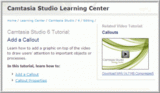
Here is an example of a product feature centric tutorial for Camtasia. The very title of the tutorial indicates it is about adding a callout and setting callout properties in Camtasia.
The tutorial above tells you all that you can do with the callout feature in Camtasia. The tutorial talks about placing callouts, resizing callouts, the different kinds of callouts and so on.
When you work with callouts in Camtasia, you are likely to get flustered trying to manually resize the callout in the timeline. The callout will refuse to get resized. This is such a serious usability issue. People spend hours figuring out how to resize callouts in the timeline. If you notice, this particular tutorial above, which is about callouts, never ever once mentions or captures this usability issue. So imagine if users trying to figure out how to increase callout length in Camtasia, go through this particular tutorial, how frustrated they would feel, when they discover that this tutorial has no solution to their problem.
Product feature centric documentation and tutorials are good to have because they give a nice overview of the product features. But then it is even more important to have tutorials that will focus on the problems users might face while they are using the product feature, especially if the problem is not going to be fixed in the product for sometime.
This is where user centric tutorials for software products work wonders.
Here are some examples of user centric tutorials for Camtasia :
How to increase callout length in Camtasia
How I learnt to work with Camtasia
How to achieve smooth visual effects in videos using Camtasia
When you look at the user centric tutorials above, they capture :
Real use cases
Real problems
Solutions for all common problems
Well, such kind of information might go into the troubleshooting guide. But then it again takes quite a lot of effort for users to search for the problem and solution. Instead if you have short tutorials on common problems that users might face, it will save so much of their time.
It really makes a lot of sense to include such user centric tutorials in help manuals or user guides where the user is likely to check for help.
If a software product is complex or has an usability issue, the users will appreciate if it is revealed upfront and the solution is disclosed. After all users want to effectively use the product and not get surprises or shocks while trying to use the product
What do you think?
Rupa Rajagopalan
.
Blog
.
<span class='date ' tip=''><i class='icon-time'></i> Jul 20, 2015 12:39pm</span>
|
|
Call for Papers: e-virtuoses 2013
International Scientific Symposium "Games for all purposes? Appropriation, Repurposing and Rejection"
On 4 and 5 June 2013 in Valenciennes, during the "e-virtuoses" scientific convention, dedicated to the use of games and play (digital or not) for utilitarian purposes, we will host a scientific symposium entitled "Games for all purposes? Appropriation, Repurposing and Rejection".The objects of study will include in particular:
Serious Game: the combination of a serious intention - education, information, communication, marketing, ideology, coaching or data collection - with a game including rules and targets.
Serious Play: the combination of a serious intention - education, information, communication, marketing, ideology, coaching or data collection - with a toy.
Serious Gaming: the process of repurposing a game via all kinds of different methods, in order to offer activities that go beyond mere entertainment and that had not been initially intended by the author of the game.
Gamification: use of game design to gamify objects and originally non-playful contexts.
These objects challenge the notions of prevention, training, knowledge assessment, coaching, communication, data collection, etc. in various fields such as education, healthcare, marketing, safety, culture... The purpose of this Symposium is to present approaches, paradigms and feedbacks using theoretical frameworks and methodologies that help observe, measure and analyse the impact of these objects and of the resulting transformations: acceptance, appropriation, resistance, repurposing, rejection... Different types of analyses can be suggested for different types of purposes, uses and scopes:
Analysis of products
Analysis of policies
Analysis of designs
Analysis of practices
...
This Symposium is intended to encourage reflection that will be fuelled by inputs from various disciplines such as education, information and communication sciences, management, IT, neurosciences, psychology, sociology, medicine, arts...
Schedule :
Paper submission (2,000 to 3,000 words): 3 March 2013
Reading committee announcement of selected papers: 31 March 2013
Symposium: 4 and 5 June 2013
(informação partilhada por Sylvain Haudegond em gamification-research@googlegroups.com)
Education & eLearning Blog
.
Blog
.
<span class='date ' tip=''><i class='icon-time'></i> Jul 20, 2015 12:39pm</span>
|
|
by ruparajgo | Create your own Cartoon at www.toondoo.com
Have you seen a kid take a toy apart and fix the toy together again? This might seem like a childish act of taking things apart just for fun. But then this childish act of taking things apart can also be a huge learning process.
Here is someone who talks about how he and his son break down a musical piece and learn to put the parts and phrases together:
Just like working through a reverse engineering problem, my son and I first break each piece down into its individual phrases. We then experiment with different strategies for learning each phrase, often further breaking a phrase down into smaller parts. We finally "solve" a piece by slowing putting its parts and phrases back together.
I have also seen people who have no knowledge in HTML design web pages by just analyzing how other web pages have been designed.
When you are trying to learn Instructional Design, you start with the concepts and then go on to do practical exercises on analysis, design and storyboarding.
Well, how about breaking any training material or e-learning course apart before you actually learn to create one?
Yes, I am talking about reverse engineering an e-learning course or any training material to learn how to do Instructional Designing.
Before we proceed further, let us understand what reverse engineering is all about.
What is Reverse Engineering?
Wikipedia defines Reverse Engineering as the process of discovering the technological principles of a device, object or system through analysis of its structure, function and operation.
In simple terms, reverse engineering is breaking an object into its basic parts in a logical fashion. It is the process of analyzing and learning how the object was put together.
What does reverse engineering an e-learning course or any training material mean?
Reverse engineering an e-learning course or any training material means analyzing, finding and documenting the following:
Who uses the information in the course and for what purpose?
What could have been the results of the requirements gathering phase?
What could have been the development process for the course?
What has been covered in the course?
How is the course structured?
How is the information structured?
How is the course flow designed?
What are the course objectives and learning objectives and how have they been derived?
What is the instructional approach used?
What are the instructional strategies used and how or why were such strategies used?
What could be the visualization for each slide?
How are the assessments designed?
How did the Analysis and Design document look like for the course?
How did the storyboard for the course look like?
How is the course layout and navigation?
Questions as listed above and many more such questions will help you reverse engineer an e-learning course or any training material.When you are reverse engineering an e-learning course you are not trying to create but trying to think how the course was created. You are not exercising your mind to come up with new ideas. You are thinking hard how ideas for the course have been derived.
The next question is how can such an exercise help you gain Instructional Design skills.
How reverse engineering helps?
Most freshers feel lost while doing instructional designing because they fail to understand the basics and the essence of instructional designing. Freshers feel less confident because they lack basic skills and fear making mistakes.
When you reverse engineer an e-learning course or any training material:
You gain basic instructional design skills with great ease
You get to understand all Instructional Design concepts instantly
You understand the relevance and importance of creating any training material
You understand what goes into creating an e-learning course or any training material without racking your brain
You get to know how a storyboard is related to the end product (e-learning course/training material)
You get the essence of visualization and its importance in creating any training material
The end product (e-learning course/training material) is your reference and guide so there is no fear of making mistakes
You are focused and learn faster
There is no information overload
In short you gain a lot of confidence to do instructional designing on your own.
My experience
When I read this training material on the web: CSharp for Kids, I tried to reverse engineer and find out how story has been woven so well to teach a programming language.I tried to figure how things have been made so simple when the subject is a complex programming language. I was amazed at the use of cartoons in the book and I studied how they have been designed to fit with the story.
Well, this was indeed a great experience and great learning too
Have you tried learning Instructional Designing or anything for that matter through reverse engineering? Please share your thoughts and experiences
Rupa Rajagopalan
.
Blog
.
<span class='date ' tip=''><i class='icon-time'></i> Jul 20, 2015 12:38pm</span>
|
|
I am glad to announce that I am an independent professional now. This is something I always wanted to do and it has finally happened now.
I launched my site: http://thewritersgateway.com/ that gives an overview of the kind of services I will offer. Of course, there are some pages to be updated. The site will look complete in the coming days.
I just wanted to share this piece of news with my readers and please wish me good luck in my venture.
In case you are interested in my services, please feel free to contact me
I will continue to share useful information in this blog.
So keep reading!
Cheers,
Rupa
Rupa Rajagopalan
.
Blog
.
<span class='date ' tip=''><i class='icon-time'></i> Jul 20, 2015 12:38pm</span>
|
|
Mitch Resnick é o responsável pelo grupo de investigação que desenvolve o Scratch, um ambiente gráfico para ensinar programação a crianças. Nesta TED Talk, defende a importância de ensinar programação a crianças, não porque programar venha a ser uma necessidade para as suas profissões futuras (nem todas se tornarão programadores ou profissionais na área das TIC) mas porque programar permite desenvolver a sua criatividade e capacidade de resolver problemas.
Resnick neste vídeo refere ainda ser crítico do rótulo de "nativos digitais" atribuído às gerações mais novas. As crianças e jovens são fluentes a "ler" tecnologias" mas menos capazes de "escrever" tecnologias. A este propósito, ler o que já se escreveu aqui.
O vídeo refere ainda outras plataformas já mencionadas aqui como o Codeacademy.
Um bom vídeo que reflecte sobre como a aquisição de competências digitais importa para a aquisição de outras competências, para o desenvolvimento da criatividade e para a capacidade de resolver problemas.
Education & eLearning Blog
.
Blog
.
<span class='date ' tip=''><i class='icon-time'></i> Jul 20, 2015 12:38pm</span>
|
|
Call for Participation Workshop on Interaction Design in Educational Environments
, ICEIS 2013 Workshop.
TOPICS OF INTEREST:
• Conceptual models for educational applications
• Educational pervasive environments
• Educational Interface design
• New devices and interaction techniques for educative environments
• Instructional and Interaction design
• Student/Teacher centered design
• Educative Ambient intelligence
• Human factors in Educative UI design
• Collaboration, cooperation and coordination
• Design patterns in collaborative educational environments
• Classroom teaching techniques
• Model-Based Development Environments
IMPORTANT DATES:
• Paper Submission: April 9, 2013
• Authors Notification: April 30, 2013
• Final Paper Submission and Registration: May 13, 2013
Education & eLearning Blog
.
Blog
.
<span class='date ' tip=''><i class='icon-time'></i> Jul 20, 2015 12:38pm</span>
|
|
This month’s game was suggested by Jacob Everist. The game Time Fcuk as Jacob puts it is really good mind-twisting game. It is perplexing and a lot of fun.
This is what Jacob has to say about the game:
I played it through and I’m not sure if there’s more than one ending. Basically I like the innovative puzzler gameplay of shifting gravity
and shifting dimensions. I also like the psychotic stream of consciousness you get from text messages of your past and future self.
Just the main screen tells you what kind of game it is. Just look at. It looks like the deranged writings of schizophrenic neighbor I
once had. I also like the intentional use of pixelated graphics.
My views about the game
I really think Time Fcuk is a complicated game and I would not play this game for fun because it taxes your brain a lot. I am still figuring out what this game is all about. I also see I enjoy playing it even without making much sense of the story or concept.
I like the changing perspectives when you press A in your keyboard. This is something innovative. I also like the background score which gives an eerie feeling.
However I feel this game is not so easy to play.
Let me know what you think
Rupa Rajagopalan
.
Blog
.
<span class='date ' tip=''><i class='icon-time'></i> Jul 20, 2015 12:38pm</span>
|