Blogs
|
Picks from Rod's Podcaster Guide and E-Learning News
Follow Rod's e-learning news sources and his Delicious bookmarks
Interview: Matthew Wasowski, Senior Manager of Customer Programs, Blackboard Collaborate
Learn about industry leading tools for synchronous and asynchronous learning. Matthew discusses Wimba Classroom, Pronto and Wimba Voice and how these products and Elluminate will be combined in the upcoming Blackboard Collaborate, due this summer.
Podsafe music selection from Ioda Promonet
Laura Sullivan plays "Pachelbel For The Potomac" from "Pianoscapes For The Trails Of North America"
Buy at iTunes Music Store
Buy at Amazon MP3
Duration: 21:42
Rods Pulse Podcast
.
Blog
.
<span class='date ' tip=''><i class='icon-time'></i> Jul 23, 2015 08:25am</span>
|
|
We like to keep this blog as up-to-date and relevant to you, our readers, as possible. We strive to keep our list of guest bloggers fresh and varied, as well as give people a chance to share their opinions and knowledge. Now we’d like you to share yours!
Whether you’re an experienced blogger, a complete novice, or just want more exposure for your work, we’re welcoming submissions from anyone for the chance to be featured here. Plenty of people have already written for us and (we hope!) they’ve all enjoyed the experience.
What’s in it for me?
There are lots of reasons why blogging for a big publisher like Oxford University Press is great for your personal and professional development.
The opportunity to reach out to a huge audience of teachers and language professionals around the world - our blog is read over 1,000 times a day; every article is shared with our Twitter audience of over 31,000 ELT professionals and our Facebook audience of over 166,000 teachers worldwide; and our ELT website receives approximately 1.5 million views per month.*
It’s great publicity for both you as a professional, and your website or blog. It could help you attract new readers to your work and connect with like-minded individuals around the world.
It’s valuable experience for your personal and professional development. Teachers and language professionals who take an active role in online professional development feel far more supported and enthused to take what they’ve learned into the classroom.
Become a guest writer for our industry-leading blog
*Audience numbers accurate as of 04/02/2015.
How can I get involved?
If you’ve written an article that you think might be suitable, or you have examples of previous work that you’d like to show us - even if you just have an idea for an article - you can get in touch with us at elt.marketing.uk@oup.com with ‘Guest blogging’ in the subject line and we’ll get back to you as soon as possible.
Are there any rules I must stick to?
There are no rules, as such, but here are a few guidelines as to what we’re looking for and what we think works best on an ELT blog:
Articles must be related to English language teaching or learning, education in general, technology in education, etc. If in doubt, take a look at our Categories page to see if your idea fits in with our themes.
Articles should be helpful and provide something of value to the readers. We won’t publish anything that is promotional or commercial in nature.
Posts should be about 300-600 words and have an interesting title.
If you want to include images in your post, please make sure that you either own the images, or you have permission to use them. Creative Commons search is a great website where you can find images that are licensed for commercial use.
Please check your spelling and grammar. Of course, we’ll work with you to improve anything that isn’t quite right, but the more accurate your post is to start with, the more likely it is that we’ll be able to use it.
If your article is chosen to be published on the blog, we’ll ask you to provide a short biography and a photo for our Guest Bloggers
Send your article to elt.marketing.uk@oup.com with ‘Guest blogging’ in the subject line to help us find and respond to your message as quickly as possible.
We look forward to receiving your articles.Filed under: Uncategorized Tagged: blogging, EdTech, Education, ELT, ESL, guest blogger
Oxford University Press ELT blog
.
Blog
.
<span class='date ' tip=''><i class='icon-time'></i> Jul 23, 2015 08:25am</span>
|
|
I am very blessed to include among my friends, some extraordinarily talented people. Two of them feature in this post.The first is Jeremy (Jerm) Nell, a South African cartoonist of note. I have known him since he was just a boy, and have watched his talent blossom into something that has made people around the world sit up and take note.Jeremy recently got married. And this is where the other half of today's equation comes in. Justin de Reuck is an exceptional photographer, and he did the photos for Jerm and Janel's wedding. Oh... and Jeremy would like to make it known that he was not crying in that photo of him first catching sight of his bride, 'kay? Yeah. Right.Both of these men have the uncanny ability to see things in a way that others might miss, and then to draw that perspective to our attention. Jeremy casts a cynical eye over situations and lampoons them mercilessly in single frame political satire cartoons, then proves he has a whimsical side with his Biggish Five strip.Justin sees potential in angles and lighting and goodness knows what all else and captures a fleeting moment. His photographs of his own family and friends are achingly beautiful, and his wedding photography is among the best I have ever seen.
Karyn Romeis
.
Blog
.
<span class='date ' tip=''><i class='icon-time'></i> Jul 23, 2015 08:24am</span>
|
|
In January this year we asked teachers from around the world to vote for their top writing challenge. Over 450 teachers took part and the results are now in!
With 23% of the vote, the most popular writing challenge was: ‘My students don’t want to write’. Many teachers felt that demotivation lay at the heart of this challenge, with students unable to see the importance of writing beyond the classroom.
Martina in the Czech Republic said: "Lack of motivation is hard to break. (Students) say they don’t need to write in their lives and what they need is to be able to speak English. They even say they’ve forgotten how to write by hand, and they don’t have computers in class."
Maja in Croatia faces a similar challenge: "My students find writing boring because it usually takes longer than other tasks and they do not feel it is important, since they are not used to writing in their own language. They feel it is something they have to do for school and not something they would do in everyday life."
Close behind with 21% of the vote, the second most popular challenge was: ‘My students keep making the same mistakes’. Jolinda in the Netherlands emphasised how frustrating this can be: "It seems to me that students do not refer to corrected work which makes me feel like my work is more or less superfluous. The students do not learn from their mistakes."
Lenka in the Czech Republic was also able to relate to this challenge: "I feel that the more meticulously I correct my students´ writing, the more mistakes they make, even if I write examples at the bottom of the paper."
The final challenge that made it into our top 3 with 14% of the vote was: ‘It’s hard to find enough class time for writing’. Silvina in Argentina explains: "It’s difficult to dedicate enough time to written activities with only two lessons a week and groups of thirty students. We usually do as much as we can, but I know that the weaker students don’t get enough guidance or scaffolding from me, and sometimes peers are unwilling to help them."
Hanna in Ukraine faces similar limitations: "The hours given for English classes are minimal, so writing is usually given as a home task, so checking it is rather complicated. I usually use some extra hours at home and use additional tools like Skype, email or blogs to check this writing."
Join us as we dedicate a month to each of these three challenges. Through a series of webinars and blog posts, Oxford’s top teacher trainers will cover a range of strategies and ideas which you can use in the classroom straight away.
Challenge
Webinar (session 1)
Webinar (session 2)
Teacher trainer
My students keep making the same mistakes
24th Feb
26th Feb
Olha Madylus
My students don’t want to write
19th Mar
20th Mar
Gareth Davies
It’s hard to find enough class time for writing
21st Apr
23rd Apr
TBC
Filed under: Teenagers Tagged: EFL, ESL, Solutions, Teenagers, writing challenge
Oxford University Press ELT blog
.
Blog
.
<span class='date ' tip=''><i class='icon-time'></i> Jul 23, 2015 08:24am</span>
|
|
I'd like to tell you a true story about something that happened to me quite recently.We keep getting mail for the previous owners of our house. We have lived in this house for more than two and a half years, so mostly, it's just junk mail. But there's one rather serious-looking envelope that keeps arriving from Paris. It's addressed in French and indicates it contains official documents which require a signature. I think it has something to do with tax, but I'm not quite sure what gave me that impression.I have repeatedly done a return to sender, but the documents keeps returning, each time with a more urgent looking message on the envelope. Last time, I wrote on the envelope in large letters: Mr Bloggs has not lived at this address for well over two years, please update your records.The documents came back last week.I was tempted to open them to find some contact details, when I noticed what appeared to be a phone number on the front of the envelope. Nothing ventured...I used Google translate to find out how to say, "Is there anyone there who can speak English, please?" and practised it a few times.When the phone was answered, I stumbled through "Est-ce qu'il ya quelqu'un qui parle anglais, s'il vous plaît?"The lady told me that there was not.Hmm. How was I going to explain my situation to her? I know enough French to say "Je ne parle pas francais, mais une moment, s'il vous plait..."I typed into the translate box, "You keep sending me letters for Mr Bloggs." followed by "But he hasn't lived in this house for more than two years." I then used the 'listen' button to play this to her through my phone.She figured out (more or less) what I was doing and spoke very slowly back to me in a combination of French and English. Eventually, we managed to establish that I no longer wanted Mr Bloggs's tax demands (or whatever they were), that I didn't have a forwarding address for him, and that she should stop sending his mail here.It was clunky, but you know what? It worked. Now where's my flipping babelfish?
Karyn Romeis
.
Blog
.
<span class='date ' tip=''><i class='icon-time'></i> Jul 23, 2015 08:24am</span>
|
|
There’s only one month left to submit your Headway Scholarship entry and have the chance to win a 2-week all-inclusive teacher training course at Oxford University.
But why should you enter? We asked some of last year’s winners to share their top 7 reasons why you should apply for the Headway Scholarship.
The top 7 reasons why you should apply for the Headway Scholarship:
Gloria Rossa
Professional development and personal growth
Experiencing life in an English-speaking country
Studying in a renowned Oxford University college, with top yet humble tutors
Increasing self-esteem and feeling a sense of accomplishment
Meeting teachers from different countries and sharing teaching experiences with them
Meeting one of the inspiring Headway authors, Liz Soars, and sharing teaching anecdotes with her
Practising English in an academic environment and getting used to a variety of accents
Gloria also writes her own blog, My English World, in which she discusses her Headway experience in more detail. A great resource for anyone considering applying for the Scholarship!
Marianne Chavarria
First of all, Oxford is a magical place, full of ancient buildings and stunning colleges, with colorful gardens and parks that invite you to relax and enjoy nature.
Second, having the opportunity to meet teachers from all over the world, developing friendship ties, partnership and creating a great chance for learning from everyone’s culture.
Third, improving my professional development by learning new techniques and tools to apply in my teaching practice.
Fourth, developing my language skills by practicing everyday with people with different accents and backgrounds.
Fifth, having the reliability that all members from OUP, The Department for Continuing Education from Oxford University and IP Teachers’ Team will do a great job in organizing a pleasant journey, an optimal stay and a worthy experience for teachers.
Sixth, the workshops are given by professional teacher trainers that are very well prepared, full of expertise and willing to share their knowledge and promote our professional growth.
Last but not least; learning to trust a little bit more in myself, in the fact that I am capable to participate and win in this kind of competitions, and be a proud ambassador for two weeks for my country.
Magya Dygala
Magda couldn’t pick just 7 reaons, so here are her 8 top reasons!
As it comes to these 7 reasons, I guess I could enumerate at least 20 of them but I will try to make it shorter… Oxford was, is and always will be a place where my heart belongs. I will quote here Aung San Suu Kyi who described Oxford in such a beautiful way:
‘The past is always there, it never goes away,
but you can select what is best from the past
to help you go forward to the future…’
Having a chance to meet the incredible and warm person, the author of Headway - Liz Soars
Getting professional experience and knowledge from amazing Oxford tutors.
A chance of a lifetime - meeting new people from all over the world and sharing teaching experience with them.
Making friends for life
Having a chance to experience being ‘out of the box’ (out of your country) in an English speaking country.
Having a pleasure to have classes and dine at 700 year old Exeter College.
Experience living in a place where past meet present, and every building has its own history.
Last but not least, make your DREAMS come true and believe in yourself more
Irina I. Krestianinova
Well, it’s been twice Headway was a turning point in my both professional and personal life.
The first time was when I started teaching with it twenty years ago. That is where the FIRST reason why I applied for the Headway scholarship 2014 comes from. My essay was meant to be a thank-you to Liz and John Soars and the Headway team. I mean people who do the extraordinary work should know there is at least one person who highly appreciates the significance of this work. I mean it!
The second turning point was a two-week course at Exeter College, Oxford in Aug 2014. And this is the SECOND, as well as the THIRD, the FOURTH, the … reason why I would strongly recommend taking part in the competition.
Just at the moment you arrive in Oxford and open the heavy old oak door to Exeter College, you feel you are in the right place and at the right time;
You become a part of the community, the fellowship of 60 people from 33 countries from all over the world. People who come from absolutely different social, political, religious, and cultural backgrounds, but who, in just two weeks, manage to create their own tiny world full of patience, tolerance, and love. People who you might not see ever again, but who have come into your life and will stay forever;
Every day in the course, though thoroughly planned and scheduled, is absolutely unpredictable. Every day with a lecture, workshops, social activities, free time, and whatever, is an amazement, even for a person who is hardly prone to be amazed;
Great, inspiring and motivating lecturers, course tutors and students who shape you in some way. You try to pick up something from everybody. You then introduce it into your classroom back home and realize that both you and your students really love your new shape;
taking part in the competition for the Headway scholarship, no matter if you win or not, is sure to give you the greatest sense of achievement: you’ve managed to come out of your comfort zone to find out the new surrounding is much more comfortable;
and in the end you feel you’ve lived another life, no way better or worse than your usual one, but, anyway, different. You’ve been an Oxford student for at least two weeks and in that way you’ve become at least some tiny part of its tremendous history.
Do you still need convincing? Liz Soars, author of Headway, explains why she and John set up the Headway Scholarship 11 years ago:
Start your entry today by visiting our Headway Scholarship competition page! Deadline: 8th March 2015.
The Headway Scholarship is made possible through the generosity of John and Liz Soars.Filed under: Professional Development Tagged: Adult courses, American Headway, Competition, English Language Learners, Headway, Headway Scholarship, Scholarship
Oxford University Press ELT blog
.
Blog
.
<span class='date ' tip=''><i class='icon-time'></i> Jul 23, 2015 08:24am</span>
|
|
Professor Hans Rosling waxes enthusiastic as he shows an animation of world health and wealth over the past two hundred years. It's an excellent video and he ends it on a very positive note. Perhaps you have to be African, though, to grieve over the fact that the back end of the continuum is almost entirely blue.
Karyn Romeis
.
Blog
.
<span class='date ' tip=''><i class='icon-time'></i> Jul 23, 2015 08:24am</span>
|
|
What is lesson flipping? Is it an effective technique for language learning? Thomas Healy, co-author of Smart Choice Second Edition, explains how he has used the concept of ‘flipping’ in his classroom ahead of his webinar on 17th or 19th February on the topic.
Since I started teaching over twenty years ago, there is one challenge that I continue to obsess about: I have many students, but there is only one of me. To address this reality, I’ve tried over the years to do a better job of making use of group work, collaborative learning opportunities, as well as trying to help my learners develop independent learning skills.
Dealing with the needs of individual learner’s needs, however, remains a major challenge. Recently, I’m trying to go beyond I’ll see you after class and Here’s an additional worksheet. I was intrigued when I stumbled on mathematics lectures on Youtube that were make by Sal Khan, and the concept of ‘flipping’.
Flipping is a very simple notion. Essentially, it means reversing how a teacher deals with presentation and practice in and outside of the class. In a flipped class, students experience (typically on video) the presentation of new material as homework. This, in theory, allows more time for students to practice and ask questions the next time in class. So, for example, in Sal Khan’s flipped classes, the learner would watch a presentation on how to multiply at home; they would do practice exercises in class, with the teacher present when they need help.
Fascinating, I thought, but would this work with language learners? How could I flip conversation practice, pronunciation exercises, and group work activities? Would students do the homework, or would I end up presenting the new material in class anyway?
Soon, it became apparent to me that I could not flip many elements of the class. But I could flip some. Or, at the very least, I could create a bank of resources that students could review again and again. For example, I could make videos explaining frequent errors what leaners make, which they could access independently.
When I went about this project, I was amazed at how simple the technology was. I’ve struggled with technology all my life, and still have
problems connecting a DVD player to a television. Of the many available, I’ve been using Camtasia.
Camtasia, which is available for Mac and PC, can be downloaded easily from the Internet. It is a ‘screen capture’ program that records what appears on your computer screen. In addition, you can add your voice, animated annotations, as well as subtitles.
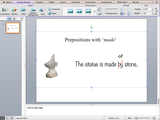
Here is an example of how I’ve used Camtasia. Some of my students struggle with using ‘Make’ and prepositions. I made a video to review the grammar, provide examples and help students test themselves.
Step 1. I made a presentation, using PowerPoint. Actually, you can use anything, including Word.
Step 2. Then I wrote out what I wanted to say- a script.
Step 3. I played the slides on my computer, using Camtasia to record what was on the screen.
Step 4. Then, while playing back the recorded presentation, I added my voice.
Step 5. I added animated annotations and subtitles, and posted the video on Youtube.
I included a simple quiz, which students could use to test themselves.
While I don’t ‘flip’ very often in the true sense, I do like to have bank of grammar, vocabulary and reading skills videos available that students can refer to independently. I’ve never had a student who, on first exposure to a new grammar point or language skill, said, "I understand. I’ve got it! I’ll always remember it!" Currently, I’m looking through examples of student writing samples and student videos to try to identify common accuracy issues so that, in the future, in addition to saying, ‘Here’s an additional worksheet, I’ll be able to say, "Watch the video and try the quiz." And if they still don’t get it, I’ll see them after class.
Want to find out more about lesson flipping? Take part in Thomas Healy’s live webinar on 17th or 19th February. Thomas will discuss models of lesson flipping and provide a technical demonstration of how to implement this technique. Register today!Filed under: Adults / Young Adults, Multimedia & Digital, Professional Development Tagged: EdTech, Flipped classroom, mlearning
Oxford University Press ELT blog
.
Blog
.
<span class='date ' tip=''><i class='icon-time'></i> Jul 23, 2015 08:24am</span>
|
|
Social Media Resources
Rod's Annotated Bookmarks for over 80 Social Media links
Faculty Social Media Survey by Pearson Learning
Pressible: Columbia University's Social Network for Educational Content
Vialogues: Columbia University's Social Media site for Video
Interview: Brian Hughes, Associate Director of Design, Publishing, and Service at Teachers College's Library of Columbia University. We address the questions...
What are the best ways to use social media for novice faculty?
Has it been shown that using social media improves learning?
What is the best way to prepare faculty to use social media for teaching?
Podsafe music selection from Music Alley
"From the Beginning" by Emerson, Lake & Palmer, from their "Then & Now" Live 1998 Album
Duration: 23:38
Rods Pulse Podcast
.
Blog
.
<span class='date ' tip=''><i class='icon-time'></i> Jul 23, 2015 08:24am</span>
|
|
Just lately, I have been thinking about some of the ironies inherent in our financial systems.When we lived in South Africa, bank charges were very high. You paid a cash-handling fee when you deposited large sums of cash. You paid an admin fee every time the bank processed a cheque of yours... or one from someone else that was made out to you. You paid for a new cheque book when the old one was empty. Basically, you paid for everything. Walk into the bank and breathe, and they charged you for the air. This is something that people in the UK simply can't relate to. Here, many bank transactions are still free. But we'll come to that in a minute. Back to South Africa for a moment (sorry, are you getting whiplash?).If you agreed never to drop below a certain balance, your banking became free. And the balance was not just a few Rands, either. So, basically, if you were flush enough not to need every last cent you had, you could have all your bank services free of charge. If, however, you were balancing on a knife edge, and needed every cent you earned, you had to pay to access this money. And it's no small matter, either - total bank charges could be among your larger expenses.It gets worse. Let me relate an anecdote that I witnessed on more than one occasion. Person X, let's call him Thando Sijawe, came into the bank to draw some money. He couldn't use the hole-in-the-wall, because, like many South Africans, he was illiterate. He explained to the cashier that he wanted R10, and she wrote out the withdrawal slip for him, which he then endorsed with his thumbprint. She gave him his R10 and he went on his way. What he didn't know was that the bank charged him R7 (I kid you not, that was the exact figure) for this service. If he had drawn out all his money at once, this might have been less significant but crime levels were (are?) high in South Africa, especially in the poorer areas where Thando lived, so the tendency was only ever to carry money enough for your immediate needs, taxis, buses and the day's food supplies. People like Thando had to deal in cash, because their illiteracy meant that they couldn't use the pay-by-card option.So, not only did Thando get penalised for being poor, he suffered the double whammy of being further penalised for being uneducated, too.But it's not just Thando. And it's not just in South Africa.In the UK, much of our banking is free. The flip side is that it is also slower. Everything takes longer. And you can do so much less at the hole-in-the-wall. But you learn to live with that. However, if you're having a bad month and one of your standing orders bounces, there is a fee of £22 that is levied. So basically, they're fining you for being broke.As I have already (very publicly) stated, my business is being declared bankrupt. This morning, I was advised that I need to pay £2500 for this process. It seems I am too broke to go bankrupt. Go figure.I'm not sure what happens next. I am going to see an insolvency adviser to discuss my options.I apologise if this transparency makes you feel uncomfortable. I just hope that it will prove helpful to others who may be having a tough time of things, right now.I also think it's important to shine a spotlight on some of the things that strike me as being out of balance in society. After all, the fat cats of the banking industry are the ones taking home the huge bonuses.Everyone knows my understanding of accounting is negligible, but I can't help feeling the wrong people are paying for those bonuses.
Karyn Romeis
.
Blog
.
<span class='date ' tip=''><i class='icon-time'></i> Jul 23, 2015 08:24am</span>
|